




Bevel vs. Convex Edges: Which Blade Geometry Suits Your Needs?
Blade geometry is one of the main reasons one pair of household scissors feels crisp while another crushes, drags or slips. The same idea applies to kitchen knives, craft blades and utility cutters: the shape behind the cutting edge affects sharpness, durability, maintenance and the type of material the tool handles best.
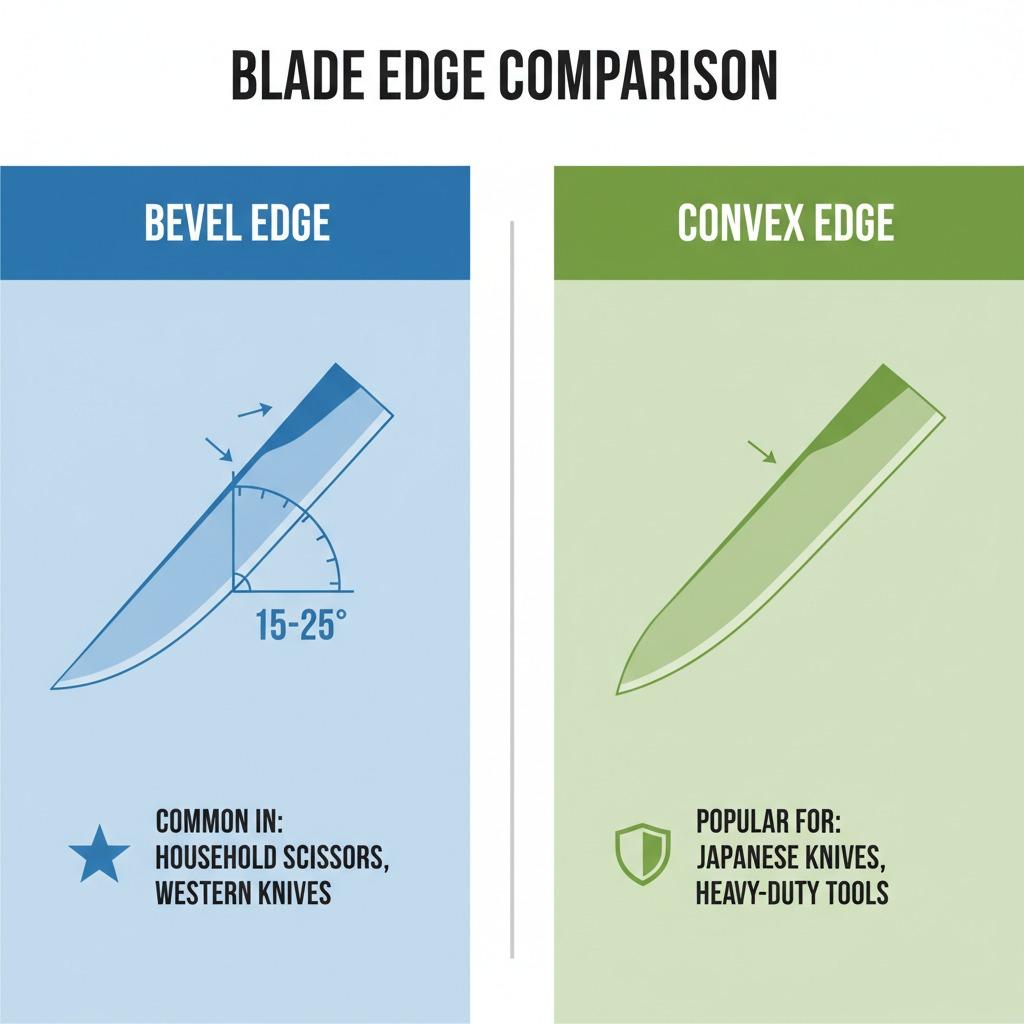
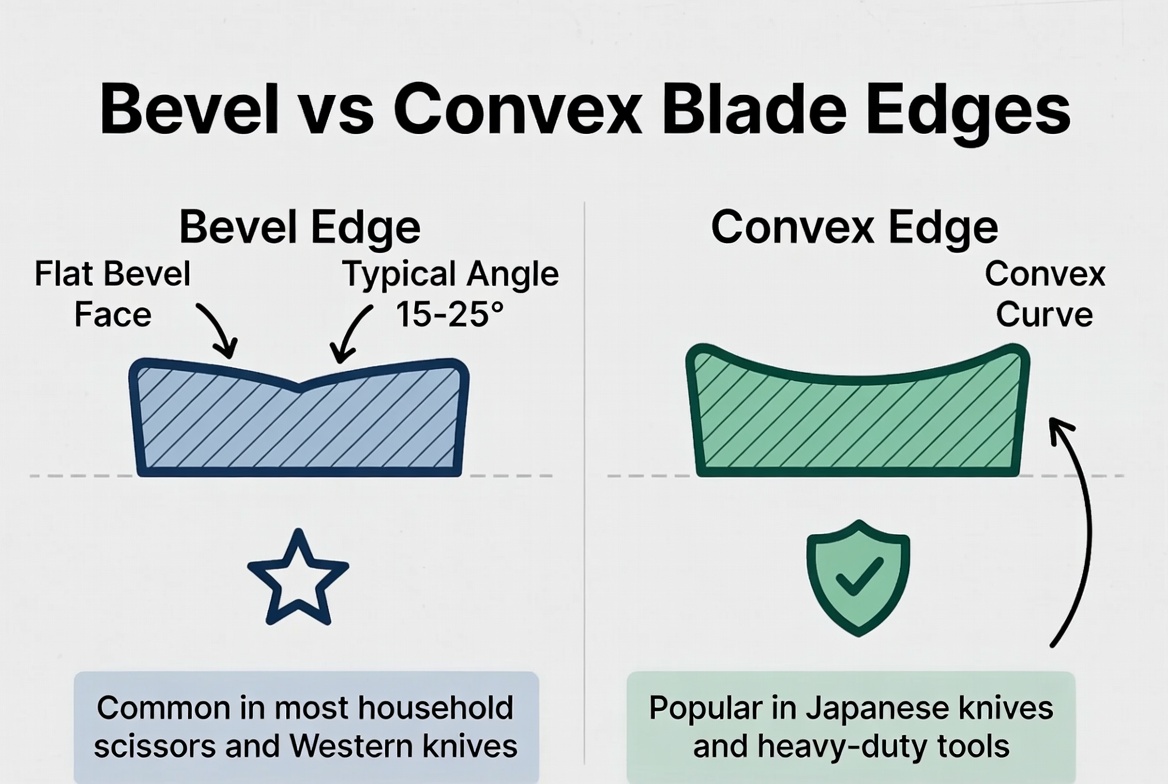
Two common edge profiles are the bevel edge and the convex edge. A bevel edge uses flat angled surfaces that meet at the cutting line, often forming a V shape. A convex edge curves outward toward the edge, creating a rounded transition rather than a flat ramp. Neither design is automatically better. The right choice depends on whether you value easy sharpening, fine precision, long edge life or toughness under pressure.
Key Takeaways
- Choose a bevel edge for clean everyday cuts, simple maintenance and most household scissors.
- Choose a convex edge when durability and resistance to rolling or chipping matter more than easy sharpening.
- For scissors, fit and alignment matter too. Even a sharp edge performs poorly if the blades do not meet correctly.
- Match the edge to the task. Paper, fabric, packaging, food prep and tough materials all place different demands on a blade.
What Is a Bevel Edge?
A bevel edge has one or more flat angled faces leading to the cutting edge. On many tools this creates a familiar V-shaped profile. Some cutting tools may use a single-sided bevel, also called a chisel-style edge, depending on their purpose.
The practical advantage of a bevel is predictability. It can be made very sharp, it is relatively easy to understand visually, and it can often be sharpened with common tools such as stones, rods or appropriate sharpening systems. For household scissors used on paper, light cardboard, packaging, thread, fabric or herbs, a bevel-style edge is common because it offers a crisp starting cut and controlled feel.
The tradeoff is that a very thin bevel can be more vulnerable when used on hard, gritty or oversized materials. If you use fine scissors to cut wire, thick plastic strapping or abrasive material, the edge may dull, roll or become damaged faster than expected.
What Is a Convex Edge?
A convex edge curves outward as it approaches the cutting line. Instead of two flat planes meeting in a sharp V, the side of the edge forms a smooth, rounded shoulder. This geometry is often associated with blades that need strength behind the edge, including some knives and heavier cutting tools.
The main benefit is durability. Because there is more support behind the edge, a convex profile can resist rolling and chipping during tougher work. It may also move through dense material with a smoother wedging action than a blunt, thick bevel. However, it is not always as simple to sharpen at home. Maintaining the curved profile usually requires stropping, careful technique or a guided system designed for convex edges.
For everyday household scissors, a true convex edge is less common than a bevel edge. That does not mean convex geometry is irrelevant; it simply means most buyers should consider whether the added durability is worth the extra maintenance.
Bevel vs. Convex Edge Comparison
| Selection Point | Bevel Edge | Convex Edge |
|---|---|---|
| Edge shape | Flat angled surfaces meeting at the edge | Smooth outward curve toward the edge |
| Cutting feel | Crisp, direct and precise | Smooth, strong and supportive |
| Best everyday uses | Household scissors, paper, packaging, light fabric, kitchen slicing | Tougher cutting, dense materials, heavier blades |
| Maintenance | Usually easier to sharpen with common methods | Requires more care to preserve the curved profile |
| Durability | Good for normal use; can suffer under abuse | Generally stronger behind the edge |
| Buyer checklist | Check blade alignment, handle comfort and whether sharpening is practical | Ask how the edge should be maintained and whether service is available |
Which Edge Is Better for Household Scissors?
For most homes, offices and craft drawers, a bevel edge is the practical choice. It gives the clean cutting action people expect from general-purpose scissors, and it is easier to maintain than a convex profile. When you cut paper, open parcels, trim thread or handle light kitchen tasks, the difference you notice most is immediate sharpness and blade alignment rather than extreme edge strength.
That said, scissors should not be judged by edge geometry alone. Two blades must pass each other closely and consistently. If the pivot is loose, the blades are warped or the inner faces are poorly aligned, even a sharp bevel can fold material instead of cutting it. When choosing household scissors, open and close them slowly if possible. The action should feel smooth, with no grinding, large gaps or wobble.
How to Choose the Right Blade Geometry
Use the task as your starting point rather than choosing an edge profile by name. A fine, acute edge is useful for detailed work, but it may not survive rough cutting. A tougher edge can last longer, but it may not feel as effortless on delicate materials.
- Identify the main material. Paper, cardboard, cloth, food packaging, herbs and plastic all behave differently under a blade.
- Consider cutting frequency. Daily use benefits from comfort, stable alignment and an edge that can be maintained.
- Check your maintenance habits. If you do not sharpen tools often, avoid edge types that require specialized upkeep unless service is available.
- Use dedicated tools. Keep one pair for clean paper or fabric and another for packaging or rough tasks.
- Inspect before buying. Ask what edge type is used, how it should be sharpened and what materials the tool is intended to cut.
Care Tips to Keep Scissors and Blades Cutting Well
Good care often matters more than the difference between bevel and convex geometry. Wipe blades after cutting adhesive packaging, plant stems or food. Sticky residue increases friction and makes a sharp tool feel dull. Dry the blades after cleaning, especially around the pivot, and store scissors closed to protect the cutting edges.
Avoid using household scissors on materials they were not designed for. Cutting wire, sandpaper, metal foil, thick plastic ties or gritty material can damage the edge. If your scissors begin to push material away instead of biting, do not force the cut. Clean the blades, check the pivot and consider professional sharpening if the edge is visibly rounded or nicked.
Common Buying Mistakes to Avoid
- Buying only by sharpness claims. Sharpness is important, but comfort, blade contact and intended use are just as important.
- Using one pair for every job. Packaging and craft materials can quickly reduce performance for delicate paper or fabric work.
- Ignoring maintenance instructions. A convex edge may need a different sharpening approach than a simple bevel.
- Assuming heavier means better. Weight can feel solid, but balance and control matter for long cutting sessions.
FAQ
Are bevel edges sharper than convex edges?
They often feel sharper at first because a flat bevel can create a very acute cutting angle. However, real performance depends on the steel, edge angle, finishing, alignment and how the tool is used.
Are convex edges harder to sharpen?
Yes, they can be. The curved profile is easier to change accidentally if you sharpen it like a flat bevel. Stropping or guided convex sharpening methods are commonly used to maintain the shape.
What edge should I choose for household scissors?
For general tasks such as paper, packaging, thread, light fabric and herbs, a bevel edge is usually the most practical choice because it cuts cleanly and is easier to maintain.
Can I sharpen scissors like a kitchen knife?
Not exactly. Scissors rely on blade geometry and the way the two blades meet. Sharpening the wrong surface or changing the angle can reduce performance. If unsure, use a suitable scissor sharpener or ask a sharpening professional.
When is a convex edge worth considering?
Consider it when the tool will face tougher materials and you are prepared for more careful maintenance. For light household cutting, the benefits may not outweigh the extra upkeep.
Final Thoughts
Bevel and convex edges solve different cutting problems. A bevel edge is straightforward, precise and well suited to most household scissors and everyday blades. A convex edge adds strength behind the cutting line and can be useful for tougher work, but it asks more from the user during maintenance. If you choose based on material, frequency of use and care routine, blade geometry becomes a practical decision rather than a technical mystery.
