




A reliable camping scissors manufacturer should be able to deliver more than a compact cutting tool with several advertised functions. For outdoor brands, camping-equipment distributors, importers, and private-label retailers, the real purchasing challenge is finding scissors that perform consistently during outdoor activities, remain practical to carry and maintain, and can be manufactured repeatedly to an approved specification.
Camping creates conditions that ordinary household scissors may not encounter. A single tool might be used to open sealed food packages, trim cord, prepare ingredients, cut fishing line, or handle small campsite maintenance tasks. Exposure to moisture, dust, sand, food residues, and frequent transportation also changes what buyers should examine during product development.
The best sourcing decision therefore starts with five questions:
-
Which outdoor tasks must the scissors perform?
-
What blade, handle, and multi-tool features support those tasks?
-
How will the product be tested under realistic field conditions?
-
Can the manufacturer customize the design, branding, and packaging for the target market?
-
Can the approved specification be reproduced consistently across bulk orders?
The right camping scissors supplier is the one that can connect practical outdoor functionality with controlled manufacturing, realistic product claims, and long-term supply reliability.
For B2B buyers evaluating Chinese manufacturers, those capabilities are more meaningful than a low initial quotation or an extensive list of features that have not been independently evaluated.
BONET HOUSEWARE, a scissors and kitchenware manufacturer based in Yangjiang, China, provides an established camping scissors product alongside broader scissors manufacturing and OEM/ODM customization services.
This guide explains how purchasing teams can evaluate such products, define specifications, compare suppliers, and develop an outdoor scissors program suitable for wholesale, retail, and private-label distribution.
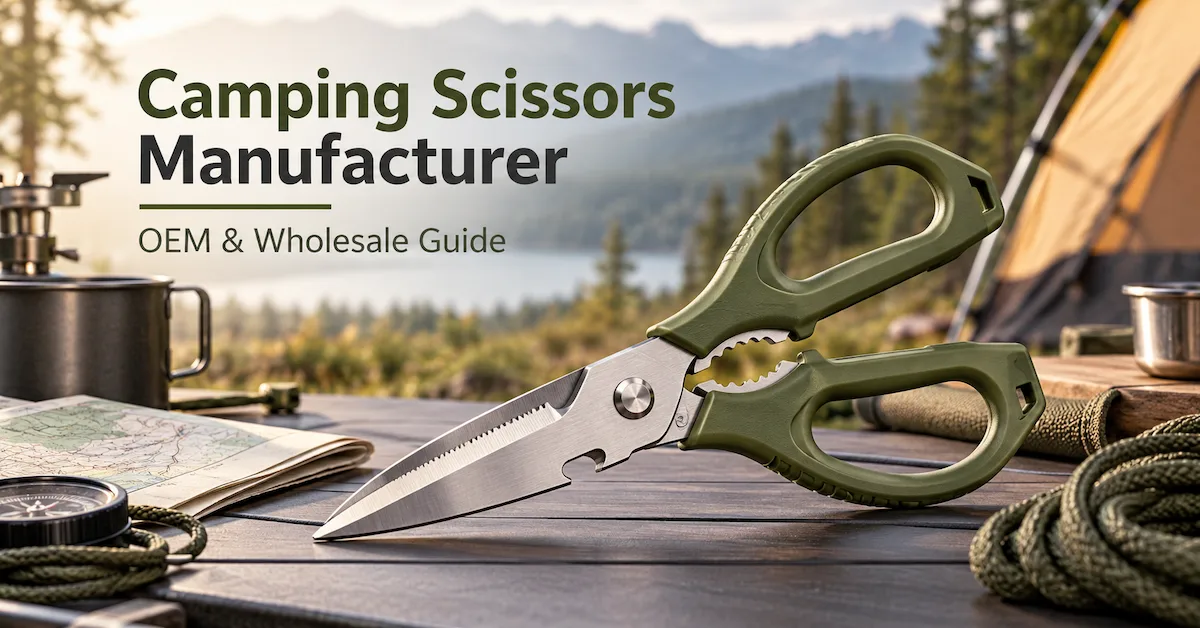
What Does a Camping Scissors Manufacturer Actually Produce?
A camping scissors manufacturer produces cutting tools designed for outdoor activities, including campsite cooking, recreational camping, fishing trips, picnics, RV travel, and selected light utility applications.
Unlike basic office scissors, camping scissors may incorporate structural features intended to support several outdoor tasks.
Depending on the model, these may include:
-
Stainless steel cutting blades.
-
Serrated cutting or gripping sections.
-
Ergonomic handles.
-
Bottle-opening functions.
-
Nutcracking mechanisms.
-
Specialized gripping features.
-
Compact storage arrangements.
-
Protective blade covers.
-
Additional food-preparation functions.
However, the product category should not be confused with professional rescue shears, industrial cutting equipment, or heavy-duty survival tools.
A camping scissors model intended for food packaging and cord trimming should not automatically be advertised as capable of cutting thick metal, heavy branches, or high-strength climbing materials.
The manufacturer's responsibility is to ensure the product matches its intended application.
For B2B sourcing, that includes selecting appropriate materials, producing consistent blade geometry, controlling assembly quality, and confirming that any additional features function as intended.
A supplier offering OEM/ODM services may also help buyers modify colors, branding, packaging, and certain product structures according to project requirements.
Why Camping Scissors Are a Distinct Outdoor Product Category
Camping scissors sit between ordinary household scissors and specialized outdoor multi-tools.
Their value comes from providing controlled cutting and selected additional functions in a relatively compact format.
For many campers, scissors are useful because they can engage flexible material between two blades rather than requiring the user to push a knife against a cutting surface.
This can make certain tasks more convenient.
For example, scissors may be useful when cutting open a vacuum-sealed food package without damaging the contents.
They can also help trim loose cord ends, cut selected packaging materials, prepare herbs, or cut fishing line.
But those applications involve different materials.
A soft plastic package does not behave like braided rope.
Fishing line behaves differently from fabric.
Food preparation introduces cleaning considerations that are less important when cutting cardboard.
This is why outdoor scissors should be evaluated as an application-specific product system rather than a generic collection of cutting functions.
A practical sourcing specification needs to define what the product is expected to cut and where its limitations begin.
Who Buys Camping Scissors in the B2B Market?
The search term "camping scissors manufacturer" usually reflects commercial investigation or supplier-selection intent.
Buyers searching for a manufacturer often have specific product-development or procurement responsibilities.
1. Outdoor Equipment Brands
Established outdoor brands may want camping scissors that fit an existing product family.
Their priorities often include:
-
Recognizable handle colors.
-
Consistent branding.
-
Practical outdoor functionality.
-
Appropriate materials.
-
Durable packaging.
-
Reliable repeat orders.
A brand may also need product photography, usage instructions, and packaging artwork that fit its existing merchandising system.
For these customers, a supplier's ability to maintain consistent product specifications is essential.
2. Camping Equipment Importers
Importers are generally responsible for coordinating production, pricing, product requirements, shipment preparation, and market-specific documentation.
They may source several outdoor products from different factories.
A camping scissors supplier that can provide clear material specifications, sample approval, manufacturing information, and packaging support can make this process more manageable.
Importers should also pay attention to supplier communication and how technical changes are documented.
3. Outdoor Gear Distributors
Distributors often need several product options for different retail customers.
They may look for:
-
Entry-level camping scissors.
-
Multifunctional outdoor scissors.
-
Kitchen-oriented camping shears.
-
Compact utility scissors.
-
Premium private-label variants.
Product assortment planning matters because not every retailer serves the same outdoor customer.
4. Supermarkets and Outdoor Retail Chains
Large retailers evaluate both the product and its retail presentation.
Important requirements may include:
-
Easy-to-understand functions.
-
Appropriate packaging dimensions.
-
Clear product labeling.
-
Barcode placement.
-
Shelf or hanging-display compatibility.
-
Consistent replenishment.
-
Stable retail pricing.
A product with many features may be attractive, but only if the packaging explains those features clearly.
5. E-Commerce and Marketplace Sellers
Online sellers need camping scissors that can demonstrate practical value through images and videos.
Integrated bottle openers, serrations, and multifunctional designs may provide additional selling points.
However, the product must perform as advertised.
A feature that appears impressive in a photograph but works poorly during actual use may lead to negative reviews and returns.
E-commerce buyers should therefore pay particular attention to functional sample testing and parcel-shipping protection.
6. Camping Kit and Outdoor Gift-Set Brands
Some businesses purchase camping scissors as components of larger outdoor kits.
For example, a branded set may include cooking utensils, a compact cutting tool, and other selected camping accessories.
These buyers may prioritize consistent packaging dimensions, coordinated branding, kit assembly, and carton efficiency.
BONET's wider kitchenware and tools portfolio provides additional product categories that may be relevant to developing coordinated outdoor cooking and utility assortments.
Which Camping Scissors Type Is Right for Your Product Line?
Choosing the correct product platform is one of the most important steps before requesting OEM customization.
The following comparison helps separate different outdoor product positions.
| Camping Scissors Type | Primary Application | Important Features | Suitable B2B Buyers |
|---|---|---|---|
| Basic camping scissors | Packaging and light camp tasks | Simple structure, compact storage | Entry-level outdoor retailers |
| Multifunctional camping scissors | Camping, picnics, general utility | Cutting plus selected additional tools | Outdoor brands and distributors |
| Camping kitchen shears | Outdoor food preparation | Grip, cutting performance, cleanability | Camping cookware brands |
| Serrated utility scissors | Cord and selected tougher materials | Serration, alignment, comfortable grip | Utility-focused outdoor retailers |
| Protective-cover camping scissors | Portable kits and stored equipment | Secure storage and blade protection | E-commerce and kit suppliers |
| Customized outdoor scissors | Private-label product programs | Brand colors, logo, packaging, selected features | OEM and ODM buyers |
These categories describe possible product directions, not guaranteed capabilities of every model.
For example, a multifunctional pair of scissors may be useful for opening bottles or cracking nuts, but those features should only be advertised if they are present and perform reliably on the chosen product.
The correct selection should follow the target customer and expected use environment.
BONET Camping Scissors: A Real Product Reference for Buyers
When evaluating manufacturers, buyers should begin with documented product information rather than assumptions.
BONET publishes a camping scissors model under the following product identification:
Camping Scissors — S52033B (CKS-220)
| Specification | Published Product Information |
|---|---|
| Product | Camping Scissors |
| Item Number | S52033B (CKS-220) |
| Product Dimensions | 22 × 7.6 × 1.3 cm |
| Metal Material | 420 Stainless Steel |
| Plastic Material | ABS |
| Product Category | All Purpose Scissors |
| Application Direction | Camping and outdoor utility |
These specifications are provided on BONET's Camping Scissors product page.
The product description also presents a multifunctional outdoor design, including serrated cutting features and integrated utility functions such as bottle opening and nut cracking.
For procurement purposes, an important distinction must be made between the structured product specifications and general marketing descriptions.
For example, the structured material field identifies ABS as the plastic material.
Buyers should not automatically assume that a specific TPR composition is used simply because the marketing description discusses a comfortable or rubberized grip.
Similarly, the product page does not establish universal values for blade hardness, cutting-cycle performance, salt-spray resistance, or the strength of every integrated function.
Those details should be confirmed if they form part of the purchasing specification.
For OEM buyers, S52033B provides a concrete product reference, but final project requirements must still be established through sample evaluation and supplier confirmation.
What Can Camping Scissors Actually Be Used For?
Practical applications should guide product design and testing.
Outdoor scissors are most valuable when they help users complete common tasks without carrying an unnecessarily complicated tool kit.
Camping Food Preparation
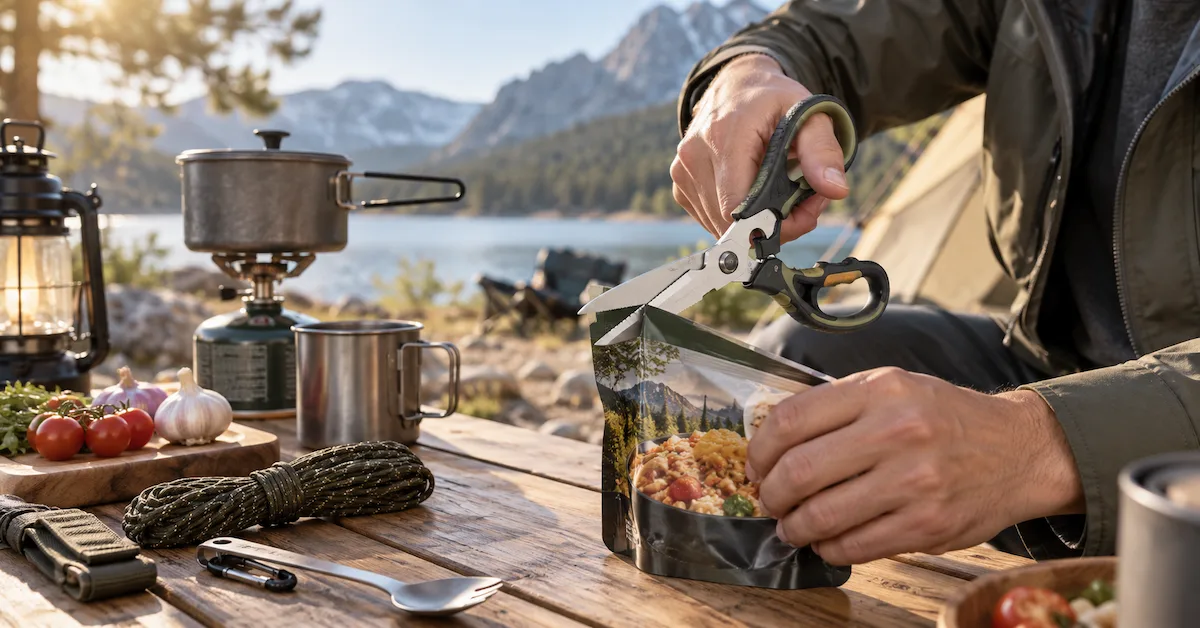
During camping trips, users may need to cut open ingredient packages, trim herbs, portion selected ingredients, or prepare food around a portable kitchen.
Scissors can be convenient for certain tasks that would otherwise require a knife and cutting board.
However, food-preparation use introduces cleaning and material requirements.
A buyer should evaluate how easily the blades, joint, and handle can be cleaned.
Products marketed for direct food contact may also require market-specific material and compliance review.
Food Packaging and Sealed Bags
Opening food packaging is one of the most practical outdoor uses.
Camping foods are often supplied in plastic bags, sealed pouches, or protective packaging.
A camping scissors product should be able to cut the types of packaging claimed in its marketing.
For evaluation, buyers can prepare representative samples of flexible plastic film, laminated packaging, and other relevant materials.
Rope and Utility Cord
Camping equipment often involves cord and rope used for non-critical organization or campsite tasks.
A serrated edge may help engage certain fibrous materials.
However, the tool should not automatically be promoted for modifying safety-critical climbing ropes, rescue equipment, or load-bearing systems.
The performance claim should remain within the tested product capability.
Fishing and Recreational Outdoor Activities
Camping scissors may be useful for selected fishing-related cutting tasks.
These can include trimming appropriate fishing line, opening tackle packaging, or preparing non-hazardous accessories.
Fishing equipment varies widely, so line-cutting capability should be verified for the intended line type.
A general claim that scissors can cut all fishing lines is too broad.
Picnic and Barbecue Preparation
For picnics and barbecue trips, scissors may help open packaging, trim selected ingredients, or handle small food-preparation tasks.
Models with appropriate integrated openers can add convenience.
The commercial advantage is portability and reduced dependence on several separate small tools.
RV and Campervan Use
RV users often have limited storage space.
Compact multipurpose tools can be useful when preparing meals or organizing supplies.
For this channel, a buyer should prioritize storage convenience, handle comfort, cleaning access, and safe placement inside cabinets or drawers.
Campsite Organization
Scissors may also assist with cutting labels, light packaging, selected fabric materials, or general campsite organization tasks.
The intended capability should be tested rather than assumed from the product's appearance.
How Do Outdoor Conditions Affect Camping Scissors Design?
A major difference between camping scissors and ordinary indoor scissors is the environment.
Outdoor tools may experience moisture, dirt, sand, repeated transportation, and irregular cleaning conditions.
These factors should influence product design and quality evaluation.
Moisture Exposure
Outdoor environments can involve rain, condensation, wet grass, or damp storage.
Stainless steel can provide useful corrosion resistance, but stainless steel does not mean completely rust-proof.
The degree of resistance depends on the material, finish, environmental conditions, and maintenance.
Buyers should confirm the blade material and any project-specific corrosion requirements.
If corrosion testing is necessary, the method and acceptance criteria should be agreed before production.
Dust and Sand
Fine particles can accumulate around joints and moving components.
For scissors, this may affect opening and closing performance.
A product intended for frequent outdoor use should be easy to inspect and clean.
For manufacturers, the pivot design and assembly quality deserve particular attention.
Food Residues
Camping scissors used around food may come into contact with oils, juices, salt, and other residues.
Those conditions make cleaning access and maintenance instructions important.
A buyer should not assume that every multifunctional scissors design is dishwasher-safe.
Cleaning recommendations should be confirmed for the selected model.
Transportation and Storage
Outdoor tools may be stored in backpacks, camp boxes, vehicles, or portable cooking kits.
Poor storage protection can expose cutting edges or damage nearby equipment.
When developing a retail product, a protective sheath or secure storage accessory may be worth considering.
The exact solution should be evaluated against the product's dimensions and intended use.
Stainless Steel Blades: What Should Outdoor Brands Specify?
Blade material is a major factor in camping scissors manufacturing.
BONET's S52033B camping scissors list 420 stainless steel as the metal material.
This provides a useful starting point, but it does not fully define performance.
For professional sourcing, buyers should confirm:
-
Exact blade material specification.
-
Blade dimensions.
-
Cutting-edge geometry.
-
Serration design, if applicable.
-
Heat-treatment requirements.
-
Grinding and finishing process.
-
Blade straightness and alignment.
-
Surface-treatment requirements.
-
Corrosion-resistance expectations.
-
Final functional performance.
Two pairs of scissors can use the same general stainless-steel grade yet perform differently.
This is because scissors rely on controlled interaction between two blades.
Manufacturing accuracy, edge formation, alignment, and assembly all affect how the tool cuts.
Therefore, a supplier should be evaluated on both material selection and manufacturing process control.
Serrated vs Non-Serrated Camping Scissors
Serration is often promoted as an advantage in outdoor cutting tools.
However, its suitability depends on the application.
When Serration Can Be Useful
A serrated surface may improve grip on certain materials.
Examples include:
-
Selected ropes.
-
Some flexible packaging materials.
-
Certain food items.
-
Other materials that tend to slip during cutting.
When Plain Cutting Edges May Be Preferable
A smoother edge may be appropriate when the application requires a cleaner cut through certain thin or delicate materials.
However, final performance depends on the overall blade geometry and assembly.
What B2B Buyers Should Check
Do not simply specify "serrated blade."
Clarify:
-
Whether one or both blades include serration.
-
The location of the serrated section.
-
The intended materials.
-
Whether the feature changes cleaning requirements.
-
How serration quality is checked during production.
An integrated feature should provide measurable value rather than exist only as a decorative product claim.
Handle Materials and Ergonomics for Outdoor Scissors
Camping scissors handles must balance grip, comfort, portability, and structural requirements.
BONET's S52033B product specification lists ABS as its plastic material.
ABS can be used in molded handle structures, but the actual grip performance depends on the complete design.
A professional buyer should examine several factors.
Handle Geometry
The shape of the finger loops influences comfort and control.
An uncomfortable handle can make repeated cutting tiring.
Surface Texture
Texture may contribute to grip, but the actual effectiveness depends on the material, contact conditions, and handle design.
If the product is intended for use with damp hands, that condition should be included in sample evaluation.
Weight and Balance
Camping equipment buyers often care about packability.
A lighter product may be attractive for travel, but reducing weight should not undermine the intended functional performance.
Use With Gloves
Some campers use lightweight outdoor gloves.
If gloved operation is part of the product's intended positioning, test the actual handle opening and cutting control with representative gloves.
Handle Cleaning
Outdoor scissors may collect dirt or food residues around handle joints and textured surfaces.
The product should be evaluated for realistic cleaning access.
The best ergonomic design is not necessarily the softest or largest handle.
It is the handle that supports the intended user and application without unnecessary bulk.
Why Multipurpose Features Need Separate Functional Testing
Integrated features can create strong retail differentiation.
They can also create additional failure points.
For example, a camping scissors model may include a bottle opener, nutcracker, gripping teeth, or other utility elements.
Each feature should be evaluated independently.
| Integrated Function | What Buyers Should Test | Potential Problem |
|---|---|---|
| Bottle opener | Correct engagement and leverage | Slipping or awkward use |
| Nutcracker | Suitable gripping action and handle load | Excessive force or unstable grip |
| Serrated section | Performance on specified materials | Tearing or slipping |
| Main cutting blades | Clean cutting across intended materials | Incomplete cutting |
| Utility gripping feature | Stability during intended use | Poor positioning |
| Protective cover, if supplied | Fit, retention, removal | Loose or inconvenient storage |
| Detachable structure, if supplied | Controlled separation and reassembly | Unexpected separation |
This is especially important for private-label programs.
If a packaging design advertises five functions, buyers should require evidence that all five perform adequately.
A manufacturer that can demonstrate ten functions in a promotional video has not necessarily shown that those functions will remain consistent throughout mass production.
A smaller number of dependable features can be commercially more valuable than a larger number of poorly implemented ones.
A Practical Field-Use Test Plan for Camping Scissors
Camping scissors should be tested under conditions relevant to the intended market.
The following framework can help B2B buyers design a sample-approval process.
It is a suggested procurement method, not a claim that BONET has already completed these exact tests.
Test 1: Flexible Food Packaging
Use representative packaging materials.
Observe:
-
Cutting smoothness.
-
Material slipping.
-
Blade interaction.
-
Tip cutting performance.
Test 2: Selected Utility Cord
Use the type of non-safety-critical cord relevant to the product's intended use.
Observe whether the scissors cut cleanly or cause excessive fraying.
Test 3: Lightweight Fabric
If fabric cutting is advertised, test appropriate material samples.
Record whether the blades snag or push the fabric.
Test 4: Outdoor Food Preparation
If the product is intended for food preparation, test representative tasks under appropriate hygienic conditions.
Inspect the tool afterward to determine whether cleaning around the joint and handle is practical.
Test 5: Bottle Opener
If the model includes a bottle opener, evaluate engagement and user control with representative bottle caps.
Test 6: Nutcracker
If the product includes a nutcracker, test appropriate nuts within the intended size and force range.
Test 7: Repeated Operation
Open and close the scissors repeatedly according to a defined test protocol.
Observe whether pivot resistance changes or components loosen.
Test 8: Damp-Condition Handling
Where relevant, assess grip and control under a defined damp-hand condition.
Do not assume that a handle described as ergonomic is automatically slip-resistant under every outdoor condition.
Test 9: Cleaning and Drying
Follow the manufacturer's intended cleaning procedure.
Evaluate whether residues remain in difficult-to-reach areas.
Test 10: Transport and Storage
Place the product in its intended packaging or storage accessory.
Check whether the blades and handles remain protected during representative handling.
A documented test procedure should identify the materials, test method, acceptance criteria, sample quantity, and responsible reviewer.
This makes the approval process repeatable.
How Manufacturing Processes Affect Camping Scissors Quality
For outdoor brands, the quality of a pair of scissors is closely connected to manufacturing consistency.
BONET's manufacturing process describes several relevant operations.
Stamping
Metal blanks are formed according to the selected design.
Consistent blank geometry supports later grinding and assembly.
Straight Adjustment
Blade straightness affects how the two blades interact during closing.
Poor alignment may create inconsistent cutting performance.
Heat Treatment
Heat treatment influences the material properties of the cutting components.
If the buyer needs a particular hardness or durability requirement, it should be defined and confirmed for the selected product.
Rough Grinding
Rough grinding prepares the blade geometry and removes material.
Water Grinding
Water grinding can help control friction and heat while refining the cutting edge.
The buyer should still judge the finished scissors through functional testing.
Polishing
Polishing affects surface appearance and finishing quality.
For private-label outdoor products, consistent appearance supports brand presentation.
Injection Molding
Injection molding produces the handle components.
Buyers should evaluate molding quality, dimensional consistency, surface finish, and color accuracy.
Ultrasonic Cleaning
Cleaning processes help remove relevant manufacturing residues before later stages.
Setting and Assembly
The pivot and blade alignment must work together.
Assembly variation can cause differences in cutting feel between units.
Quality Inspection
Inspection should compare actual products with the agreed project specification.
Final Cleaning and Packing
The finished product should be properly cleaned, protected, and packed according to its intended distribution channel.
Understanding these processes helps buyers ask more meaningful questions during supplier selection.
Instead of asking whether the factory produces "high-quality scissors," ask how the relevant cutting, assembly, and finishing characteristics are controlled.
OEM Camping Scissors: What Can Be Customized?
An OEM camping scissors project can involve different levels of modification.
The most practical approach depends on the buyer's development budget, target market, and desired product differentiation.
Logo Customization
Logo printing and laser engraving can provide straightforward private-label branding where suitable for the selected model.
Buyers should define:
-
Logo artwork.
-
Size.
-
Position.
-
Color.
-
Application method.
-
Surface compatibility.
-
Appearance acceptance criteria.
Handle Color
Outdoor brands may prefer colors that fit their product identity.
Potential design directions include olive green, black, gray, sand, or other brand-specific colors.
These are positioning possibilities, not claims that every color is currently available for every BONET model.
Color feasibility and production requirements should be confirmed with the supplier.
Surface Finish
A project may explore polished, matte, brushed, or other appropriate finishes.
The choice should consider appearance, manufacturing practicality, and intended maintenance.
Packaging
Buyers may request:
-
Printed retail boxes.
-
Hanging display cards.
-
Branded product sleeves.
-
Gift-style packaging.
-
Protective transit packaging.
-
Barcode labels.
-
Export cartons.
Functional Configuration
Depending on the product structure, buyers may discuss integrated functions, protective accessories, or changes to existing features.
Not all modifications can be made without tooling changes.
Structural Development
New handle geometry, cutting structures, or additional mechanisms may require ODM engineering.
BONET's OEM/ODM services describe support for drawings and samples, material customization, colors, logo application, packaging, concept development, structural optimization, and sample development.
The appropriate scope must be confirmed for the selected camping scissors model.
OEM vs ODM: Which Is Better for Outdoor Gear Brands?
The choice between OEM and ODM depends on how much product development has already been completed.
Choose OEM When
You already have:
-
A finished product concept.
-
A reference sample.
-
Technical drawings.
-
Defined materials.
-
Required functions.
-
Branding.
-
Packaging specifications.
The manufacturer mainly needs to reproduce and customize the defined product.
Choose ODM When
You have a market opportunity but need further development.
For example, you may want a distinctive outdoor scissors design for an established camping brand without having a complete engineering specification.
The project may require:
-
Concept development.
-
Structure optimization.
-
Material recommendations.
-
Prototyping.
-
Functional evaluation.
-
Packaging development.
-
Manufacturing feasibility review.
For many newer outdoor brands, using an existing product platform with customized colors, branding, and packaging may be a more practical first step.
For established brands seeking stronger differentiation, deeper ODM development may provide greater product control.
How Should Camping Scissors Be Packaged for Retail and E-Commerce?
Camping scissors packaging must communicate product value while protecting the tool.
Different channels need different packaging strategies.
Outdoor Retail Stores
In physical retail, buyers need to understand the main features quickly.
The package should make the product type, intended use, and key functions clear.
Packaging may also need to accommodate hanging displays or shelf placement.
E-Commerce
E-commerce packaging must withstand individual parcel handling.
Buyers should consider:
-
Blade protection.
-
Internal movement.
-
Handle protection.
-
Packaging dimensions.
-
Accessory retention.
-
Opening experience.
-
Shipping efficiency.
Camping Gift Sets
Gift sets may require coordinated presentation with other outdoor tools.
Packaging should remain practical and avoid unnecessary bulk.
Wholesale Distribution
Wholesale programs may prioritize:
-
Standardized carton quantities.
-
Clear SKU identification.
-
Carton strength.
-
Warehouse handling.
-
Accurate labels.
-
Efficient stacking.
BONET's OEM/ODM offering includes custom retail packaging, color boxes, gift boxes, barcode labels, and export cartons.
However, the exact packaging solution should be reviewed against the selected product and distribution channel.
What Affects Camping Scissors MOQ?
MOQ depends on the product specification and customization requirements.
Buyers should not expect one universal minimum order quantity for every camping scissors project.
Factors that may influence MOQ include:
-
Existing versus newly developed models.
-
Custom handle colors.
-
Blade finishing requirements.
-
Integrated components.
-
Logo application.
-
Retail packaging.
-
Printed packaging minimums.
-
Protective accessories.
-
New molds or tooling.
-
Production setup.
-
Component availability.
For example, an existing camping scissors model with basic branding may require a different production arrangement from a redesigned multifunctional model with new tooling and exclusive packaging.
A more useful inquiry is:
"What MOQ applies to the S52033B camping scissors model with our custom handle color, branded retail box, laser logo, barcode label, and proposed initial order quantity?"
This gives the manufacturer enough information to evaluate the actual project.
What Determines Wholesale Camping Scissors Cost?
The lowest quoted unit price is not necessarily the most economical purchase.
Several factors influence the total project cost.
Blade Material and Processing
Material requirements, blade geometry, heat treatment, grinding, and finishing affect manufacturing complexity.
Handle Design
Material selection, handle structure, surface texture, and molding requirements can influence cost.
Integrated Functions
Additional mechanisms may increase tooling, assembly, and inspection requirements.
Branding
Logo methods, custom colors, and special finishes may affect setup and processing.
Packaging
Retail boxes, accessories, labels, inserts, and export cartons influence overall cost.
Order Volume
Volume can affect production efficiency and component purchasing arrangements.
Quality Requirements
Additional inspections, testing, or product-specific documentation may create further project costs.
Logistics
Packaging dimensions, carton configuration, destination, freight terms, and shipment arrangements contribute to landed cost.
For B2B sourcing, compare suppliers using the same specification and commercial terms.
A cheaper product with inadequate packaging or inconsistent cutting performance can create higher downstream costs through damage, claims, returns, and customer dissatisfaction.
How to Compare Camping Scissors Manufacturers
A structured supplier evaluation can help procurement teams avoid decisions based solely on product photos or quotations.
| Evaluation Area | What Buyers Should Verify | Why It Matters |
|---|---|---|
| Product experience | Available camping or outdoor scissors models | Confirms category relevance |
| Material transparency | Blade and handle specifications | Reduces material uncertainty |
| Outdoor functionality | Demonstration of intended tasks | Confirms practical suitability |
| Manufacturing | Relevant processes and controls | Supports consistency |
| Sample approval | Documented functional and visual review | Establishes production reference |
| OEM capability | Colors, logos, finishes, packaging | Supports brand differentiation |
| ODM capability | Structural and functional development | Supports original concepts |
| Quality control | Product-specific inspection criteria | Reduces defect risk |
| Packaging | Retail and parcel-shipping suitability | Protects product and presentation |
| Commercial terms | MOQ, cost, lead time, inclusions | Enables fair comparison |
| Repeat orders | Specification and change control | Protects long-term supply |
A Practical Supplier Scoring Method
Buyers may also use a weighted scorecard.
The following weights are an illustrative purchasing method, not a published BONET factory rating.
| Evaluation Category | Suggested Weight |
|---|---|
| Product suitability and outdoor functionality | 25% |
| Materials and manufacturing capability | 20% |
| Quality inspection and repeatability | 20% |
| OEM/ODM customization | 15% |
| Packaging and logistics | 10% |
| Commercial terms and communication | 10% |
| Total | 100% |
The scoring weights should be adapted to the actual purchasing strategy.
A premium outdoor brand may emphasize functionality and product differentiation.
A high-volume distributor may place greater weight on supply consistency, packaging efficiency, and commercial terms.
What Should Be Included in a Camping Scissors RFQ?
A professional request for quotation should provide enough information for the supplier to evaluate the product accurately.
| RFQ Field | Information to Provide |
|---|---|
| Product Type | Camping scissors or multifunctional outdoor scissors |
| Reference Model | S52033B (CKS-220) or another selected model |
| Target Market | Country or region |
| Buyer Channel | Retail, e-commerce, distributor, outdoor brand |
| Intended Applications | Food packaging, cord, selected food preparation, etc. |
| Blade Material | Required specification or supplier recommendation |
| Handle Material | Required structure or reference |
| Dimensions | Approved or target dimensions |
| Required Functions | Cutting, serration, opener, nutcracker, etc. |
| Color | Standard or custom color reference |
| Logo | Artwork, size, placement, application method |
| Packaging | Retail box, display card, gift pack, etc. |
| Order Quantity | Initial order and forecast |
| Testing | Required functional or durability tests |
| Compliance | Applicable destination-market requirements |
| Delivery | Destination and requested schedule |
The RFQ should also distinguish between mandatory and optional functions.
This helps the manufacturer identify potential design trade-offs and prevents quotations from being based on different assumptions.
A Practical OEM Camping Scissors Development Workflow
A successful private-label program should move through defined approval stages.
BONET's published OEM/ODM workflow provides a useful six-stage structure.
Step 1: Requirement Communication
Define the market, applications, product reference, materials, functions, colors, packaging, quantities, and quality expectations.
For outdoor scissors, include actual camping-use scenarios.
Step 2: Design and Sampling
Select an existing model or develop the proposed modifications.
Approve appearance, cutting performance, functions, handle feel, logo, and packaging.
Step 3: Quotation and Confirmation
Review commercial terms only after the specification is sufficiently clear.
Confirm:
-
Price.
-
MOQ.
-
Product specification.
-
Packaging.
-
Sampling arrangements.
-
Lead time.
-
Project schedule.
Step 4: Mass Production
Production should follow the approved specification and reference sample.
Any relevant changes should be discussed before implementation.
Step 5: Quality Inspection
Inspection should cover the agreed functional, dimensional, visual, assembly, and packaging requirements.
Step 6: Packaging and Delivery
Finished products should be packed according to the approved packaging specification and delivery arrangement.
This process helps buyers manage technical decisions separately from commercial and shipment decisions.
Quality Control for Outdoor Scissors: What Should Be Inspected?
Quality control should be designed around the actual product.
Camping scissors with integrated utility features require more inspection points than basic paper scissors.
Blade Inspection
Check blade geometry, alignment, cutting edges, surface finish, and relevant material requirements.
Pivot and Assembly Inspection
Check opening and closing action, joint stability, and overall assembly condition.
Functional Inspection
Test the intended cutting applications and all advertised additional functions.
Handle Inspection
Check molding finish, color, grip, component fit, and ergonomic characteristics.
Appearance Inspection
Check scratches, stains, polishing quality, logos, and surface-treatment consistency.
Packaging Inspection
Confirm:
-
Correct product.
-
Correct accessories.
-
Approved artwork.
-
Barcode.
-
Labels.
-
Carton configuration.
-
Product protection.
Final Batch Consistency
A single acceptable sample does not establish bulk-order consistency.
Buyers should agree on sampling and acceptance methods before shipment.
The inspection plan may classify defects by severity and identify which functional problems are unacceptable.
Product Safety and Maintenance Claims Should Be Specific
Outdoor products often use broad marketing phrases such as:
-
Rust-proof.
-
Waterproof.
-
Heavy-duty.
-
Dishwasher-safe.
-
Food-safe.
-
Unbreakable.
-
Suitable for all cutting tasks.
These claims can be misleading if they are not supported by the actual product specification or suitable testing.
For camping scissors, buyers should request confirmation before using such statements in packaging or e-commerce listings.
For example, a stainless steel blade may have good corrosion resistance without being completely immune to corrosion.
A comfortable handle may be practical for outdoor use without being certified slip-resistant in every wet condition.
A product used for preparing food should not automatically be marketed as dishwasher-safe.
Claims should be written around verified product performance, not around the most attractive possible marketing language.
The same principle applies to safety.
Scissors should not be used on materials or equipment beyond the product's intended capabilities.
For mixed food and utility use, proper cleaning between tasks is important. Food-contact materials and destination-market requirements should be reviewed where applicable.
How to Maintain Consistent Quality Across Repeat Orders
Repeat-order reliability is one of the most important considerations for outdoor equipment brands.
A successful first order may lead to repeated seasonal purchases.
However, changes in components, colors, packaging, or production arrangements can affect product consistency.
A controlled specification should include:
-
Item number.
-
Product revision.
-
Blade material.
-
Handle material.
-
Dimensions.
-
Finish.
-
Approved functions.
-
Color references.
-
Logo artwork.
-
Packaging files.
-
Carton configuration.
-
Approved sample.
-
Critical inspection requirements.
-
Approved change history.
Before each repeat order, the buyer should confirm whether any relevant material, component, process, or packaging change has occurred.
If a change may affect performance, appearance, or compliance, additional sample approval may be appropriate.
This protects the brand from unexpected variation between production batches.
Common Camping Scissors Sourcing Mistakes
1. Choosing the Product by Feature Count
A large number of functions does not automatically create a better tool.
Prioritize reliable features that solve genuine outdoor problems.
2. Using Indoor Cutting Tests Only
Testing only paper does not establish suitability for camping applications.
Use representative outdoor materials and tasks.
3. Assuming Stainless Steel Cannot Rust
Stainless steel still requires appropriate maintenance.
Confirm any corrosion-performance claims.
4. Ignoring Cleaning Access
Food residues and outdoor dirt can accumulate around joints.
Evaluate how the product can be cleaned and maintained.
5. Overlooking Storage Protection
Unprotected cutting edges can damage other packed equipment.
Consider appropriate storage arrangements.
6. Making Claims Without Testing
Do not advertise heavy-duty cutting, dishwasher compatibility, or other special properties without suitable evidence.
7. Approving Appearance Instead of Function
A visually attractive sample is not sufficient.
Every advertised function needs evaluation.
8. Finalizing Packaging Too Late
Packaging affects retail presentation, shipping protection, and cost.
Develop it alongside the product.
9. Comparing Different Quotations as If They Were Equivalent
Different materials, features, packaging, and inspection requirements create different costs.
Compare equivalent specifications.
10. Ignoring Future Reorders
Document the approved product before mass production and retain the information for future orders.
Why Consider BONET for Camping Scissors Manufacturing?
BONET HOUSEWARE CO., LTD. is based in Yangjiang, China, a manufacturing region recognized for knives and scissors.
The company supplies scissors and kitchenware products and offers OEM/ODM support for international B2B buyers.
Several aspects of its published capabilities are relevant to camping scissors projects.
A Specific Camping Scissors Product
BONET publishes the S52033B (CKS-220) camping scissors model with defined dimensions and materials.
This provides a concrete starting point for product selection and sampling.
Scissors Manufacturing Processes
The company describes metal forming, straight adjustment, heat treatment, grinding, polishing, handle production, assembly, cleaning, inspection, and packing.
These are relevant to evaluating cutting performance and production repeatability.
OEM and ODM Services
BONET supports customer-specific projects involving material, color, logo, surface treatment, packaging, sample development, and manufacturing.
Broader Kitchenware Capabilities
The company's product portfolio also includes kitchen tools, knives, multifunctional utensils, and related products.
This may be useful for buyers building coordinated outdoor cooking assortments.
Quality and Management Information
BONET's company profile identifies ISO9001, BSCI, Sedex, and 6S management information.
For professional supplier evaluation, buyers should confirm any required current certification documents and product-specific compliance needs.
Project-Specific Quotations
Published capabilities do not mean that every customization option is available on every model.
Buyers should provide their intended application, reference model, branding requirements, order quantity, packaging, and quality expectations so that feasibility and commercial terms can be assessed.
How Outdoor Brands Can Build a Camping Scissors Product Range
A single product may not meet the needs of every outdoor customer.
For a brand or distributor, a coordinated assortment can provide stronger market coverage.
A possible range could include:
Entry-Level Camping Scissors
A straightforward model focused on basic utility cutting.
This may suit value-oriented retail programs.
Multifunctional Camping Scissors
A model with selected additional functions for general camping and picnic use.
This can support stronger feature-based marketing.
Outdoor Food-Preparation Scissors
A model selected primarily for campsite cooking applications.
Cleaning and practical food-preparation performance become important.
Premium Private-Label Camping Scissors
A model differentiated through handle design, finish, branding, packaging, and selected product features.
Outdoor Cooking Kit Scissors
A product intended for inclusion in a larger camping cookware or tool set.
Packaging dimensions and coordinated branding may be particularly important.
The objective is not to create unnecessary SKUs.
Each product should serve a distinct customer requirement, sales channel, or price segment.
How to Turn a Camping Scissors Inquiry Into a Practical OEM Project
A useful manufacturer inquiry does not need to be complicated.
However, it should include enough detail to guide technical and commercial evaluation.
For example:
"We are developing a private-label camping scissors product for our outdoor equipment range. The target customers are recreational campers and RV users. We are interested in the S52033B (CKS-220) product platform or a comparable design.
Our preferred features include stainless steel cutting blades, suitable utility functions, comfortable handles, and compact retail packaging.
We would like to discuss custom handle colors, logo application, branded packaging, initial order quantity, sample approval, testing requirements, and production arrangements.
Please confirm the available product specifications, customization feasibility, MOQ, sample process, and quotation requirements."
This type of enquiry is more actionable than asking:
"What is your best price for camping scissors?"
If you are planning a similar project, you can submit your requirements through BONET's contact page.
A clear product brief helps the manufacturer recommend an appropriate development route and identify any technical questions before production.
FAQ: Camping Scissors Manufacturing and OEM Sourcing
1. What is a camping scissors manufacturer?
A camping scissors manufacturer produces scissors intended for outdoor activities such as camping, food packaging, light utility cutting, picnics, and selected recreational tasks.
Depending on the model, these products may include serrated blades, ergonomic handles, bottle openers, nutcrackers, or other multifunctional features.
B2B manufacturers may also provide OEM branding, product development, packaging customization, sampling, quality inspection, and bulk production support.
2. What materials are used in camping scissors?
Camping scissors commonly use metal blades combined with molded handle components.
For example, BONET's S52033B (CKS-220) model lists 420 stainless steel as the metal material and ABS as the plastic material.
Other product configurations may use different materials.
Buyers should confirm the exact specifications for their selected model.
3. Are camping scissors better than ordinary household scissors?
Camping scissors may offer advantages for certain outdoor tasks because they can include serrated sections, additional utility functions, or features intended for outdoor use.
However, they are not automatically better for every application.
Ordinary household scissors may be more appropriate for paper or general indoor tasks.
The correct choice depends on what the product must cut and the conditions in which it will be used.
4. Can camping scissors replace a camping knife?
Not completely.
Scissors can be convenient for controlled cutting of flexible materials, packaging, selected food items, and light cord.
A knife may be more appropriate for other cutting tasks.
Neither tool should be used outside its intended capability.
Camping scissors are best positioned as practical complementary tools rather than universal replacements for all outdoor cutting equipment.
5. Can camping scissors be customized for private-label brands?
Yes, depending on the selected product and manufacturing feasibility.
Customization may include colors, logos, surface finishes, packaging, and certain accessories or structural features.
More complex modifications may require additional development or tooling.
BONET's OEM/ODM service provides a framework for evaluating these requests.
6. What affects the MOQ for camping scissors?
MOQ can depend on the selected model, custom colors, branding methods, packaging requirements, accessories, tooling, and overall production arrangement.
A standard existing model with simple branding may have different minimum requirements from a custom-developed outdoor multi-tool.
Buyers should submit a complete specification to receive a meaningful MOQ proposal.
7. What should I test before approving a camping scissors sample?
Test the intended cutting applications, blade alignment, pivot action, handle comfort, integrated functions, appearance, storage arrangements, and packaging.
For outdoor use, consider relevant moisture, dirt, cleaning, and transportation conditions.
The exact test methods and acceptance criteria should be agreed before approval.
8. Are stainless steel camping scissors rust-proof?
Not necessarily.
Stainless steel can provide corrosion resistance, but performance depends on the steel, finish, environment, and care.
Outdoor use may expose scissors to moisture and contaminants.
Buyers should confirm material specifications and avoid unsupported rust-proof claims.
9. What is the difference between OEM and ODM camping scissors?
OEM generally involves producing scissors according to an existing buyer specification, drawing, sample, or approved design.
ODM may include concept development, structural optimization, material recommendations, sampling, and other product-development activities.
The better approach depends on whether the buyer already has a finished design or needs development support.
10. How can I request a camping scissors quotation from BONET?
Provide the target market, intended outdoor applications, preferred model, material requirements, integrated functions, handle preferences, branding, packaging, order quantity, and any relevant testing or compliance requirements.
You can review the BONET camping scissors product and submit your project details through the BONET contact page for a project-specific evaluation.
Conclusion
Choosing a reliable camping scissors manufacturer requires matching the product to real outdoor applications, verifying blade materials and multifunctional performance, and controlling quality, packaging, and repeat-order consistency. Buyers should approve samples against practical field-use requirements before committing to bulk production.
BONET offers the S52033B camping scissors, documented manufacturing processes, and OEM/ODM customization services. For a private-label or wholesale project, contact BONET with your target market, required functions, branding preferences, packaging, and expected quantity to discuss sampling and quotation.
