




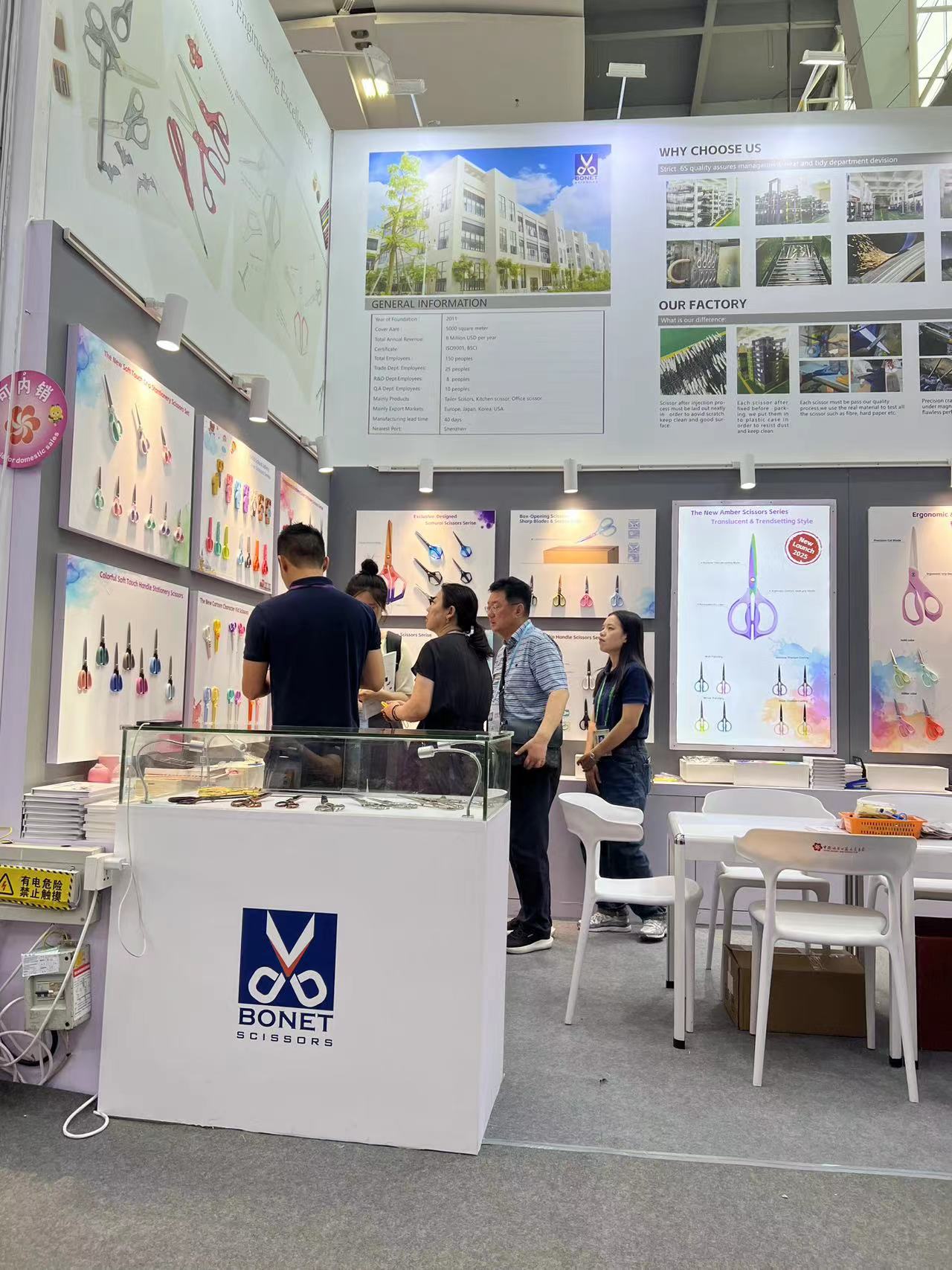
Canton Fair Stationery Sourcing: How to Evaluate Bonet Scissors
The Canton Fair is a useful place to compare stationery, household tools, and craft products in person. For buyers looking at scissors, the goal is not only to find an attractive sample on a display shelf. A good sourcing decision should consider the intended user, cutting application, handle comfort, blade options, packaging, and the supplier information needed before placing a wholesale or OEM order.
The original Bonet Houseware article introduced Bonet scissors as stationery products shown for Canton Fair visitors, with applications for students, tailors, artists, home users, and some industrial users. It also described ergonomic soft handles, right- and left-hand usability, high carbon stainless steel blades, straight and serrated blade choices, vibrant colors such as soft blue and bold red, metallic finishes, and recyclable packaging. This rewritten guide turns those points into a practical evaluation checklist for B2B buyers and product managers.
Key Takeaways
- Match each scissor type to a clear end user: school, home, craft, tailoring, office, or heavier cutting tasks.
- Check comfort through actual use, not only by looking at the handle shape.
- Confirm blade material, edge type, packaging, labeling, and order terms directly with the supplier.
- Ask for samples and written specifications before discussing large wholesale or OEM orders.
Why Scissors Are Worth Careful Evaluation at the Canton Fair
Scissors may look simple, but buyers know that small differences affect returns, repeat orders, and user satisfaction. A student scissor needs safe, easy handling. A craft scissor must cut cleanly through paper or light materials. A tailor or workshop user may focus on edge retention, grip comfort, and blade alignment. A household scissor should be reliable for common everyday cutting jobs.
At a trade fair booth, ask to test products with materials similar to your target market. If your customers cut paper, fabric, thread, cardboard, ribbon, or packaging film, bring sample materials or request a demonstration. A scissor that feels smooth for three cuts may feel different after repeated use, so pay attention to hand pressure, blade play, and whether the cut stays controlled from the pivot to the tip.
Applications: Match the Scissor to the Buyer and User
The original article noted a wide range of users, including students, tailors, artists, households, and professionals in industrial settings. For sourcing, this range should be separated into product categories. A mixed order may need different sizes, handle styles, blade edges, and packaging formats. Avoid choosing one model for every channel unless it has been tested across those use cases.
- School and student use: consider comfortable handles, manageable size, and packaging suitable for retail display.
- Home and office use: look for general-purpose cutting performance and durability under everyday tasks.
- Craft and art use: test cutting accuracy, tip control, and clean edges on paper and decorative materials.
- Tailoring and fabric tasks: evaluate blade sharpness, smooth opening and closing, and comfort during repeated cuts.
- Heavier cutting tasks: ask the supplier which models are intended for tougher materials and request appropriate test data or samples.
Comfort and Handle Design: What to Test in Person
The source article described ergonomic soft handles and usability for both right- and left-handed users. These are important points, but buyers should verify them during evaluation. A handle that looks ergonomic may not fit every hand size. A soft grip may be comfortable, but it should also stay firmly attached and resist slipping during use.
When reviewing Bonet scissors or any competing product, test the opening angle, finger-hole size, thumb pressure, and weight balance. Ask several people to try the same sample, including users with smaller and larger hands. If the product is promoted for both right- and left-handed users, have both types of users make repeated cuts and note whether the blade visibility and cutting direction feel natural.
Blade Options, Materials, and Cutting Performance
The original article mentioned high carbon stainless steel blades, straight blade options, and serrated blade options. Before purchasing, ask the supplier to confirm the blade material in writing, including any finish, hardness information if available, and care instructions. Do not rely on a display card alone if you need stable specifications for a retail program or private label project.
Straight blades are commonly chosen for clean, general cutting. Serrated blades can help grip certain materials, depending on the application. The best choice depends on what the end user will cut most often. During sample review, check whether the blades meet evenly, whether the pivot feels stable, and whether the scissor cuts near the tip as well as near the base. If the product will be sold through a professional or specialty channel, ask whether replacement policies, quality inspection criteria, or batch consistency information can be provided.
Design, Color, and Packaging Considerations
The source article described Bonet scissors in colors such as soft blue and bold red, as well as metallic finishes. Color can help segment a line for school, craft, office, or home channels, but design should support the commercial goal. A bright color may work well in student stationery, while a metallic finish may suit a more professional retail presentation.
The original also referred to recyclable packaging and sustainable production practices. For B2B sourcing, treat these as topics to verify. Ask what packaging materials are used, whether recycling markings are available, and whether the supplier can provide documentation for any environmental statements needed in your market. If you sell in regions with specific labeling or packaging rules, confirm requirements with your compliance team before finalizing artwork.
Comparison and Buyer Checklist
| Evaluation Area | What to Check at the Fair | Questions to Ask the Supplier |
|---|---|---|
| Target application | Test on paper, fabric, craft materials, or packaging samples. | Which models are recommended for each use case? |
| Handle comfort | Try repeated cuts with different hand sizes. | Are handle materials and colors customizable? |
| Blade type | Compare straight and serrated cutting performance. | Can the blade material and specification be confirmed in writing? |
| Left- and right-hand use | Have both user types test the sample. | Is the model designed for universal use or separate versions? |
| Packaging | Review retail display, labeling space, and protective packing. | What packaging options and artwork requirements are available? |
| Commercial terms | Collect catalogs, samples, and contact details. | What are the MOQ, lead time, sample policy, and inspection process? |
OEM and Wholesale Sourcing Questions
If you are sourcing for wholesale distribution, private label, or retail programs, the booth visit should lead to a structured follow-up. Ask for a product specification sheet, available packaging formats, customization options, sample costs, production lead time, minimum order quantity, carton information, and inspection standards. These details were not provided in the original article, so they should be confirmed directly rather than assumed.
For OEM work, clarify which parts can be customized: handle color, logo placement, packaging artwork, blade finish, assortment mix, or display format. Also ask how pre-production samples are approved and how changes are controlled after approval. Clear written communication reduces the risk of receiving a shipment that differs from the fair sample.
Practical FAQ
Are Bonet scissors suitable for school, home, and craft use?
The original article described applications for students, artists, households, tailors, and other users. Buyers should still test specific models against the materials and safety expectations of their own sales channel.
What should I confirm about the blades?
Confirm the stated blade material, blade edge type, finish, cutting application, and any care guidance. If high carbon stainless steel is listed for a model, request written confirmation for your records.
How can I evaluate ergonomic handles?
Use the scissors repeatedly, not just once. Check pressure points, grip stability, finger-hole size, and comfort for both right- and left-handed testers if universal use is claimed.
Can I request private label packaging?
That depends on the supplier’s available services. Ask about artwork templates, packaging materials, logo options, MOQ, approval samples, and whether recyclable packaging claims can be documented.
What should I do after meeting a supplier at the Canton Fair?
Request samples, written specifications, pricing terms, MOQ, lead time, packaging details, and quality inspection criteria. Compare those details with competing offers before placing an order.
