




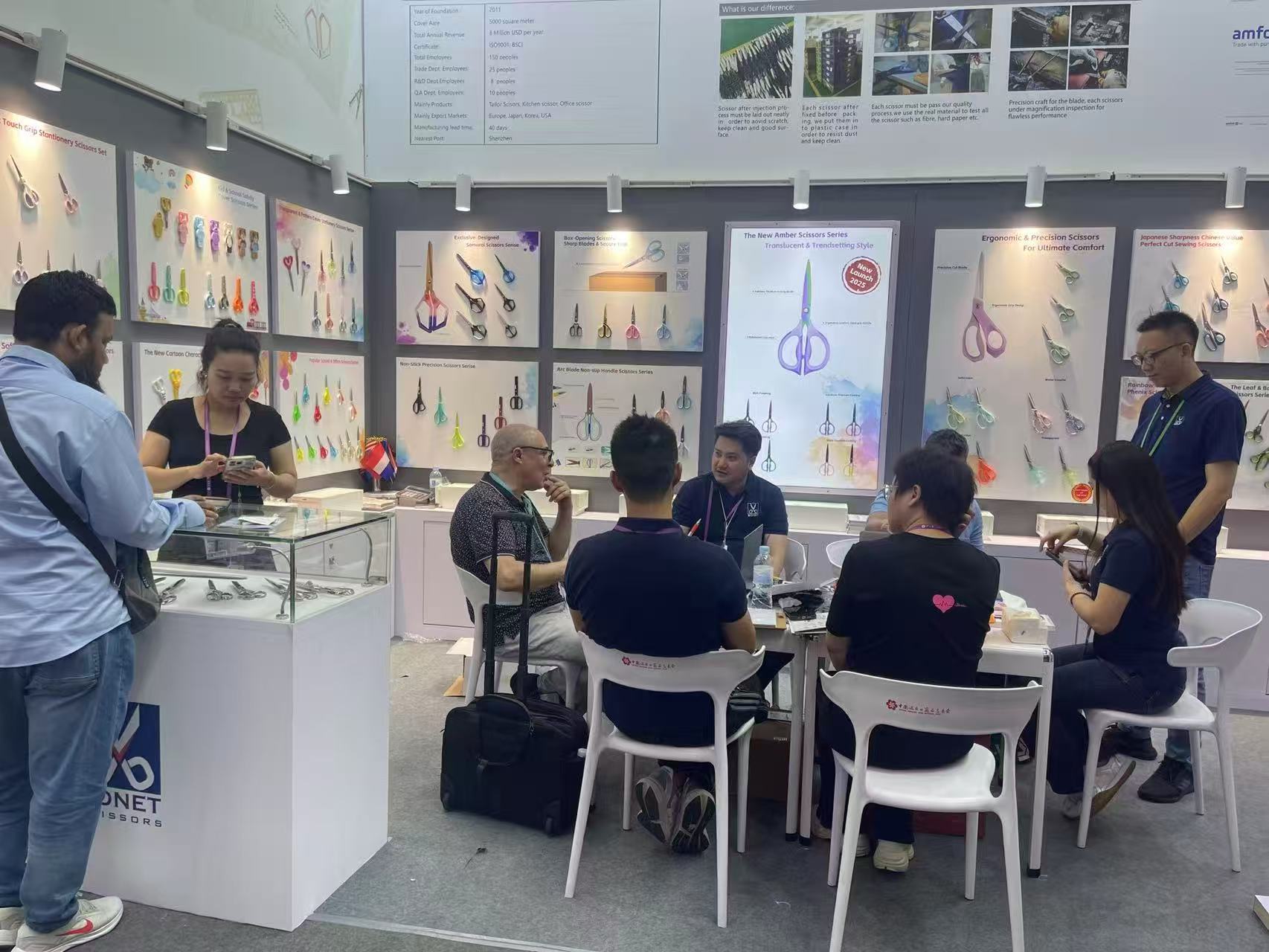
Canton Fair Stationery Sourcing: How to Evaluate Bonet Scissors
The Canton Fair stationery section is a useful place to compare cutting tools for school, office, craft, retail, and promotional channels. For buyers looking at Bonet scissors, the goal should not be to judge a product by color or display presentation alone. A good sourcing decision comes from checking how the scissors feel in hand, how consistently they cut, what models are available, and whether the supplier can support your market requirements.
The original article highlights Bonet scissors as colorful, ergonomic, and versatile, with options positioned for everyday users as well as creative or professional tasks. This rewritten guide turns that broad introduction into practical sourcing guidance for importers, distributors, retailers, and private-label buyers attending the fair or reviewing product information remotely.
Key Takeaways
- Use the fair to compare handle comfort, cutting smoothness, blade finish, packaging, and model range side by side.
- Ask the supplier which features apply to each exact model, such as non-stick blades or adjustable tension, instead of assuming all scissors include them.
- For B2B orders, confirm commercial terms, sample policy, packaging options, lead time, inspection process, and after-sales handling.
- Choose scissors based on the end user: students, offices, craft users, tailoring users, or industrial buyers may need different designs.
Why Bonet Scissors Attract Attention in Stationery Displays
Stationery buyers often need products that are practical, easy to merchandise, and visually clear to shoppers. Bonet scissors are presented in the original article as having a vibrant design, ergonomic shapes, and a color range that may include softer tones and brighter neon-style shades. Those details matter in retail because scissors are frequently bought on quick comparison: the shopper looks at size, handle shape, color, and perceived comfort before checking the rest of the pack.
However, a buyer should separate shelf appeal from performance. A bright handle may help a product stand out, but repeat purchases and low return rates depend on cutting quality, comfort, durability, and the accuracy of product claims. At a trade fair, treat design as the starting point, then move quickly to hands-on testing and supplier questioning.
Match the Scissors to the Intended User
Not every scissor belongs in the same sales channel. A model for a student pencil case is different from one used for craft paper, office packaging, tailoring, or heavier-duty tasks. The original article mentions use cases such as crafting, tailoring, and industrial applications, but buyers should verify the exact model suitability before placing an order.
For school and office ranges, prioritize safe handling, comfortable grips, clean cutting on paper, and packaging that explains the intended use clearly. For craft buyers, test how well the scissors cut curves, layered paper, labels, tape, and thin card. For tailoring or fabric-related users, ask whether the model is designed for fabric cutting and request suitable samples for fabric tests. For any industrial-style positioning, clarify the materials, thickness limits, and recommended applications in writing.
Product Evaluation Checklist
Use a simple comparison sheet when visiting booths. This prevents decisions from being driven by display lighting, packaging design, or a short demonstration using only easy-to-cut paper.
| Evaluation Point | What to Check | Questions to Ask the Supplier |
|---|---|---|
| Cutting performance | Smoothness, starting cut, tip control, and whether paper bends or tears | Which materials is this exact model recommended for? |
| Handle comfort | Grip size, finger spacing, pressure points, and left/right-hand suitability | Are there different handle sizes or ergonomic options? |
| Blade features | Blade finish, alignment, and whether special coatings are present | Do any models include non-stick blades, and how are they identified? |
| Tension or pivot | Opening and closing feel, looseness, and consistency between samples | Is the tension adjustable on this model or fixed? |
| Packaging | Retail display strength, barcode area, warning text space, and pack protection | Can packaging be adapted for our channel or language requirements? |
| Order support | Sampling, inspection, carton marks, and documentation | What are the MOQ, lead time, payment terms, and sample process? |
Hands-On Testing at the Canton Fair
Bring a small testing kit if you are seriously sourcing scissors. Include copy paper, thin card, adhesive label material, ribbon, fabric scraps, and a basic note sheet. Ask permission before testing anything beyond the supplier’s prepared samples. Cut straight lines, curves, and short snips near the blade tip. Open and close the scissors repeatedly to feel whether the pivot remains smooth or becomes loose.
Check several units of the same model, not just the display sample. A strong sample is encouraging, but consistency across pieces is more important for wholesale buying. Look for blade alignment, even handle molding, clean edges, and stable packaging. If the scissors are promoted as precision-designed, ergonomic, non-stick, or adjustable, ask the supplier to show which SKUs include those features and how they are described on the product sheet.
B2B Questions Before You Commit
A Canton Fair conversation should move from product interest to commercial clarity. Do not rely only on verbal statements. Request a written quotation and product specification sheet for each model under consideration. If Bonet scissors are being considered for distribution or private-label projects, ask whether branding, packaging layout, assortments, and carton configuration can be discussed. Do not assume these services are available until the supplier confirms them.
- What is the MOQ for each model, color, and packaging type?
- What is the normal sample lead time and production lead time?
- Which product features apply to the quoted SKU?
- Can the supplier provide packaging artwork templates?
- What inspection steps are used before shipment?
- How are defective, damaged, or short-shipped goods handled?
- Are there market-specific labeling or safety requirements the buyer must provide?
If you sell into regulated markets, consult your own compliance adviser or testing partner. The supplier can provide information and documents where available, but the importer is usually responsible for confirming market requirements before sale.
How to Build a Balanced Scissors Range
Retailers and distributors should avoid buying only the most eye-catching model. A balanced assortment may include entry-level school scissors, general office scissors, craft-oriented scissors, and more specialized options if demand exists. Color can help segment the range, but function should remain the main organizing principle.
For example, a stationery retailer may need compact scissors for students, medium everyday scissors for office counters, and colorful craft scissors for hobby buyers. A gift or promotional buyer may care more about packaging, handle color, and perceived value. A professional channel may care less about bright colors and more about blade performance, hand comfort, and replacement consistency.
FAQ
Are all Bonet scissors suitable for craft, office, and tailoring use?
No. Buyers should confirm the intended application for each model. A scissor that works well for paper may not be appropriate for fabric, adhesive materials, or heavier-duty use.
Should I ask for samples after seeing the scissors at the Canton Fair?
Yes. Fair samples help with initial screening, but formal samples allow your team to test the scissors under real user conditions and compare them with your current range.
What features should I verify in writing?
Verify blade material details if provided, coating or non-stick claims, adjustable tension, handle design, packaging type, colors, carton information, MOQ, lead time, and inspection arrangements.
How can I judge whether the scissors are comfortable?
Test the grip for several minutes, not just one cut. Check finger pressure, handle spacing, opening resistance, and whether the scissors feel stable during straight and curved cuts.
What is the best next step for a wholesale buyer?
Create a shortlist, request written quotations and samples, test the products in your target use cases, and confirm all commercial and packaging details before placing a purchase order.
