




Choosing the Best Office Scissors Supplier from China
Office scissors are simple products, but buying them in bulk is not a simple decision. Retailers, stationery brands, school supply distributors, promotional product companies, and office wholesalers all need scissors that cut cleanly, feel comfortable, and arrive with consistent quality. The right office scissors supplier can help you build a dependable product range; the wrong one can create returns, delayed shipments, and uneven customer reviews.
China remains a major sourcing market for office and stationery products because buyers can often compare many designs, handle types, blade finishes, packaging choices, and OEM options in one supply chain. However, a low unit price should not be the only selection standard. This guide explains how to evaluate wholesale office scissors from China with a practical B2B sourcing mindset.
Key Takeaways
- Choose an office scissors supplier based on consistency, communication, sample quality, packaging control, and after-sales response, not price alone.
- For titanium scissors or titanium-coated scissors, confirm the exact material description, coating process, and intended use before placing a bulk order.
- Ask suppliers direct questions about customization, MOQ, lead time, inspection standards, carton details, and replacement policies.
- Always test samples for cutting performance, handle comfort, screw tension, blade alignment, and packaging durability.
Why Source Wholesale Office Scissors from China?
Many buyers look to buy office scissors from China because the market offers broad product variety and flexible sourcing channels. A buyer can compare everyday office scissors, school scissors, craft scissors, ergonomic handle designs, and coated blade options. This makes it easier to create a product mix for different retail price points or customer groups.
For wholesale purchasing, China sourcing may also support private label packaging, color variation, and mixed assortment planning. These options are useful for importers and distributors that need to serve multiple channels, such as supermarkets, online stores, office supply catalogs, or institutional buyers. Still, every project should begin with clear specifications. If you do not define blade length, handle material, color, packaging, carton requirements, and quality expectations, suppliers may quote products that look similar but perform differently.
What Makes a Reliable Office Scissors Supplier?
A reliable supplier is not only a company that can quote quickly. For office scissors, reliability means the supplier can maintain the agreed design and quality from sample approval through mass production. Buyers should look for clear communication, complete product information, and willingness to answer technical and commercial questions.
Before selecting a supplier, ask whether they are a manufacturer, trading company, or sourcing partner. Each model can work, but the buyer should understand who controls production and who is responsible for quality follow-up. Ask for product photos, packaging options, available colors, sample policy, estimated lead time, and the process for confirming pre-production samples. If you need OEM office scissors, ask what customization is available and what artwork files or color references are required.
Product Details to Compare Before Buying
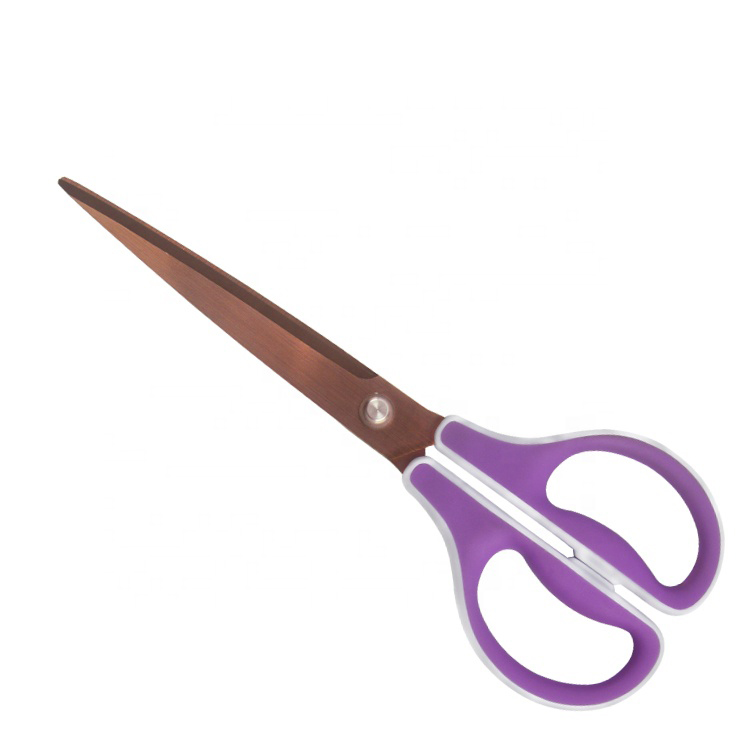
The original product description highlights stylish titanium scissors with blades designed for edge retention and durability, plus resistance to rust and corrosion. It also mentions a purple and white ergonomic handle intended to reduce hand fatigue during extended use. These are useful features to discuss with a supplier, but buyers should verify them through samples and written specifications.
In office environments, scissors may be used for paper, envelopes, labels, tape, thin cardboard, packaging materials, or light craft tasks. A pair that works well for paper may not be suitable for frequent cardboard cutting. Buyers should define the target use case and select blade size, handle design, and packaging accordingly.
| Checklist Item | What to Confirm | Why It Matters |
|---|---|---|
| Blade description | Material, coating, edge finish, and intended cutting use | Avoids confusion between titanium material and titanium coating claims |
| Handle design | Shape, color, comfort, and left or right hand suitability | Affects user satisfaction and repeat purchases |
| Cutting performance | Paper, tape, fabric, or cardboard sample tests | Confirms the scissors match the customer use case |
| Packaging | Blister card, hanging card, box, barcode, and label needs | Impacts retail display, shipping protection, and warehouse handling |
| Bulk order control | Inspection method, defect handling, and approved sample reference | Reduces risk of inconsistent mass production |
How to Evaluate Titanium Scissors Claims
Titanium scissors are often marketed for durability, edge retention, and corrosion resistance. When sourcing, do not rely only on promotional wording. Ask the supplier to state whether the scissors are made from titanium, titanium alloy, stainless steel with titanium coating, or another construction. These descriptions can mean very different things in performance and cost.
Request a written specification sheet and compare it with your market positioning. If you plan to sell the product as premium office scissors, the claim should be clear and supportable. Also ask how the blade finish should be cleaned and whether the coating has any special care requirements. For B2B buyers, this information helps avoid inaccurate product listings and reduces disputes with downstream customers.
Sample Testing for Wholesale Office Scissors
Sampling is one of the most important steps when choosing an office scissors supplier. A sample should be tested by people who will use the product in realistic conditions. Do not only check appearance. Open and close the scissors repeatedly, cut different papers, test a strip of tape, and check whether adhesive residue affects performance. If your customers may cut cardboard or fabric, include those materials in the test.
- Check blade alignment from the tip to the pivot area.
- Test whether the scissors cut cleanly at the tip and along the full blade.
- Feel the handle during repeated use and note any pressure points.
- Inspect the screw or pivot for smooth movement and stable tension.
- Review packaging for barcode placement, hanging strength, and shipping protection.
Keep one approved sample as the reference for production. If you later place a repeat order, confirm whether the same material, color, packaging, and production process will be used.
OEM and Private Label Questions to Ask
If your project requires OEM office scissors, prepare questions before requesting a quotation. Ask what parts can be customized: handle color, printed logo, blade marking, packaging design, carton label, or assortment sets. Ask whether there are minimum order quantities for each customization option, and request artwork templates if packaging is involved.
Buyers should also ask about lead time for samples, lead time for mass production after sample approval, and how changes are handled. If you need compliance documents for your sales market, do not assume they are available. Ask the supplier what documents they can provide for the exact product you are buying, and verify whether those documents match your importer responsibilities.
Balancing Price, Quality, and Risk
Wholesale sourcing is always a balance. A lower price may be acceptable for a basic promotional item, but not for a product intended for long-term office use. Compare quotations only after confirming that each supplier is quoting the same size, handle material, blade type, packaging, and order quantity. Small differences in specification can explain large price gaps.
It is also wise to discuss inspection before production begins. Ask whether the supplier supports pre-shipment inspection and what happens if defects are found. Clarify who pays for replacement goods, rework, or additional shipping if the goods do not match the approved sample. These conversations are easier before an order is placed than after a container is ready to ship.
FAQ
What should I ask before choosing an office scissors supplier in China?
Ask whether the company is a manufacturer or trader, what materials and coatings are used, what customization is available, what MOQ applies, how samples are approved, and how quality is inspected before shipment.
Are titanium scissors always better for office use?
Not always. Titanium or titanium-coated scissors may offer useful durability or corrosion-resistance benefits, but the best choice depends on the intended use, price point, handle comfort, and verified cutting performance.
How can I reduce risk when buying wholesale office scissors?
Define detailed specifications, test samples, keep an approved reference sample, confirm packaging, request clear production timelines, and agree on inspection and defect-handling procedures in writing.
Can I request private label packaging?
Many suppliers may offer private label or OEM packaging, but availability, MOQ, cost, artwork requirements, and lead time vary. Ask the supplier to confirm these details for the exact scissors model you plan to order.
