




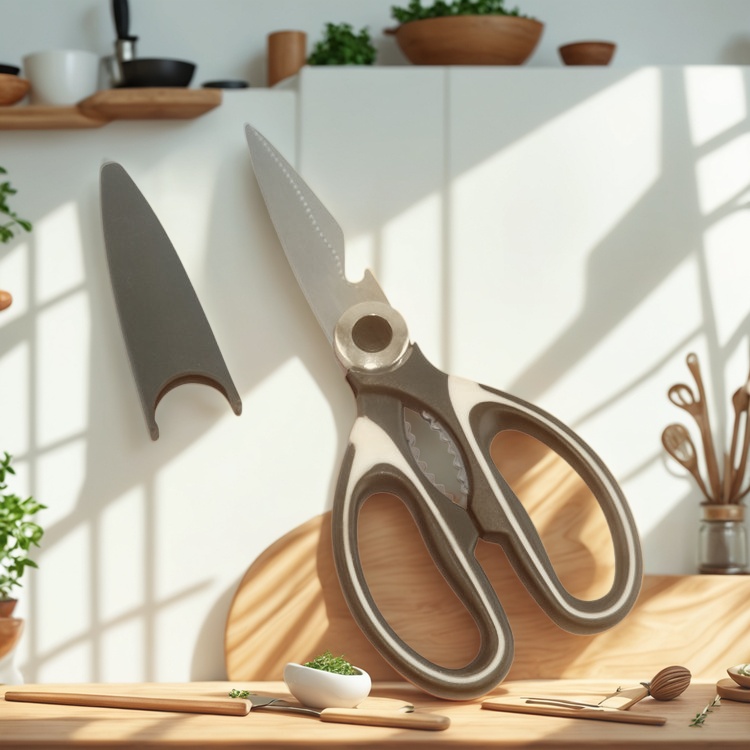
Choosing Your Ideal Kitchen Scissors OEM Partner
Finding the right kitchen scissors OEM partner is not only about locating a factory that can produce a cutting tool. For importers, brand owners, distributors, and private-label kitchenware buyers, the decision affects product consistency, packaging, delivery planning, after-sales issues, and how well the finished item matches the target market. Kitchen scissors are handled frequently, used around food, and often expected to cut poultry, herbs, packaging, vegetable stems, and other everyday kitchen materials. That makes supplier evaluation more important than a quick price comparison.
The original article introduced Bonet Houseware Co., Ltd. and its kitchen scissors category, with contact information for Jeff Lin and a product link at https://bonethome.com/scissors. It also highlighted common buyer priorities such as precision, durability, ergonomic handles, multifunctional design, and protective accessories. This rewritten guide turns those ideas into a practical sourcing checklist for buyers comparing OEM kitchen scissors suppliers.
Key Takeaways
- Choose a kitchen scissors OEM partner by evaluating product fit, communication, sample quality, quality-control process, and packaging support together.
- Do not rely only on claims such as sharp, durable, or premium; ask how the supplier verifies those qualities during production.
- Confirm material, blade design, handle construction, accessories, and packaging details before approving a production sample.
- For OEM or private-label orders, ask what information the factory needs for branding, cartons, manuals, barcode labels, and market-specific requirements.
- Keep commercial details such as MOQ, lead time, tooling cost, and payment terms as written questions until the supplier confirms them directly.
Start With the Product Positioning
Before contacting a factory for kitchen scissors, define the product you need to source. A budget utility scissor for promotion packs has different priorities from a retail kitchen scissor positioned for frequent poultry preparation. A product for supermarket shelves may need packaging that explains functions clearly, while an online product may need strong images, clear dimensions, and safe storage features.
Useful positioning questions include: Who is the buyer? What will they cut most often? Is the product sold as a single item or part of a kitchen tool set? Should the scissor include a sheath, nutcracker, bottle opener, or detachable blades? Does your market prefer a simple handle color, a two-tone design, or a more visible retail appearance? These answers help the OEM supplier recommend suitable existing models or discuss customization without guessing.
Evaluate Materials Without Assuming Specifications
The original article mentioned stainless steel blades and ergonomic handles with soft, rubberized grips as desirable features. Those are common purchase criteria, but buyers should still ask the supplier to confirm the exact material, handle construction, blade thickness, finishing method, and cleaning guidance for the model being quoted. If a product page or catalog does not state a grade, coating, or performance test, do not assume it.
For B2B sourcing, ask for a specification sheet for each candidate model. It should ideally clarify blade material, handle material, overall size, unit weight, surface finish, packaging method, and available colors. If the scissors will be sold in a market with particular labeling or safety expectations, ask the supplier what documentation they can provide and what remains the buyer's responsibility to verify.
Check Design, Comfort, and Everyday Function
Kitchen scissors need to feel stable in the hand. A design that looks acceptable in a catalog may feel uncomfortable when cutting thicker food items or packaging. Request samples and test them with realistic tasks, such as cutting herbs, trimming poultry, opening food packaging, and handling wet conditions. If the scissor includes multifunctional elements such as a nutcracker or bottle opener, test whether those features are easy to identify and use.
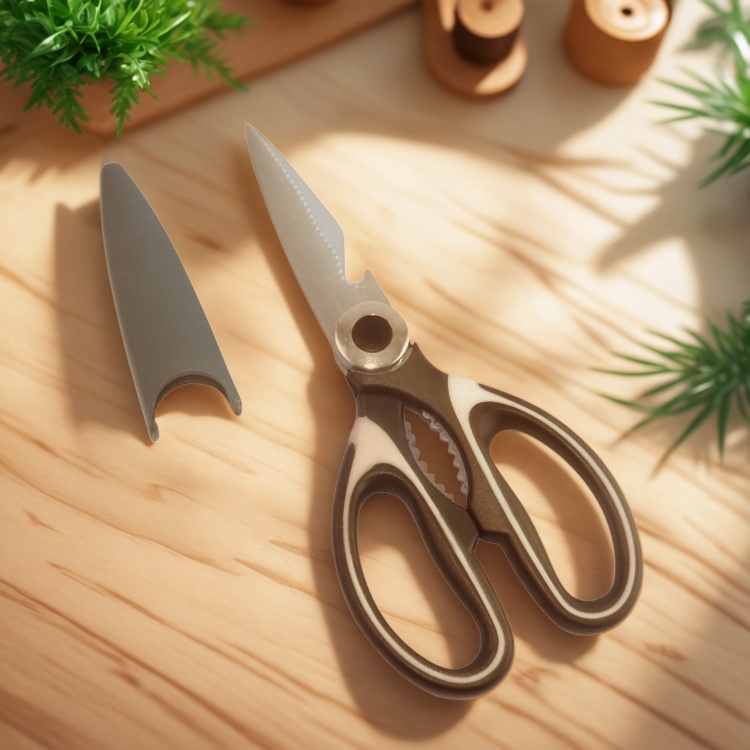
Pay attention to the pivot area, blade alignment, handle opening size, grip texture, and whether the tool can be cleaned easily. A protective blade sheath can be valuable because it reduces accidental contact during storage and helps protect the cutting edge. However, the sheath should fit securely without being difficult to remove. These small usability points often influence customer reviews and repeat orders.
Use a Structured OEM Supplier Checklist
A clear comparison table helps buyers avoid choosing a kitchen scissors supplier based only on the lowest quoted price. Use the table below when comparing Bonet Houseware or any other potential OEM partner.
| Evaluation Area | What to Ask | Why It Matters |
|---|---|---|
| Product specification | Can you provide confirmed material, size, weight, finish, and handle details? | Prevents misunderstandings between sample approval and mass production. |
| Sample quality | Can we review pre-production samples before order confirmation? | Allows physical testing of sharpness, comfort, balance, and packaging. |
| OEM customization | What logo, color, packaging, and accessory options are available for this model? | Helps align the product with brand and retail channel needs. |
| Quality control | What inspections are performed during and before shipment? | Shows whether the factory has a repeatable process, not just a finished sample. |
| Commercial terms | What are the MOQ, lead time, payment terms, and carton details? | Supports accurate costing, inventory planning, and launch scheduling. |
| Documentation | What test reports, declarations, or compliance support can you provide if required? | Clarifies what the supplier can supply and what the buyer must arrange. |
Ask About Factory Process and Quality Control
A reliable factory for kitchen scissors should be able to explain how it controls consistency. You do not need every technical detail at the first conversation, but you should expect clear answers about incoming material checks, blade processing, assembly, handle inspection, packaging inspection, and final random inspection. If a supplier cannot describe how it finds defects before shipment, the buyer may inherit those defects after arrival.
Ask whether the approved sample will be sealed or photographed for reference. Confirm how color, logo placement, packaging artwork, carton marks, and accessories will be checked. If third-party inspection is part of your sourcing policy, tell the supplier early so inspection timing and access can be planned before shipment.
Clarify Packaging, Branding, and Retail Readiness
OEM sourcing often fails at the details: a logo is slightly misplaced, a barcode is missing, the product image does not match the final color, or carton marks are incomplete. For kitchen scissors, packaging also affects safety and presentation. A blade sheath, blister card, color box, hang tag, or instruction insert may all change cost, carton quantity, and retail appearance.
Before confirming production, prepare the final artwork files, logo requirements, color references, barcode information, and any warning or care language required by your sales channel. Ask the supplier to provide a packaging mockup or digital proof before printing. If the product will be sold online, also ask what sample photography or product dimensions can be provided, but verify all details yourself before publishing listings.
Compare Price With Total Sourcing Risk
Price matters, but the cheapest quotation is not automatically the best value. A lower unit cost can become expensive if the blades do not perform well, packaging is inconsistent, or the shipment misses a launch window. Compare quotes only after confirming that each supplier is quoting the same model, same packaging, same logo method, same accessory set, same carton requirements, and same inspection expectations.
For an OEM kitchen scissors order, ask suppliers to separate costs where possible: product, packaging, logo process, sample fee, tooling if any, inner and master carton details, and freight terms. This makes it easier to see what is included and what still needs confirmation.
Practical FAQ for Kitchen Scissors OEM Buyers
How should I choose between an existing model and a custom design?
An existing model is usually easier to sample and compare because the supplier already understands the production process. A custom design may support stronger brand differentiation, but it can require tooling, longer development time, more testing, and clearer technical drawings. Ask the supplier what changes are possible on the selected model before assuming a fully custom product is necessary.
What should I test in a kitchen scissors sample?
Test cutting performance, handle comfort, blade alignment, pivot smoothness, cleaning convenience, sheath fit, and packaging durability. Use real tasks that match your target customer rather than only cutting paper. If the scissor includes a nutcracker or bottle opener, test those functions separately.
Can I request private-label packaging?
Many OEM suppliers can discuss logo and packaging options, but available methods, MOQ, cost, and lead time must be confirmed for the exact product. Provide artwork, color references, barcode requirements, and retail channel instructions early to avoid delays.
What questions should I ask before placing a bulk order?
Ask for confirmed specifications, sample approval steps, MOQ, lead time, payment terms, packaging details, carton measurements, inspection process, shipping terms, and available documentation. Keep all approved details in writing so both sides can reference the same standard during production.
Final Sourcing Advice
A good kitchen scissors OEM partner should help you turn a product idea into a repeatable, inspectable, and market-ready item. Focus on clear specifications, realistic sample testing, transparent communication, and documented quality checks. Whether you are comparing Bonet Houseware with other suppliers or shortlisting a factory for kitchen scissors for the first time, the strongest choice is the supplier that can answer practical questions clearly and support consistent execution from sample to shipment.
