




Quick Answer
A reliable chopping board manufacturer in China should help buyers match the board material, construction, thickness, working surface, edge design, weight, packaging and cleaning requirements to a clearly defined chopping application. Buyers should evaluate flatness, stability, surface consistency, material documentation, workmanship, logo feasibility, packaging protection, inspection criteria and reorder traceability before approving production. Request a production-intent sample and an itemized quotation that separates the product, custom features, branding, tooling, packaging, inspection and shipping assumptions. Buyers can review the BONET product catalog and submit a detailed project brief through Contact Us.
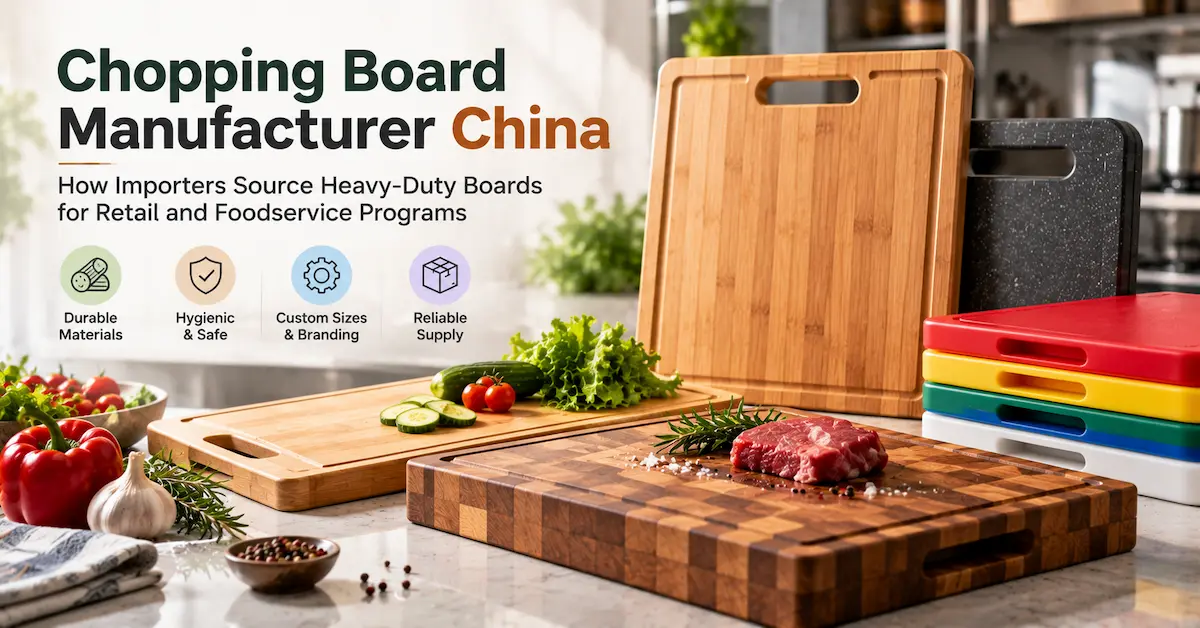
Why Chopping Boards Need a Different Buying Approach
“Cutting board” and “chopping board” are frequently used as interchangeable terms. In a commercial sourcing project, however, the word “chopping” often suggests more demanding preparation tasks, a greater need for stability and a stronger focus on board thickness, impact behavior and working-surface durability.
A lightweight board may be suitable for slicing fruit or preparing sandwiches. It may not be the right solution for repeated chopping, heavy food preparation or a professional kitchen environment. A decorative board may look attractive on a retail shelf but prove inconvenient to lift, wash or store. A thick board may feel stable during use but create higher freight costs and require stronger retail packaging.
This makes chopping board sourcing a balance between function, appearance, logistics and price.
An importer searching for a chopping board manufacturer in China may be solving one of several commercial problems:
- Developing a private label range for supermarkets or kitchenware retailers.
- Sourcing durable boards for restaurant and hospitality distribution.
- Building a multi-size chopping board collection for an online brand.
- Creating a bamboo or wood chopping board for premium gifting.
- Developing color-coded plastic boards for organized food preparation.
- Adding a custom logo, handle, groove or package to an existing model.
- Replacing a supplier whose product quality changes between shipments.
- Reducing damage, warping or surface complaints from current customers.
A useful supplier evaluation therefore goes beyond catalog photographs and unit price. The buyer needs to understand what is produced, how the board is constructed, how quality is assessed and whether the approved result can be repeated.
What Is a Chopping Board Manufacturer in China?
A chopping board manufacturer in China produces boards for food preparation according to standard designs or buyer-specific requirements. Depending on its capabilities, the supplier may offer existing models, private label branding, OEM modifications, custom packaging or ODM product development.
A professional sourcing program should define the chopping board as a complete commercial product rather than a rectangular piece of material. Its specification may include:
- Intended user and preparation task.
- Board material and construction.
- Length, width and thickness.
- Total weight or target weight range.
- Working-surface texture.
- Edge profile and corner radius.
- Handle, hanging hole or finger grip.
- Juice groove or liquid-control feature.
- Feet or anti-slip components.
- Reversible or single-sided use.
- Logo method and position.
- Care and cleaning instructions.
- Retail packaging and shipping carton.
- Inspection criteria.
- Batch or reorder identification.
The manufacturer should translate these requirements into a product that can be sampled, approved, inspected and reordered. If important details remain only in chat messages or reference photographs, the risk of misunderstanding remains high.
Search Intent and Target Buyers
The principal search intent behind “chopping board manufacturer China” is commercial investigation with supplier-comparison and RFQ intent. The searcher is usually not looking for a general definition of a chopping board. The buyer is comparing manufacturing options and trying to reduce procurement risk.
This article is intended for:
- Kitchenware importers.
- Private label houseware brands.
- Restaurant-equipment distributors.
- Hotel and hospitality suppliers.
- Supermarket and department-store buyers.
- E-commerce kitchenware sellers.
- Corporate gift companies.
- Food-preparation equipment wholesalers.
- Purchasing agents developing a chopping board range.
Common buyer questions include:
- How can I identify a reliable chopping board factory in China?
- Which material is appropriate for heavy chopping?
- Should I buy bamboo, wood, plastic or composite boards?
- How thick should a chopping board be?
- Can the manufacturer produce custom sizes and shapes?
- What should be inspected in a chopping board sample?
- How can I control warping and surface inconsistency?
- Can the supplier add a logo and private label packaging?
- Which MOQ applies to the board, color, branding and package?
- How can I make the second order match the first?
A high-quality sourcing guide should help the buyer answer these questions before requesting a final price.
Define the Chopping Application First
The first sourcing decision should be the intended application. Material and design choices should follow the application rather than lead it.
A household buyer may prioritize appearance, manageable weight, easy storage and retail presentation. A restaurant distributor may prioritize stability, practical cleaning, size identification and replacement availability. A premium gift buyer may prioritize surface finish, natural material appearance and branded packaging.
Use an application statement such as:
“This chopping board is intended for household customers who prepare vegetables, meat and general ingredients. It should provide a stable working surface, manageable weight, smooth edges, an easy-grip feature and retail packaging suitable for supermarket display.”
For commercial use:
“This board is intended for restaurants and catering operations that require repeated chopping and organized preparation. The product should have a stable footprint, clear size or color identification, practical storage and packaging suitable for wholesale distribution.”
These descriptions help the manufacturer understand which characteristics are critical. They also help the buyer create an inspection plan based on actual use.
Before selecting a product, answer the following:
- What ingredients will normally be prepared?
- Is the board intended for slicing, light preparation or repeated chopping?
- Will the board be used in a household or commercial kitchen?
- Does the buyer require one board or a coordinated range?
- How frequently will the board be washed?
- Will it be stored flat, vertically or on a rack?
- Is low weight, stability or premium appearance the priority?
- Must the board include a groove, handle, feet or hanging hole?
- Will the product be sold individually or as a set?
- Which destination-market requirements apply?
Chopping Board Materials Compared
Material choice affects chopping feel, weight, appearance, maintenance, packaging and retail positioning. No material is best for every buyer.
| Material category | Commercial advantages | Points requiring verification | Typical sourcing context |
|---|---|---|---|
| Bamboo | Natural visual identity, moderate weight and strong retail recognition | Construction, bonding, moisture control, sanding, grain variation and care instructions | Household retail, gifts and natural kitchenware ranges |
| Solid wood | Premium appearance and substantial working feel | Species, grain, moisture response, finish, weight and maintenance | Premium retail, gift programs and selected hospitality applications |
| Plastic or polymer | Color flexibility, efficient assortment planning and relatively light handling | Material declaration, thickness, deformation, surface wear, odor and cleaning limitations | Retail, foodservice and color-organized preparation |
| Composite material | Potential for distinctive appearance and controlled construction | Composition, surface behavior, edge finish, impact response and care requirements | Differentiated private label ranges |
| Flexible chopping mat | Compact storage and lower shipping weight | Stability, curl recovery, cutting resistance and surface movement | Small kitchens, travel and value programs |
| Mixed-material board | Can combine functional or visual features | Component compatibility, joining, cleaning access and inspection | Branded product development and premium ranges |
Material names should not be treated as complete specifications. “Bamboo,” “wood” and “plastic” identify broad categories. Buyers should ask the manufacturer to document the material and construction proposed for the exact model.
If the buyer plans to make statements concerning food contact, temperature, dishwasher use, antibacterial performance, sustainability or chemical resistance, those statements should be supported by evidence appropriate to the product and destination market. Marketing copy should not be written first and justified later.
Bamboo Chopping Boards
Bamboo chopping boards are popular in private label kitchenware because they offer a recognizable natural appearance and can support multiple shapes and sizes. Their performance depends on more than the word “bamboo.”
A buyer should review:
- Strip or layer construction.
- Bonding and joint consistency.
- Moisture management.
- Surface sanding.
- Edge finishing.
- Flatness.
- Grain and color variation.
- Groove workmanship.
- Handle or hole strength.
- Care instructions.
- Packaging against moisture and impact.
Natural variation should be addressed in the inspection standard. A buyer may accept reasonable grain or tone differences while rejecting cracks, raised fibers, open joints, rough areas, structural lifting or excessive warping.
The board should also be evaluated after unpacking. Packaging and storage conditions can influence a natural-material product. A beautiful approval sample does not prove that the retail shipment will remain protected if the packaging is too loose or the carton environment is unsuitable.
When sourcing from a bamboo chopping board manufacturer, ask whether the production-intent sample represents the proposed material, construction, finish and packaging. If any element is substituted during mass production, the change should require written approval.
Wood Chopping Boards
Wood chopping boards can support premium retail, gifting and hospitality concepts. They also require clear expectations concerning natural appearance and maintenance.
Important points include:
- Wood species or material description.
- Board construction and grain orientation.
- Moisture and storage conditions.
- Surface coating or finish.
- Edge and corner workmanship.
- Weight variation.
- Acceptable grain and color variation.
- Care instructions.
- Package protection.
- Traceability of approved materials.
A wood board can be positioned as a functional preparation product, a serving product or a combined product. These use cases should not be confused. If the board includes decorative surfaces, inlays or special finishes, the buyer should confirm which areas are intended for chopping.
The buyer should inspect the underside as carefully as the visible face. Surface defects, uneven feet, rough edges or inconsistent finishing can affect the customer's experience even if the display side looks acceptable.
Plastic Chopping Boards
Plastic chopping boards can be useful for household ranges, foodservice supply and color-organized preparation. They can support custom shapes, handles, surface patterns and multiple colors, but the specification still needs detail.
Confirm:
- Exact material category.
- Overall dimensions and thickness.
- Flatness.
- Surface texture.
- Edge quality.
- Color reference.
- Odor expectations.
- Flexibility or stiffness.
- Handle or hanging-hole strength.
- Anti-slip components, if present.
- Cleaning conditions.
- Packaging support.
If several colors are used, the buyer should decide whether color communicates a specific kitchen task or simply provides consumer choice. That decision affects packaging, instructions, SKU coding and carton labels.
For foodservice programs, color systems should be defined clearly. The supplier should not assume which ingredient category corresponds to a color because practices can vary by buyer and market.
A plastic chopping board supplier in China should provide a real color sample and identify how future batches will be compared. Screen colors and digital renderings cannot serve as final color approval.
Thickness, Weight and Chopping Stability
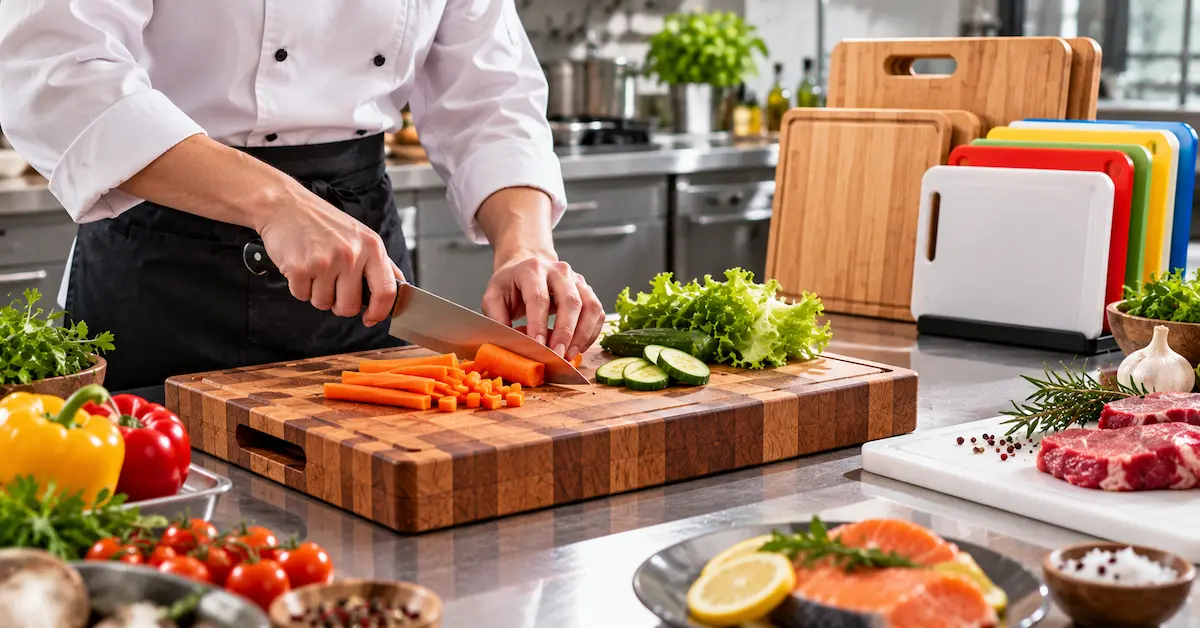
Thickness is one of the most important differences between a chopping board and a lightweight preparation board. It influences rigidity, stability, perceived value, package dimensions and shipping cost.
A thicker product is not automatically better. It may create:
- Higher material consumption.
- Greater unit weight.
- Higher freight cost.
- Larger retail packages.
- More difficult shelf display.
- More demanding storage.
- A premium feel and greater working stability.
A thinner board may be easier to handle and ship but may feel less stable under repeated chopping. The buyer should define the performance objective rather than request maximum thickness without considering the commercial consequences.
Weight should also be considered. A stable board should not move excessively during use, but the user must still be able to lift, clean and store it. For e-commerce, package weight can materially affect delivery cost. For hospitality buyers, repeated handling by staff may matter more than luxury appearance.
If feet or anti-slip components are used, inspect their attachment, position, height and contact with the work surface. A board with uneven feet can rock even when the main board is flat.
Working Surface and Knife Interaction
The working surface should support the intended preparation task without creating avoidable instability or maintenance problems. A smooth surface may be easy to clean but can allow wet ingredients to move. A heavily textured surface may improve grip but trap residue or become difficult to inspect.
The buyer should evaluate:
- Surface uniformity.
- Texture depth.
- Visible manufacturing marks.
- Rough areas.
- Scratches before use.
- Reaction to representative chopping.
- Ease of cleaning.
- Staining behavior where relevant.
- Drying and storage.
- Interaction with the selected packaging.
Knife interaction is also a buyer concern. The article should not promise universal knife protection because outcomes depend on the board material, knife edge, force and use. Instead, the supplier and buyer should agree on practical evaluation conditions for the intended market.
When comparing samples, use the same ingredient or test medium, knife type and user method where possible. A casual test performed differently for each sample produces weak evidence.
Chopping Board Features and Their Commercial Value
Features should solve real user problems. Adding features only to increase the number of selling points can make the board harder to manufacture, package and clean.
Juice Groove
A groove can help contain liquid during selected preparation tasks. Confirm groove depth, width, corner finish, cleaning access and the remaining usable chopping area. A poorly finished groove may collect residue or reduce working space without offering meaningful value.
Handle or Finger Grip
A handle can make the board easier to lift, carry or hang. Confirm edge smoothness, finger clearance and structural strength. A large handle can reduce the working surface or increase package size.
Hanging Hole
A hanging hole supports vertical storage but must be positioned so the board hangs securely. Check the remaining material around the hole and whether the retail package uses the same feature.
Anti-Slip Feet
Feet can improve stability but may make the board single-sided. Confirm material, attachment, alignment and replacement expectations. The package should not place pressure on the feet.
Reversible Design
A reversible board increases usable surface area. Confirm whether both sides share the same finish and whether features such as grooves or feet restrict use.
Color Coding
Color coding can support organization in commercial kitchens or product differentiation in retail. It also increases SKU complexity. The buyer should create a clear color and carton identification system.
Integrated Containers or Trays
A tray or removable container may support ingredient transfer, but it adds components, fit requirements and packaging complexity. Inspect the complete assembly and cleaning access.
Each feature should be reviewed for functional value, production risk, added cost and packaging impact.
OEM, ODM and Private Label Development
A chopping board factory in China may support several customization levels.
| Development route | Buyer provides | Manufacturer provides | Suitable use |
|---|---|---|---|
| Standard private label | Existing model choice, logo and packaging | Standard board with agreed branding | Faster launch and market testing |
| OEM customization | Base model plus size, color, feature or finish changes | Manufacturing review and controlled modification | Differentiated brand program |
| ODM development | Target user, market need and product concept | Product design and manufacturing proposal | New product architecture |
| Co-development | Reference products, target cost and performance priorities | Iterative engineering and sampling | Complex retail or hospitality program |
The supplier should explain what is standard and what requires new tooling, fixtures or process development. A custom logo may require a marking setup. A new plastic shape may require a mold. A custom wood outline may require revised machining and packaging without a conventional mold.
Buyers should separate one-time development costs from recurring production costs. This makes quotations easier to compare and makes the financial model for future reorders clearer.
Logo and Private Label Options
Branding can be applied to the board, packaging or both.
Engraving
Engraving may suit bamboo, wood or other compatible surfaces. Confirm logo size, depth, contrast, position and cleaning implications. Do not approve an engraving from artwork alone.
Printing
Printing can provide color and visibility. Confirm surface preparation, ink or coating compatibility, curing, abrasion expectations and acceptable variation.
Molded Branding
A logo can sometimes be integrated into a molded plastic board. This may create consistent placement but require tooling and higher development commitment.
Label or Package Branding
Package branding may be the most efficient option for a market test. It offers more space for product benefits, care instructions, legal information and brand storytelling.
Logo placement should respect the working area. A large mark may look attractive in a presentation but interfere with chopping, cleaning or product photography. Request a placement drawing followed by a physical sample.
Packaging for Retail and Foodservice Channels
Packaging should reflect how the product is sold and transported.
Retail channels may use:
- Paper bands.
- Printed sleeves.
- Hanging cards.
- Shrink wrapping where appropriate.
- Window boxes.
- Gift boxes.
- Multi-board set packaging.
Foodservice channels may prefer:
- Protective bags.
- Inner cartons.
- Bulk cartons.
- Size or color labels.
- Simple identification sleeves.
The package must protect corners, surfaces, feet, handles and logos. A heavy chopping board can damage its own package if the insert is weak. Multiple boards can scratch one another if nested without separation.
Packaging approval should include:
- The real production-intent board.
- The final insert or sleeve.
- Barcode and label positions.
- Care and use instructions.
- Inner-pack quantity.
- Master-carton arrangement.
- Carton marks.
- Handling and storage orientation.
- Protection against surface contact.
- Confirmation of final package dimensions and weight.
Package dimensions affect freight, warehouse planning and retail shelf efficiency. They should be confirmed before the buyer finalizes landed-cost calculations.
Quality Control and Order-Linked Evidence
“Strict quality control” is not enough information for a professional buyer. The manufacturer should explain what is checked, when it is checked and how the result is recorded.
| Control point | Typical checks | Evidence buyers can request |
|---|---|---|
| Incoming material | Material identity, condition, color and moisture where relevant | Material declaration or receiving record |
| First-piece approval | Dimensions, thickness, surface, edge and features | Approved sample and specification |
| In-process inspection | Cutting, forming, sanding, molding, bonding or assembly | Process inspection record |
| Functional inspection | Flatness, stability, handle strength and feature performance | Defined test method and result |
| Visual inspection | Cracks, stains, scratches, roughness, color and logo | Visual standard and defect limits |
| Packaging inspection | Correct SKU, protection, labels and quantity | Packing checklist |
| Final inspection | Shipment sample, carton marks and order completeness | Final inspection report or photographs |
| Corrective action | Root cause and corrective measure for nonconformity | Corrective-action record |
Evidence should be connected to the actual product and order. A certificate belonging to another material, another model or an expired system should not be treated as proof for the current project.
Buyers should also define document ownership. Decide who retains:
- Approved product samples.
- Technical specifications.
- Artwork.
- Color references.
- Packaging files.
- Inspection standards.
- Change records.
- Batch or order references.
These records support continuity when purchasing staff, suppliers or production teams change.
Sampling and Approval
Sampling should progress from concept to production intent.
A practical sequence is:
- Catalog or reference selection.
- Unbranded product sample.
- Material and dimension confirmation.
- Logo or feature sample.
- Packaging proof.
- Complete production-intent sample.
- Signed approval and retained reference.
Not every project requires every stage, but skipping directly from a digital image to production creates unnecessary risk.
The production-intent sample should represent the proposed:
- Material.
- Construction.
- Dimensions.
- Surface.
- Edge.
- Features.
- Color.
- Logo.
- Package.
- Care instructions.
If the sample uses a temporary material or process, that difference must be disclosed. The buyer should understand what will change in production and approve the change before the order begins.
MOQ and Commercial Structure
A chopping board quotation may contain several minimum quantities.
| MOQ layer | Commercial effect |
|---|---|
| Base board MOQ | Minimum production quantity for the model |
| Material MOQ | Minimum material purchase or preparation quantity |
| Size MOQ | Minimum quantity for each dimension |
| Color MOQ | Minimum quantity for each custom color |
| Logo MOQ | Minimum quantity for engraving, printing or molding setup |
| Packaging MOQ | Minimum print quantity for sleeves, boxes or cards |
| Set MOQ | Minimum quantity per combination in a multi-board set |
| Reorder MOQ | Quantity required when approved setup is reused |
Ask the supplier to state these separately. A quotation stating only one MOQ can hide restrictions that appear later.
Lead time should also be divided into:
- Tooling or setup.
- Sample production.
- Sample delivery.
- Artwork approval.
- Packaging proof.
- Material preparation.
- Mass production.
- Final inspection.
- Shipping.
The buyer should know which event starts each period. Production normally cannot proceed until the specification, sample, artwork, commercial terms and required payment milestones are complete.
Cost and Landed-Value Analysis
Unit price is only one part of the sourcing decision. A lower-priced board can create higher costs if it uses inefficient packaging, suffers from damage, generates customer returns or cannot be reordered consistently.
Request an itemized quotation covering:
- Board price.
- Custom material or finish.
- Logo marking.
- Tooling or fixture.
- Custom feature.
- Retail packaging.
- Inner and master cartons.
- Sampling.
- Inspection or testing.
- Freight.
- Insurance where applicable.
- Destination charges where included.
Evaluate package dimensions and weight before choosing the final thickness. A small increase in each unit can affect carton quantity, pallet configuration and container use across a large order.
A commercial comparison should consider:
- Purchase price.
- Development cost.
- Packaging cost.
- Freight efficiency.
- Expected damage rate.
- Inspection cost.
- Reorder stability.
- Supplier response and corrective-action capability.
This is a more useful comparison than choosing the lowest initial unit price.
Comparing Potential Suppliers
Use a structured scorecard when comparing a chopping board manufacturer in China.
| Evaluation area | Questions |
|---|---|
| Product fit | Does the supplier understand the chopping application and channel? |
| Material clarity | Can the supplier identify the proposed material and construction? |
| Customization | Can it explain what is standard and what requires development? |
| Sampling | Can it provide a production-intent sample? |
| Quality control | Are inspection points and evidence clear? |
| Packaging | Can it design or follow a protective packing specification? |
| Commercial clarity | Are MOQ, tooling, packaging and lead-time assumptions itemized? |
| Reorder control | Can it retain specifications, colors, artwork and samples? |
| Communication | Does it answer technical questions directly and consistently? |
| Corrective action | Is there a defined process for resolving nonconformity? |
Do not score a supplier highly simply because it answers quickly. Speed is useful, but a detailed and qualified answer can be more valuable than an immediate price based on assumptions.
Nine-Step Chopping Board Sourcing Process
Step 1: Define the target buyer
Identify the household, professional, hospitality, retail or gift customer. Record the sales channel and price position.
Step 2: Define chopping tasks
State the ingredients, chopping intensity, cleaning routine, storage and frequency of use.
Step 3: Select material and construction
Compare bamboo, wood, plastic, composite or flexible formats. Request documentation for the proposed material.
Step 4: Define dimensions and features
Confirm length, width, thickness, weight, groove, handle, feet, hole, surface and edge.
Step 5: Develop branding
Choose engraving, printing, molded identity or packaging-only branding. Approve the logo on the actual surface.
Step 6: Develop packaging
Define protection, barcode, instructions, inner packing, carton quantity and display method.
Step 7: Approve the production-intent sample
Evaluate the product and package against measurable requirements. Record any permitted natural variation.
Step 8: Confirm quotation and inspection
Separate all commercial components and approve the final quality-control plan.
Step 9: Control production and reorders
Retain specifications, samples, artwork, color standards, inspection results and approved changes.
RFQ Template for Buyers
Include the following information when contacting a China chopping board supplier:
Product: Chopping board
Application: Household, foodservice, hospitality, gift or promotional
Preparation task: General chopping, vegetables, meat, bread, serving or another defined use
Material: Bamboo, wood, plastic, composite or supplier recommendation
Construction: Solid, layered, molded, flexible or other format
size: Length, width and thickness
Target weight: Required when commercially important
Surface: Smooth, textured, grooved, reversible or patterned
Features: Handle, hole, groove, feet, color code or tray
Branding: Logo file, size, method and position
Packaging: Sleeve, band, box, card, bag, set package or bulk carton
Quantity: By size, color and package variant
Destination: Country, channel and required language
Evidence: Material information, samples, inspection or testing requirements
Commercial terms: MOQ, tooling, setup, production assumptions and shipping basis
Approval: Sample approver and change-control procedure
Send the brief with clear drawings or annotated photographs. Identify which features are mandatory and which can be optimized by the manufacturer.
Buyers can submit a project through the BONET contact page. Use “chopping board manufacturer China RFQ” as the subject and include the anticipated quantity and destination.
Common Sourcing Risks
Warping or Loss of Flatness
Define how flatness is measured, when it is inspected and how the board is supported in packaging.
Rough or Inconsistent Surface
Approve a physical standard and define scratches, stains, fibers, molding marks and other acceptable or unacceptable conditions.
Cracks or Open Joints
For natural or bonded materials, define structural defects separately from acceptable grain variation.
Board Movement During Chopping
Evaluate weight, surface contact and anti-slip features under representative use.
Color Variation
Use a physical color reference where color is critical. Define acceptable batch variation.
Logo Damage or Poor Contrast
Test the logo method on the production-intent material and finish. Approve size and location.
Packaging Damage
Test the real board in the real package. Pay particular attention to corners, weight and nested surfaces.
Undisclosed Material Substitution
Require written approval for any change that affects material, construction, appearance, performance or claims.
Reorder Differences
Keep the approved sample, specification, artwork, color reference and inspection standard linked to the SKU.
Incomplete Quotation
Require separate lines for product, customization, tooling, packaging, inspection and shipping.
FAQ About Chopping Board Manufacturers in China
What should buyers check when selecting a chopping board manufacturer in China?
Buyers should check material clarity, manufacturing capability, sample quality, customization options, packaging control, inspection methods, commercial transparency and reorder traceability. A useful supplier should answer technical questions rather than provide only a price.
What is the difference between a chopping board and a cutting board?
The terms often overlap. “Chopping board” may imply a thicker or more stable board intended for repeated chopping, while “cutting board” can include lighter preparation surfaces. Buyers should specify the actual task rather than rely on terminology alone.
Can a manufacturer produce custom chopping board sizes?
Many suppliers can support custom sizes, subject to material, process, tooling and quantity. The quotation should identify whether the change requires a new mold, fixture, cutting program or package.
Can I add my private label logo?
Logo options may include engraving, printing, molded branding or packaging-only branding. Feasibility depends on the material, surface, logo size and intended use.
Which chopping board material is best?
There is no universal best material. Bamboo, wood, plastic and composite boards have different benefits, limitations, care requirements and commercial positions. Select the material based on the application and verified specification.
How thick should a chopping board be?
Thickness should reflect chopping intensity, stability, weight, package size and target price. Ask the supplier to provide samples or options rather than selecting thickness solely from a photograph.
How should I approve a chopping board sample?
Check the material, construction, dimensions, thickness, weight, flatness, surface, edges, features, logo, odor where relevant, package fit and care instructions.
What MOQ applies to a custom chopping board?
MOQ may apply separately to the base product, material, size, color, logo, packaging and mixed set. Request a breakdown rather than one general quantity.
How can I compare factory quotations?
Use the same specification for every supplier and compare product, tooling, branding, packaging, inspection, carton and shipping assumptions. An incomplete quote should not be treated as equivalent to a complete quote.
How can I reduce warping risk?
Define material, construction, moisture or environmental assumptions where relevant, flatness criteria, storage and packaging. Inspect production against an approved standard.
What information supports a private label claim?
Use confirmed material information, relevant testing, care instructions and documented product features. Avoid claims that are not supported by evidence for the exact board.
How can I keep reorders consistent?
Retain the approved sample, specification, material information, color standard, artwork, package file and inspection criteria. Require written approval before substitutions.
Where can buyers review BONET's kitchenware range?
Buyers can begin with the BONET product catalog. Exact chopping board availability, customization, MOQ, testing and production terms should be confirmed for the proposed project.
Final Buyer Checklist
| Area | Approval question |
|---|---|
| Buyer intent | Is the customer, sales channel and price level defined? |
| Application | Are the chopping tasks and use environment clear? |
| Material | Is the proposed material and construction documented? |
| Dimensions | Are length, width, thickness and tolerances approved? |
| Stability | Has flatness and movement been evaluated? |
| Surface | Are texture, finish and defect limits documented? |
| Edges | Are the perimeter and corners smooth and consistent? |
| Features | Are grooves, handles, holes or feet functional and cleanable? |
| Branding | Is logo method, size and location approved? |
| Packaging | Has the real product been tested in the final package? |
| Evidence | Are material, inspection and approval records available? |
| Commercials | Are MOQ, tooling, packaging and shipping assumptions separated? |
| Reorder | Can the approved product standard be retrieved later? |
| Responsibility | Is there a clear contact for changes and corrective action? |
If several questions remain unanswered, the buyer should continue with specification development or sampling before authorizing mass production.
Request a Chopping Board Proposal
For a retail, foodservice, hospitality, wholesale or private label project, send BONET the intended application, preferred material, dimensions, thickness, required features, logo artwork, packaging concept, quantity and destination market.
Request:
- A production-intent sample.
- Material and construction confirmation.
- An itemized quotation.
- MOQ by product, size, color and packaging.
- Sampling and production milestones.
- Written inspection criteria.
- Reorder and change-control information.
Review the BONET kitchenware catalog, then submit the project through Contact Us.
The right chopping board manufacturer in China is not simply the supplier that can make a rectangular board at the lowest price. It is the partner that can connect material, construction, chopping stability, branding, packaging, quality evidence and repeat-order control into a product your purchasing team can approve confidently.
