








Cloth Scissors Factory: How B2B Buyers Can Source Precision and Style
For garment workshops, sewing schools, craft retailers and private-label tool brands, choosing a cloth scissors factory is not only about finding a sharp blade. Buyers also need consistent quality, practical sizes, reliable packaging, clear customization options and communication that supports repeat orders. A good sourcing process helps you avoid mismatched expectations and select scissors that fit your market, whether your customers are professional tailors, hobby sewists or students learning fabric cutting skills.
This guide uses the original Bonet Houseware product information as a starting point and explains how to evaluate zinc alloy handle tailor scissors, water transfer handle versions and wholesale supply questions without relying on vague marketing claims.
Key Takeaways
- Match scissor size to the cutting task, fabric type and user experience level.
- Confirm handle material, finish, sample quality and packaging details before placing a bulk order.
- For custom cloth scissors, ask exactly which parts can be customized and what artwork files are required.
- Do not assume certifications, MOQ, production capacity or testing results; request supplier documentation where needed.
What Buyers Should Expect from a Cloth Scissors Factory
A cloth scissors factory should be able to explain its product range in practical sourcing terms: available sizes, handle options, finishes, packaging choices, sample lead time, bulk order process and after-sales handling. If you are purchasing for wholesale distribution or OEM branding, ask for a clear quotation sheet that separates product cost, packaging, customization, freight terms and any tooling or artwork charges.
Precision is important for fabric cutting, but buyers should define what precision means for their target users. A professional tailor may value long cutting strokes and a comfortable grip for repeated use, while a school buyer may prioritize durability, easy handling and cost control. Retail buyers may also care about visual finish, shelf presentation and product photography consistency.
Product Options Mentioned in the Original Article
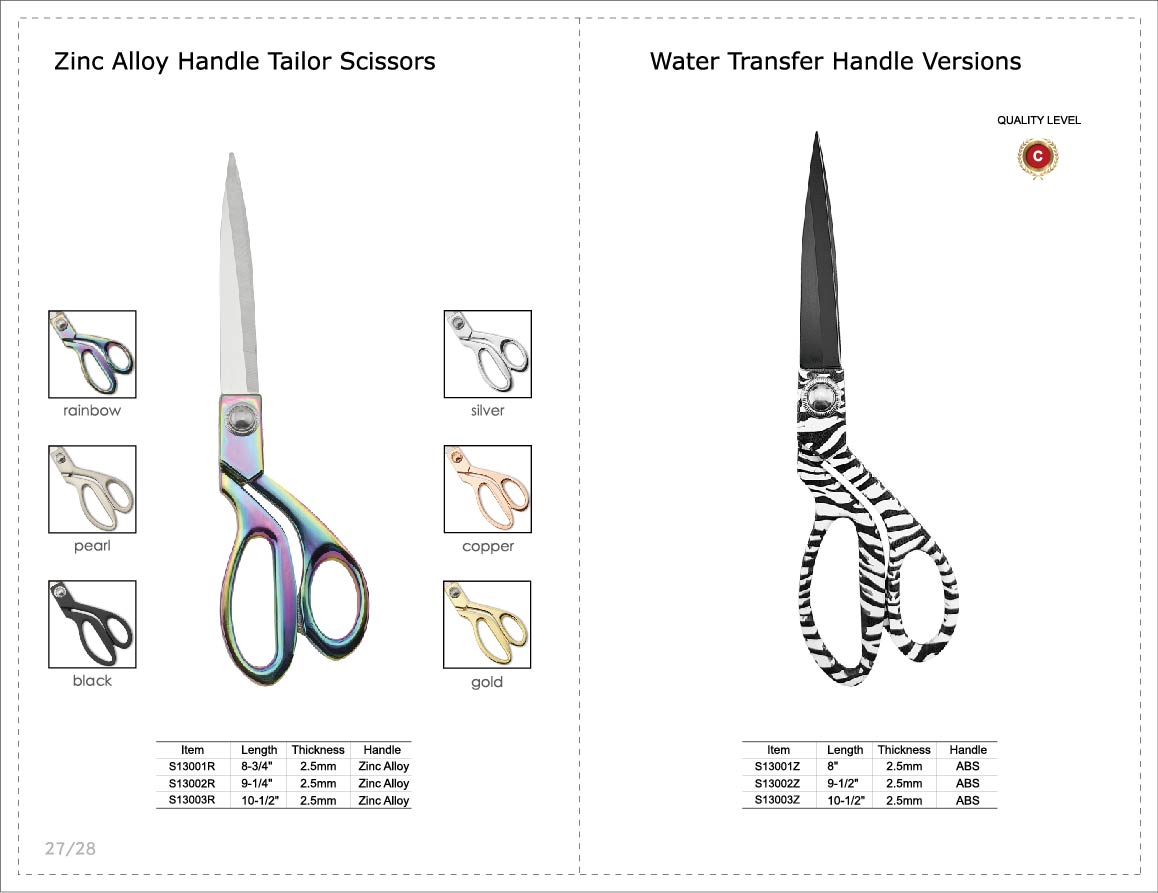
The original article highlights two handle directions. The first is a zinc alloy handle tailor scissors option, available in finishes listed as Rainbow, Silver, Copper, Pearl and Black. The stated sizes are 8-3/4 inch, 9-1/4 inch and 10-1/2 inch. These sizes can serve different cutting preferences, from general sewing room use to longer cuts on fabric panels.
The second option is a water transfer handle version with a Zebra pattern and ABS handles. The stated sizes are 8 inch, 9-1/2 inch and 10-1/2 inch. Water transfer decoration is commonly used to apply patterns to a surface, but buyers should request samples to review pattern alignment, surface feel and appearance after normal handling.
Comparison Checklist for Sourcing Cloth Scissors
| Item to Compare | Zinc Alloy Handle Tailor Scissors | Water Transfer ABS Handle Version | Buyer Questions |
|---|---|---|---|
| Handle information from source | Zinc alloy handle | ABS handle with Zebra pattern | Can the supplier confirm material, finish and sample appearance? |
| Listed sizes | 8-3/4 inch, 9-1/4 inch, 10-1/2 inch | 8 inch, 9-1/2 inch, 10-1/2 inch | Which size sells best for your customer segment? |
| Visual options | Rainbow, Silver, Copper, Pearl, Black | Zebra pattern | Are colors and patterns consistent across production batches? |
| Best-fit buying scenario | Retail, tailoring tools, giftable sewing products | Craft, design-led retail, school or hobby channels | Does the design match your brand positioning? |
| Custom order checks | Ask about logo, packaging and finish options | Ask about pattern, artwork and packaging options | What are the MOQ, lead time and approval process? |
How to Choose Sizes for Different Fabric Cutting Needs
Size selection should be based on use case rather than appearance alone. Shorter scissors are easier to control for small projects, curved pieces and users with smaller hands. Mid-size scissors are suitable for general sewing work and may be the safest choice for mixed retail assortments. Longer scissors can help experienced users make longer, cleaner strokes when cutting larger fabric pieces, but they may feel heavy or awkward for beginners.
If your business serves several customer types, consider building an assortment instead of relying on one size. For example, an 8 inch or 8-3/4 inch model may suit craft and household sewing, while 9-1/2 inch to 10-1/2 inch options may appeal to tailoring, dressmaking and studio environments. Always test samples with the type of fabric your customers commonly use.
Customization and OEM Questions to Ask
The original article refers to custom cloth scissors and wholesale supply, but buyers should confirm details before making commercial plans. Customization can mean many different things, including handle color, printed logo, retail card, gift box, barcode label, carton mark or full private-label packaging. Not every factory offers every option for every model.
- Which parts of the scissors can be customized?
- What artwork format is required for logos or packaging?
- Is there a pre-production sample approval step?
- What is the MOQ for standard stock and for customized orders?
- How are color differences handled between sample and bulk production?
- What packaging options are available for wholesale, retail and e-commerce?
- Can the supplier provide product photos, dimensions and carton information for your listing needs?
Quality Checks Before a Wholesale Order
Before ordering in quantity, request samples from the cloth scissors supplier and create a simple inspection checklist. Check cutting performance on lightweight cotton, denim scraps or the fabric types relevant to your market. Open and close the scissors repeatedly to feel the pivot action. Inspect the handle finish for rough edges, visible defects or inconsistent color. For decorated handles, review whether the pattern is positioned acceptably and whether the surface feels comfortable in hand.
For B2B purchasing, it is also wise to ask how the supplier handles defects, replacement claims and batch traceability. If your sales channel requires compliance documents or specific testing, ask the factory directly and do not assume availability. Keep written records of agreed specifications, approved samples and packaging details.
Wholesale Buying Tips for Retailers and Distributors
Wholesale buyers should balance appearance, function and replenishment reliability. A dramatic finish may attract attention online or in store, but repeat customers will remember whether the scissors cut fabric smoothly and remain comfortable during use. If you sell through multiple channels, think about packaging durability for shipping, clear product naming and easy-to-understand size labels.
When comparing quotations, avoid choosing only by unit price. A lower price can become expensive if packaging is unsuitable, colors are inconsistent or the product does not match your customer expectations. Instead, compare samples, communication quality, customization clarity and the supplier’s willingness to answer technical and commercial questions.
Practical FAQ
What size cloth scissors should I buy for a mixed retail assortment?
A mixed assortment often benefits from both mid-size and longer options. Consider 8 inch to 9-1/2 inch scissors for general sewing and craft users, and 10-1/2 inch scissors for customers who prefer longer cutting strokes.
Can I request custom cloth scissors for my brand?
Possibly, but the available options depend on the factory and the specific model. Ask whether logo printing, handle finish, packaging, labels or carton marks can be customized, and request MOQ and sample requirements in writing.
Are zinc alloy handles or ABS handles better?
Neither is automatically better for every buyer. Zinc alloy handle models may suit buyers looking for a metallic handle appearance and the listed finish options. ABS handle versions may suit buyers interested in patterned decoration such as the Zebra water transfer design. Compare samples for comfort, weight and finish quality.
What should I confirm before placing a wholesale order?
Confirm size, handle material, finish, packaging, MOQ, lead time, payment terms, inspection standard, defect handling and any required compliance documents. Keep an approved sample as the reference for bulk production.
How can I avoid quality disputes with a cloth scissors factory?
Use clear written specifications, approve samples before production and define acceptable tolerances for appearance, packaging and performance. For larger orders, consider pre-shipment inspection based on your agreed checklist.
