




Custom Fabric Shear Manufacturing: Tyrannosaurus Scissors
 Contact: Jenny Zhang, BONET HOUSEWARE CO.,LTD. Email: jenny@bonetcn.com
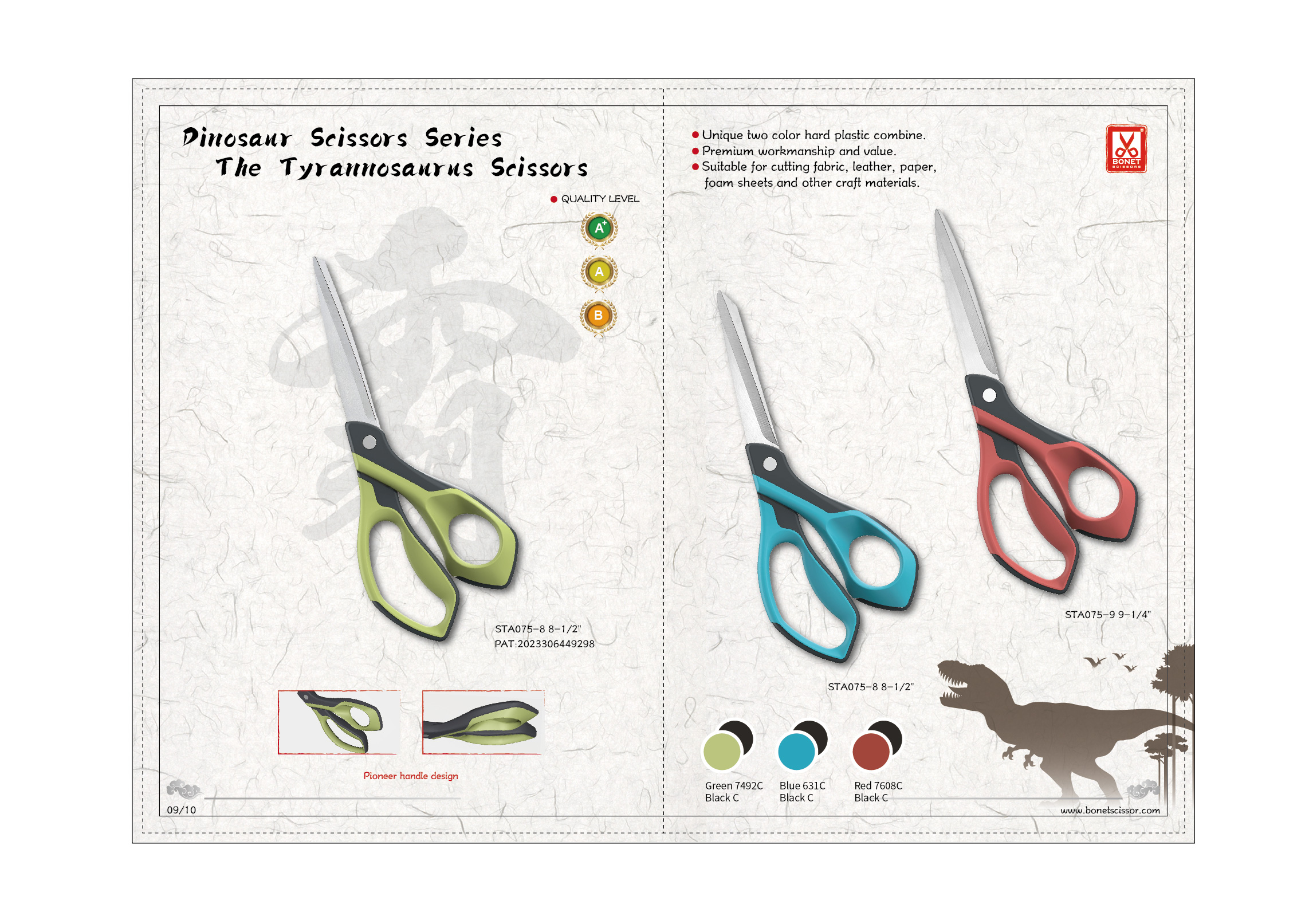

For garment workshops, craft brands, sewing-kit distributors and private-label buyers, fabric shears are not a generic accessory. A poor cutting tool can slow production, fray material and create inconsistent results. The Tyrannosaurus Scissors series is presented as a fabric shear option for customers who need a distinctive handle design and practical cutting performance for common workshop materials. This guide rewrites the product introduction as a sourcing-focused article, helping buyers evaluate whether this style of custom fabric shear fits their line, market and quality expectations.
Key Takeaways
- The Tyrannosaurus Scissors series features a two-color hard plastic handle design mentioned in the original product information.
- Available color combinations include Green 7492C, Blue 631C and Red 7608C, each paired with Black C.
- The original article lists 8 1/2-inch and 9 1/4-inch length options.
- Buyers should verify blade material, packaging, MOQ, testing process, logo options and delivery terms directly with the supplier.
What Makes the Tyrannosaurus Scissors Series Different?
The Tyrannosaurus Scissors concept is built around a bold visual identity. Instead of a plain single-color handle, the source information describes a pioneering two-color hard plastic handle. The listed combinations are Green 7492C with Black C, Blue 631C with Black C and Red 7608C with Black C. For distributors and retail brands, this matters because color can help separate a product line from standard tailor scissors on the shelf or in online listings.
However, appearance should not be the only sourcing factor. A fabric shear also needs appropriate hand comfort, stable cutting control and consistent production quality. The original article states that the handle is designed for ergonomic grip and reduced hand fatigue. Because comfort can vary by hand size and cutting habits, B2B buyers should request samples and test them with the actual users: tailors, sewing teachers, craft packers or textile workers.
Size Options and Intended Cutting Tasks
The source article lists two lengths: 8 1/2 inches and 9 1/4 inches. These are practical sizes for many textile and craft applications. A shorter shear is often easier to control for curves, trimming and smaller workpieces. A longer shear can be preferred for straighter cuts, pattern cutting and larger fabric sections. The original information also mentions use on fabric, leather, paper and foam sheets. Before marketing one model across all these uses, buyers should confirm the maximum material thickness and suitable use cases with the supplier.
For wholesale programs, it may be sensible to offer both sizes rather than choosing one. A sewing enthusiast, craft classroom and garment sample room may all have different expectations. If you are building an OEM assortment, ask whether the supplier can keep the same handle color system across different lengths so the range looks consistent.
Comparison Checklist for B2B Buyers
| Evaluation Point | What the Source Says | Questions to Ask Before Ordering |
|---|---|---|
| Handle design | Two-color hard plastic handle | Can the handle color be customized? Are Pantone references accepted for OEM orders? |
| Listed colors | Green 7492C, Blue 631C and Red 7608C with Black C | Are these colors always available, and is there any color tolerance standard? |
| Lengths | 8 1/2 inch and 9 1/4 inch | Are both sizes available for sampling and bulk production? |
| Cutting applications | Fabric, leather, paper and foam sheets are mentioned | What thickness and material types are recommended or excluded? |
| Quality reference | The original article mentions quality levels A and A | What does this grading mean, and can inspection criteria be shared in writing? |
| Private label | Not specified in the source | Can logo, barcode, hang card, blister card or carton marks be customized? |
How to Assess Cutting Quality Without Guesswork
When sourcing fabric shears, sample testing should be practical and repeatable. Do not rely only on photographs or short product descriptions. Ask for production samples in each length and color you plan to buy. Test them on the materials your customers actually use, such as cotton fabric, denim scraps, felt, craft paper or foam sheets if those are part of your market.
- Check whether the blades close smoothly from pivot to tip.
- Cut a straight line through single-layer and folded fabric.
- Inspect whether the cut edge is clean or crushed.
- Use the shears for several minutes to judge handle comfort.
- Compare multiple samples to see if the performance is consistent.
- Record any looseness, uneven finish, burrs or packaging damage.
If the supplier provides an internal inspection method, request the details. For example, ask what is checked before shipment, how many units are inspected and what defects are considered acceptable or unacceptable. Avoid assuming a product claim is equivalent to a formal certification unless documentation is provided.
OEM and Wholesale Sourcing Questions
Because this topic concerns custom fabric shear manufacturing, commercial clarity is important. The original article does not provide MOQ, price, lead time, blade material, packaging formats or compliance documents. A responsible buyer should treat those as open questions rather than assumptions.
Before placing a trial order, ask the supplier the following: What blade material is used? What handle material specification is available? Is logo printing, laser marking or custom packaging possible? What is the minimum order quantity for standard colors and for custom colors? How are pre-production samples approved? What is the lead time after artwork confirmation? Which payment terms, carton details and shipping options are available? Are any market-specific compliance documents needed for your destination country?
These questions protect both sides. The buyer receives a clearer quotation, while the supplier can recommend realistic options based on production capability and order volume.
Positioning the Product for Your Market
The Tyrannosaurus Scissors series may fit several channels: sewing tool distributors, craft retailers, school supply bundles, promotional tool kits, online marketplaces and private-label tailoring accessories. The visual handle design is helpful for listings because the product can be recognized quickly in images. Still, the strongest positioning should combine appearance with verified usability.
For a professional tailoring audience, emphasize size, grip comfort and cutting control only after sample tests confirm performance. For craft and hobby markets, explain suitable materials clearly and avoid overstating heavy-duty capability unless the supplier confirms it. For private-label programs, keep packaging claims simple, accurate and aligned with the tested product.
FAQ: Sourcing Tyrannosaurus Fabric Shears
Are Tyrannosaurus Scissors suitable for professional tailoring?
They are presented as fabric shears for tailoring and craft use, with 8 1/2-inch and 9 1/4-inch options. Professional buyers should test samples on their own fabrics before bulk purchasing.
Can the handle colors be customized?
The source lists Green 7492C, Blue 631C and Red 7608C with Black C. Custom color availability, color tolerance and MOQ should be confirmed with the supplier.
What materials can these shears cut?
The original article mentions fabric, leather, paper and foam sheets. Buyers should ask for recommended material thickness and limitations before making product claims.
What should I confirm for an OEM order?
Confirm blade material, handle specification, logo method, packaging, MOQ, sample approval process, lead time, inspection standard and shipping terms.
Does the article confirm certifications or test results?
No specific third-party certification or test report is provided in the source. If your market requires documentation, request it directly from the supplier before ordering.
Final Sourcing Advice
The Tyrannosaurus Scissors series offers a recognizable two-color handle design and practical listed size options for fabric shear buyers. For organic search users looking for custom fabric shear manufacturing, the most useful next step is not simply choosing a color; it is building a clear sourcing checklist. Request samples, test real materials, verify specifications in writing and align packaging claims with confirmed performance. That process will help you decide whether this fabric shear series is the right match for your wholesale, OEM or retail program.
