




Quick answer: A reliable custom kitchen gadgets manufacturer should do more than turn a drawing into an attractive sample. The manufacturer and buyer need to define the user task, identify every critical component interface, prove that the chosen materials and mechanisms work together, and create measurable acceptance criteria before tooling, production, and reorders. For peelers, choppers, sharpeners, slicers, and combination utensils, product failures frequently begin at the connection between two parts—not in the product's overall appearance.
For kitchenware importers, private-label brands, retail product developers, and sourcing managers, this means treating a new gadget as a small engineered system. Blade-to-frame alignment, handle-to-body fit, container-to-cutter engagement, hinge movement, disassembly access, and packaging protection all need decisions that survive the jump from prototype to repeated production. A clear project file can reduce ambiguity in quotations and prevent attractive prototypes from becoming difficult-to-manufacture commercial orders.
BONET HOUSEWARE CO., LTD., a Yangjiang-based kitchenware supplier, describes OEM and ODM services covering production from drawings or samples, structural optimization, material advice, samples, branding, packaging, quality inspection, and export delivery coordination. The company also publishes real examples of multifunctional kitchen tools. These references are useful starting points, but the availability of a particular new mechanism, mold, color, output volume, certification, or production schedule must be confirmed for each project.
What Makes a Custom Kitchen Gadget Different From a Standard Wholesale Tool?
A standard wholesale tool is normally bought against an existing model and its approved specification. A custom tool changes something that must be engineered, verified, or controlled: a blade angle, a grip profile, a locking feature, an insert, the relationship between a cutter and container, a material combination, or even a new cleaning and storage mechanism. A logo or color change can be a legitimate customization request, but it rarely carries the same engineering risk as changing functional geometry.
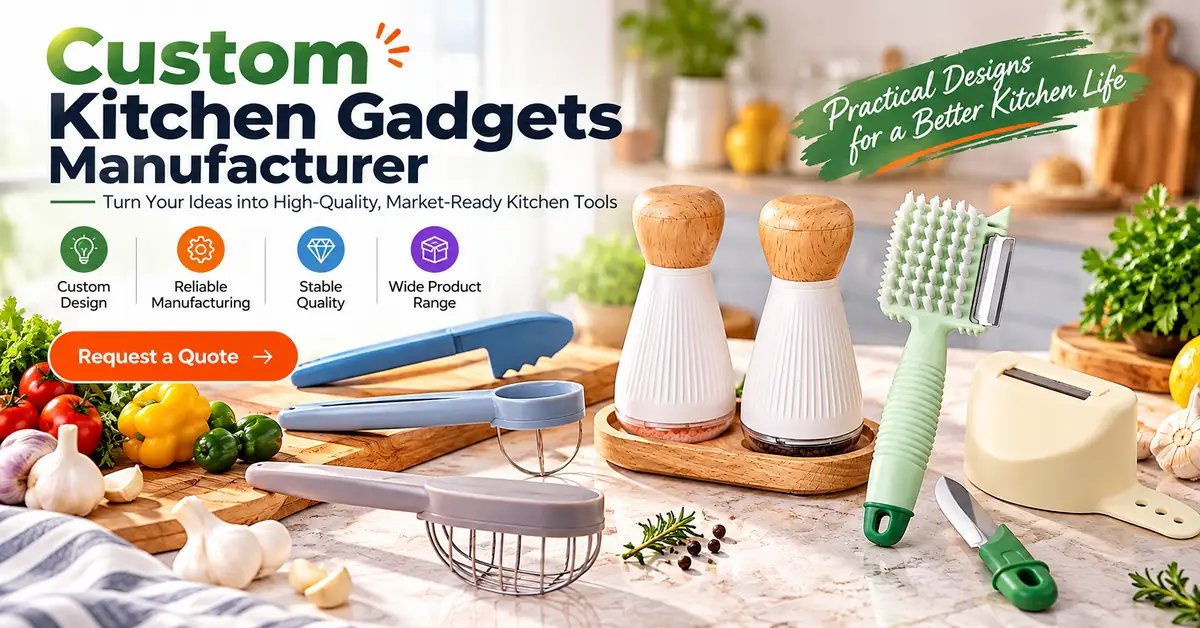
A custom kitchen gadgets manufacturer may support different routes. In an OEM project, the buyer provides a sufficiently defined drawing, sample, or specification and asks for controlled reproduction. In an ODM project, the buyer may begin with a consumer problem, target cost, reference images, and functional objectives, while the supplier contributes concept and feasibility work. Private-label work adds branded presentation to an agreed product platform. These routes can overlap, but they should not be priced or approved as if the engineering scope were identical.
The practical distinction is between a surface decision and a functional decision . New retail artwork changes how a product is sold; a thinner blade carrier can change stiffness, assembly, safety, and tooling. Changing the color of an existing molded handle may require color matching and material checks; adding a detachable cover may introduce a new tolerance chain and a new retention test. A serious RFQ identifies which changes affect function, tooling, material, assembly, or inspection.
Which B2B buyers benefit most?
This guide is for product managers at kitchenware brands, importers building exclusive assortments, supermarket procurement teams commissioning differentiated tools, distributors replacing inconsistent legacy products, and e-commerce sellers moving from unbranded catalog items to controlled product specifications. It is also useful to sourcing agencies that manage design, supplier communication, inspection, and packaging on a client's behalf.
It is less appropriate for a buyer who only needs one unmodified stock unit, or for a project requiring a specialized certified appliance without the necessary technical scope and evidence. If the proposed product includes electrical systems, contact with unusual chemicals, or high-temperature applications, the verification program must expand beyond the manual-gadget examples in this article.
Why Component Interfaces Deserve Their Own Engineering Review
An interface is the point where components touch, move, transfer load, lock, seal, guide, or separate. Every interface can change how a gadget feels and works. A handle that is visually attractive may flex where a blade attaches. A chopper may cut effectively but trap food in the gap between a lid and a chamber. A slicer may operate smoothly with one vegetable size but jam when a dimension or alignment shifts. These are questions about the system, not just individual parts.
For useful design reviews, organize each interface around four questions: what motion or load should occur, what dimensional relationship controls it, what material or surface participates, and how will an inspector know it is acceptable? That final question is essential. A supplier cannot consistently inspect instructions such as "good fit" or "smooth action" unless both sides agree on a reference and an observable pass/fail method.
| Critical interface | Typical kitchen-gadget example | Failure to anticipate | Verification evidence to request |
|---|---|---|---|
| Blade to frame | Replaceable or fixed vegetable-peeler head | Misalignment, movement, uneven cutting | Drawing, blade seat check, functional sample |
| Grip to body | Molded handle attached to a working head | Looseness, uncomfortable force path, separation | Assembly method, retention or use test |
| Cutter to container | Potato cutter or food-preparation chamber | Jamming, poor seating, food trapped in corners | Assembly sample, guided-use trials, cleaning review |
| Moving joint | Combination tongs or folding utensil | Excess friction, instability, inconsistent return | Defined operating sequence, repeated-use check |
| Cover to product | Sharpener sleeve or protective cap | Loose closure, accidental removal, abrasion | Fit test, packed-unit review, repeat sample |
| Tool to packaging | Box insert, hanger, sleeve or carton | Scratches, blade exposure, excess freight volume | Packed sample, drop/handling plan where appropriate |
A useful cross-functional meeting includes product development, sourcing, quality, packaging, and the manufacturing contact. Each person sees a different consequence of the same interface. Engineering may focus on tolerance; quality on inspection; branding on visible seams; logistics on transit damage; and retail on whether the customer can use and clean the gadget without confusion.
Five Published BONET Models as Engineering Reference Points
BONET's multifunctional kitchen-tool selection illustrates how varied a custom-development discussion can be. The following values come from the company's public product listings. They are published references , not test results or guarantees of availability for a newly designed variant.
| Published reference | Listed dimensions / weight | Listed materials | Functional system to investigate |
|---|---|---|---|
| M054 3-in-1 Vegetable Peeler | L: 18 × 10.8 × 2.5 cm, 32.6 g; M: 15.1 × 9.2 × 2 cm, 23 g; S: 13 × 6 × 2 cm, 16.5 g | 420 stainless steel; PP | Blade placement, three task modes, handle control |
| M028 Lazy Garlic Pounder | 10 × 9.5 cm | 420 stainless steel; ABS | Lid/chamber fit, operating motion, blade access |
| M031 Dual-Stage Knife Sharpener | 12.3 × 5 × 6 cm; 108 g | 420 stainless steel; PP | Slot alignment, housing stability, sharpening insert identification |
| M047 Multi-Functional Potato Cutter | 15.9 × 11.7 × 11.5 cm; 314.6 g | 420 stainless steel; PP + TPR | Cutter/grid to frame, guide alignment, removable components |
| U103 2-in-1 Spatula Tongs | 27.5 × 8 × 4 cm | 420 stainless steel; product data lists nylon | Joint travel, utensil-head geometry, material verification |
Material verification note: The U103 product narrative describes silicone in places, while its published specification field lists nylon. Do not assume one wording is authoritative for a purchase order. Request a component-level bill of materials and approved sample before claiming a particular head material, temperature capability, or cookware compatibility. Similarly, a published steel designation alone does not establish blade hardness, corrosion resistance, or service life.
These examples are intentionally diverse. They help procurement teams understand why one universal gadget inspection checklist is insufficient. An M054-type peeler asks whether individual cutting modes function as intended; an M028-type chopping tool introduces enclosure and cleaning questions; an M031-type sharpener introduces slot and blade-use limitations; an M047-type cutter adds multi-part alignment; and a U103-type hybrid utensil combines movement and material compatibility.
Start With the Consumer Job, Then Define Engineering Requirements
A custom kitchen gadget should solve a specific everyday problem. "More innovative" is not a testable requirement. "Peel carrots and potatoes with comfortable control" is more useful, but still incomplete. The buyer should specify the intended food types, user groups, preparation method, size limits, cleaning expectations, expected storage conditions, and the commercial claim the brand plans to make.
Translate the brief into critical-to-quality (CTQ) characteristics . For a manual cutter, CTQs might include alignment of the cutting insert, stability of the base, ease of assembly, cut consistency within a defined reference task, cleaning access, and packaging protection. For a peeler, the focus may include blade seating, handle grip and operation across selected produce. For a sharpener, a safe and correct assessment requires particular attention to knife types and manufacturer-approved instructions; do not assume every knife or edge geometry is compatible.
A procurement brief should also record what the gadget is not intended to do. For instance, a compact household tool should not automatically be presented as a professional restaurant instrument. A vegetable-cutting feature should not be advertised as suitable for frozen food or hard bones without designed capability and testing. Exclusion statements protect both the supplier and the brand from unverified claims.
Example of a testable requirement
Weak: "A premium garlic chopper with smooth performance and easy cleaning."
Better: "An enclosed manual garlic-preparation tool intended for peeled garlic cloves; operators must be able to assemble and remove approved components using the supplied instructions, carry out the agreed reference task, and access designated food-contact areas for cleaning; acceptance will follow a recorded sample protocol."
The second brief does not pretend to know a numerical pass threshold in advance. It defines what must be tested and leaves the numerical or visual acceptance limit to approval after engineering review. That is more useful than promising arbitrary percentages of time savings without measured evidence.
Build a Function-to-Interface Risk Map Before Prototyping
A custom kitchen gadgets manufacturer should be able to discuss potential failure modes at the interface level. A practical risk map has six fields: user action, involved components, intended outcome, potential failure, consequence, and proposed verification. A formal FMEA process can deepen the analysis where appropriate, but even a simple cross-functional table improves early communication.
| User action | Interface under load | Possible failure | Buyer / supplier action |
|---|---|---|---|
| Pull a peeler along produce | Blade carrier to handle | Head shifts or catches | Agree on blade-seat design and use-case test |
| Operate a chopper | Lid to chamber and internal mechanism | Food traps, uneven motion | Review accessible geometry and cleaning instructions |
| Insert and move a knife | Blade to sharpener slot | Wrong angle or unsuitable blade | Define compatible knives and safe-use instructions |
| Press food through cutter | Grid to frame and food guide | Misalignment or excess force | Inspect alignment and representative produce trial |
| Open/close tongs | Pivot and opposing arms | Pinch point or uncontrolled movement | Review clearance, travel and repeat-operation sample |
| Repack for retail | Gadget to insert / box | Scratches or loose parts | Approve packed sample and shipment protection |
A risk map is not a certification and does not prove that the product passed any test. Its value is identifying decisions while they are still relatively inexpensive to change. For example, moving a blade seat early in a concept model is usually a different commercial decision from revising a finished production mold. Both may be possible, but the latter can carry additional timing, cost and sample consequences.
Design for Manufacturing: Geometry, Draft, Wall Sections and Tolerance Chains
Once the functional brief is stable, a factory-feasibility conversation can begin. For injection-molded plastic parts, the team should review likely molding direction, draft, wall transitions, ribs, weld lines, gates, ejector effects, surface finish and assembly constraints. For stamped or formed metal parts, the review may focus on profile, forming sequence, edge condition, post-processing and repeatability. These are engineering considerations to evaluate for the proposed product, not a claim that every BONET model uses every process .
Critical dimensions often sit across more than one part. Imagine a blade insert held by a molded carrier inside a sliding cover. Even if each part meets its individual dimensional tolerance, the combined tolerance stack could create excessive play or interference. Therefore a drawing should identify datum features, fit requirements, inspection locations, and which dimension controls the functional relationship. Avoid assigning an arbitrary tolerance such as ±0.1 mm to every feature without checking actual tooling and measurement capability.
Design teams should also discuss whether the component can be assembled reliably in the intended sequence. Can a sharp edge damage an adjacent plastic surface during assembly? Can a small insert be installed backward? Does a snap-fit require uncontrolled force? Can a replacement component be confused with a different size? This is where a design that looks elegant on screen begins to earn its manufacturing credibility.
A supplier review should end with a short action list: geometry approved, concerns requiring prototype work, requested material alternatives, tooling assumptions, dimensions requiring measurement trials, and questions about final inspection. A good DFM discussion reveals uncertainty rather than disguising it with confident-looking concept images.
Material Selection Means Evaluating Each Component, Not Just the Product Name
A kitchen gadget is rarely made from one material. A metal cutting insert, molded body, soft-touch section, fastener, transparent chamber, and packing insert can each have different performance and regulatory considerations. The material decision should therefore start with a component-level bill of materials (BOM) describing what touches food, what bears load, what moves, what is visible, and what the buyer intends to claim.
BONET's catalog includes product references listing 420 stainless steel alongside PP, ABS, PP+TPR or nylon, depending on the SKU. Those declarations help establish a conversation, but a stainless-steel grade does not state finished-edge properties, and a polymer acronym does not specify the resin formulation, colorant, additive package or suitability for a particular food-contact condition. If a buyer requests a different resin or a softer grip, ask how the substitution changes stiffness, dimensions, abrasion, cleaning, cost and production consistency.
| Component question | Why it matters | Evidence to request |
|---|---|---|
| What exactly is the component material? | General product descriptions can mix head, housing and grip terms | Component BOM and approved drawing |
| Is the part expected to contact food? | Intended contact changes documentation and cleaning questions | Intended-use statement and market-relevant evidence |
| Will the material flex, carry load or retain a blade? | Mechanical behavior affects connection design | Feasibility note, use test and sample |
| Does the surface receive a logo or coating? | Finish influences readability, adhesion and wear | Process proposal and marked sample |
| Is the material suitable for the claimed cleaning method? | Heat, chemicals and repeated cleaning may affect components | Approved care conditions and supporting tests |
| Could an alternative material alter the tooling? | Shrinkage, surface finish and process settings may change | Supplier impact assessment before approval |
A buyer should distinguish a development recommendation from approved product evidence. "Silicone might improve the grip" is a design hypothesis. "The released part uses approved silicone formulation X" requires a controlled specification and documentary support. For hybrid utensils in particular, clarify whether the working surface is silicone, nylon, another polymer or a combination before writing claims about heat resistance or non-stick cookware.
Prototype Progression: Separate Appearance, Function and Production Readiness
A first model answers whether the concept has potential, not whether production has been qualified. For new kitchen gadgets, it is helpful to distinguish appearance models , functional prototypes , engineering samples , and production-intent samples . Their materials and methods can differ, so a prototype that works beautifully in a demonstration should not automatically become the approved mass-production reference.
An appearance model can check silhouette, storage footprint and visual language. A functional prototype can test user movement, grip, cutting path and assembly logic. An engineering sample can address fit, critical dimensions and material or process alternatives. A production-intent sample should reflect the selected manufacturing route, actual intended components and relevant packaging. The labels and exact stages should be agreed with the supplier; they are recommended planning terms, not universal BONET milestones.
Every sample request should state the question being answered. For example, "Does the revised latch remain closed during normal storage?" is a clearer objective than "Please improve the prototype." The sample log should record revision, date, deviation from the previous version, parts changed, test method, observations, disposition, and whether the next action is to improve, freeze, or stop the design.
The difference between a concept pass and a release pass
Suppose a peeler prototype can shave carrots cleanly and feels comfortable in one person's hand. That may justify further development. It does not yet establish repeated-production variation, cleaning instructions, final pack fit, metal insert identification, or conformity with destination-market requirements. A release decision requires the appropriate evidence for the finished article and the agreed manufacturing process.
For buyers commissioning an original mechanism, sample ownership and tool ownership should be recorded independently. Receiving physical samples is not equivalent to owning the drawings, molds, CAD files or intellectual property. Conversely, a buyer-supplied drawing does not give the supplier permission to copy protected competitor designs. Clarify these matters commercially before investing in tooling.
Create a Verification Matrix That Covers the Full User Cycle
Custom kitchen gadgets manufacturer selection becomes more objective when the buyer requests a design verification matrix rather than a single video demonstration. The most useful sequence follows the product through receiving, unpacking, first assembly, use, cleaning, drying, storage and repeat operation. The sequence should reflect the product's real task and foreseeable user behavior.
| Verification stage | Possible test question | Suggested record |
|---|---|---|
| Incoming and identity | Are all specified components present and correctly labeled? | BOM-to-sample check |
| First assembly | Can the user install parts in the intended orientation? | Assembly observations and instructions |
| Intended task | Does the tool perform on agreed representative inputs? | Procedure, result photos and sample identification |
| Operational feel | Are force, control and grip acceptable for target users? | Agreed test method and observations |
| Cleaning access | Can designated contact surfaces be cleaned as instructed? | Cleaning and disassembly review |
| Repeat operation | Does movement or retention change over the agreed cycles? | Cycle count, outcome and deviation notes |
| Storage and packing | Are sharp components protected and parts retained? | Packed sample and handling review |
| Production variation | Do multiple units behave consistently within approved limits? | Lot and inspection records |
No universal cycle count or force limit applies to every hand tool. A peeler, slicer, sharpener and gripping utensil have different mechanisms and risks. Buyers should set an appropriate sample size and acceptance condition with the manufacturer and, when needed, a qualified testing partner. The goal is a repeatable comparison , not an invented claim that a product passed an unspecified "10,000-cycle test."
The test plan must also include negative-use boundaries. For a knife sharpener, the manufacturer should state which blade types and edge geometries are intended and which are excluded. Do not assume the same slot is suitable for all serrated knives, specialty blades or kitchen scissors. For cutters, specify food hardness, size and loading position; never market resistance to exceptional loads without evidence.
Turn DFM Findings Into a Production Process Map
A custom gadget involves decisions about manufacturing sequence, components, assembly, inspection and packing. For planning, the process map can follow component sourcing or fabrication → incoming checks → finishing → assembly → functional inspection → cleaning where relevant → packing → shipment release . The exact route depends on the product; BONET's OEM/ODM page describes manufacturing and quality support but does not provide a complete process route for every individual model.
Ask the supplier which operations are performed in-house, which are subcontracted, and who controls the results. A kitchen-gadget program can include separately sourced metal pieces, molded bodies and printed retail packs. The buyer need not require every component to come from one facility, but should require clarity about responsibility for specifications, traceability, nonconformities, and change approval.
For interfaces identified as critical, the process map should mark where fit is checked. For instance, an insert should not be approved solely after assembly if dimensional verification is needed before it becomes inaccessible. A snap or moving joint may need a first-off functional check and a later lot-based inspection. A pack containing multiple attachments may need a contents check separate from appearance inspection.
First-article and in-process checkpoints
A first-article review verifies whether early production matches the approved files. In-process checks look for drift. Pre-shipment review looks at the finished goods and packaging. These checkpoints answer different questions and should not be treated as interchangeable. A clear inspection plan identifies who samples, what the measuring method is, what evidence is kept, and what happens when a result is outside the agreed limit.
If an inspector finds an issue, record whether the action is segregation, rework, replacement, concession, or a new engineering revision. Do not quietly treat a one-time accepted exception as the normal specification on the next purchase order.
A Manufacturing Comparison: Five Products, Five Different Risk Profiles
The table below uses existing models as illustrations of engineering priorities . It does not imply that BONET performed the hypothetical tests, or that each proposed design change is commercially available today.
| Reference model | Engineering focus in a custom variant | Risk if changed without review | Useful buyer question |
|---|---|---|---|
| M054 peeler | Blade carrier, ergonomic reach, three functional modes | New angle changes cutting feel or task behavior | Which functions will be revalidated after a handle redesign? |
| M028 garlic tool | Lid, chamber, internal working mechanism | Misfit or difficult cleaning | How will chamber fit and removal be checked? |
| M031 sharpener | Slot geometry, housing, protective features | Incorrect knife presentation or unstable use | Which knives and motions are intended, and what is excluded? |
| M047 potato cutter | Cutting grid, food guide, container seat | Binding, poor alignment or trapped residues | Which interfaces require drawings and first-article checks? |
| U103 combination tongs | Pivot travel, working head and material identity | Unreliable movement or unsupported heat claims | Which material is approved for the head, and how is motion verified? |
When buyers discuss multiple tools with one supplier, each should have an independent specification and sample decision. Sharing a color palette or retail branding system does not make their technical verification identical. This is why a manufacturer's component-engineering capability may be more valuable than a generic catalog count.
Quality Control and Food-Contact Documentation Without Unsupported Claims
A custom kitchen gadgets manufacturer and its customer should agree which component claims require evidence before artwork is approved. For tools used during food preparation, material and product claims should be supported by documents appropriate to the destination market, actual formulation and intended use. For the European Union, relevant frameworks include Regulation (EC) No 1935/2004 on food-contact materials and, for applicable plastic food-contact materials, Regulation (EU) No 10/2011 as amended. For the United States, relevant requirements depend on the substances, finished article and intended contact conditions under the FDA food-contact framework. These are buyer due-diligence references , not statements that any listed BONET model holds a specific certificate.
Ask whether the offered evidence identifies the tested article, material, colorant where relevant, conditions, laboratory, and date. A raw-resin document may help establish traceability but does not automatically prove every finished product or color is compliant. A test report for one tool should not be assumed to cover another model with a different surface, polymer, coating, blade insert or adhesive.
Other claims need similar care. "Dishwasher safe" requires an appropriate product-specific basis. "Heat resistant" must name conditions, component and evidence. "BPA-free" should be traceable to the material or finished article and the applicable claim context. "Rust proof," "unbreakable," or "100% safe" are not suitable substitutes for measurable criteria. Where a reference product description and a specification field disagree, resolve the conflict before marketing or ordering.
Quality sampling standards, including ISO 2859-1 when selected and properly applied, can help parties define acceptance sampling plans; however, a named AQL alone does not describe the full inspection. A professional plan identifies defect classes, chosen inspection levels, batch definition, acceptance numbers and critical functional checks. The final criteria should reflect the specific gadget and commercial agreement.
Tooling, Unit Cost and Engineering Change: What Drives a Custom Quote?
Buyers often ask a custom kitchen gadgets manufacturer for a price before the product definition is stable. A useful preliminary range is possible in some projects, but a reliable manufacturing quotation should state the assumptions on which it depends. An unpriced mechanism, unspecified resin, undefined tolerance or unapproved retail package can change cost significantly after the initial conversation.
Separate non-recurring costs from recurring costs. Non-recurring items may include engineering work, prototypes, dedicated tooling, fixtures, development samples and test setup. Recurring costs may include component materials, manufacturing, assembly, inspection, logo application, unit packing, master cartons and transportation-related charges under the agreed trade term. Ask who owns any paid tooling, how maintenance works, and whether future design changes create new charges.
| Quotation element | Clarify before comparison | Typical risk if omitted |
|---|---|---|
| Product revision and features | Identified drawing, mechanisms, accessories | Different suppliers quote different products |
| Material / components | Approved component BOM and substitutions policy | Unplanned cost or performance change |
| Tooling and fixtures | Scope, ownership, payment and modification process | Hidden one-time charges |
| Testing and inspection | Included work, responsibilities and reports | Late discovery of documentation gaps |
| Branding / packaging | Artworks, labeling, inserts, carton quantities | Price excludes retail-ready delivery |
| Quantity and schedule | Pilot and production quantities, MOQ per version | Unrealistic cost and lead-time comparison |
| Trade basis | Currency, Incoterms rule and named place | Costs or delivery risks are double counted |
A cheaper product price does not necessarily mean a cheaper finished, sellable SKU. For multi-component tools, assembly time, rejected parts, packaging complexity and after-sales complaints can overwhelm a small quoted difference. The procurement decision should consider the value of a stable, inspectable design rather than focus entirely on the lowest unit price.
MOQ, capacity and lead time are project-specific
BONET describes OEM/ODM quoting and quantity confirmation, but its public service page does not establish one universal MOQ, production capacity figure, prototype duration or lead time for every new gadget. Those values depend on the approved model, development scope, tooling, color, packaging, component sourcing and order size. Request a schedule with separate dates for concept review, prototype, tooling (if required), production-intent sample, release, production and shipping.
A schedule should also show dependencies: artwork cannot be released before the correct product revision is known; mass production should not begin merely because a concept sample looks good; a document request may need time for a competent laboratory or market specialist. A well-managed quote says what is confirmed and what remains conditional.
Engineering Change Control: Protect the Next Production Run
The first production approval is not the end of the engineering job. A mold repair, supplier substitution, different colorant, revised blade geometry, packaging adjustment or assembly-method change can all affect what customers receive. Engineering change control means documenting proposed changes, evaluating consequences and releasing a defined version to production only after the appropriate approvals.
For a lean B2B project, the change log can use fields such as SKU, drawing revision, component affected, reason for change, risk assessment, new sample ID, test needed, approval owner, effective purchase order, and inventory disposition. The supplier and buyer should know whether the old and new versions may be mixed within one order. This prevents an earlier sample from silently becoming irrelevant.
In a color update, for instance, the buyer may think only the visual palette has changed. Yet a new material formulation could require checks for shade, fit, processing behavior or market evidence. In a blade change, the team may need to revisit functional behavior, assembly protection, labeling and instructions. A change notice is useful precisely because it links several decisions that might otherwise sit in different email threads.
What a Buyer Should Include in a Custom Gadget RFQ
A high-quality request for quotation makes it easier for a custom kitchen gadgets manufacturer such as BONET to assess the project honestly. Include the consumer task, target audience, design reference, functional requirements, proposed materials, critical component interfaces, target markets, packaging, preliminary quantity and required evidence . If the design is unfinished, explicitly request feasibility and prototyping rather than treating the first price as a firm production offer.
For a supplier discussion, prepare the following RFQ fields in one document:
- Project identity: company, contact person, proposed product name, destination countries and channel (supermarket, online, specialty retail, hospitality).
- Reference route: existing BONET model, buyer-owned drawing or sample, or a new concept needing ODM development.
- User task: what the gadget must do, reference foods or utensils, excluded uses and expected cleaning and storage behavior.
- Component requirements: blade or working part, body and grip, moving interface, detachable features, critical dimensions and assembly method.
- Materials and claims: desired materials, approved substitutions, intended food-contact conditions, target labels and documentation needs.
- Branding and presentation: logo files, colors, artwork, pack dimensions, barcode, instructions and case-pack requirements.
- Volumes and timing: sample quantity, expected pilot, proposed first order, reorder assumptions and target launch window.
- Commercial quotation: development scope, tooling, MOQ per version, unit prices, inspection, Incoterms and named location, validity and exclusions.
- Approval and quality: sample stages, CTQ matrix, acceptance method, change notifications and production release authority.
- IP and repeat orders: ownership of designs and tools, confidentiality arrangement, drawing and artwork revision control, effective PO version.
Ask for the supplier's response in three columns: already available , requires feasibility or new development , and cannot be confirmed yet . This is often more valuable than receiving a quick undifferentiated quote. If several models are in scope, provide one page per SKU rather than mixing requirements from a peeler, a cutter and a sharpener into a single specification.
BONET invites OEM/ODM inquiries through its contact page . Buyers can also review the company's existing kitchenware products to select references before the engineering conversation.
Common Development Mistakes—and How to Prevent Them
Treating a rendering as an approved specification. A good-looking concept image lacks process limits, material identity and acceptance criteria. Ask for revision-controlled drawings and a physical or production-intent sample as appropriate.
Changing the handle without rechecking function. A new grip can alter user force, blade presentation and adjacent-part geometry. Revalidate the original user task after an ergonomic change.
Assuming one material description covers every component. A plastic body can contain a metal blade, a soft grip and an additional coating or insert. Approve the BOM at the component level.
Overlooking cleaning and disassembly. Tight gaps, hidden chambers or removable parts can influence daily satisfaction and the truthfulness of care instructions. Include cleaning access in prototype reviews.
Comparing quotes with different development scopes. One supplier may quote a stock item with an updated box, while another quotes an original mold and new mechanism. Align deliverables, tooling assumptions and quantities first.
Skipping the pilot and change record. Real production may reveal variation not visible in a single sample. Record first-article evidence, any concessions and the final revision for the next order.
Frequently Asked Questions About Custom Kitchen Gadget Manufacturing
1. What does a custom kitchen gadgets manufacturer actually do?
A custom kitchen gadgets manufacturer helps turn a defined kitchen task and product brief into a manufacturable tool through design or feasibility review, component choices, sampling, production planning, inspection and packaging coordination. The exact responsibilities depend on the agreed OEM or ODM scope. Do not assume that every supplier owns every manufacturing process or provides an automatic certification package.
2. How is custom gadget manufacturing different from private labeling?
Private labeling usually applies a buyer's brand to an existing or approved product, while custom manufacturing may change geometry, components, function or materials. A private-label project can still require material, artwork and packaging approvals, but an original mechanism generally needs deeper engineering and verification work.
3. Can BONET develop a completely new vegetable peeler or slicer?
BONET's OEM/ODM page describes concept development, structural optimization, sampling, feasibility evaluation and production support. Whether a specific new peeler, slicer or cutting mechanism can be developed—and at what cost and schedule—must be confirmed from drawings, functional objectives, materials and project quantity.
4. Which published BONET models can be used as development references?
Its public catalog includes M054 3-in-1 Vegetable Peeler, M028 Lazy Garlic Pounder, M031 Dual-Stage Knife Sharpener, M047 Multi-Functional Potato Cutter and U103 2-in-1 Spatula Tongs. Each has different design interfaces and verification needs. Their published presence does not prove any requested custom variant has already been manufactured.
5. What information should I send before requesting tooling?
Provide drawings or concept sketches, the intended user task, target market, material and finish preferences, interface details, preliminary order estimates, packaging requirements, performance questions and ownership expectations. Ask for a DFM and feasibility response before authorizing a mold or fixture purchase.
6. How do I know whether a prototype is ready for mass production?
A prototype is ready for a production-release decision only when the agreed functional requirements, critical dimensions, materials, assembly method, packaging and relevant documentation have appropriate evidence and approvals. An attractive demonstration alone is not sufficient. The approval must identify the exact revision and any remaining limitations.
7. What is the MOQ for custom kitchen gadgets from BONET?
There is no verified single MOQ that applies to every custom gadget on the public OEM/ODM service page. MOQ may depend on whether the project uses an existing design, new tooling, a unique color, component sourcing or printed packaging. Request a separate minimum for each approved SKU and variation.
8. Are all custom kitchen gadgets food-contact certified or dishwasher safe?
Do not assume so. Suitability and claims depend on the finished components, intended use and destination market. Ask for product-specific supporting documentation, appropriate cleaning instructions and confirmation of which components are food-contact surfaces. A material grade name alone does not establish compliance.
9. Can I combine several custom kitchen gadgets in one wholesale order?
A combined purchase program may be possible, but each SKU should retain its own BOM, drawing, sample, inspection criteria and MOQ. Confirm with the supplier how minimum quantities, cartons, artwork, testing responsibilities and delivery dates are handled when multiple products or colors share an order.
10. How can I request a technical quotation from BONET HOUSEWARE?
Review BONET's multifunctional tool references , identify a starting model or attach a new concept, and send the user task, desired changes, quantity range, intended market and documentation needs through the BONET contact page . Request a response distinguishing stock capabilities, new development and open feasibility questions before comparing final prices.
Conclusion
A successful custom kitchen gadgets manufacturer partnership is measured by whether the approved tool can be built, inspected, packed and reordered consistently—not just whether its first prototype looks appealing. For manual kitchen gadgets with blades, moving parts, containers and detachable components, the highest-value work lies at the interfaces: where parts locate, move, carry force, retain food, separate for cleaning and fit into the final package.
Start from a specific consumer task, use published products as technical references, identify critical-to-quality features, map interface risks, review DFM and materials, progress samples against clear questions, agree on verification evidence, and release a controlled production file. Keep tooling, test scope, MOQ, lead time and market claims explicit rather than relying on broad sales promises.
BONET HOUSEWARE publishes relevant gadget references and describes OEM/ODM collaboration for material selection, structural optimization, design and sampling, quality checks and export packaging. To evaluate a custom project, explore BONET kitchenware products , review its OEM/ODM services , and contact the BONET team for a project-specific quotation with your drawing, target use, quantity, packaging brief and technical questions. The next step is not a generic price request; it is an informed engineering and commercial discussion built around your actual product.
