




Quick Answer
A successful custom kitchen utensil set starts with the cooking tasks and sales channel, not with the number of pieces or a packaging mockup. Buyers should define the target user, core tools, material combination, handle design, heat and cleaning conditions, logo method, package format, inspection criteria and reorder plan before requesting a quotation. A reliable supplier should identify what is standard, what requires tooling, which components share the same quality standard and how a mixed set will be packed and inspected. Review the BONET product catalog, shortlist suitable kitchenware formats, and send your set brief through Contact Us for an order-specific discussion.
Introduction: Why a Custom Kitchen Utensil Set Needs a Sourcing System
A kitchen utensil set looks simple on a retail page. A buyer sees a group of tools, a color theme and a package. A manufacturer sees several individual products with different materials, forming processes, edge conditions, handle interfaces, packing positions and inspection points. A distributor sees a product family that must fit a channel, a price architecture and a replenishment plan. These perspectives need to be aligned before production begins.
The phrase “custom kitchen utensil set” can describe many different projects. One buyer may want a basic cooking set for a supermarket private label. Another may need a coordinated collection for a cookware brand. A hospitality distributor may need a durable set for restaurants, hotel kitchens or catering operations. A gift company may need a compact set with an attractive box. An e-commerce brand may want a branded color, a clear product story and a package that survives parcel delivery.
Each project creates different sourcing questions:
- Which utensils are essential for the intended cooking tasks?
- Should the set use one material family or a combination of stainless steel, silicone, nylon, wood or polymer components?
- Does the handle need to withstand frequent washing, high heat or commercial use?
- How should the tools be stored: hanging, boxed, tray-packed or placed in a container?
- Is the logo required on every tool, on the handle, on a holder or only on the package?
- What evidence will the buyer need for material, function, packaging and final inspection?
- How should the supplier quote mixed colors, mixed components and repeat orders?
The best buying decision is not always the set with the most pieces. It is the set that solves a defined user problem, fits the channel's price and packaging requirements, and can be reproduced against a clear specification. This guide is written for kitchenware importers, private label brands, wholesalers, hospitality suppliers, gift-set buyers and product managers who need a professional OEM or ODM process.
What Is a Custom Kitchen Utensil Set?
A custom kitchen utensil set is a coordinated group of cooking or food-preparation tools produced to a buyer's agreed specification, branding program or packaging concept. Customization may involve the tool selection, handle shape, material, color, finish, logo, holder, package or complete assortment architecture. The buyer may start with standard models and customize the presentation, or may request a deeper product-development project.
The set should be treated as one commercial SKU even when it contains many individual components. That means the buyer needs one clear product identity, one approved assortment, one packaging logic and one quality plan. A set is not controlled simply because each tool is acceptable when inspected separately. The tools must also fit together, look consistent, pack correctly and tell a coherent product story.
Common set components include:
| Component group | Typical items | Buying questions |
|---|---|---|
| Cooking tools | Turner, spoon, ladle, whisk and tongs | Does the group cover the intended cooking tasks without unnecessary pieces? |
| Preparation tools | Peeler, grater, scraper and measuring tools | Are cutting edges, working surfaces and cleaning instructions appropriate? |
| Serving tools | Serving spoon, pasta server and salad tools | Does the set fit home, buffet or hospitality service? |
| Storage accessories | Crock, rail, stand or hanging loop | Is the storage solution stable, cleanable and suitable for the package? |
| Brand elements | Logo, color, handle detail and package | Is the brand visible without making the product difficult to use? |
The right composition depends on the user and the market. A compact apartment set may prioritize a few high-frequency tools. A gift set may prioritize visual completeness. A restaurant supply program may prioritize replaceable, durable and easy-to-clean tools. A cookware brand may want a set that complements its pans and appliances. The supplier should understand that context before suggesting an assortment.
Search Intent and Buyer Questions
The primary intent for this article is commercial investigation combined with RFQ intent. The buyer is not only asking what a kitchen utensil set is. The buyer is trying to decide whether a supplier can turn a product concept into a controlled, saleable and repeatable program.
Typical search and procurement questions include:
- How do I choose a custom kitchen utensil set manufacturer?
- Which materials are suitable for a private label cooking utensil set?
- How many pieces should a retail kitchen utensil set contain?
- Can the supplier customize handles, colors and logos?
- What is the difference between OEM and ODM kitchen utensil sets?
- How can I compare a factory quote with a trading-company quote?
- What should be checked in a production sample?
- How should a mixed set be packed and inspected?
- Which MOQ applies to the set, color, logo and packaging?
- What information should be included in a kitchen utensil set RFQ?
Answering these questions directly improves both buyer confidence and AI extractability. It also prevents the article from becoming a generic product introduction. A useful sourcing page should help a buyer make a decision, request evidence and take the next commercial step.
Who Buys Custom Kitchen Utensil Sets?
Private Label Kitchenware Brands
Private label brands usually need a recognizable set that can be positioned at a specific price tier. They may want a signature handle color, a consistent logo treatment and packaging that communicates the range. Their biggest risk is inconsistency between the first shipment and a later reorder. The specification should cover every component, not just the most visible tool.
Retail Importers and Distributors
Importers and distributors often manage several channels at once. They need to know whether the set is appropriate for supermarkets, department stores, independent kitchen shops, online marketplaces or hospitality customers. They also need carton information, barcode placement, package dimensions and a practical product claim that sales teams can explain.
Hospitality and Foodservice Suppliers
Hospitality buyers may value repeated use, cleaning practicality, storage and replacement availability more than decorative branding. Their set may need to be simplified, strengthened or packed in bulk. The supplier should ask about the operating environment rather than assume a household set will work for commercial use.
Cookware and Appliance Brands
A cookware or appliance brand may use utensils as an accessory range. In this case, the set must match the visual language of the core product. The handle, finish, logo scale and packaging should look intentional beside pans, ovens, induction products or countertop appliances.
Corporate Gift and Promotional Buyers
Promotional programs often have a fixed campaign date and a strong branding requirement. The buyer should clarify whether the set will be used as a premium gift, an event giveaway or a loyalty reward. That choice affects the number of tools, package quality, logo location, delivery milestones and approval process.
Start with the Use Case, Not the Piece Count
Piece count is easy to compare, but it is a weak starting point. A ten-piece set can be less useful than a six-piece set if several tools duplicate the same task or cannot be stored conveniently. Start by describing the cooking environment and the user journey.
For example:
“This set is for apartment cooks who need daily stovetop tools in a compact retail package. It should include the most frequently used cooking tools, provide a stable storage option, use a coordinated handle color and fit a mid-market private label price position.”
Or:
“This set is for restaurant and catering buyers who need easy-to-clean tools for repeated preparation and service. The assortment should avoid decorative pieces, use a robust material specification and support bulk packing with clear replacement identification.”
These statements allow a supplier to propose a useful product architecture. They also create a basis for testing. A household set can be evaluated for grip, storage and package appeal. A foodservice set should be evaluated for cleaning, handling, durability and operational efficiency. The buyer should not apply one test plan to every channel.
Set Architecture and Product Specification
The table below provides a practical specification framework for a custom kitchen utensil set.
| Specification area | Buyer should define | Supplier should confirm |
|---|---|---|
| Target user | Home cook, gift recipient, chef, restaurant or caterer | Suitability and use limitations |
| Set composition | Exact tools, quantity per tool and optional variants | Model references and component availability |
| Working surfaces | Spoon bowl, turner edge, whisk wires, tong tips or other contact areas | Material, forming process and functional consistency |
| Handles | Shape, length, color, grip, hanging feature and logo area | Material, assembly, comfort and marking feasibility |
| Temperature environment | Household cooking, commercial cooking or storage only | Recommended use wording and test assumptions |
| Cleaning | Hand wash, dishwasher discussion or commercial cleaning | Care instructions and surface limitations |
| Finish | Polished, satin, coated, colored, textured or natural | Process, color reference and visual acceptance |
| Storage | Holder, rail, box, tray, hanging or loose pack | Stability, dimensions and cleaning access |
| Packaging | Card, sleeve, box, tray, bag or gift presentation | Insert design, barcode, labels and carton packing |
| Branding | Logo location, artwork, colors and method | Print, laser, molded or package-only options |
| Inspection | Critical dimensions, appearance and function | Inspection stages and records |
| Commercials | Quantity by set, variant and destination | MOQ layers, tooling, setup and lead-time assumptions |
The specification should identify which details are fixed and which details are open for supplier recommendation. A buyer can state a desired color and ask the supplier to recommend the most stable process. A buyer can state a package size and ask whether an insert or a foldable handle solution is more practical. Collaboration is useful when the decision remains documented.
Material Selection for Custom Kitchen Utensils
Material selection should follow the intended contact, heat, cleaning and handling conditions. There is no single material that is best for every tool in every set. A coordinated assortment can use one material family for visual consistency, or a combination that gives each tool an appropriate function.
Stainless Steel Components
Stainless steel is commonly considered for tools that need a clean appearance, structural strength and resistance to routine kitchen exposure. Buyers should still confirm the exact material category, thickness, forming process, edge condition and surface finish. “Stainless steel” alone does not specify every performance property.
Silicone or Elastomer Details
Silicone or other flexible materials may be used for grip zones, scraper heads or heat-exposed working surfaces. The buyer should state the intended temperature environment and cleaning routine. Color consistency, bonding, edge finish and odor expectations should be evaluated on the actual sample.
Nylon or Engineering Polymer Parts
Polymer tools can be suitable for cookware surfaces where a softer contact is desired. The buyer should confirm the intended heat conditions, stiffness, deformation expectations and cleaning instructions. A polymer tool designed for household use should not automatically be presented as suitable for every commercial kitchen.
Wood or Natural Components
Wood can give a warm, premium or craft-oriented appearance. It also introduces questions about moisture, finish, grain variation, care instructions and package protection. If a wood component is included, the buyer should define the visual tolerance and the acceptable level of natural variation.
Mixed-Material Sets
Mixed-material sets can offer functional advantages but require stronger coordination. The handle color, texture, logo placement and packaging should make the set look like one family. The buyer should ask how different materials will be inspected and whether the same care instructions apply to every component.
Handle Design, Ergonomics and Brand Recognition
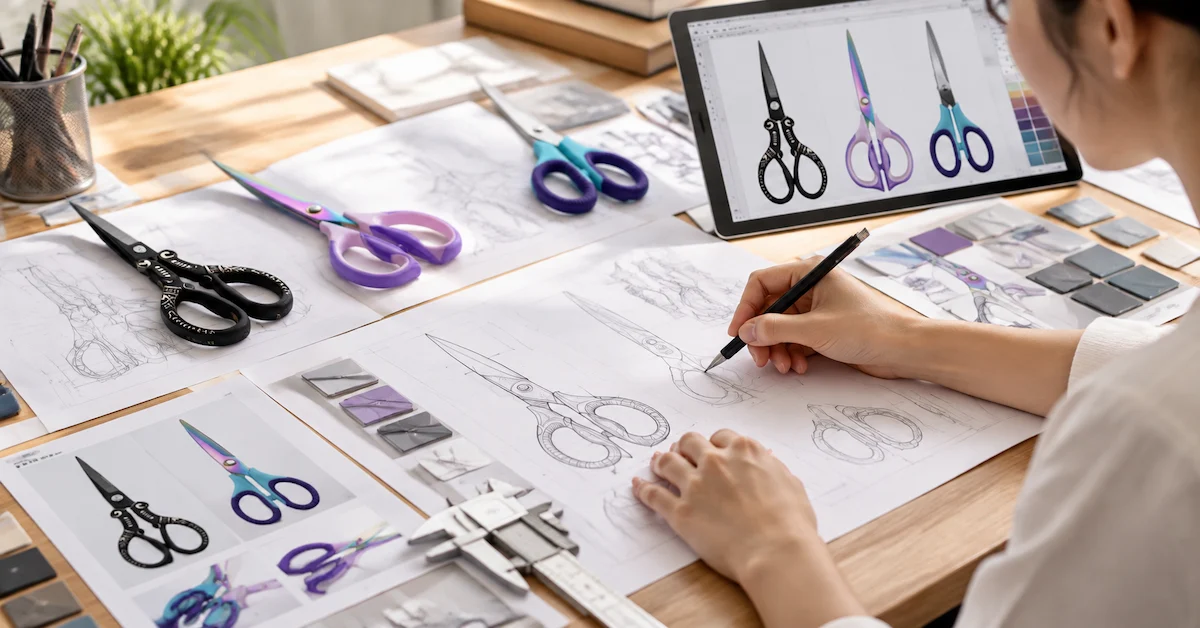
The handle is where usability and branding meet. A handle must fit the hand, provide control and survive the intended environment. It also offers a visible surface for a logo or color identity. A design that is attractive in a rendering may feel too narrow, too slippery or unbalanced when held.
Evaluate the following:
- Finger clearance during the most common movement.
- Grip texture when the hand is dry or wet.
- Balance between the working head and the handle.
- Edge smoothness and the absence of uncomfortable flash or seams.
- Hanging hole or storage feature position.
- Logo readability at normal viewing distance.
- Color consistency across every handle in the set.
- Connection strength between the handle and the working part.
Request a physical set sample whenever the handle design is custom. A single tool may feel comfortable, but the full set can reveal differences between a ladle handle, a turner handle, a whisk grip and a tong mechanism. The buyer should approve the collection as a family, not only as individual components.
OEM, ODM and Private Label Options
The correct development route depends on the buyer's differentiation and launch schedule.
| Development route | Typical buyer input | Supplier role | Suitable situation |
|---|---|---|---|
| Standard private label | Existing set, logo and package direction | Supply approved models and apply branding | Fast launch or market test |
| OEM customization | Existing models plus material, color, handle or package changes | Review feasibility and implement agreed modifications | Brand-specific program |
| ODM development | User problem, market position and product concept | Recommend assortment, design and manufacturing solution | New product family |
| Co-development | Reference products, target cost and functional priorities | Iterate samples and document the specification | Complex or differentiated project |
Do not assume that every visual change is inexpensive. A new color may require a color approval and separate quantity. A new handle can require tooling. A new holder changes the packing arrangement. A revised utensil head can affect forming, finishing and inspection. The supplier should distinguish one-time development costs from recurring unit costs.
Logo, Color and Packaging Customization
Branding should be planned together with the physical design. A logo placed on a small handle may need to be simplified. A laser mark on a metal surface may have a different visual character from a printed mark on a polymer handle. A package-only logo may offer more space for claims and instructions.
Product Marking
Confirm the available area, logo dimensions, contrast, method, position tolerance and sample appearance. Artwork should be supplied in a usable format, and any very fine detail should be reviewed before production.
Color Program
Define the color reference, surface finish and acceptable variation. If multiple tools use different materials, the same color reference may not look identical on every surface. Approve the real set under an agreed lighting condition where possible.
Retail Packaging
Packaging should protect the tools, display the set clearly and support the destination market's labeling needs. Define the package format, insert, barcode, language, care information, carton marks and quantity per carton. Test the actual set inside the actual package before approving the artwork.
Storage Holder or Container
A holder can raise perceived value, but it can also add cost, space and cleaning questions. Confirm stability, drainage or cleaning access, material compatibility and whether the holder is shipped assembled or flat.
For a current product starting point, buyers can review the BONET kitchenware catalog and then ask the team which existing utensils can be combined into a private-label set.
Quality Control for a Mixed Utensil Set
A mixed set needs a quality plan that covers both individual tools and the complete package. The buyer should request clear evidence rather than relying on a general statement such as “strict quality control.”
| Control stage | What to check | Useful evidence |
|---|---|---|
| Incoming materials | Material identity, color, surface and components | Material declaration or incoming record |
| First-piece approval | Shape, dimensions, assembly and finish | Approved sample and signed specification |
| In-process production | Forming, joining, coating, printing and assembly | Process checklist or inspection record |
| Functional check | Grip, movement, working edge, balance and fit | Agreed test method and result |
| Appearance check | Scratches, stains, color, logo and surface defects | Visual standard and defect limits |
| Set assembly | Correct components, quantity and orientation | Packing checklist and SKU verification |
| Carton inspection | Labels, carton quantity, marks and protection | Final packing record and photographs |
The most important evidence is tied to the actual order. A company brochure can explain capability, but it cannot prove that a specific set was packed correctly. The buyer should retain the approved sample, artwork files, specification, inspection criteria and any approved change record.
MOQ, Sampling, Lead Time and Cost Structure
Custom kitchen utensil sets often have several different quantity thresholds. The minimum quantity for a complete set may not be the same as the minimum quantity for a color, logo setup, package or holder.
| Quantity layer | Why buyers should ask separately |
|---|---|
| Sample quantity | Allows the set, branding and package to be evaluated physically |
| Base product MOQ | Applies to the selected utensil models or set configuration |
| Color MOQ | May apply separately to each handle or finish color |
| Logo setup quantity | May depend on the marking or printing process |
| Packaging MOQ | Custom cards, boxes, inserts and sleeves may have separate limits |
| Holder MOQ | A stand or container may require another production setup |
| Reorder quantity | Indicates whether the approved setup can be reused efficiently |
Lead time should also be divided into stages: product sampling, artwork approval, packaging proof, tooling, production, inspection and shipping. Ask the supplier to state what event starts the production clock and which approvals are required before that point.
An itemized quotation should identify whether the price includes:
- Individual utensil components.
- Set assembly.
- Logo marking or printing.
- New tooling or mold charges.
- Custom color or surface treatment.
- Holder or storage accessory.
- Retail packaging and inserts.
- Sampling and revision charges.
- Inspection or testing.
- Export carton and labeling.
- Freight and destination charges.
This structure makes quotes comparable and shows which costs are one-time, recurring or dependent on quantity. It also helps a buyer model the effect of adding one more utensil to the set. A larger piece count may increase perceived value, but it can also raise packing space, inspection time, carton size and freight.
Comparing a Manufacturer, Trading Company and Catalog Reseller
Different sourcing partners can be suitable for different programs. A catalog reseller may be appropriate for a standard, low-risk purchase. A trading company may help coordinate a broad assortment. A direct manufacturer or specialized OEM partner may be better when the buyer needs product development, tooling, evidence and reorder control.
| Evaluation point | Direct manufacturing partner | Trading or sourcing intermediary | Catalog reseller |
|---|---|---|---|
| Set development | Can review component and process compatibility | Coordinates with upstream sources | Usually limited to fixed sets |
| Custom handles and colors | Can discuss process feasibility | Depends on factory relationship | Usually limited options |
| Logo control | Can approve marking at production stage | May add an extra communication layer | Often offers standard branding only |
| Packaging control | Can review assembly and packing sequence | Depends on the packing partner | Commonly limited to stock packaging |
| Quality evidence | Can link records to production | Depends on what is shared upstream | May provide limited evidence |
| Reorder management | Can retain the approved specification | Depends on the relationship | Availability may change |
Ask five ownership questions before moving forward:
- Who owns the set specification?
- Who approves the production-intent sample?
- Who controls component substitutions?
- Who checks the complete set after assembly?
- Who handles a quality issue or repeat order?
The goal is not to use the largest supplier. The goal is to identify the partner that can keep the complete set under control from concept to reorder.
Nine-Step Development Process for a Custom Kitchen Utensil Set
Step 1: Define the customer and channel
State whether the set is intended for household retail, hospitality, gifting, e-commerce or another channel. Explain the target price position and the user's main problem.
Step 2: Map the cooking tasks
List the tasks the set must cover. Remove duplicate tools and identify any missing high-frequency tool. A clear use map prevents the set from becoming a random collection.
Step 3: Select the base models
Review standard products or provide references. Record model numbers, dimensions, materials and available colors. Ask which components are already used in production.
Step 4: Confirm materials and functional limits
Define material categories, heat environment, cleaning conditions, grip requirements and any care limitations. Keep claims aligned with evidence.
Step 5: Design the set identity
Choose handle color, finish, logo position, holder style and visual relationships between components. Approve a physical sample when feel and balance matter.
Step 6: Build the packaging brief
Select card, sleeve, box, tray, pouch or holder. Define labels, barcode, language, warnings, carton quantity and protection requirements.
Step 7: Approve production-intent samples
Evaluate individual tools and the complete packed set. Check function, appearance, logo, color, fit, movement and package stability.
Step 8: Confirm the quotation and quality plan
Separate product, tooling, branding, packaging, inspection, shipping and payment assumptions. Approve the acceptance criteria in writing.
Step 9: Control production and repeat orders
Use the approved specification, artwork, sample and inspection plan for every order. Record any change before it enters production.
What to Include in a Kitchen Utensil Set RFQ
An organized RFQ helps the supplier respond with fewer assumptions. Use the following structure:
Product: Custom kitchen utensil set
Target channel: Retail, hospitality, gift, e-commerce or wholesale
Target user: Home cook, chef, restaurant, caterer or gift recipient
Set composition: List each utensil and quantity
Reference models: Catalog links, images, drawings or samples
Materials: Preferred metal, polymer, silicone, wood or mixed construction
Handle: Shape, color, finish, grip, hanging feature and logo area
Branding: Logo artwork, method, position and size
Packaging: Box, sleeve, card, tray, pouch, holder or bulk pack
Quantity: First order by color and set variant, plus expected reorder
Destination: Country, language, channel and shipping basis
Evidence: Material information, sample, inspection method or test requirement
Commercial request: Itemized cost, setup, tooling, MOQ, lead-time assumptions and shipping
Approval process: Decision maker, sample approval and change-control method
Attach vector artwork when possible and state whether the logo can be resized to suit each component. If several utensils share one logo but have different handle areas, request a marking layout for each tool.
You can submit this type of request through BONET's Contact Us page. Include “custom kitchen utensil set RFQ” in the subject line and identify the planned sales channel.
Common Risks and Practical Controls
Too Many Pieces, Too Little Use
Control this risk by mapping real cooking tasks and reviewing the set with the target user. A smaller, coherent set may create a stronger product proposition.
Different Tools Look Like Different Product Families
Control this risk with a common color reference, handle language, logo rule and package layout. Approve the full set together.
A Handle Works for One Tool but Not Another
Control this risk by testing each handle with the tool's actual movement. A ladle, whisk and turner may need different balance or finger clearance.
The Package Is Attractive but Difficult to Assemble
Control this risk by testing the packing sequence with real production samples. Confirm whether the product is packed flat, assembled or inserted by hand.
Component Substitution Changes the Set
Control this risk with a written substitution rule. No material, finish or component change should enter production without buyer approval when it affects appearance or function.
The Quote Hides Set-Assembly Costs
Control this risk by asking for individual components, assembly, packaging and carton costs to be listed separately.
The Reorder Cannot Match the Original Color
Control this risk with a retained color standard, approved sample and written tolerance. Ask how the standard will be referenced in future orders.
Claims Exceed the Evidence
Control this risk by connecting product-page claims to confirmed material, test or care information. Avoid broad claims that cannot be supported for every tool in the set.
A Sample Is Approved Without Packaging
Control this risk by approving the physical set inside the final package. The package can affect tool movement, surface contact and logo visibility.
FAQ: Custom Kitchen Utensil Set Sourcing
1. What does custom kitchen utensil set mean?
It means a coordinated set of kitchen tools made to a buyer's agreed composition, material, color, branding or packaging requirements. The buyer may customize an existing set or develop a new assortment with the supplier.
2. How many pieces should a set contain?
There is no universal number. The correct composition depends on the target user, cooking tasks, channel, price position, package size and storage solution. Start with the tasks, then remove duplication.
3. Can I combine different utensil models into one set?
Usually the supplier must confirm model availability, material compatibility, color matching and packing feasibility. Request a complete set sample because individual tools may look different when placed together.
4. Can the supplier customize the handle color and logo?
Many programs can customize color and branding, but the feasible method depends on the material and surface. Ask for a marking layout and a physical sample before approving mass production.
5. Is OEM or ODM better for a private label brand?
OEM is often suitable when the buyer has a clear model and wants controlled changes. ODM may be more suitable when the buyer has a market concept but needs help with assortment, design and manufacturing decisions.
6. What materials can be used in a kitchen utensil set?
Potential materials include stainless steel, polymer, silicone, wood or mixed constructions. The exact choice should follow heat, cleaning, contact, grip, finish and packaging requirements. Confirm the material for each component rather than assuming the whole set uses one material.
7. How do I compare suppliers?
Compare their ability to control the entire set: model selection, material evidence, sample approval, logo consistency, packaging, inspection, quotation detail and reorders. A low unit price without these controls can create a higher total risk.
8. What MOQ should I ask about?
Ask separately about the set, individual components, colors, logo setup, packaging, holder and reorder quantity. These thresholds may differ and should appear separately in the quotation.
9. What should be checked in a production sample?
Check every tool's function, dimensions, surface, handle comfort, logo, color, assembly, balance, package fit and packing sequence. Approve the complete set, not only a single representative utensil.
10. How can I prevent a different result in the second order?
Keep the approved set, specification, artwork, color reference, packaging file and inspection standard together. Confirm every change in writing and request order or batch traceability.
11. Can a custom set be shipped in bulk packaging?
Possibly, but the packing method must protect the tools and keep the set components together. Ask for carton quantity, inner packing, labels and assembly requirements in the quotation.
12. Where can I review BONET's current kitchenware products?
Start with the BONET kitchenware catalog. Product availability, customization options, MOQ and commercial terms should be confirmed for the exact set you plan to source.
Final Buyer Checklist
Before approving a custom kitchen utensil set, confirm the following:
| Check | Approval question |
|---|---|
| Intent | Is the target user, channel and price position clear? |
| Composition | Does every piece serve a defined cooking or serving task? |
| Materials | Is each component's material category documented? |
| Function | Has every tool been evaluated for its intended movement or contact? |
| Handles | Are comfort, grip, balance and logo areas approved? |
| Branding | Are artwork, color, method and position controlled? |
| Packaging | Does the complete set fit and remain protected in the final pack? |
| Quality | Are individual-tool and complete-set inspection criteria written down? |
| Commercials | Are MOQ, tooling, setup, packaging and shipping costs separated? |
| Timing | Are sampling, approval, production and shipping milestones clear? |
| Reorder | Can the same sample, artwork and specification be retrieved later? |
| Ownership | Is one supplier contact responsible for questions and corrective action? |
If several answers are not yet clear, the project may be ready for a discovery discussion or sample request, but not for an uncontrolled production commitment. A strong supplier helps convert the unanswered questions into a practical specification.
Request a Custom Kitchen Utensil Set Proposal
For a retail, hospitality, gift or private-label program, send BONET your target user, set composition, reference models, materials, branding, packaging, first-order quantity and destination market. Ask for a production-intent set sample, an itemized quotation and written confirmation of the material, logo, packing and inspection assumptions. Review the BONET product range, then use the Contact Us page to begin the conversation.
The best custom kitchen utensil set is not simply the one with the longest piece list. It is the set that users can understand, retailers can present, suppliers can reproduce and buyers can reorder against a clear standard.
