




Custom Kitchen Utensils Manufacturer: How to Build a Cohesive Line
Choosing a custom kitchen utensils manufacturer is not only about finding a factory that can make spoons, spatulas, whisks, tongs, measuring cups, colanders, knives, scissors, or utensil holders. For B2B buyers, the bigger question is whether those items can become a coherent retail or wholesale line. A utensil range has to feel consistent in the hand, look organized on shelf, fit the intended price position, and survive packing, shipping, and everyday use.
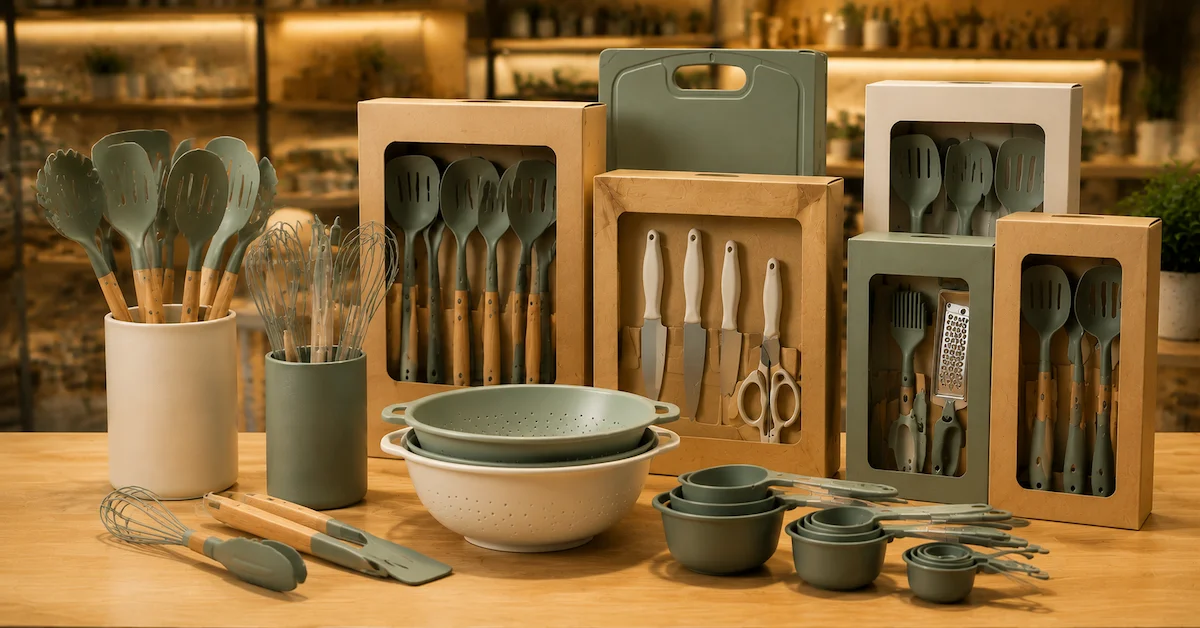
The original assortment shows a broad kitchenware program with long-handled tools, muted sage green elements, light wood visual cues, boxed presentation, and nesting or stackable items. Those details are useful because they show how a buyer might think beyond individual SKUs and plan a full private label kitchenware family. The guidance below focuses on how sourcing teams can evaluate that type of supplier without relying on unsupported assumptions.
Key Takeaways
- A strong utensil line needs consistent design language, not just matching colors.
- Mixed materials such as wood, metal, coated surfaces, and molded parts require clear sample approval standards.
- Packaging should be reviewed as part of the product, especially for retail and gift channels.
- Buyers should ask suppliers about customization options, quality checks, packing methods, and reorder consistency before placing an order.
Why Custom Kitchen Utensils Need a Clear Brief
Kitchen tools look simple, but small choices can change the commercial result. A handle profile affects comfort. A rounded spoon head changes the visual language of a set. A matte or muted color can make a line feel more coordinated, while an inconsistent finish can make it look like unrelated inventory. For private label buyers, these details influence shelf appeal and return risk.
A good sourcing brief should define the intended channel first. A promotional utensil set, a giftable boxed range, and a long-term retail assortment may use different materials, packaging, and SKU structures. Before asking a supplier for a quote, decide whether the goal is a low-cost item, a coordinated brand family, a seasonal gift set, or a repeatable core program.
Planning the Product Mix
The visible product mix includes common everyday tools: slotted spoons, serving spoons, spatulas, whisks, tongs, knives, scissors, measuring cups, colanders or sieves, and holders. This matters because a manufacturer that can discuss multiple categories may be better suited to a complete line than a supplier focused on a single tool.
When building the mix, avoid launching too many similar items at once. A focused assortment is easier to forecast, merchandise, and reorder. Many buyers start with several hero items, then add supporting pieces after testing demand. Useful questions include:
- Which tools are essential for the target customer’s daily cooking habits?
- Which items should be sold individually, and which should be bundled as a set?
- Will measuring tools, strainers, or holders support the main utensil range?
- Can the supplier keep appearance consistent across different product types?
Materials, Finish, and Construction Questions
The original image suggests a mix of wooden-looking handles, metal or wire tools, muted colored heads, and molded or coated components. Because the source does not confirm exact material grades or technical specifications, buyers should treat material details as questions to verify with the manufacturer.
For wood-handled tools, ask about handle material, finishing method, color tolerance, and how the handle connects to the working head. For metal tools such as whisks, knives, scissors, or tongs, ask about forming, joining points, edge or wire consistency, and inspection steps. For coated or molded parts, ask how color matching is controlled between batches and whether the finish is suitable for the intended use and care instructions.
Physical samples are essential. Photos may hide balance issues, rough joints, weak packaging support, or inconsistent surface texture. Test samples in ordinary kitchen conditions: grip them with wet hands, place them in drawers, check whether heads flex appropriately, and review how each item sits inside its packaging.
Comparison Checklist for Supplier Evaluation
| Evaluation Area | What to Check | Questions to Ask the Supplier |
|---|---|---|
| Assortment fit | Range depth, hero items, supporting accessories | Can you support separate SKUs and coordinated sets? |
| Design consistency | Color, handle shape, finish, visual family | How do you control color and finish across categories? |
| Material clarity | Component materials and construction methods | What materials are used for each part, and which can be customized? |
| Packaging | Retail box, gift box, window display, bulk pack | What packaging formats are available, and how are they transit-tested? |
| Sample review | Comfort, balance, joints, finish, packing position | Can you provide pre-production samples for approval? |
| Commercial details | MOQ, lead time, labeling, reorder process | What are your current order terms for this program? |
Packaging and Private Label Presentation
Packaging is often where a custom utensil line becomes retail-ready. The source article notes boxed retail or gift-style presentation, including a display box with a carry handle. For a private label kitchenware program, that kind of packaging can improve shelf organization and make the set easier to understand at a glance.
However, buyers should not judge packaging by appearance alone. Ask whether the box protects the tools during shipping, whether the window or handle weakens the structure, and how labels, barcodes, warnings, or multilingual copy will be handled. If the set includes nesting or stackable items, check whether they stay secure in the box after vibration and handling. Packaging should support the sales story, but it must also reduce damage and simplify logistics.
Common Mistakes in OEM Kitchenware Sourcing
One common mistake is designing for a catalog photo instead of real use. A spoon, spatula, or tong can look clean and modern but feel unbalanced or uncomfortable. Another mistake is using too many colors, finishes, or handle styles in one launch. A controlled palette, such as the sage green and light wood direction shown in the original materials, often creates a clearer family impression.
Buyers also sometimes separate product development from packaging development. That creates problems when a beautiful utensil set does not fit securely in its box or when packaging increases freight cost unnecessarily. Finally, do not assume that a sample represents all future batches. Ask how production samples, batch approvals, and ongoing inspections are managed.
Practical Buying Process
- Define the target channel: retail, wholesale, gift, hospitality, promotion, or online marketplace.
- Select the core tools and decide which items should be bundled.
- Prepare a design brief covering color, handle style, packaging direction, and branding needs.
- Ask the manufacturer which components are customizable and which are standard.
- Review physical samples for comfort, finish, assembly, and packaging performance.
- Confirm commercial details such as MOQ, lead time, packing method, labeling, and reorder procedure directly with the supplier.
FAQ for Buyers of Custom Kitchen Utensils
Should I start with a full utensil set?
Not always. Many buyers reduce risk by starting with a smaller group of core tools, then expanding after sales data and customer feedback are available.
What makes a private label kitchenware line look coherent?
Consistent color, similar handle profiles, compatible finishes, coordinated packaging, and a clear SKU structure all help the range feel intentional.
How should I compare samples from different suppliers?
Use the same checklist for every sample: grip comfort, weight, balance, finish quality, joining points, packaging fit, labeling space, and visible consistency across items.
Can I assume material grades or compliance from product photos?
No. Photos do not confirm material grade, testing, or compliance. Ask the supplier for exact specifications and any documents required for your market.
What is the best next step before requesting a quotation?
Create a concise brief with target channel, product list, preferred visual direction, packaging format, branding needs, and questions about MOQ, lead time, and sample approval.
