




Custom Kitchenware Manufacturer: How to Build a Coordinated Set
Choosing a custom kitchenware manufacturer is rarely just about finding someone who can add a logo to a utensil. For retail, hospitality, gifting, and private-label programs, the bigger goal is to create a coordinated product family that looks intentional, works in daily use, and can be sourced without avoidable quality or supply issues.
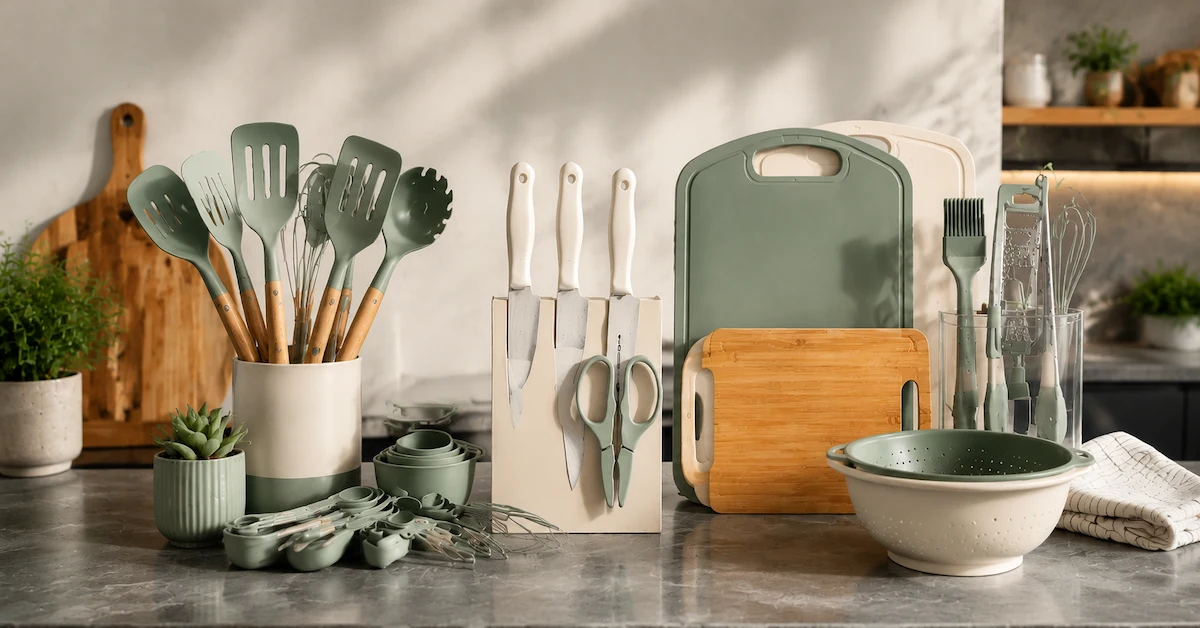
The original assortment shows a practical direction: spatulas, slotted spoons, whisks, knives, scissors, cutting boards, a colander or strainer, measuring cups, serving utensils, and storage pieces in muted sage green, cream, and natural wood tones. That visual consistency is what turns familiar kitchen tools into a sellable collection. For sourcing teams, the key question is not only “Can these items be made?” but “Can they be made as one coherent line?”
Key Takeaways
- Start with the market use case before selecting colors, materials, or decoration.
- Coordinated kitchenware sets require control of color, texture, handle shape, storage format, and packaging.
- Mixed-material assortments are useful but need more supplier discipline than single-item orders.
- Ask suppliers specific OEM and ODM questions before approving samples or packaging.
Why Buyers Source Custom Kitchenware Sets
A coordinated kitchenware set helps buyers simplify merchandising. Instead of presenting scattered individual tools, a brand can offer a ready-made assortment for home cooks, gift buyers, starter kitchens, or hospitality use. The end customer understands the product faster because the pieces share a common design language.
For B2B buyers, coordination can also support clearer range planning. A retailer may need a core utensil set, a board-and-knife bundle, and a countertop storage option that all appear to belong together. A hotel or serviced apartment buyer may prefer a practical kit that is easy to replace and present neatly. In each case, the custom manufacturer must understand the full program, not just one product drawing.
Define the Set Before Asking for Samples
Many sourcing problems begin when buyers request samples before defining the set architecture. A better approach is to decide the role of each item first. Which pieces are essential? Which are visual anchors? Which are optional add-ons?
For example, cutting boards often anchor the assortment because they are large, visible, and useful in photography or retail display. Utensils such as spatulas and slotted spoons define the daily-use value. Whisks, knives, scissors, measuring cups, and strainers add practical range, but they also introduce different materials and inspection needs.
A clear product brief should answer:
- Is the set for retail shelves, online bundles, gifting, hospitality, or wholesale resale?
- Which items are fixed, and which can be adjusted after costing or sampling?
- What color family and handle style should be shared across the line?
- Will the set need a utensil holder, gift box, sleeve, tray, or simple bulk packaging?
Compare Common Set Elements
Not every kitchenware item carries the same sourcing risk. The table below helps buyers compare typical pieces in a coordinated program and identify what to discuss with a supplier.
| Product element | Role in the set | Buyer checks |
|---|---|---|
| Spatulas and slotted spoons | Daily-use tools that define the look and handling feel | Head shape, handle comfort, color match, joining quality |
| Whisks and metal tools | Add technical utility to the assortment | Wire finish, handle fit, balance, visible edges |
| Knives and scissors | Increase perceived completeness and household usefulness | Blade finish, grip consistency, protective packaging needs |
| Cutting boards | Visual anchor for display, gifting, and countertop use | Shape, thickness, handle cutout, surface finish, wood tone variation |
| Colander, measuring cups, holders | Complete the kitchen system and improve organization | Stacking, stability, color consistency, carton fit |
Manage Materials as a System
Custom kitchenware programs often combine natural wood or bamboo-style visual elements, coated or silicone-like utensil heads, metal parts, and ceramic or stoneware-looking storage pieces. The source article shows a restrained palette of sage green, cream, and natural wood tones. Those facts are useful because they highlight a common sourcing challenge: materials may look coordinated in a photo but feel inconsistent in production.
Ask how the supplier controls visible variation. Wood-toned handles and boards can differ from batch to batch. Coated utensil heads may vary in gloss or shade. Curved storage pieces may display color differently from flat handles. None of these issues is unusual, but they should be discussed before approval samples are treated as final standards.
Buyers should avoid vague instructions such as “make everything match.” Instead, provide reference samples, approved color limits where available, finish preferences, and notes on which items must match most closely when displayed together.
Evaluate a Custom Kitchenware Manufacturer
A polished product image is helpful, but it is not enough to qualify a manufacturing partner. For OEM or private-label kitchenware, buyers should evaluate how the supplier manages product range, customization, inspection, and packaging across different item types.
Useful supplier questions include:
- Which items in the proposed set are made directly, and which are supported through partner production?
- What customization options are available for handles, colors, surface finishes, packaging, and logo placement?
- How are reference samples stored and used during production checks?
- How does the supplier handle color or material differences between utensils, boards, and holders?
- What quality checkpoints are used before packing mixed-item sets?
- What commercial details, such as MOQ, lead time, tooling needs, and sample cost, should be confirmed in writing?
Do not assume capacity, certifications, testing results, or compliance details unless the supplier provides current documentation. For regulated markets or food-contact products, buyers should ask what documentation is available for the intended destination market and confirm it independently when needed.
Plan Packaging Early
Packaging is often treated as the final step, but for coordinated kitchenware sets it affects cost, damage risk, presentation, and customer understanding. A set with knives, boards, utensils, and ceramic or rigid storage pieces may need separators, protective sleeves, molded trays, or carefully arranged cartons.
For retail and gifting, packaging should explain the set quickly. Shoppers should be able to see what is included, how the items relate to one another, and whether the collection fits their kitchen style. For wholesale or hospitality orders, packaging may need to prioritize efficient handling, easy counting, and replacement logistics.
Common Sourcing Mistakes to Avoid
The first mistake is overbuilding the set. More pieces can make a sample table look impressive, but unnecessary items may raise cost, complicate packaging, and weaken the offer. A focused assortment is often easier to sell and easier to control.
The second mistake is approving each item separately. A spatula, cutting board, holder, and measuring cup may all look acceptable alone but mismatched when viewed together. Review samples as a complete set under realistic lighting.
The third mistake is leaving branding until the end. Logo placement that works on a board may not work on a narrow handle or curved container. Discuss decoration methods early and request samples on the actual materials where possible.
Practical FAQ
What should I prepare before contacting a custom kitchenware manufacturer?
Prepare a target market, item list, preferred color direction, branding needs, packaging expectation, order destination, and any documentation requirements your market may need.
Is OEM or ODM better for a coordinated kitchenware set?
OEM is useful when you have defined specifications. ODM can be efficient when you want to adapt existing product concepts into a coordinated private-label line. Many projects combine both approaches.
How many items should be in a kitchenware set?
There is no universal number. Choose items based on the selling channel, target price position, packaging size, and real user value. Avoid adding pieces only to make the set look larger.
What is the most important sample approval step?
Review the complete set together. Check color harmony, handle feel, surface finish, storage fit, packaging layout, and whether the assortment looks like one planned collection.
What supplier claims should buyers verify?
Verify commercial terms, material details, compliance documentation, testing reports, production responsibilities, lead times, and packaging specifications. Ask for written confirmation rather than relying on general statements.
Next Step for Sourcing Teams
Before requesting a quotation, build a concise product brief that treats the kitchenware line as a system. Identify hero items, optional items, color and material direction, branding locations, packaging format, and quality concerns. Then ask the custom kitchenware manufacturer to respond with a coordinated assortment plan, not isolated product suggestions.
This approach gives buyers a better chance of developing a set that looks consistent, is practical to use, and can be sourced with fewer surprises. In custom kitchenware, the value is not only in the individual tools. It is in how well the entire collection works together.
