




Custom Pepper Grinders: OEM and Wholesale Sourcing Guide
Custom pepper grinders can be a practical product category for restaurants, catering companies, kitchenware retailers, promotional gift buyers, and private-label brands. A grinder is simple in daily use, but the sourcing decision is not simple: buyers need to consider grind adjustment, mechanism type, body material, filling method, packaging, branding, and quality consistency across bulk orders.
The original article highlighted three important ideas: the appeal of custom pepper grinders, the value of wholesale pepper grinders for bulk needs, and the importance of understanding pepper mill manufacturing. This expanded guide keeps that focus while giving B2B buyers a clearer framework for evaluating options and preparing supplier questions before placing an order.
Key Takeaways
- Custom pepper grinders should be evaluated by usability, grind control, refill design, durability, and branding options.
- Wholesale sourcing is useful for restaurants, retailers, gift programs, and distributors, but buyers should request samples before bulk ordering.
- Do not assume material grade, mechanism quality, compliance status, or production capacity; ask the supplier to confirm these details in writing.
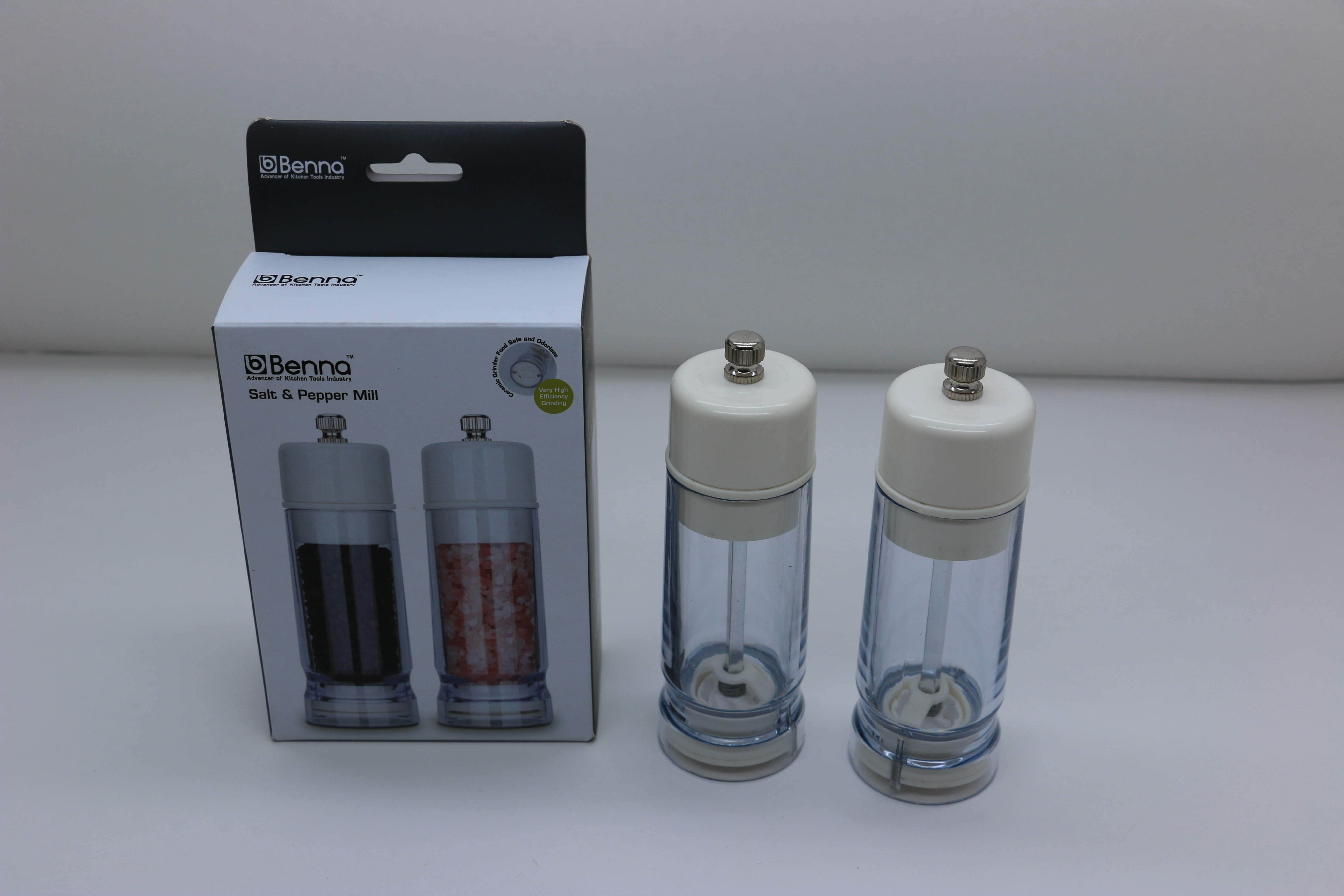
- A transparent body and adjustable top nut, as seen in some salt and pepper mill sets, can help users monitor fill levels and change grind size.
Why Buyers Choose Custom Pepper Grinders
Freshly ground pepper is valued because it allows users to control texture and release aroma close to serving time. For a foodservice operator, that can improve table presentation and kitchen consistency. For a retailer or gift brand, a pepper grinder also offers visible surface area for design, labeling, color matching, or packaging customization.
Customization does not always mean a completely new product mold. Depending on the supplier, it may include logo printing, gift box design, color selection, set configuration, label application, or packaging changes. More advanced OEM projects may involve shape changes, material substitutions, or a dedicated design, but those options require more detailed technical discussion.
Wholesale Pepper Grinders: When Bulk Buying Makes Sense
Wholesale pepper grinders are commonly considered by restaurants, catering services, hotel suppliers, homeware retailers, and promotional buyers that need consistent products in quantity. Bulk purchasing can simplify assortment planning, but only if the product performs reliably and the supplier can maintain the same specification from batch to batch.
For example, the original article referenced a Salt & Pepper Mill Set with transparent bodies that make seasoning levels easy to monitor. It also noted an adjustable grind size controlled by a top nut, allowing users to move between finer and coarser textures. These are useful features to consider because they affect both consumer convenience and after-sale satisfaction.
Before committing to a wholesale order, buyers should clarify whether the product is suitable for pepper only, salt only, or both. Salt can be more demanding on some mechanisms, so it is important to ask the supplier what the grinder is designed to hold and how it should be cleaned or maintained.
Comparison Checklist for Sourcing Pepper Grinders
| Evaluation Point | What to Check | Questions to Ask the Supplier |
|---|---|---|
| Grind adjustment | Fine, medium, and coarse settings; ease of adjustment | How is the grind size adjusted, and is the adjustment stable during use? |
| Mechanism | Material, corrosion resistance, consistency, replacement options | What mechanism material is used, and can you provide sample performance testing information? |
| Body design | Transparency, grip comfort, refill opening, visual appearance | Is the body transparent, opaque, or mixed material? How is it refilled? |
| Customization | Logo, color, packaging, set configuration, private label | Which customization methods are available, and what artwork files are required? |
| Bulk order control | Sample approval, inspection, packaging consistency | Can production samples be approved before mass production? |
| Commercial terms | MOQ, lead time, payment terms, shipping method | What are the MOQ, estimated lead time, carton details, and delivery options? |
Manufacturing Factors That Affect Quality
Pepper mill manufacturing involves more than assembling a container and a grinding mechanism. The user experience depends on how the mechanism fits inside the body, how smoothly the top or handle turns, how securely the adjustment system holds its position, and whether the grinder can be refilled without spills or loose parts.
Some pepper grinders may use ceramic mechanisms, stainless steel components, plastic bodies, glass bodies, acrylic bodies, wooden parts, or mixed materials. The original article mentioned durable materials and ceramic mechanisms as common in wholesale products, but buyers should not treat those as guaranteed specifications. Instead, request a product specification sheet for the exact model being quoted.
For OEM or private-label projects, also ask how the supplier controls color matching, logo placement, packaging artwork, and pre-shipment inspection. If the product will be sold in a regulated market, buyers should ask what documents, declarations, or third-party test reports are available for that destination and product use. Do not rely on general claims; confirm what applies to your order.
Product Selection Guidance for Different Buyers
Different buyers need different grinder configurations. A restaurant may prefer easy refill and stable grind adjustment. A retailer may focus on shelf appearance, barcode labeling, and packaging durability. A gift buyer may require a matching salt and pepper set with consistent finishing and attractive presentation packaging.
- Restaurants and catering operators: Prioritize easy cleaning, comfortable handling, visible fill levels, and consistent grind output.
- Retail buyers: Review packaging, shelf display, product instructions, and damage protection during shipping.
- Private-label brands: Confirm logo method, color options, packaging proofing, and sample approval steps.
- Promotional buyers: Ask about print area, logo durability, delivery schedule, and carton packing details.
- Distributors: Look for repeatable specifications, spare parts policies, and clear reorder item codes.
How to Evaluate Samples Before a Bulk Order
Sample evaluation should be practical and repeatable. Fill the grinder with the intended seasoning, adjust through the available grind settings, and test it over multiple uses. Check whether the adjustment top nut is easy to use, whether coarse settings remain coarse, and whether fine settings clog or require excessive force.
Also examine packaging. A grinder can function well but still create problems if it arrives scratched, loose in the box, or difficult to identify in a warehouse. For wholesale orders, ask for carton dimensions, packing method, labeling options, and whether inner boxes or protective inserts are included. If packaging needs to match a brand style, approve a physical or digital proof before production.
Supplier Questions to Ask Before Ordering
- What exact materials are used for the body, lid, shaft, and grinding mechanism?
- Is the grinder suitable for pepper, salt, dried spices, or only specific seasonings?
- What customization options are available for logo, color, packaging, and set configuration?
- Can you provide pre-production samples for approval?
- What are the MOQ, lead time, payment terms, and shipping options?
- What quality checks are performed before shipment?
- Are any compliance documents or test reports available for the intended market?
- How should the grinder be cleaned, refilled, and maintained by end users?
Practical FAQ
Can custom pepper grinders be ordered as a salt and pepper set?
Often yes, but buyers should confirm the exact set configuration with the supplier. If the same grinder is intended for salt, ask whether the mechanism is suitable for salt use and whether any maintenance guidance is required.
What customization is most common for wholesale pepper grinders?
Common options may include logo printing, packaging design, color selection, labels, and bundled sets. Availability depends on the supplier and the chosen model, so request a customization sheet before quoting.
How can I judge grind quality from a sample?
Test the grinder with the actual peppercorns or seasoning you plan to use. Move through fine and coarse settings, check output consistency, and see whether the adjustment remains stable during repeated use.
Should I ask for certifications?
Ask what documents are available for the materials, food-contact use, and destination market. Do not assume a product has a specific certification unless the supplier provides relevant documentation for that exact item.
What information should be included in a purchase specification?
Include product model, materials, dimensions if provided by the supplier, color, logo method, packaging, carton requirements, inspection requirements, sample approval process, delivery terms, and any required documents.
Final Thoughts
Custom pepper grinders are useful products when the sourcing process is handled carefully. Buyers should look beyond appearance and compare grind adjustment, refill convenience, mechanism details, packaging, and supplier communication. For wholesale and OEM projects, the best results usually come from clear specifications, approved samples, and written confirmation of commercial and quality requirements before production begins.
