




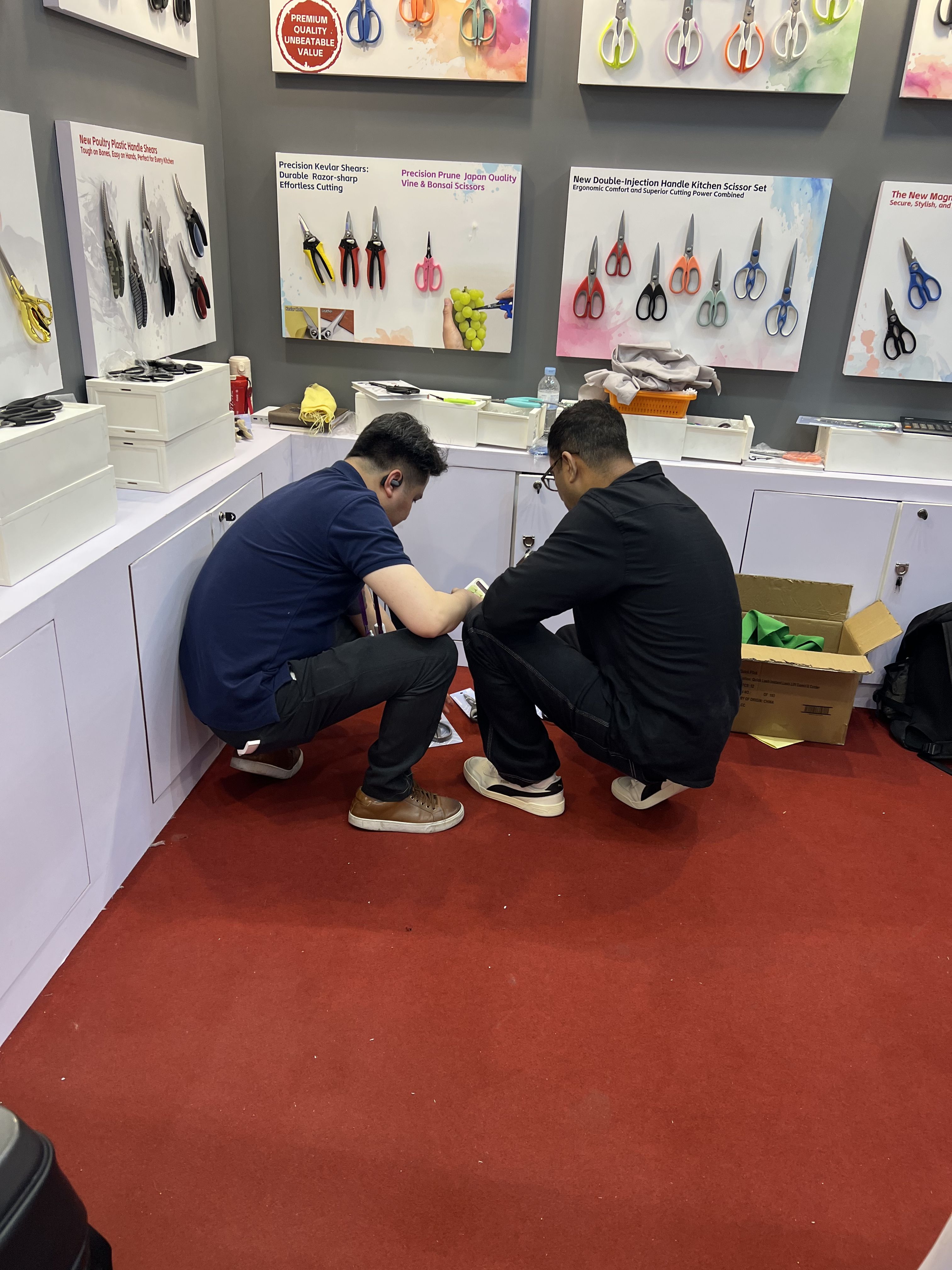
Canton Fair Kitchenware: Practical Scissor Innovations to Evaluate
The Canton Fair kitchenware section is a useful place for buyers to compare everyday tools side by side. Among cookware, utensils, storage items, and household accessories, kitchen scissors often receive attention because they are compact, repeat-purchase products that can fit many retail, promotional, and household assortments. The original article highlighted transparent kitchen scissors, soft color options, stainless steel cutting edges, and soft-touch handles. Those details are a good starting point, but serious sourcing requires more than a quick look at appearance.
For importers, wholesalers, supermarket buyers, and OEM project managers, the goal is to understand whether a scissor design is suitable for the intended market, packaging channel, and price position. A fair booth can show samples, but the buyer should still ask structured questions about materials, function, customization, production consistency, and inspection arrangements before placing an order.
Key Takeaways
- Kitchen scissors at trade fairs should be evaluated for function, comfort, safety, packaging, and supplier reliability.
- Transparent handles and soft-touch grips can help a product stand out, but buyers should confirm durability and care instructions.
- Do not assume blade grade, certifications, or testing results unless the supplier provides written documentation.
- Sample testing should include cutting performance, handle comfort, cleaning, packaging fit, and carton durability.
- OEM buyers should prepare artwork, target retail price, labeling needs, and inspection criteria before negotiating.
Why Kitchen Scissors Matter in a Sourcing Plan
Kitchen scissors are small, but they can be strategically important in a kitchenware range. They are easy to display, simple to bundle with other tools, and familiar to consumers in many markets. A buyer may source them as a single retail item, a gift set component, a private-label product, or an accessory for a broader cookware promotion.
Because scissors are handled directly and used for repeated cutting tasks, poor quality is quickly noticed. A weak pivot, uncomfortable handle, uneven cutting edge, or fragile packaging can create returns and complaints. At the Canton Fair, buyers should treat kitchen scissors as functional tools, not merely colorful add-ons.
Design Features to Review at the Booth
The source article mentioned transparent kitchen scissors with smooth handles in gentle colors such as soft pink and mint green. It also referred to soft-touch handle scissors in brighter colors such as orange, blue, and red. These visual options can be useful for different retail positions. Transparent handles may suit a modern homeware display, while bold colors may work well for value sets, seasonal promotions, or family kitchen assortments.
However, color and style should be evaluated alongside real usability. Ask to hold the sample, open and close it several times, and test whether the grip feels stable for different hand sizes. If the handle has a soft-touch coating, ask whether it resists peeling, discoloration, and odor transfer. If the handle is transparent, ask how it performs under daily washing, repeated use, and exposure to light.
Blade and Cutting Performance Questions
The original article described high-precision blades with stainless steel edges, but it did not state a specific stainless steel grade, hardness, coating, or test result. Buyers should not assume these details. Instead, ask the supplier to confirm the material in writing and explain what cutting tasks the scissors are designed for.
Useful questions include: Are the scissors intended for food preparation, general household use, crafting, or a mix of light-duty tasks? Can they cut herbs, packaging, paper, thin plastic bags, or cooked food cleanly? Are they dishwasher safe, hand-wash only, or subject to any drying requirements? Is the pivot adjustable or fixed? Are replacement samples available from different production batches for comparison?
Comparison Checklist for Buyers
| Evaluation Point | What to Check | Questions to Ask the Supplier |
|---|---|---|
| Handle design | Comfort, grip stability, color consistency, finish quality | What handle material is used, and has it been tested for repeated use? |
| Blade material | Sharpness, alignment, corrosion resistance claims | What stainless steel grade is specified, and can documentation be provided? |
| Cutting function | Smooth opening, clean cut, no blade rubbing | Which cutting tasks is this model designed to handle? |
| Cleaning and care | Food-contact suitability, washing instructions, drying needs | What care instructions should appear on the packaging or manual? |
| Packaging | Retail display, barcode area, safety cover, carton strength | Can packaging be customized for private label or multilingual markets? |
| Quality control | Sample consistency, inspection criteria, defect limits | What inspection process is used before shipment? |
OEM and Wholesale Sourcing Guidance
For OEM and wholesale projects, preparation makes fair meetings more productive. Bring a clear brief that states the target market, sales channel, preferred color range, packaging format, logo position, estimated order volume, and any required documentation. If you need food-contact compliance, labeling in a specific language, or retailer-specific testing, ask the supplier what they can support and what must be arranged through third-party testing.
Do not rely only on booth samples. Request pre-production samples after artwork and packaging are confirmed. If the project involves multiple colors, ask whether each color can be produced consistently across batches. If the scissors are part of a kitchen set, check whether the handle colors match the rest of the range under normal lighting.
Commercial details such as MOQ, lead time, customization cost, sample fee, payment terms, and packaging charges should be confirmed directly with the supplier. If any claim is important to your sales channel, request written confirmation before listing the product or making marketing statements.
Sample Testing Before Order Approval
A simple office review is not enough for kitchen scissors. Create a small test routine before approving production. Open and close each sample repeatedly, test common cutting materials, wash and dry the sample according to the supplier's instructions, and check whether the pivot remains stable. Look for burrs, gaps, loose screws, uneven edges, uncomfortable pressure points, and color defects.
- Compare samples from the booth and later sample shipments for consistency.
- Test cutting on realistic materials rather than only thin paper.
- Check whether the packaging protects the blade and prevents accidental opening.
- Review barcode space, warning text, care instructions, and country-of-sale labeling needs.
- Define acceptable defects before mass production begins.
Packaging, Merchandising, and Retail Fit
Kitchen scissors can be sold in blister cards, paper cards, gift boxes, hanging sleeves, or set packaging. The best option depends on the buyer's channel. A supermarket may need strong hanging visibility and barcode placement. An e-commerce seller may care more about compact shipping and damage prevention. A gift set buyer may prioritize a clean presentation and color coordination.
At the Canton Fair, ask suppliers to show packaging examples they have produced before, but avoid copying another customer's design. For private label projects, provide your own artwork requirements and confirm print color, material thickness, carton size, and master carton packing. Also ask whether the supplier can provide blank die-lines for design work.
FAQ
What should buyers check first when viewing kitchen scissors at the Canton Fair?
Start with the intended use, handle comfort, blade alignment, opening action, and packaging format. A product that looks attractive still needs to cut smoothly and feel safe in the hand.
Can I claim the scissors are food-safe or dishwasher safe?
Only make those claims if the supplier provides appropriate written information and, where needed, testing documents for your target market. If care instructions are unclear, ask before ordering.
Are transparent handles better than soft-touch handles?
Neither is automatically better. Transparent handles may create a clean visual effect, while soft-touch handles may improve grip feel. Buyers should compare durability, cleaning, appearance, and target customer preference.
What information should I prepare for an OEM inquiry?
Prepare target quantity, market, packaging type, logo needs, color preferences, inspection requirements, labeling language, and any retailer or regulatory documentation requests.
How can I reduce quality risk before mass production?
Approve samples carefully, define inspection standards, confirm materials in writing, test packaging, and consider pre-shipment inspection for large or retailer-sensitive orders.
Final Sourcing Notes
The Canton Fair is valuable because it lets buyers compare kitchen scissors by touch, appearance, and supplier response in one place. The most promising models are not only colorful or modern-looking; they are practical, consistent, well packaged, and clearly documented. By asking the right questions about handles, blades, care, customization, and inspection, buyers can turn a simple kitchen tool into a reliable product for wholesale, retail, or private-label programs.
