




Discover Quality at a Top Kitchen Knife Factory
Finding the right kitchen knives is not only a consumer decision. For importers, distributors, hospitality buyers, private-label brands, and retail sourcing teams, the bigger question is how to evaluate the factory behind the product. A good knife set must cut cleanly, feel secure in the hand, and hold up to daily use; a good sourcing decision also requires clear communication, stable quality control, practical packaging options, and realistic expectations about materials and finishes.
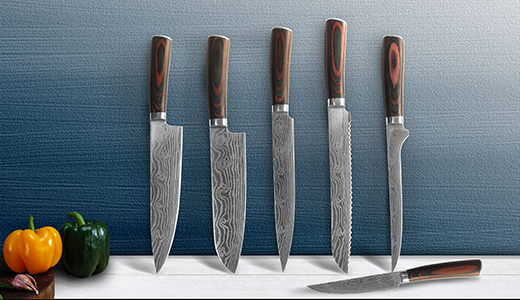
The original discussion around a kitchen knife factory focused on the value of precision, durability, and ergonomic design. Those points remain important, but buyers also need a structured way to compare suppliers. This guide explains what to look for when sourcing kitchen knives, how to assess common product features such as 5CR15MOV high carbon stainless steel, Premium Pakka Wood handles, and a Damascus laser pattern, and which questions to ask before committing to an OEM, wholesale, or private-label order.
Key Takeaways
- A reliable kitchen knife factory should be evaluated on product consistency, communication, quality control process, packaging support, and after-sales responsiveness.
- Material claims should be verified. If a knife is described as 5CR15MOV high carbon stainless steel, ask how the steel is specified, processed, and inspected.
- Handle comfort matters as much as blade sharpness, especially for chef knives, cleavers, boning knives, and bread knives used repeatedly.
- Decorative finishes such as a Damascus laser pattern should be understood as surface styling unless the supplier provides clear technical evidence otherwise.
- Before ordering, ask about samples, lead time, branding options, carton packing, inspection standards, and any compliance documents required for your market.
What Defines a Quality Kitchen Knife Factory?
A kitchen knife factory is more than a place where blades are shaped and handles are fitted. For B2B buyers, the factory should be able to explain how it controls each stage of production, from raw material selection to grinding, polishing, assembly, cleaning, packaging, and shipment preparation. A supplier that can answer detailed questions clearly is usually easier to work with than one that relies only on broad claims.
Look for transparency. Ask what steps are performed in-house and which are outsourced. Ask how the factory checks blade straightness, edge consistency, handle fit, surface finish, and final appearance. If your business sells to professional kitchens or retail customers, small quality differences can lead to returns, complaints, or inconsistent reviews. A sample order is useful, but buyers should also understand whether the sample quality reflects normal mass production.
Understanding Blade Material and Cutting Performance
The original article mentioned 5CR15MOV high carbon stainless steel. This material is commonly used in practical kitchen knives because it can support everyday sharpness while offering stainless properties suitable for general kitchen environments. However, buyers should avoid assuming performance from the steel name alone. Heat treatment, edge geometry, blade thickness, grinding quality, and finishing all influence how a knife performs.
When discussing blade material with a supplier, ask for the confirmed steel specification, the intended hardness range if available, and the recommended use case. A chef knife for chopping vegetables, a cleaver for heavier work, a boning knife for precision trimming, and a bread knife for slicing loaves all place different demands on the blade. The best factory partner should help match blade design to market positioning rather than offering a single generic answer for every knife.
Handles, Balance, and Everyday Comfort
Knife handles are often judged visually, but comfort and control are more important. The source article referred to Premium Pakka Wood handles, which can provide a secure and attractive grip when properly shaped and assembled. For buyers, the key is to check handle finish, seam smoothness, rivet or connection quality if applicable, weight distribution, and how the handle feels during repeated cutting motions.
Ergonomic design should be assessed with actual use. Does the handle feel stable when wet? Are there sharp edges where the hand meets the bolster or tang area? Is the knife too handle-heavy or blade-heavy for its intended task? These questions are especially important for professional users who may hold the same knife for long prep sessions. If you are developing a private-label line, request samples across the full set rather than evaluating only the chef knife.
Comparing Common Knife Set Components
A well-curated knife set can help customers handle most kitchen tasks without buying each tool separately. The original article mentioned essential pieces such as a chef knife, cleaver, boning knife, and bread knife. For wholesale sourcing, the right mix depends on your sales channel. Retail gift sets may favor a broad assortment and attractive packaging, while restaurant supply buyers may prefer fewer, task-focused knives with practical durability.
| Knife type | Typical purpose | Buyer evaluation points |
|---|---|---|
| Chef knife | General chopping, slicing, and dicing | Check balance, edge consistency, handle comfort, and blade profile. |
| Cleaver | Heavier chopping and larger ingredients | Confirm intended use; not every cleaver is designed for bones or extreme impact. |
| Boning knife | Trimming meat and working around bones | Assess tip control, blade flexibility or stiffness, and grip security. |
| Bread knife | Slicing bread and soft foods | Review serration uniformity, cutting smoothness, and blade length. |
| Decorative set finish | Visual differentiation for retail display | Clarify whether a Damascus laser pattern is decorative and how it wears over time. |
Decorative Details: Damascus Laser Pattern
A Damascus laser pattern can make a knife set more visually distinctive, especially for retail display, gifting, or online product photography. Buyers should understand what the finish represents. Unless a supplier provides specific technical documentation, treat a laser pattern as a decorative surface effect rather than proof of layered forged steel. This distinction matters for honest product descriptions and customer trust.
When sourcing a patterned blade, ask how the pattern is applied, how it is protected during packaging, whether it may fade or scratch with normal use, and what cleaning instructions should be provided to end users. Good suppliers will help you create accurate product copy that highlights appearance without overstating performance.
OEM and Wholesale Sourcing Questions to Ask
Before choosing a kitchen knife factory, prepare a written sourcing checklist. Clear questions reduce misunderstandings and help you compare suppliers fairly. If you are considering Yangjiang Bonet Houseware Co., Ltd. or any other knife supplier, request specific answers rather than relying on general product descriptions.
- What blade materials are available, and how are material specifications verified?
- Which handle materials and shapes can be offered for this product line?
- Can the factory provide pre-production samples for approval before mass production?
- What branding options are available, such as logo placement, handle marking, blade marking, or packaging design?
- What quality checks are performed during production and before shipment?
- What packaging formats are available for retail, e-commerce, or bulk distribution?
- What documents can the supplier provide for your destination market, and which must be arranged by the buyer?
- How are defects, shortages, or shipment issues handled after delivery?
Quality Control Before Shipment
Quality control should be planned before production begins. Define acceptable appearance standards, edge sharpness expectations, packaging requirements, barcode placement if needed, and carton labeling details. For larger orders, buyers may also arrange third-party inspection according to their own standards. Avoid vague instructions such as “good quality”; instead, use measurable or photograph-based criteria wherever possible.
For knife sets, inspect both individual knives and the assembled set. A single mismatched handle color, loose part, scratched blade, or poorly fitted tray can affect the perceived value of the entire product. Packaging should protect the blade tips and edges during transit, especially for retail-ready products.
Practical Use and Care Guidance for End Customers
Even a well-made knife performs better when used correctly. If you sell kitchen knives under your own brand, include simple care instructions. Recommend cutting on suitable boards, washing and drying knives promptly, and storing them safely to protect the edge. Avoid presenting any knife as maintenance-free. Clear care guidance reduces unnecessary complaints and helps customers understand normal wear.
For sets with wood-based handles such as Pakka Wood, buyers should ask the supplier for recommended cleaning and storage language. This ensures your product insert, online listing, and customer service team all communicate the same guidance.
FAQ
How do I know if a kitchen knife factory is suitable for OEM orders?
Ask for relevant samples, branding options, packaging capabilities, quality control steps, and examples of how the supplier manages pre-production approval. Do not assume OEM readiness without confirming details in writing.
Is 5CR15MOV high carbon stainless steel good for kitchen knives?
It can be a practical choice for everyday kitchen knives, but performance depends on heat treatment, grinding, edge design, and production consistency. Ask the supplier how the finished knife is controlled.
Does a Damascus laser pattern mean the blade is true Damascus steel?
Not necessarily. A Damascus laser pattern is often decorative. Unless the supplier provides clear evidence of layered construction, describe it as a laser pattern rather than true Damascus steel.
What should buyers check in a knife set sample?
Check sharpness, balance, handle comfort, surface finish, blade alignment, packaging protection, and consistency across all pieces, including the chef knife, cleaver, boning knife, and bread knife.
Should I request compliance documents from a knife supplier?
Yes, but requirements vary by destination market and sales channel. Ask what documents the supplier can provide and confirm with your importer, retailer, or compliance adviser before placing an order.
Final Thoughts
Sourcing from a kitchen knife factory is a balance of product performance, reliable communication, and realistic claims. Materials such as 5CR15MOV high carbon stainless steel, Pakka Wood handles, and decorative Damascus laser patterns can all support a strong product line when accurately described and consistently manufactured. The best buying decision comes from asking specific questions, reviewing complete samples, defining quality standards, and choosing a supplier that can support your market needs with clarity.
