




5 Inch School Scissors for Students: Practical Buying and Sourcing Guide
For schools, stationery brands, distributors, and education supply buyers, 5 inch school scissors are a small product with many purchase decisions behind them. The right pair should be comfortable for young learners, suitable for classroom paper crafts, consistent in quality, and easy to evaluate before bulk ordering. This guide rewrites the original product introduction into a clearer sourcing resource for buyers comparing children’s scissors, soft grip designs, and OEM school scissors options.

Key Takeaways
- 5 inch school scissors are commonly chosen for students because the compact size is easier for small hands to control.
- Soft grip and ergonomic finger holes can improve comfort during repeated classroom cutting tasks.
- For OEM or wholesale sourcing, buyers should verify samples, packaging, labeling, blade performance, and age suitability claims before ordering.
- Do not rely only on appearance; test cutting consistency, handle comfort, and durability under realistic school-use conditions.
Why 5 Inch School Scissors Fit Classroom Use
The original article highlights a 5 inch school scissors design intended for young learners. This size is practical for common classroom activities such as cutting paper, worksheets, craft shapes, and simple art materials. A smaller scissor body can help students keep better control than with larger general-purpose scissors, especially when they are still developing fine motor skills.
For school procurement, the important question is not simply whether the scissors look child-friendly. Buyers should consider how the product performs across a full classroom: different hand sizes, left- and right-hand preferences, frequent use, and repeated storage in pencil cases or supply bins. If the scissors will be used by younger children, ask the supplier to clarify the intended age range and any safety guidance that should appear on packaging.
Comfort Features: Soft Grip and Finger Hole Design
The product described in the source includes soft grip elements and ergonomic swirl-patterned finger holes. These details matter because students may cut for longer periods during art lessons or project work. A handle that feels too hard, too narrow, or slippery can cause discomfort and reduce control.
When reviewing samples, ask several users to hold the scissors rather than relying only on catalog images. Check whether the finger holes fit comfortably, whether the grip supports both small and slightly larger student hands, and whether the handle surface remains stable when hands are dry or slightly damp. Comfort is also a quality signal: inconsistent molding, rough edges, or uneven grip material may suggest poor production control.
Blade Material and Cutting Performance
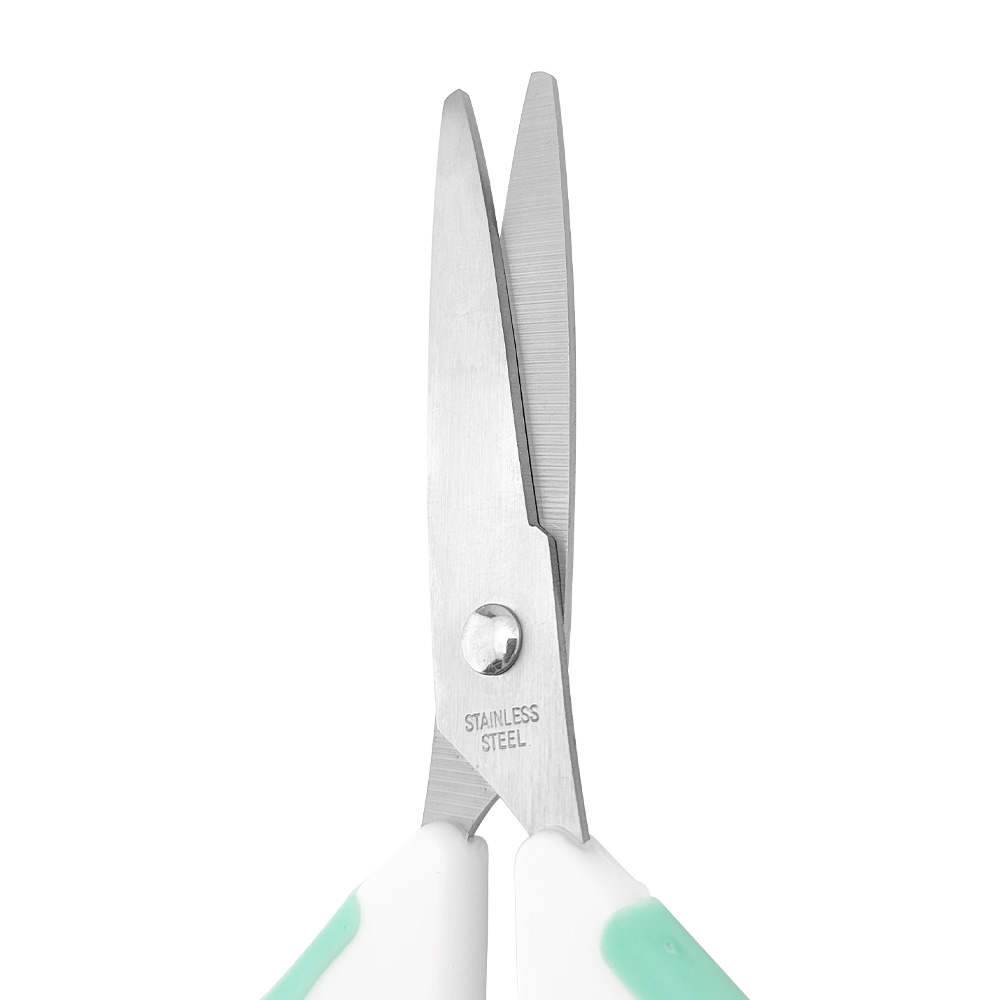
The original copy states that the scissors use stainless steel blades. Stainless steel is widely used for school scissors because it can offer a balance of cutting performance and everyday durability. However, buyers should avoid assuming blade thickness, hardness, coating, or long-term sharpness unless the supplier provides clear specifications and sample testing supports the claim.
For evaluation, test the scissors on the materials your customers actually use. Paper is the basic test, but classrooms may also use thin card, colored paper, craft sheets, or light fabric for supervised projects. Because the source mentions cutting materials such as paper and fabric, it is sensible to confirm the intended material range directly with the supplier. If the product is marketed mainly as children’s scissors, safety and controllability should remain more important than aggressive cutting power.
Design and Appearance: Useful, but Not the Only Factor
The original article describes a matte white body with mint green accents. For retail, school kits, and branded stationery ranges, color and finish can help the scissors fit a product line. A clean, modern color combination may appeal to parents, schools, and students, but visual design should be checked alongside durability.
During sample review, inspect the handle color consistency, surface finish, and connection between the blade and handle. If you are buying for a private label program, ask whether the supplier can discuss color matching, logo placement, insert cards, barcode labels, and outer carton markings. These details should be confirmed in writing, because OEM options vary by factory and by order requirements.
Comparison Checklist for Bulk Buyers
Use the following checklist when comparing 5 inch school scissors from different suppliers or factories. It is designed for B2B sourcing teams, education supply distributors, and brand owners preparing sample approvals.
| Item to Check | Why It Matters | Questions to Ask the Supplier |
|---|---|---|
| Size and fit | Students need control and comfort. | Is the finished length 5 inches, and what age range is it intended for? |
| Handle comfort | Soft grip can reduce hand strain. | What grip material is used, and can samples be tested before bulk order? |
| Blade performance | Clean cuts improve classroom usability. | What materials are recommended for cutting, and are there blade specifications? |
| Safety guidance | Children’s products need clear use instructions. | What warnings, age grading, or supervision notes should appear on packaging? |
| OEM packaging | Retail and school channels need correct labeling. | Can the supplier support logo, barcode, color card, or carton mark requirements? |
| Quality control | Bulk orders must be consistent. | What inspections are performed, and what sample approval process is available? |
OEM School Scissors: What to Confirm Before Ordering
The original article refers to OEM school scissors and factory quality. For professional sourcing, this should lead to practical verification rather than broad assumptions. A supplier may be able to discuss customization, but buyers should confirm exactly what is possible for the selected model.
- Request pre-production samples and compare them with catalog photos.
- Confirm the handle colors, finish, and any logo or packaging requirements.
- Ask for written product specifications, including size, blade material, and packaging format.
- Clarify acceptable quality limits, inspection standards, and how defects are handled.
- Ask whether commercial details such as MOQ, lead time, and payment terms apply to your order size.
If you need compliance documents for a specific market, ask the supplier which documents are available for this exact product and shipment. Do not assume that one scissor model automatically meets every market requirement.
Use and Care Guidance for Schools and Parents
Even well-made student scissors should be used and stored properly. Teachers and parents can help extend product life by keeping scissors dry, wiping blades after messy craft work, and storing them in a pencil case or classroom tray. Students should be taught to cut only approved materials and to carry scissors with the blades closed.
For younger learners, supervision is important. A 5 inch size can support better control, but it does not replace safe classroom habits. If scissors become loose, bent, rusty, or difficult to open and close, remove them from student use and replace them.
FAQ
Are 5 inch school scissors suitable for all students?
They are often suitable for many children because of their compact size, but suitability depends on age, hand size, and school policy. Ask the supplier for the intended age range and test samples with real users.
What should I test before placing a wholesale order?
Test comfort, cutting smoothness, blade alignment, handle finish, packaging quality, and consistency across multiple samples. Also confirm specifications and commercial terms in writing.
Can these scissors be used for fabric?
The source mentions use on paper and fabric, but buyers should confirm the recommended materials with the supplier. For classroom projects, test the exact fabric or craft material before making claims.
What OEM details should a buyer prepare?
Prepare logo files, target colors, packaging requirements, barcode needs, carton marks, order quantity, destination market, and any compliance or documentation requirements for your sales channel.
How can schools improve scissor safety?
Choose age-appropriate scissors, provide supervision, teach students to carry them closed, and inspect tools regularly for damage or looseness.
