




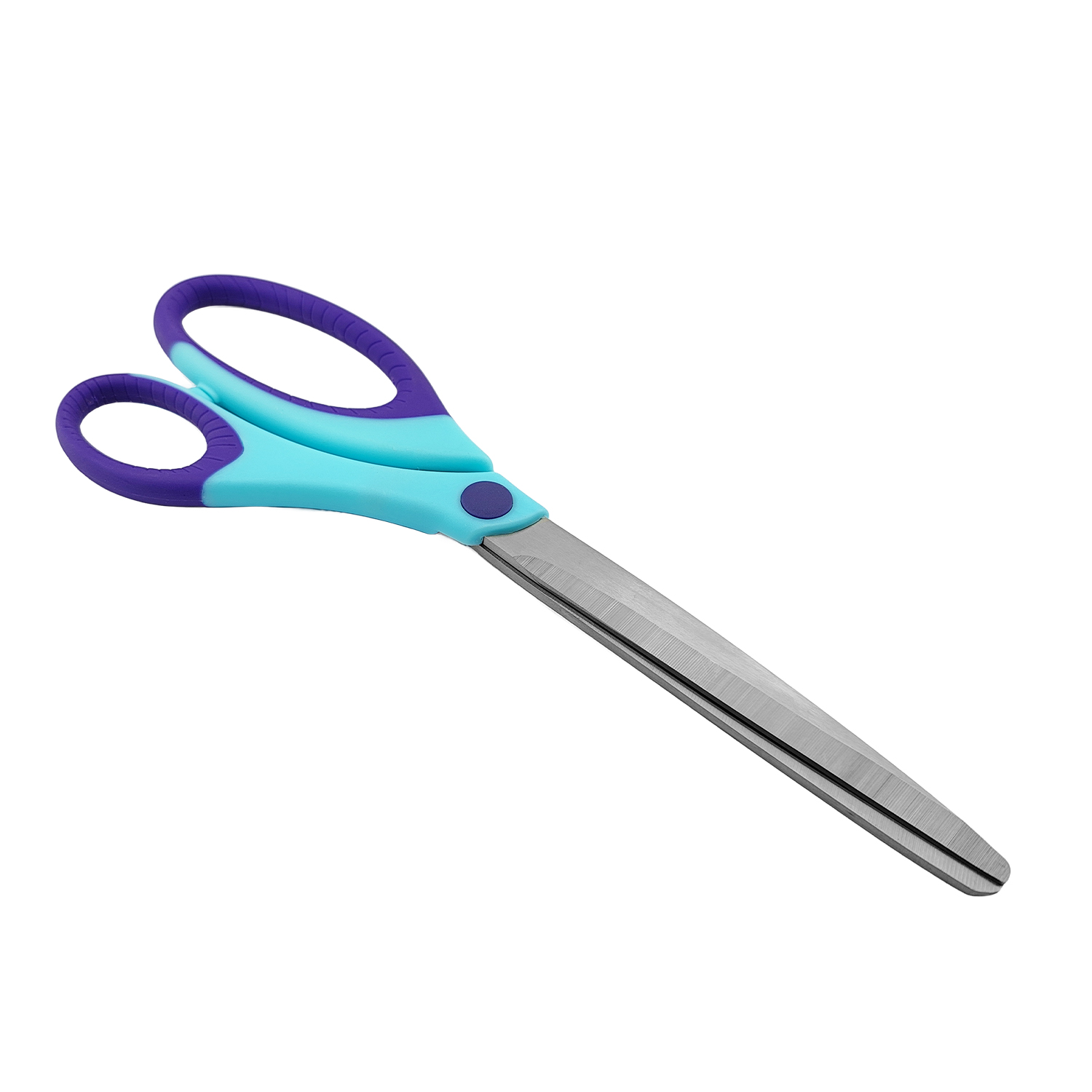
Discover the Charm of OEM Soft Grip Scissors
OEM soft grip scissors are a familiar item in household, school, office, and craft categories, but sourcing them well requires more than choosing a handle color. Buyers need to balance comfort, blade performance, packaging, appearance, and supplier communication. The original product presentation highlights a soft grip handle design, vibrant turquoise and purple handles, and stainless steel blades for everyday cutting tasks. Those are useful starting points, especially for retailers, importers, and private-label brands building a practical scissors range.

This guide explains how to assess OEM soft grip scissors from a sourcing perspective. It focuses on what buyers should check before placing an order, what questions to ask a household scissors manufacturer, and how to match scissors to real end-user needs without relying on vague marketing claims.
Key Takeaways
- Soft grip scissors should be evaluated for comfort, control, and consistency across repeated cutting tasks.
- Handle color and shape can support shelf appeal, but blade quality and assembly are central to user satisfaction.
- For OEM projects, buyers should confirm customization options, packaging, samples, quality checks, and lead-time expectations directly with the supplier.
- Do not assume material grade, certifications, MOQ, or testing performance unless the supplier provides written confirmation.
What Makes Soft Grip Scissors Useful?
The main value of soft grip scissors is hand comfort. A cushioned handle can reduce pressure points during longer tasks such as cutting paper patterns, trimming packaging, preparing craft materials, or organizing household items. For family use, office drawers, school kits, and DIY sets, this comfort can make a noticeable difference compared with hard plastic handles.
The original article also mentions stainless steel blades and a smooth cutting experience on paper, fabric, and cardboard. For sourcing decisions, buyers should treat this as a product feature to verify through samples. Ask whether the blade material, edge finish, screw tension, and surface treatment can remain consistent across production batches. A pair of scissors that performs well in one sample but varies in bulk production can create returns and negative reviews.
OEM Design: Color, Grip, and User Fit
OEM scissors often need to fit a specific retail position. A turquoise and purple handle combination may work well for craft, home organization, or colorful stationery assortments. Other buyers may prefer neutral colors for professional office ranges or coordinated colors for seasonal promotions. The important point is to connect design choices with the target user, not only with visual preference.
Handle size and opening shape should also be reviewed. A design that feels comfortable for one hand size may not suit all users. If the scissors are intended for general household use, request samples and test them with several users. Check whether the grip feels stable, whether the handle edges press into the fingers, and whether the scissors can be opened and closed smoothly without excessive force.
Comparison Checklist for Buyers
| Evaluation Point | What to Check | Questions to Ask the Supplier |
|---|---|---|
| Handle comfort | Softness, finger space, grip stability, edge smoothness | Can the handle material, color, or texture be customized? |
| Blade performance | Cutting paper, fabric, cardboard, and packaging samples | What blade material and thickness are used, and can these be documented? |
| Assembly quality | Screw tension, alignment, smooth opening and closing | How is consistency checked during production? |
| Appearance | Color matching, surface finish, logo position, retail appeal | What artwork files are needed for private-label branding? |
| Packaging | Retail display, protection during shipping, barcode placement | What packaging formats are available for OEM orders? |
| Commercial terms | MOQ, lead time, sample cost, payment terms | Can the supplier confirm all terms in a written quotation? |
How to Test Samples Before Ordering
Sample testing should be simple, repeatable, and practical. A buyer does not need a laboratory to identify many common issues. Start by checking several pairs, not just one. Open and close each pair repeatedly. Listen for scraping sounds, feel for wobble, and check whether the blades meet evenly from the pivot to the tip.
- Cut standard copy paper in straight and curved lines to check smoothness and control.
- Cut thin cardboard or packaging material to evaluate strength and hand comfort.
- Cut fabric only if the product will be marketed for craft or textile use.
- Inspect the handle after use for loose parts, sharp edges, or visible defects.
- Compare multiple samples to see whether performance is consistent.
If the supplier provides stainless steel blades, ask for the exact grade and whether it can be stated on packaging. If not documented, avoid making grade-specific claims in retail copy. Clear product descriptions reduce compliance risk and help customers understand what they are buying.
Packaging and Private-Label Considerations
Packaging can influence both retail presentation and logistics. Soft grip scissors may be sold in blister cards, hanging cards, paper sleeves, or multipack formats, depending on the sales channel. For e-commerce, protection during transport matters as much as shelf display. For supermarkets or stationery stores, hang-hole placement, barcode readability, and product visibility may be more important.
Private-label buyers should prepare artwork, logo files, color references, warning text, and barcode requirements early. Ask the manufacturer whether packaging artwork will be checked before production and whether pre-production samples can be approved. Also clarify who is responsible for translation, labeling, and any market-specific requirements. The supplier can provide production support, but the buyer should verify legal and retail obligations for the destination market.
Questions to Ask a Household Scissors Manufacturer
For OEM sourcing, the best supplier conversations are specific. Instead of asking only for the lowest price, ask questions that reveal process control and communication quality. Useful questions include:
- What handle colors and soft grip options are currently available?
- Can you provide samples that match the proposed bulk production materials?
- What blade material, blade thickness, and surface finish are used?
- What quality checks are performed for blade alignment and handle defects?
- What are the MOQ, sample timeline, production lead time, and packaging options?
- Can all specifications be confirmed in a written quotation or product sheet?
These questions help prevent misunderstandings. They also make it easier to compare suppliers on more than price. A slightly higher unit cost may be acceptable if the product is more consistent, the packaging is better suited to the channel, or the supplier communicates clearly.
Positioning Soft Grip Scissors in a Product Range
OEM soft grip scissors can serve several product positions. For household ranges, they can be promoted as comfortable scissors for everyday cutting. For craft categories, color and grip comfort may be emphasized. For office and school assortments, durability, clean cutting, and practical packaging may matter more. The product message should match the end user and avoid exaggerated promises.
If the scissors are part of a wider houseware or stationery program, consider whether the handle colors coordinate with other products. Consistent color families can make a range easier to merchandise. However, visual coordination should not replace product testing. The best retail results usually come from combining reliable performance with a clear, simple presentation.
FAQ
Are OEM soft grip scissors suitable for everyday home use?
Yes, they can be suitable for common household tasks such as cutting paper, light packaging, labels, and craft materials. Buyers should test samples against the exact use cases planned for the product listing.
Can handle colors be customized for private-label orders?
Color customization may be possible, but it depends on the supplier, materials, order quantity, and production setup. Ask the manufacturer to confirm available colors, color-matching process, and any MOQ requirements.
What should buyers verify before claiming stainless steel blades?
Ask the supplier to provide the blade material details in writing. If a specific stainless steel grade is important for your market, confirm it before packaging or marketing text is approved.
How can I compare two scissors suppliers?
Compare sample consistency, blade alignment, handle comfort, packaging quality, communication speed, written specifications, MOQ, lead time, and after-sales support. Price is important, but it should not be the only factor.
What is the most common sourcing mistake?
A common mistake is approving one attractive sample without testing multiple pieces or confirming the production specification. Always document the agreed product details before moving to bulk production.
