




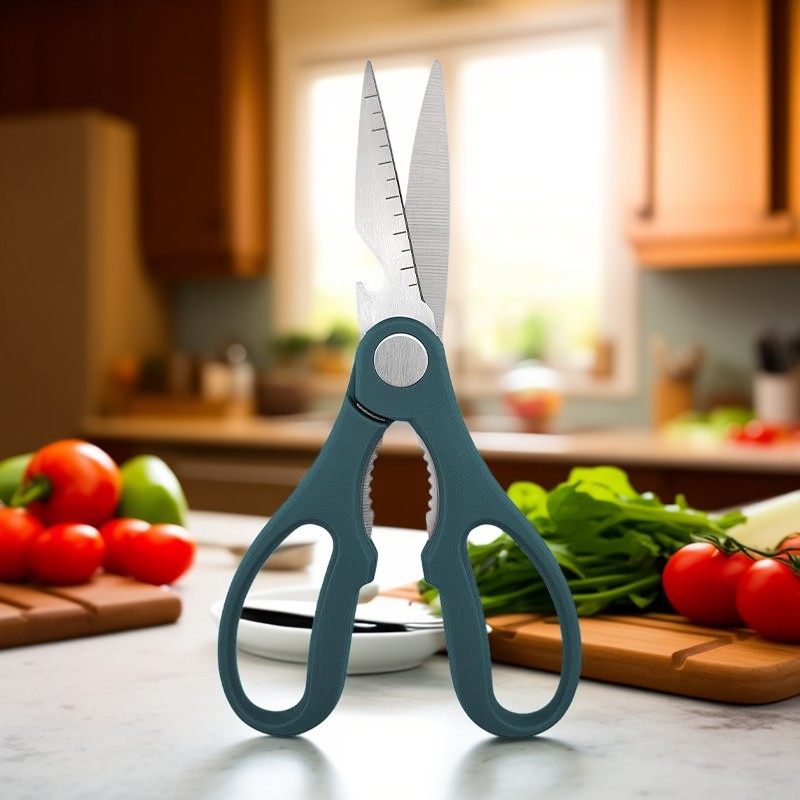
Magnetic Kitchen Scissors: Practical Buying and Use Guide
Magnetic kitchen scissors are designed for cooks who want one compact tool for everyday cutting, trimming, and small household tasks. The original article highlights several useful features: stainless steel blades, serrated cutting edges, an integrated nutcracker, a bottle-opener ridge, ergonomic handles, a matte finish, and in many cases a protective sheath. Those features can be helpful, but the best choice still depends on how the scissors will be used, how they will be stored, and how easy they are to clean after contact with food.
This guide explains what magnetic kitchen scissors can do, what to check before buying, and how to care for them so they remain safe and practical in a busy kitchen. It is written for product selection rather than as a sales brochure, because small details such as blade shape, handle comfort, storage method, and cleaning access can make a large difference in daily use.
Key Takeaways
- Choose kitchen scissors based on real tasks: herbs, poultry trimming, packaging, nuts, and general prep all place different demands on the tool.
- Serrated edges can help grip slippery food or tough packaging, while stainless steel blades are commonly chosen for durability and corrosion resistance.
- A sheath improves drawer safety and helps protect the blade edge when the scissors are not in use.
- Integrated tools such as a nutcracker or bottle opener are useful only if they are comfortable to grip and easy to clean.
- Ask suppliers clear questions about materials, cleaning instructions, blade construction, magnetic storage, and replacement packaging before ordering in quantity.
What Makes Magnetic Kitchen Scissors Different?
The defining idea behind magnetic kitchen scissors is convenient storage and quick access. Instead of disappearing in a crowded drawer, a magnetic design can make the scissors easier to keep near a food-prep area, provided the storage location is safe and stable. Buyers should confirm exactly what is magnetic: the scissors themselves, a sheath, a holder, or a storage accessory. The original product text refers to magnetic kitchen scissors but does not specify the magnet location or holding strength, so that detail should be verified before purchase.
Beyond storage, these scissors are described as multipurpose kitchen shears. Their value comes from combining cutting blades with extra functions such as a nutcracker and bottle opener. This can reduce the number of small tools needed for light kitchen tasks, but it should not replace specialized tools for heavy-duty cutting, bones, hard shells, or commercial food preparation unless the supplier confirms suitable use.
Common Tasks and Where the Features Help
For everyday cooking, kitchen scissors can be faster than a knife and cutting board. They are useful for snipping herbs, opening sealed food bags, trimming vegetables, cutting parchment, portioning soft ingredients, and handling some packaging. Serrated blade edges can improve grip on slippery surfaces, helping the scissors bite into food or plastic rather than sliding away.
The built-in nutcracker mentioned in the source may be useful for cracking walnuts or similar shells. However, shell hardness varies, and using excessive force can damage a tool that was designed for occasional household use. The bottle-opener ridge is another convenience feature, especially for kitchens, outdoor meals, or break rooms where a separate opener is not always nearby.
Feature Comparison Checklist
| Feature to Check | Why It Matters | Questions to Ask |
|---|---|---|
| Stainless steel blades | Supports durability and easier cleaning in kitchen environments | What stainless steel type is used, and what care instructions apply? |
| Serrated edge | Helps grip herbs, packaging, and slippery foods | Is one blade serrated or both, and can the edge be sharpened? |
| Ergonomic handle | Reduces hand fatigue during repeated cutting | What hand size is the handle designed for, and is it suitable for left-handed users? |
| Nutcracker section | Adds utility for walnuts and similar shells | What types of nuts are recommended, and what should be avoided? |
| Protective sheath | Improves drawer safety and helps protect blade edges | Is the sheath included, removable, washable, and securely fitted? |
| Magnetic storage | Keeps scissors accessible and may reduce drawer clutter | Where is the magnet located, and what surfaces are compatible? |
How to Choose Kitchen Scissors for Home Use
Start by listing the jobs you expect the scissors to perform most often. If the main use is cutting herbs, opening bags, and trimming soft foods, comfort and cleaning access may matter more than heavy force. If you want to crack nuts or open bottles, check whether the handle shape gives enough leverage without pinching the hand.
Look closely at the blade length and tip shape. Longer blades can cut packaging and greens quickly, while shorter blades may feel easier to control. A pointed tip is useful for piercing packaging, but it also needs safer storage. If children or shared kitchen users may access the drawer, a protective sheath becomes more important.
Handle material and texture also affect safety. Smooth handles may be easy to wipe clean, but they can become slippery when wet. A comfortable grip should allow firm control without forcing the wrist into an awkward angle. If possible, compare samples before buying multiple units.
Cleaning, Safety, and Care
Kitchen scissors touch many surfaces, including raw ingredients, food packaging, herbs, and sometimes shells. Clean them promptly after use, especially after contact with meat, fish, or sticky foods. Follow the supplier's care instructions for dishwasher use, soaking, and drying. If no dishwasher guidance is provided, hand washing and immediate drying are usually the safer assumption for preserving edge quality and reducing corrosion risk.
- Rinse away food particles soon after cutting.
- Wash the blades, handle grooves, nutcracker area, and opener ridge with warm water and mild dish soap.
- Use a small brush for tight areas where residue can collect.
- Dry fully before returning the scissors to a sheath, drawer, or magnetic holder.
- Store with the blade covered or fixed securely away from children and high-traffic counter edges.
Do not use kitchen scissors for tasks outside their intended scope, such as cutting wire, hard plastic, bones, or frozen food unless the supplier specifically states that the product is designed for those uses. Misuse can dull the blade, loosen the pivot, or create safety risks.
Guidance for Wholesale, OEM, and Supplier Buyers
For B2B sourcing, product appearance is only one part of the decision. A matte finish and compact design may look appealing, but buyers also need consistent quality, clear packaging information, and realistic use instructions. Because the original article does not provide manufacturing capacity, MOQ, certifications, testing results, or detailed specifications, those points should be treated as supplier questions rather than assumptions.
Before placing a wholesale or OEM order, ask for a complete specification sheet covering blade material, handle material, product dimensions, magnet design, sheath inclusion, unit weight, packaging options, care instructions, and recommended applications. Request samples from the same production route intended for bulk supply, then test them for grip comfort, cutting performance, sheath fit, cleaning access, and finish consistency.
If you plan to sell in a specific market, ask the supplier what documents are available and independently confirm any compliance obligations for that market. Avoid printing claims such as food-grade status, dishwasher safety, anti-rust performance, or professional-grade durability unless they are supported by appropriate documentation from the supplier and your own review process.
FAQ
Are magnetic kitchen scissors safe to store on a refrigerator or metal rail?
They can be convenient, but safety depends on magnet strength, surface compatibility, blade coverage, and household traffic. Confirm the intended storage method with the supplier and avoid locations where the scissors can be knocked down.
Can these scissors replace a chef's knife?
No. They are useful for quick cutting tasks, herbs, packaging, and light prep, but knives and cutting boards are still better for precise slicing, chopping, and larger ingredients.
Is a sheath necessary?
A sheath is strongly recommended for drawer storage because it protects fingers and helps prevent the blade edge from rubbing against other utensils.
Can the nutcracker handle all nuts?
Not necessarily. The source mentions walnuts, but different shells require different force. Ask the supplier which nuts are suitable and avoid using excessive pressure.
What should B2B buyers verify before ordering?
Confirm materials, dimensions, magnet placement, sheath design, packaging, cleaning instructions, sample quality, labeling needs, and any documentation required for the target market.
