




Kitchen Scissors Manufacturer Guide for OEM Buyers
Kitchen scissors are a small product category with a large impact on the user experience. A pair may be used for cutting herbs, trimming meat, opening food packaging, portioning vegetables, or handling everyday kitchen tasks that do not require a knife and cutting board. For retailers, importers, promotional brands, and private-label kitchenware buyers, the challenge is not simply finding a kitchen scissors manufacturer. The real task is choosing a supplier that can translate your target market, packaging plan, feature requirements, and quality expectations into a consistent finished product.
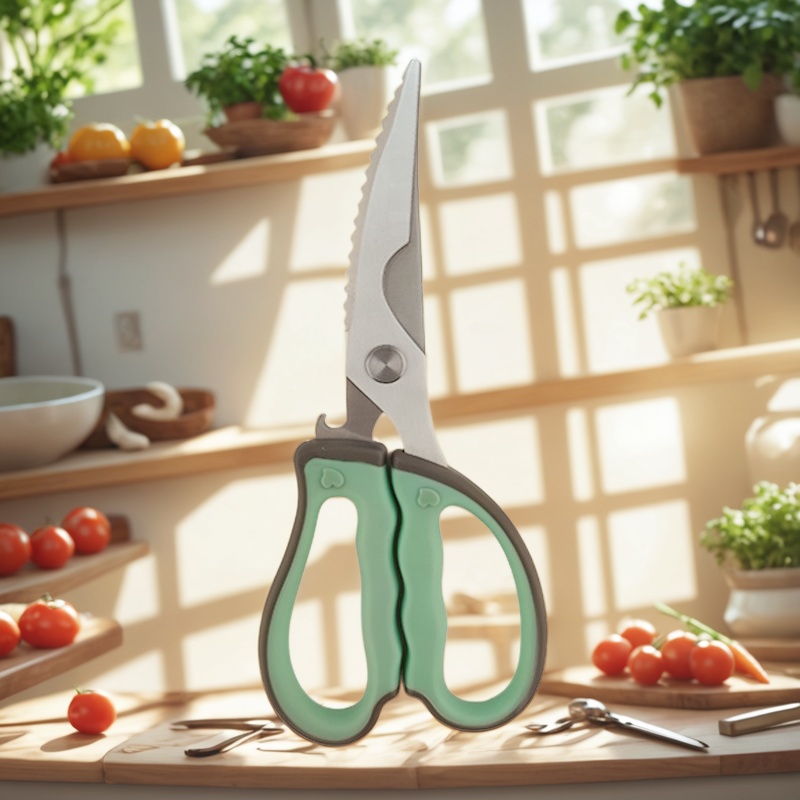
The original product information highlights Bonet Houseware Co., Ltd. as a contact point for kitchen scissors and references Yangjiang kitchen scissors OEM services. It also describes a multi-purpose kitchen scissors design with mint green handles, stainless steel blades, one serrated edge, one conventional edge, and integrated functions such as a bottle opener and nutcracker. Those details are useful starting points, but a sourcing decision should still be based on clear specifications, samples, inspection criteria, and commercial questions answered in writing.

Key Takeaways
- Define the target use first: meat trimming, herb cutting, packaging, household utility, or a multi-function kitchen tool.
- Ask the manufacturer to confirm material, blade treatment, handle material, packaging, MOQ, lead time, and inspection standards before ordering.
- Evaluate samples for cutting performance, pivot smoothness, grip comfort, cleaning convenience, and consistency between units.
- Do not rely only on product photos; request drawings, pre-production samples, and agreed acceptance criteria.
- For OEM kitchen scissors, branding, packaging, labeling, and compliance requirements should be discussed early.
What Buyers Should Look For in Kitchen Scissors
A good pair of kitchen scissors needs to perform several jobs without feeling awkward or unsafe. Blade alignment matters because poor alignment can cause slipping, crushing, or uneven cutting. The pivot should open and close smoothly without excessive looseness. Handles should feel stable in the hand, especially when the user is cutting wet or dense food. If the design includes a serrated edge, the teeth should help grip meat or slippery surfaces rather than tear excessively.
The source article describes a dual-action blade layout: one serrated edge for gripping tougher meats and a conventional edge for smoother slicing of vegetables and herbs. This is a common and practical approach for multi-purpose kitchen shears. However, buyers should confirm the exact blade material, hardness target, edge geometry, and corrosion-resistance expectations with the supplier instead of assuming a grade or performance level that has not been stated.
OEM Sourcing From a Manufacturing Hub
Yangjiang is widely associated with knife and blade manufacturing, and the original article positions Yangjiang kitchen scissors OEM services as part of that manufacturing ecosystem. For B2B buyers, location can be helpful because it may support access to component suppliers, tooling resources, and production know-how. Still, location alone is not a quality guarantee. The supplier’s process control, sample discipline, communication, and willingness to document requirements are more important than a broad regional reputation.
When discussing OEM kitchen scissors, ask whether the supplier can support your required handle color, logo placement, blister card or box packaging, instruction leaflet, barcode labeling, carton marks, and market-specific language. If your product will be sold through retailers or online marketplaces, packaging durability and product presentation can be as important as the scissors themselves.
Product Feature Checklist for Multi-Purpose Kitchen Shears
| Feature or Decision Point | Why It Matters | Questions to Ask the Supplier |
|---|---|---|
| Blade design | Determines cutting performance for meat, herbs, vegetables, and packaging. | Is one edge serrated? What cutting tests are used during inspection? |
| Blade material | Affects sharpness retention, corrosion resistance, and cleaning expectations. | What material grade is used, and can it be confirmed in the specification sheet? |
| Handle design | Influences comfort, control, and perceived product quality. | What handle material is available, and can the color be customized? |
| Integrated tools | Functions such as a bottle opener or nutcracker can add utility but also complexity. | Are these features included in the standard model or optional OEM variations? |
| Pivot construction | Controls smooth opening, stability, and long-term usability. | How is pivot tightness checked during production? |
| Packaging | Protects the product and communicates value to the buyer or end user. | What packaging formats are available, and can artwork be approved before production? |
How to Evaluate Samples Before Ordering
Sample review should be structured. Avoid judging only the appearance of one attractive sample. Test several units if possible, and use the same tasks your customers are likely to perform. Cut herbs, thin plastic packaging, poultry skin, cooked food packaging, and light cardboard if those uses match your market. Check whether the blades meet cleanly from pivot to tip and whether the handles remain comfortable after repeated use.
- Inspect the finish for burrs, sharp handle edges, stains, loose parts, or inconsistent color.
- Open and close each unit repeatedly to check pivot smoothness and blade alignment.
- Test cutting performance on realistic kitchen materials rather than only paper.
- Wash and dry the sample according to the expected care instructions, then inspect for changes.
- Compare all samples against the same written specification and record any variation.
If the sample includes mint green ergonomic handles, stainless steel blades, a serrated edge, a conventional edge, a bottle opener, and a nutcracker, document each of those elements in your approval file. That prevents confusion when the purchase order is placed and helps both sides identify whether later production matches the approved sample.
Quality Control Points to Confirm
Precision manufacturing matters because kitchen scissors combine blade performance, mechanical movement, and hand comfort in one compact tool. Buyers should ask how incoming materials are checked, how in-process blade alignment is controlled, and what final inspection standards apply. If the product will be sold in a regulated market, ask the supplier what documents can be provided and verify whether they match your importer or retailer obligations. Do not assume certifications, test results, or compliance claims unless the supplier provides current, relevant documents for the exact product and order.
Useful inspection criteria may include appearance, dimensions, blade sharpness, pivot function, handle color, logo accuracy, packaging condition, carton labeling, and quantity per carton. For private-label projects, keep an approved golden sample and signed artwork file. If your order uses custom packaging, request a pre-production packaging proof before mass production.
Commercial Questions for OEM Buyers
Before selecting a kitchen scissors supplier, gather answers to the practical business questions that affect cost, timing, and risk. Ask about MOQ, sample fees, tooling charges if custom parts are required, production lead time, payment terms, packaging options, inspection arrangements, and shipping support. If you need exclusivity for a handle color, design, or market, discuss it before investing in artwork or tooling.
It is also wise to ask how changes are managed. A small change in blade thickness, pivot hardware, handle material, or packaging tray can affect performance and user perception. Require written approval for any substitution. Clear communication is especially important when sourcing OEM kitchen scissors for a brand that must maintain consistent reviews and repeat orders.
FAQ
What makes kitchen scissors different from ordinary scissors?
Kitchen scissors are designed for food preparation and kitchen utility tasks. Depending on the model, they may include stronger blades, a serrated gripping edge, larger handles, or integrated tools such as a bottle opener or nutcracker.
Can a manufacturer customize kitchen scissors for private label orders?
Many OEM suppliers can discuss logo, color, packaging, and feature adjustments, but buyers should confirm available options, MOQ, tooling needs, lead time, and artwork requirements directly with the supplier.
What should I ask before approving a sample?
Ask for the exact material specification, blade design, handle material, color standard, packaging details, inspection criteria, and whether the approved sample will be used as the production reference.
Are stainless steel blades always the same quality?
No. Stainless steel is a broad category. Buyers should ask the supplier to state the exact grade or specification used for the order and provide documentation when required.
How can I reduce sourcing risk?
Use a written specification, approve samples carefully, confirm packaging artwork, define inspection standards, and arrange pre-shipment inspection when order value or customer requirements justify it.
