









Discovering a Top Scissors Factory for Kitchen Scissors
Finding the right scissors factory is not only about locating a producer that can make a sharp cutting tool. For importers, distributors, kitchenware brands, and promotional product buyers, the decision also affects product consistency, packaging options, after-sales risk, and long-term supply reliability. Kitchen scissors are a practical everyday tool, but small design details can make a major difference in how consumers judge comfort, safety, cleaning, and usefulness.
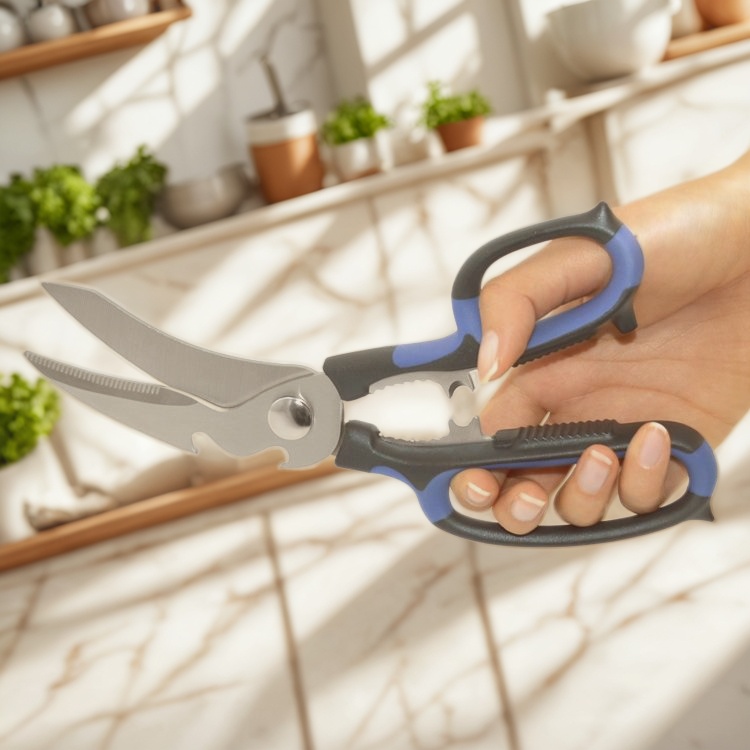
The original Bonet Houseware product article highlights multifunctional kitchen scissors with black and blue handles, a thumb-controlled unlocking mechanism for easy disassembly, a micro-serrated edge, and added functions such as a bottle opener or nutcracker. Those details are useful starting points. This revised guide explains how B2B buyers can evaluate a scissors factory, compare features, and prepare better questions before requesting samples or quotations.
Key Takeaways
- A good kitchen scissors sourcing process starts with sample evaluation, not only catalogue photos.
- Multifunctional features can add value, but each function should be tested for comfort and practical use.
- For OEM kitchen scissors, ask suppliers about tooling, handle color options, packaging, branding methods, and approval samples.
- Do not assume material grade, certification, MOQ, or production capacity unless the supplier confirms it with documentation.
- Detachable designs can make cleaning easier, but the locking and unlocking mechanism should feel secure and intuitive.
What Buyers Should Look for in a Scissors Factory
A capable scissors factory should be able to explain how its kitchen scissors are designed, assembled, inspected, and packed. Buyers should ask whether the factory produces standard catalogue items, supports OEM customization, or works with trading partners. None of these models is automatically better; the right choice depends on order size, timeline, customization needs, and quality expectations.
Start by requesting clear product photos, a sample policy, packaging details, and a product specification sheet. If specifications are incomplete, ask direct questions rather than making assumptions. For example, confirm blade material, handle material, product weight, surface finish, carton packing, and whether replacement parts or spare packaging can be supplied. If compliance testing is required for your market, ask what documentation is available and whether new testing can be arranged through a recognized lab.
Multifunctional Kitchen Scissors: Useful Features to Compare
Kitchen scissors are often expected to do more than cut paper or plastic bags. The product described in the original article includes multifunctional use for snipping herbs, cutting meats, opening bottles, and cracking nuts. These features can appeal to retailers because they create a more versatile product story, but buyers should still verify whether each function performs reliably.
When reviewing samples, test the scissors on common kitchen tasks. Cut herbs to see whether the blades crush or slice cleanly. Try meat or poultry packaging tasks with appropriate food-safety handling. Test the bottle opener and nutcracker functions for hand comfort, stability, and leverage. If the tool is marketed as multifunctional, the extra functions should not interfere with basic cutting performance.
Design Details: Handles, Locking, and Cleaning
The original product description mentions black and blue handles and an ergonomic design. Handle comfort matters because kitchen scissors are often used with wet hands, during repetitive preparation tasks, or by users with different hand sizes. Buyers should check whether the grip feels balanced, whether edges are smooth, and whether the handle opening works for the intended customer group.
The thumb-controlled unlocking mechanism is another important feature. A detachable or easily disassembled design can support more convenient cleaning, especially when scissors are used around food. However, the mechanism should not feel loose during cutting. Ask the supplier how the disassembly feature is demonstrated, whether instructions are included, and whether the product can be packed with user guidance for retail sales.
Micro-Serrated Edges and Cutting Performance
A micro-serrated edge is useful because it can help grip slippery foods or materials while cutting. This can be especially relevant for kitchen scissors used on herbs, meat, poultry skin, or flexible packaging. Still, buyers should avoid judging the blade only by appearance. Cutting performance depends on blade alignment, edge finishing, pivot tightness, and overall build quality.
During sample testing, compare several pieces from the same batch if possible. Open and close the scissors repeatedly. Listen for scraping, check whether the tips meet properly, and test whether the blades cut cleanly near the pivot as well as near the tip. If one sample performs well but another feels inconsistent, discuss inspection standards with the supplier before moving forward.
Comparison Checklist for OEM Kitchen Scissors Sourcing
| Evaluation Area | What to Check | Questions to Ask the Supplier |
|---|---|---|
| Basic cutting | Sharpness, blade alignment, smooth opening and closing | What inspection steps are used before packing? |
| Multifunctional features | Bottle opener, nutcracker, herb and meat cutting performance | Can each function be demonstrated with samples or videos? |
| Handle design | Comfort, grip size, black and blue color accuracy | Are handle colors customizable for OEM orders? |
| Disassembly mechanism | Thumb-controlled unlocking, ease of cleaning, secure locking | Are user instructions or warning labels available? |
| Branding and packaging | Logo placement, retail card, box, carton markings | What artwork files and approval samples are required? |
| Commercial terms | MOQ, lead time, payment terms, sample cost | Can these details be confirmed in a written quotation? |
OEM and Wholesale Questions to Ask Before Ordering
OEM sourcing requires more discipline than buying a ready-made product. Even if the product looks simple, details such as handle color, logo position, packaging thickness, barcode placement, and carton labeling can cause delays if they are not confirmed early. Before placing an order, prepare a written checklist and ask the factory or supplier to confirm each item.
- What blade and handle materials are used, and can they be documented?
- What customization options are available for color, logo, packaging, and instructions?
- What is the minimum order quantity for standard and customized versions?
- How long do samples and mass production usually take?
- What quality inspection criteria are used for sharpness, assembly, appearance, and packaging?
- Can the supplier support third-party inspection if the buyer requests it?
- What documents are available for export, customs, or retailer requirements?
These questions do not imply that every supplier will offer every service. They help buyers identify whether a factory is suitable for their channel, whether that channel is wholesale, private label, e-commerce, supermarket retail, or promotional distribution.
Sample Testing and Quality Control Tips
Samples are essential because kitchen scissors are judged by feel as much as by specifications. Ask for production-representative samples, not only showroom pieces. If possible, test the same model several times and record observations. A simple internal test sheet can include cutting performance, handle comfort, disassembly, locking security, surface finish, packaging appearance, and any safety concerns.
For larger orders, discuss pre-shipment inspection. Buyers may want to define acceptable quality limits, carton drop requirements, barcode checks, or packaging artwork verification. If your market has specific compliance rules for kitchenware, confirm them with your own compliance advisor and ask the supplier what support they can provide. Avoid relying on verbal claims when documentation is required.
Practical FAQ
What makes multifunctional kitchen scissors different from regular scissors?
Multifunctional kitchen scissors are designed for kitchen tasks and may include added functions such as a bottle opener, nutcracker, detachable cleaning design, or micro-serrated cutting edge. Buyers should test every advertised function before approving a product.
Are detachable kitchen scissors easier to clean?
They can be easier to rinse and dry because the blades separate, but the unlocking mechanism must be secure and simple to operate. Ask whether care instructions are included for end users.
Can a scissors factory make OEM kitchen scissors with custom branding?
Many suppliers offer some form of OEM service, but options vary. Ask about logo methods, handle colors, packaging design, sample approval, MOQ, and lead time before assuming customization is available.
What should I verify before placing a wholesale order?
Confirm specifications, sample quality, packaging, carton details, inspection criteria, commercial terms, and required documents. If certifications or testing are needed for your market, request written evidence or arrange new testing.
How should buyers compare two similar kitchen scissors suppliers?
Compare sample consistency, response accuracy, willingness to document specifications, packaging support, communication speed, and quality-control process. The lowest quotation is not always the best sourcing decision if product consistency is uncertain.
Final Thoughts
A strong scissors factory partner should help buyers understand both the product and the sourcing process. Multifunctional kitchen scissors with ergonomic handles, a thumb-controlled unlocking mechanism, micro-serrated edges, and added tools can be attractive for retail and OEM programs. The best results come from careful sample testing, clear written specifications, and direct questions about customization, documentation, and inspection before production begins.
