




Dressmaking Scissors Factory: Precision & Quality
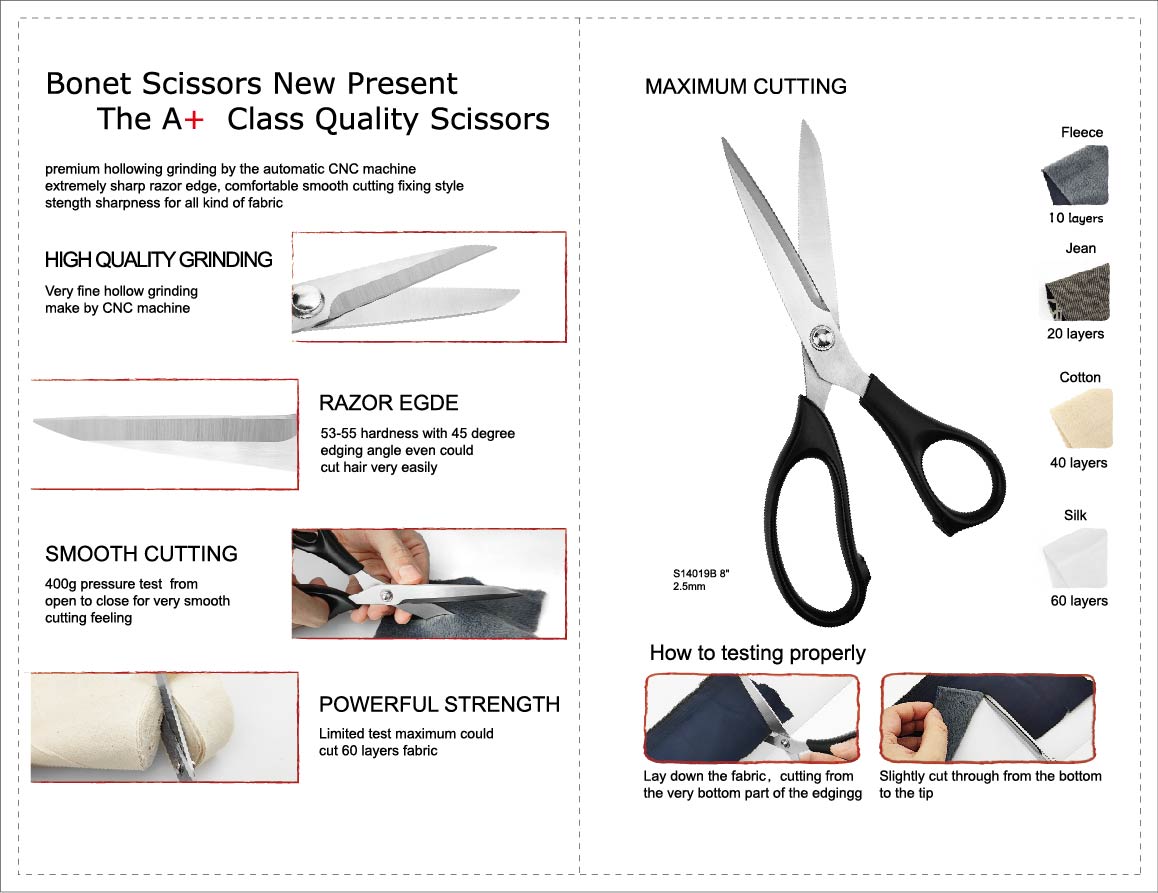
Choosing a dressmaking scissors factory is not only about finding a sharp pair of blades. For wholesalers, sewing-tool brands, garment supply distributors, and OEM buyers, the real question is whether a supplier can deliver consistent cutting performance, comfortable handling, and dependable quality from batch to batch. Dressmaking scissors are used on delicate silk, dense denim, cotton, lining fabric, pattern paper, and layered textile stacks, so small differences in blade alignment, edge finishing, and handle balance can affect the user experience.
This guide rewrites the key product ideas into practical sourcing advice. It explains what to look for when assessing professional dressmaking scissors, what facts can be verified from the current Bonet scissors description, and which commercial details buyers should confirm directly with any factory before placing an order.
Key Takeaways
- Professional dressmaking scissors should be assessed for edge sharpness, blade alignment, cutting smoothness, handle comfort, and batch consistency.
- The existing Bonet product description states hollow grinding by CNC machines, razor-edge blades, hardness of 53-55, and an 8-inch ergonomic design.
- Layer-cutting claims, packaging options, OEM branding, inspection standards, MOQ, and lead time should be confirmed in writing with the supplier.
- For B2B sourcing, sample approval and pre-shipment inspection are as important as the initial quotation.
What Defines a Reliable Dressmaking Scissors Factory?
A reliable dressmaking scissors factory should be able to explain how it controls the most important parts of scissor production: blade shaping, grinding, edge finishing, pivot adjustment, handle assembly, and final inspection. Dressmaking scissors require a clean, continuous cut from the heel of the blade to the tip. If the blades are misaligned or the pivot is too loose, fabric may fold, snag, or fail to cut cleanly at the end of the stroke.
For buyers, factory evaluation should move beyond appearance. A polished product photo does not prove stable quality. Ask how samples are checked, whether each production batch follows the approved sample, and what inspection criteria are used for sharpness, opening-and-closing action, handle fit, and surface finish. If you plan to sell under your own brand, also ask how private label artwork, cartons, barcodes, and user instructions are handled.
Product Details Preserved from the Original Article
The original article describes Bonet scissors as professional dressmaking scissors designed for smooth textile cutting. It states that the scissors are engineered with premium hollow grinding by advanced CNC machines. It also describes razor-edge blades with a hardness of 53-55. These details are useful for buyers because blade geometry and hardness both influence edge retention, cutting feel, and long-term performance.
The source article also states that the scissors have been tested to cut up to 60 layers of silk, 20 layers of denim, or 40 layers of cotton. Because layer-cutting results can depend on fabric thickness, weave, tension, and operator method, B2B buyers should request the supplier’s exact test conditions before using such claims in catalogs or online listings. The original also identifies an 8-inch Bonet scissors model with an ergonomic design intended to provide a stable, comfortable grip during extended use.
Comparison Checklist for Sourcing Dressmaking Scissors
Use the table below when comparing factories or evaluating samples. It focuses on practical checks that procurement teams, importers, and brand owners can apply before approving a production order.
| Evaluation Area | What to Check | Questions to Ask the Supplier |
|---|---|---|
| Blade edge | Clean cut from base to tip without chewing fabric | How is blade sharpness inspected before packing? |
| Grinding method | Consistent blade profile and smooth contact between blades | Is hollow grinding used for this model, and how is it controlled? |
| Hardness | Balance between edge retention and toughness | Can the stated hardness range be verified for the ordered batch? |
| Pivot action | Smooth opening and closing without looseness | Is pivot tension adjusted manually, mechanically, or both? |
| Handle comfort | Stable grip, suitable finger opening, reduced pressure points | Can handle color, material, or packaging be customized? |
| Batch consistency | Samples match bulk production in finish and cutting feel | What is the inspection plan for mass production? |
How to Test Samples Before Placing an Order
Before discussing a large order, request production-representative samples rather than display-only samples. Test them on fabrics that match your target customer’s real use: lightweight silk, woven cotton, denim, felt, or pattern paper. Cut straight lines, curves, and short notches. Pay attention to whether the scissors push fabric forward, whether the tips cut precisely, and whether the blades feel smooth through the full stroke.
A simple sample test plan can include:
- Inspect the surface finish, handle fit, blade alignment, and packaging condition.
- Open and close the scissors repeatedly to check pivot smoothness and noise.
- Cut single layers and multiple layers of different fabrics.
- Check tip accuracy on small curves and notches.
- Record whether hand fatigue or pressure points appear after repeated cutting.
- Compare at least three samples from the same supplier for consistency.
If a supplier makes strong performance claims, ask for the test method, material description, and whether the results apply to the specific model you intend to buy.
OEM, Wholesale, and Private Label Questions to Confirm
When the search intent is “dressmaking scissors factory,” buyers are usually looking for more than a single retail unit. They may need OEM branding, wholesale cartons, stable reorder supply, or a product line that includes multiple sizes. However, commercial details should not be assumed. Ask clear questions before committing to artwork or listing copy.
- What is the MOQ for the exact model, handle color, and packaging style?
- Can the supplier provide logo printing, laser marking, hang cards, blister packaging, or retail boxes?
- What is the sample lead time and mass-production lead time?
- How are defective products handled after shipment?
- Can the supplier share product dimensions, unit weight, carton size, and packing method for logistics planning?
- Are there any market-specific labeling, safety, or documentation requirements the buyer must arrange?
These questions help avoid misunderstandings. They also make quotations easier to compare because each supplier is responding to the same specifications.
Quality Control Points for Bulk Orders
For bulk sourcing, quality control should be planned before production starts. An approved sample should be kept by both buyer and supplier. The purchase order can reference the model, size, packaging, logo placement, acceptable appearance standard, and cutting-performance requirements. If the order is important to your brand, consider arranging an inspection before the goods leave the factory.
Inspection can include random checks for blade defects, rust, burrs, handle cracks, incorrect packaging, loose pivots, and poor cutting performance. Scissors should not only look acceptable; they should cut smoothly and safely. Because dressmaking customers often rely on these tools for long work sessions, comfort and repeatable performance are part of product quality.
Practical FAQ
What size is commonly useful for dressmaking scissors?
The original article mentions an 8-inch Bonet scissors model. An 8-inch size is often practical for fabric cutting because it offers control while still providing enough blade length for longer cuts. Buyers should confirm the exact size range available from the supplier.
Can I use layer-cutting claims in my marketing?
Only use claims that you can verify. The source article states cutting up to 60 layers of silk, 20 layers of denim, or 40 layers of cotton, but buyers should ask for test conditions and confirm whether the claim applies to their ordered model and materials.
What should I ask before ordering OEM scissors?
Ask about MOQ, logo method, packaging options, sample approval, lead time, inspection standards, and after-sales handling. Do not assume customization is available until the supplier confirms it in writing.
How do I know if a factory sample is good?
A good sample should cut cleanly from base to tip, open smoothly, feel stable in the hand, and show consistent finishing. Test more than one sample and compare performance on fabrics your customers actually use.
Are hardness and grinding important?
Yes. The original description states razor-edge blades with hardness of 53-55 and hollow grinding by CNC machines. These factors can affect sharpness, cutting smoothness, and edge durability, but buyers should still verify specifications for the production batch.
