




How to Choose the Best Vegetable Slicer for Everyday Meal Prep
A good vegetable slicer can make daily cooking more predictable. Instead of uneven cucumber rounds, rushed garnish, or thick vegetable strips that cook at different speeds, the right tool helps you prepare ingredients with better consistency. For home cooks, the goal is not to own every gadget available; it is to choose a small set of tools that match the foods you prepare most often, are easy to clean, and feel safe in the hand.
This guide reviews common options mentioned in the original article: a handheld vegetable slicer, a stainless steel ginger grater, and a three-in-one kitchen grater set. It focuses on practical selection, safe use, cleaning, and when each tool makes sense.
Key Takeaways
- A handheld vegetable slicer is best for quick, thin, uniform slices of cucumbers, carrots, zucchini, and similar vegetables.
- A stainless steel ginger grater is useful when you want smooth ginger or garlic pulp without large fibers.
- A three-in-one grater set gives more flexibility for slicing, shredding, and zesting in a compact format.
- Choose tools based on blade quality, grip comfort, cleaning method, storage space, and the ingredients you use most.
- Even simple slicers require careful handling because sharp blades can cause injuries if used without attention.
Why a Vegetable Slicer Matters in Meal Preparation
Uniform cuts are not just about appearance. Thin, even slices cook at a similar rate, absorb dressings more evenly, and create better texture in salads, pickles, stir-fries, sandwiches, and garnishes. A vegetable slicer can also reduce preparation time when compared with cutting every piece by knife, especially for repetitive tasks such as slicing cucumbers for water, preparing salad toppings, or cutting vegetables for lunch boxes.
However, the best vegetable slicer is not always the largest or most complex model. Many kitchens benefit from a simple handheld slicer because it is easy to reach, quick to rinse, and does not require a large setup area. If a tool is convenient, it is more likely to be used regularly.
Handheld Vegetable Slicer: Best for Thin, Even Cuts
The original article describes a modern handheld slicer with a stainless steel blade, lightweight body, and soft green design. This type of slicer is suitable for cooks who want thin, uniform vegetable pieces without assembling a full mandoline system. It can often be used directly over a plate or bowl, which helps reduce mess and keeps the workflow simple.
When selecting a handheld vegetable slicer, look closely at the blade area and handle shape. A sharp stainless steel blade should cut cleanly without requiring heavy pressure. The handle should feel stable, especially when your hands are damp. A lightweight tool is convenient, but it should not feel flimsy during use.
Use this type of slicer for quick jobs such as cucumber slices, carrot ribbons, zucchini rounds, or radish garnish. For very hard vegetables or large-volume prep, consider whether a larger slicer with a food holder would be safer and more efficient.
Stainless Steel Ginger Grater: For Ginger, Garlic and Fine Pulp
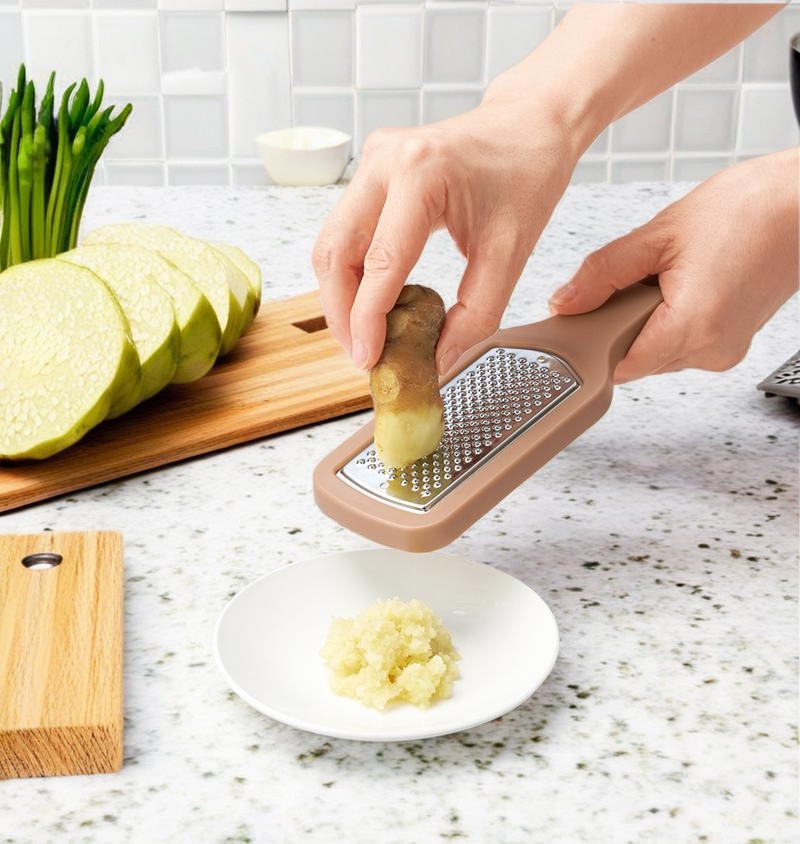
A vegetable slicer is not the right tool for every ingredient. Ginger and garlic often need a finer texture than slicing can provide. The original article highlights a handheld stainless steel ginger grater with an ergonomic form and micro-textured surface designed to produce smooth, less fibrous ginger or garlic pulp.
This style of grater is especially useful for sauces, marinades, soups, stir-fries, dressings, and tea preparations where large ginger fibers are unpleasant. Instead of mincing with a knife, you can rub peeled ginger across the grating surface and collect the pulp directly.
Before buying, consider how easy it is to clean. Ginger fibers and garlic residue can cling to small teeth or textured surfaces. A tool that rinses quickly under running water is easier to maintain. If dishwasher cleaning is important to you, check the supplier or product instructions rather than assuming all stainless steel tools are dishwasher safe.
Three-in-One Grater Set: When Versatility Is More Important
The original article also mentions a three-in-one kitchen grater set with three ergonomic graters for slicing, shredding, and zesting. It describes a green grater for consistent strips, a lime-colored grater for softer items such as cheese, and a yellow fine-tooth grater for citrus zest or ginger.
A set like this works well for people who prepare a wider range of dishes. One tool can handle vegetables for salads, another can process cheese or softer foods, and the fine grater can help with citrus peel, ginger, or other aromatic ingredients. The advantage is flexibility without needing a bulky box grater.
The tradeoff is that sets require more storage space than a single slicer. Before choosing one, ask whether you will use all three pieces. If you only slice cucumbers and carrots, a single handheld vegetable slicer may be enough. If you regularly cook with cheese, citrus zest, ginger, and shredded vegetables, a multi-piece grater set may be more practical.
Comparison Table: Which Kitchen Tool Fits Your Task?
| Tool | Best For | Main Advantage | What to Check Before Buying |
|---|---|---|---|
| Handheld vegetable slicer | Thin vegetable slices, salad prep, garnishes | Fast setup and uniform slicing | Blade sharpness, grip comfort, hand protection, ease of rinsing |
| Stainless steel ginger grater | Ginger, garlic, fine aromatic pulp | Creates smooth texture for sauces and marinades | Surface texture, cleaning difficulty, handle stability |
| Three-in-one grater set | Slicing, shredding, zesting, cheese, ginger | More functions in a compact set | Whether each grater will be used, storage space, dishwasher guidance |
Selection Checklist for Home Cooks
Use the following checklist before adding a vegetable slicer or grater to your kitchen drawer:
- Match the tool to your cooking habits. Choose a slicer for vegetables, a ginger grater for aromatics, or a set if you need several preparation styles.
- Prioritize safe handling. Sharp blades work better but require care. Look for a stable grip and consider whether a finger guard or food holder is needed.
- Check cleaning instructions. Dishwasher-safe claims should come from the product information. If uncertain, hand washing is often the safer default.
- Consider storage. Flat handheld tools are easier to store than large countertop slicers.
- Inspect the blade or grating surface. A tool that tears rather than cuts will create poor texture and require more effort.
Use and Care Tips for Better Results
For clean slices, use firm, fresh vegetables and steady pressure. Do not force food through the blade; if it resists, the vegetable may be too hard, too large, or positioned incorrectly. Cut long vegetables into manageable sections before slicing. Keep fingertips away from the blade path and slow down as the food piece becomes smaller.
Clean slicers and graters soon after use. Starches, vegetable residue, ginger fibers, and cheese can dry onto the surface and become harder to remove. Rinse from the back side of the blade or grating surface when possible to push food particles out safely. Dry the tool before storage to reduce spots and keep the drawer cleaner.
If a blade becomes dull, bent, or damaged, replace the tool or contact the supplier for guidance. A dull slicer is not safer; it often requires more pressure, which can increase the risk of slipping.
FAQ
What is the best vegetable slicer for beginners?
A simple handheld vegetable slicer is often the easiest starting point. It is compact, quick to use, and suitable for common vegetables such as cucumbers, carrots, radishes, and zucchini. Beginners should focus on stable grip and careful hand placement.
Can a vegetable slicer replace a knife?
No. A slicer is useful for repetitive, uniform cuts, but a knife is still needed for trimming, peeling, chopping larger items, and cutting foods that do not fit the slicer safely.
Is a ginger grater useful if I already own a vegetable slicer?
Yes, if you cook with ginger or garlic often. A slicer creates pieces, while a ginger grater creates fine pulp that blends more easily into sauces, marinades, soups, and dressings.
How do I reduce the risk of cutting my fingers?
Use steady pressure, keep fingers away from the blade, stop before the food piece becomes too small to hold safely, and use a food holder if available. Never rush when using sharp kitchen tools.
Should I choose one slicer or a three-in-one grater set?
Choose one slicer if your main task is cutting vegetables into thin pieces. Choose a three-in-one grater set if you also need shredding and zesting functions for cheese, citrus, ginger, or varied meal prep.
Conclusion
The best vegetable slicer is the one that fits your actual cooking routine. A handheld slicer is practical for fast, uniform vegetable cuts. A stainless steel ginger grater is better for fine aromatics. A three-in-one grater set offers broader preparation options when you regularly slice, shred, and zest. By comparing use cases, safety, cleaning, and storage, you can choose kitchen tools that make meal preparation more consistent without adding unnecessary complexity.
