





Expert Kitchen Scissors Factory for OEM Solutions
For brands, importers, wholesalers and kitchenware distributors, choosing a kitchen scissors factory is not only about finding a product that cuts well. It is a sourcing decision that affects product positioning, packaging, quality consistency, after-sales issues and repeat orders. The original article highlighted three useful ideas: factory expertise, OEM manufacturer selection and the advantages of kitchen shears OEM. This expanded guide turns those points into a practical checklist for buyers preparing to source kitchen scissors for private label or customized product lines.
Key Takeaways
- A capable kitchen scissors factory should be evaluated on product consistency, customization support, communication and quality control process.
- OEM kitchen scissors projects require clear specifications before sampling, including blade design, handle style, packaging and branding requirements.
- Do not rely only on catalog photos; request samples, compare cutting performance and ask how the supplier controls production variation.
- Commercial details such as MOQ, lead time, testing, compliance documents and packaging options should be confirmed directly with the supplier.
What a Kitchen Scissors Factory Does for OEM Buyers
A kitchen scissors factory typically supports the development, production and packaging of kitchen shears for different market channels. For an OEM project, the buyer may provide a design concept, brand requirements, packaging artwork or a target retail position. The factory then helps translate those requirements into a manufacturable product. The level of support can vary significantly, so buyers should clarify what is included before committing to an order.
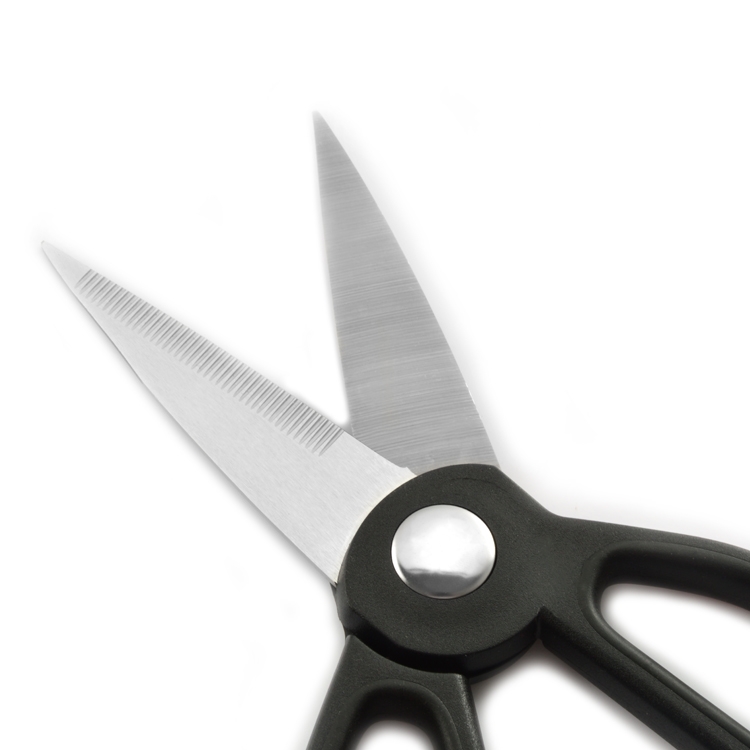
Useful factory expertise may include understanding blade shape, handle comfort, opening and closing action, rivet or joint stability, packaging formats and inspection steps. However, buyers should avoid assuming that every supplier offers the same service scope. Ask whether the supplier supports logo application, packaging customization, color selection, sample adjustments and production inspection reports. If the product will be sold in a regulated market, ask what documentation the supplier can provide and whether additional third-party testing is needed.
How to Define Your OEM Kitchen Scissors Requirements
Before contacting a kitchen scissors supplier, prepare a short but specific product brief. A vague request such as “good quality kitchen scissors” makes it difficult to compare quotations. A better brief explains the target user, sales channel, expected price position, packaging type and any required functions. This helps the factory recommend realistic options and reduces confusion during sampling.
Important points to define include:
- Target market: retail, online, promotional, wholesale, professional kitchen or general household use.
- Product type: standard kitchen scissors, kitchen shears, detachable design if available, or a simpler household model.
- Branding needs: logo placement, packaging language, barcode, instruction sheet or private label design.
- Quality expectations: smooth operation, clean cutting, comfortable grip, stable assembly and consistent finish.
- Commercial questions: MOQ, sample cost, production lead time, payment terms and carton packing details.
Kitchen Shears OEM Customization Options to Discuss
OEM does not always mean a fully new product from the ground up. In many sourcing projects, buyers customize an existing model through color, logo, packaging or minor design changes. This approach can be more efficient than developing a completely new tool. For more distinctive product lines, buyers may ask whether the factory can support deeper customization, but tooling, development time and approval steps should be discussed in advance.
Common customization areas include handle color, logo method, product finish, packaging structure, printed card design, instruction content and outer carton markings. If you need a specific blade style, handle shape or accessory feature, confirm whether it is already available or requires new development. Avoid assuming material grades, coating types or performance claims unless the supplier provides clear written confirmation and supporting documents.
Comparison Checklist for Supplier Evaluation
The table below can help buyers compare several OEM kitchen scissors manufacturers in a structured way. It is especially useful when quotations look similar but service details differ.
| Evaluation Area | What to Ask | Why It Matters |
|---|---|---|
| Product samples | Can the supplier provide current samples and revised OEM samples? | Samples show real cutting feel, finish and assembly quality. |
| Customization | Which logo, color, handle and packaging options are available? | Confirms whether the supplier can match your brand plan. |
| Quality control | What inspections are performed before shipment? | Helps reduce inconsistent batches and customer complaints. |
| Documentation | What product, packing or test documents can be provided? | Supports import, retail and internal approval requirements. |
| Commercial terms | What are the MOQ, lead time, sample terms and payment terms? | Determines whether the project fits your budget and schedule. |
| Communication | Who confirms specifications and manages production updates? | Clear communication reduces errors during OEM production. |
Quality Checks Before Placing a Bulk Order
Quality should be evaluated before mass production, not only after goods are ready to ship. Start with physical samples and check whether the scissors open and close smoothly, cut common kitchen materials cleanly and feel comfortable in the hand. Look for visible burrs, uneven finishing, loose joints, weak packaging or inconsistent logo placement. If your customers expect a specific use case, test the sample in that context before approving it.
For OEM orders, buyers should also confirm the approved sample standard. Ask the supplier how production will be matched to the approved sample and what happens if the final goods differ. Depending on order value and market requirements, consider a pre-shipment inspection by your own team or a third-party inspection company. The goal is not to create unnecessary complexity; it is to make sure the delivered product matches the agreed specification.
Packaging, Labeling and Retail Readiness
Kitchen scissors are often judged by both performance and presentation. For wholesale and retail buyers, packaging must protect the product, communicate essential information and fit the sales channel. Before ordering, confirm whether the supplier can produce the packaging format you need, such as a printed card, blister, color box or other agreed structure. If packaging artwork is supplied by the buyer, check file format, color expectations, barcode placement and proofreading responsibility.
Labeling should be handled carefully. Do not add claims that have not been verified. If your market requires warnings, importer details, language translations or recycling marks, confirm those requirements with your compliance advisor and then ask the supplier whether they can apply them correctly. A good OEM process treats packaging as part of the product specification, not as an afterthought.
Questions to Ask a Kitchen Scissors Supplier
When comparing suppliers, direct questions are more useful than general promises. Ask for information in writing and keep a confirmed specification sheet for the project. Practical questions include:
- Which existing kitchen scissors models are available for OEM customization?
- What logo methods and packaging options can be used for this product?
- What is the sample process, and how many sample revisions are reasonable?
- What are the MOQ, production lead time and carton packing details?
- Which quality checks are performed during and after production?
- Can the supplier provide documents needed for your target market, if applicable?
Practical FAQ
What is the difference between OEM and wholesale kitchen scissors?
Wholesale usually means buying an existing product, often with limited changes. OEM kitchen scissors usually involve customization such as branding, color, packaging or specification adjustments based on the buyer’s requirements.
Should I choose the cheapest kitchen scissors factory?
Not necessarily. A low unit price may be attractive, but buyers should also compare sample quality, communication, packaging, inspection process, lead time and the supplier’s ability to repeat the approved standard.
How can I avoid quality problems in an OEM order?
Use a clear specification sheet, approve physical samples, confirm packaging details, request production updates and consider inspection before shipment. Clear written approvals reduce misunderstandings.
What details should be confirmed before payment?
Confirm the exact model, customization details, packaging, MOQ, unit price, sample approval, production lead time, payment terms, shipping terms and any documents needed for your sales market.
Can a kitchen scissors factory help with branding?
Many factories can support some form of branding, but the available options vary. Ask about logo method, artwork requirements, packaging formats and whether any setup cost or MOQ applies.
Final Sourcing Advice
An expert kitchen scissors factory can be a valuable OEM partner when the buyer provides clear requirements and verifies details early. Focus on evidence rather than broad claims: samples, written specifications, realistic timelines and defined quality checks. For brands building a long-term kitchenware line, the best supplier is not only the one that can make a pair of scissors, but the one that can communicate clearly, maintain consistency and support repeatable sourcing decisions.
