




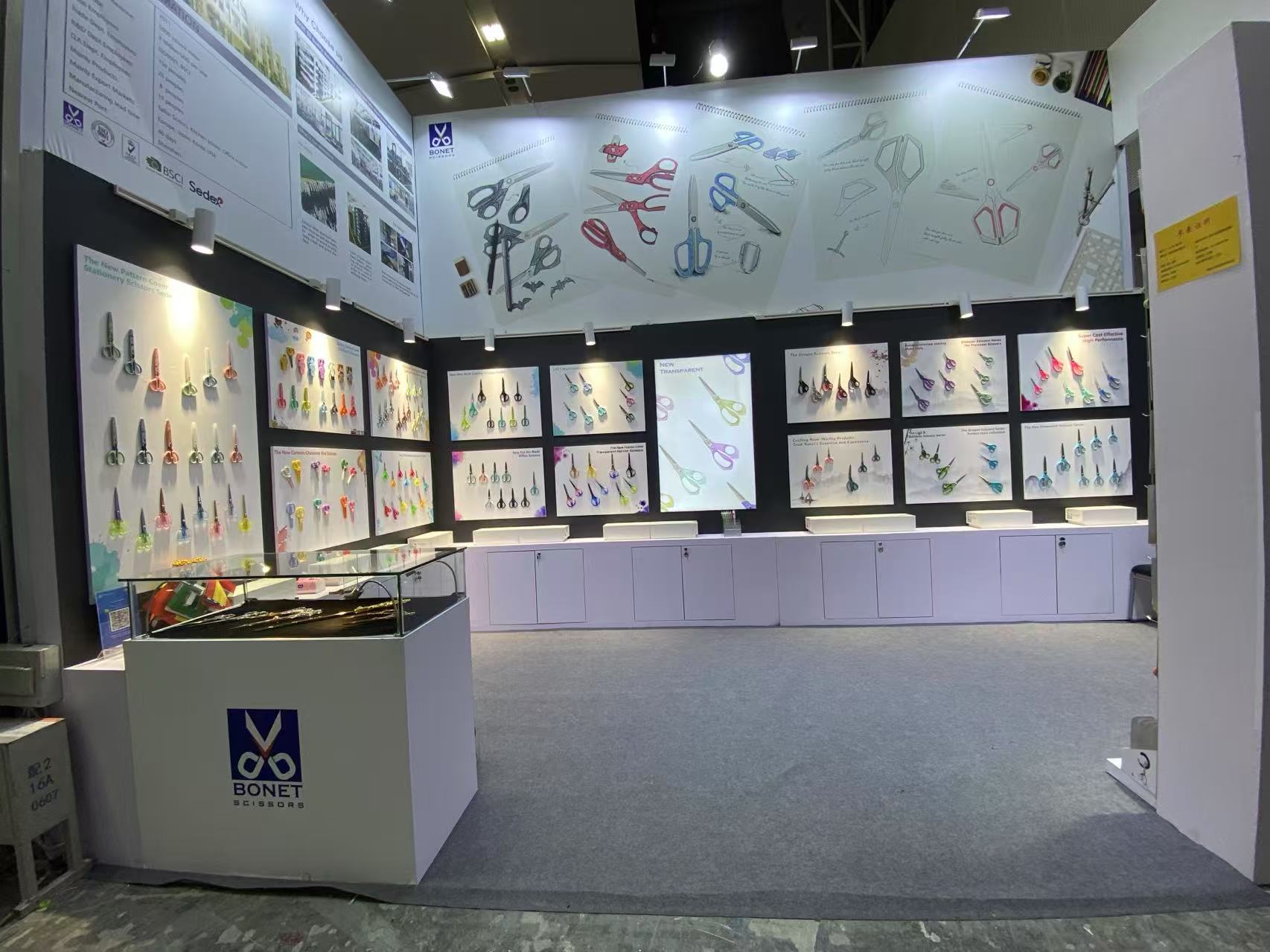
Exploring Bonet Scissors at the Guangzhou Stationery Fair
Trade fairs are useful because they let buyers compare products in a realistic way: not only by reading a catalog, but by holding samples, checking packaging, and asking direct sourcing questions. The Guangzhou stationery fair setting described in the original article places Bonet scissors among everyday office, craft, and school-use products. For distributors, importers, retailers, and promotional product buyers, the value is not simply whether a scissor looks attractive on display. The real question is whether the range fits the target market, whether the supplier can answer technical and commercial questions clearly, and whether samples perform consistently across common cutting tasks.
The original article highlights several visible strengths: a broad stationery-focused presentation, scissors intended for precision and versatility, colorful styling, stainless steel blades, ergonomic handles, heavy-duty models, craft scissors, and children’s scissors with safety-oriented edges and playful designs. This rewritten guide turns those points into a practical checklist for evaluating Bonet scissors or any similar stationery scissors supplier at a fair.
Key Takeaways
- Use a fair display as a starting point, not as the final proof of quality.
- Check the product range by use case: office, craft, heavy-duty, school, and children’s scissors.
- Confirm any material, safety, packaging, and compliance details directly with the supplier before ordering.
- Ask for samples from the exact production version, not only display pieces.
- Evaluate cutting feel, blade alignment, handle comfort, packaging durability, and assortment planning together.
What Buyers Can Learn from a Stationery Fair Display
A well-organized scissors display can reveal how a brand positions its products. If the booth groups items by user type, size, color, or application, it becomes easier for buyers to imagine how the range may work in retail shelves, office supply catalogs, school assortments, or online listings. Bonet’s display, as described, emphasized the mix of practical cutting tools and visual variety. That matters in stationery because scissors are often bought both for function and for personal preference.
However, buyers should look beyond the first impression. A colorful handle or clean display does not confirm long-term performance. At the booth, examine whether multiple samples have the same opening and closing feel. Check whether the blades meet evenly from pivot to tip. Look at the packaging copy and ask whether the same packaging is available for wholesale orders, private label projects, or market-specific language requirements.
Product Range: Office, Craft, Heavy-Duty, and Children’s Scissors
The original content refers to office scissors, ergonomic models for detailed art and craft projects, heavy-duty models for tougher materials, and children’s scissors with safety edges and fun designs. This range can be useful for buyers who want a complete stationery assortment rather than a single item.
For office supply channels, general-purpose scissors should feel reliable for paper, envelopes, labels, and light packaging. For craft channels, shoppers may care more about control, tip precision, and comfort during repeated small cuts. Heavy-duty scissors require closer inspection because “heavy-duty” can mean different things depending on the supplier; buyers should ask what materials the model is intended to cut and what it should not be used for. For children’s scissors, safety claims must be checked carefully against the destination market’s requirements and the age range printed on packaging.
Comparison Checklist for Evaluating Scissors at the Booth
| Evaluation Area | What to Check | Questions to Ask the Supplier |
|---|---|---|
| Blade and cutting feel | Smooth opening, clean paper cuts, even blade contact | What blade material is used, and is it the same in production samples? |
| Handle design | Grip comfort, finger space, left/right-hand suitability | Are ergonomic handle versions available across sizes? |
| Product segmentation | Office, craft, school, children’s, and heavy-duty options | Which models are recommended for each use case? |
| Packaging | Retail display quality, barcode area, warning labels | Can packaging be adapted for language, branding, or channel needs? |
| Quality consistency | Compare several pieces, not just one display sample | How are finished scissors inspected before shipment? |
| Commercial details | Assortments, lead times, order process | What are the MOQ, sample policy, payment terms, and production timeline? |
How to Assess Precision and Versatility
Precision is often claimed in stationery marketing, but buyers should define it practically. Ask to cut standard office paper, thin card, thread, wrapping paper, and any material relevant to your customers. For craft scissors, test whether the tip can start a cut accurately and whether the blades drag on curves. For office scissors, focus on clean straight cuts and comfortable use by different hand sizes.
Versatility should also be tied to a clear user group. A school scissor, an office scissor, and a heavy-duty model do not need to perform the same way. A better sourcing approach is to create a small matrix: intended user, intended material, target price band, packaging format, and retail channel. Then compare Bonet samples against that plan.
Design, Color, and Shelf Appeal
The original article mentions bold colors, soft shades, metallic finishes, playful patterns, and minimalist styles. In stationery, these visual differences can help retailers build assortments for different audiences. A bright children’s line, a neutral office line, and a more decorative craft line may serve separate shelves or online categories.
Still, color decisions should be commercial rather than random. Ask which colors are standard, which require custom production, and whether color matching can be confirmed before mass production. If you are planning OEM or private label packaging, request physical color samples and clarify whether handle color may vary between batches. For e-commerce sellers, photograph samples under consistent lighting to see whether finishes match product listing expectations.
Supplier Questions Before Placing an Order
Because the source article does not provide manufacturing capacity, certifications, MOQ, prices, or test results, buyers should not assume them. Instead, use the fair as a place to collect evidence. Before moving from interest to purchase order, ask for answers in writing and request samples that match the final quoted product.
- What exact materials are used for the blades, handles, pivot, and packaging?
- Which models are suitable for children, and what warnings or age guidance appear on packaging?
- Are there test reports or compliance documents required for the target market?
- What is the MOQ by model, color, and packaging type?
- Can the supplier support OEM branding, and what artwork files are required?
- How are scissors packed for export to reduce blade damage or packaging deformation?
- What inspection steps are used for blade alignment, sharpness, and appearance?
- What is the sample lead time and expected mass production lead time?
Practical FAQ
Are Bonet scissors only for office use?
No. The original article describes a broader range, including office scissors, craft-focused models, heavy-duty options, and children’s scissors. Buyers should confirm the intended use of each model before listing or purchasing.
Can buyers assume the scissors are compliant for school or children’s markets?
No. Even if a product is described as having safety-oriented edges or child-friendly styling, buyers should ask for market-specific compliance information, age labeling, warnings, and any relevant test documentation.
What should I test first when reviewing samples?
Start with cutting consistency, blade alignment, handle comfort, and packaging condition. Test several pieces from the same model to see whether performance is consistent.
Is visual design important for B2B sourcing?
Yes, especially in retail stationery and online sales. Color, packaging, and assortment planning can affect shelf appeal, but they should be evaluated together with durability, usability, and supply terms.
What information is missing from a typical fair display?
A display usually does not prove MOQ, final pricing, production capacity, certification status, or quality-control procedures. Those details should be requested from the supplier and verified before order confirmation.
Final Sourcing Advice
Bonet scissors, as presented in the Guangzhou stationery fair context, appear positioned around everyday usefulness, varied styling, and multiple application categories. That makes them worth evaluating for buyers who need a stationery scissors range. The best next step is disciplined sample review: compare models by user need, ask precise supplier questions, and verify any technical, compliance, and commercial details before committing to volume orders.
