




Stationery Scissors Manufacturer: How to Source the Right Cutting Tools
Choosing a stationery scissors manufacturer is not only about finding a low unit cost. For school distributors, office supply wholesalers, craft brands, and promotional product buyers, the right supplier should help match scissors to real user needs: safe classroom use, clean paper cutting, comfortable handling, and consistent presentation across bulk orders. A well-planned sourcing process reduces quality disputes and helps buyers avoid unsuitable products for their market.
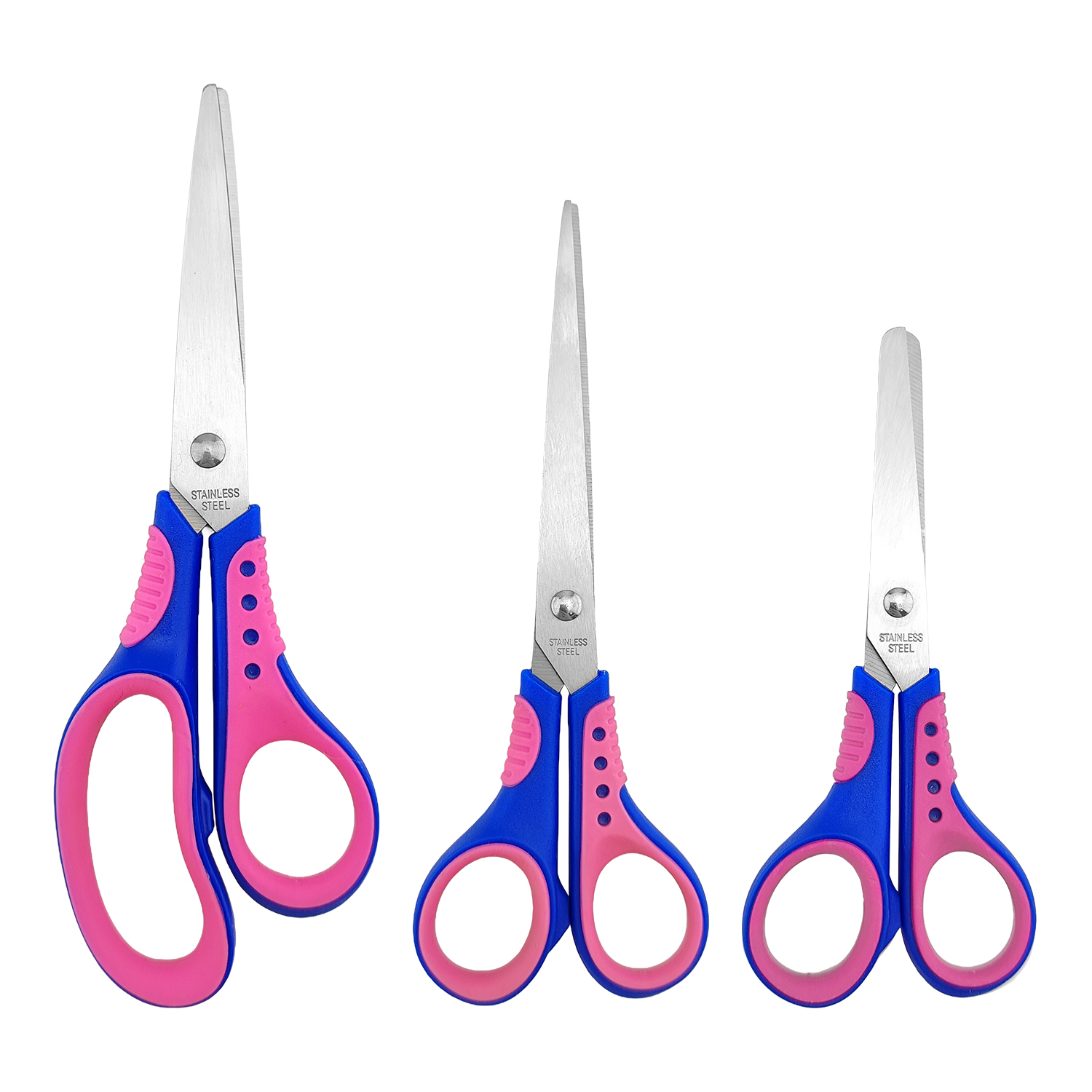
The original product information highlights a three-pair scissors set with stainless steel blades, ergonomic non-slip handles, and a dual-color blue and pink design. The set includes large, medium, and small scissors for different cutting tasks. These details make it a useful example for discussing how B2B buyers can evaluate stationery scissors before placing wholesale or OEM orders.
Key Takeaways
- Match scissor size to the end user: classroom, office, craft, or retail stationery use.
- Confirm blade material, handle design, packaging, and any safety expectations before ordering.
- For OEM projects, ask clear questions about color, branding, packaging artwork, and sample approval.
- Do not rely on product photos alone; request samples and compare cutting feel, comfort, and finish.
What Makes Stationery Scissors Different from General Scissors?
Stationery scissors are usually designed for frequent paper, card, label, and craft material cutting. Unlike kitchen scissors or heavy-duty industrial shears, they need to feel light, controlled, and comfortable during repeated use. In schools, they may be used by students and teachers. In offices, they are often shared tools. In craft settings, users may need both general cutting and smaller detail work.
Because of these varied use cases, a stationery scissors manufacturer should be able to discuss more than appearance. Buyers should ask how each size is intended to be used, whether the handle shape suits different hand sizes, and what cutting materials the supplier recommends. If a supplier cannot clearly explain the product application, the buyer may face higher return rates or mismatched expectations.
Understanding the Three-Size Scissors Set
The source article describes a set containing three sizes. This format is common for retail packs, school kits, and craft assortments because it gives users flexibility without needing separate purchases. The large pair can be suited to thicker paper or cardstock, the medium pair can serve general office and school tasks, and the small pair can help with detail cutting.
For wholesale buyers, the benefit of a multi-size set is simple merchandising: one SKU can cover several uses. However, it is still important to verify the exact dimensions, blade length, package size, and carton packing with the supplier. These details affect shelf planning, shipping cost, barcode label placement, and whether the set fits an existing product line.
Product Selection Checklist for B2B Buyers
| Check Point | Why It Matters | Questions to Ask the Supplier |
|---|---|---|
| Blade material | The source states stainless steel blades, which are commonly valued for durability and clean cutting. | What stainless steel specification is used? How is sharpness checked before shipment? |
| Handle comfort | Ergonomic, non-slip handles can improve control and reduce hand fatigue during repeated use. | Can you provide samples for hand-feel testing? Are different handle colors available? |
| Size assortment | Large, medium, and small scissors support different paper and craft tasks. | What are the exact sizes and recommended cutting applications? |
| Packaging | Retail, school, and wholesale channels often require different pack formats. | Can packaging be customized? What artwork files and approvals are required? |
| OEM branding | Private label buyers may need logo, color, and packaging consistency. | What branding methods are available? Are there minimum order requirements? |
| Quality control | Consistency matters in bulk orders, especially for school and office distributors. | What inspection steps are used for blade alignment, handle finish, and packaging? |
How to Evaluate Blade and Handle Design
The described scissors use stainless steel blades and ergonomic non-slip handles. These are useful features, but buyers should still check how they perform in practice. A sample should cut standard office paper smoothly without tearing. It should open and close without excessive looseness or stiffness. The blade tips, screw or pivot area, and handle edges should be checked for a clean finish.
Handle design is especially important for stationery scissors because users may cut for long periods. Non-slip handles can help improve grip, but the buyer should test whether the handle opening is comfortable for the target user group. A school scissors supplier may need different priorities from a craft brand or office supply wholesaler. If the product is intended for children, buyers should discuss appropriate design expectations and any market-specific safety requirements with the supplier rather than assuming compliance from appearance alone.
OEM and Custom Cutting Solutions
The original article mentions scissors for schools OEM services and custom cutting solutions for branding, color, and functionality. For buyers, OEM sourcing should begin with a written product brief. This brief should define the target market, preferred size set, handle colors, packaging type, logo placement, carton labeling, and inspection requirements. Without these details, quotations can be difficult to compare.
Before confirming an order, ask the manufacturer for a pre-production sample or equivalent approval process. Confirm whether the final product will match the approved sample in handle color, blade finish, packaging layout, and assortment. If you require retailer-specific labeling, language, barcodes, warnings, or documentation, raise those requirements early. A responsible supplier should be willing to clarify what can be provided and what must be arranged by the buyer.
Wholesale Sourcing Process: From Inquiry to Shipment
- Define the sales channel. School supply kits, office wholesale, supermarket stationery aisles, and craft retail packs may need different specifications.
- Request complete product details. Ask for size, material description, packaging, carton information, and available customization options.
- Review samples. Test cutting performance on paper, cardstock if relevant, labels, and other intended materials.
- Confirm commercial terms. Ask about MOQ, lead time, payment terms, sample cost, packaging cost, and shipping arrangements.
- Set inspection criteria. Include appearance, function, blade alignment, packaging accuracy, and carton labeling.
- Approve before mass production. Keep approved samples and artwork files as references for final inspection.
Common Mistakes When Buying Stationery Scissors in Bulk
One common mistake is choosing scissors based only on bright colors or a low quote. The blue and pink dual-color design in the source article can help a product stand out and make tools easy to find, but appearance should be balanced with cutting comfort and consistency. Another mistake is failing to test all sizes in a set. A large pair may perform well while the small pair may feel too tight or unsuitable for detailed work.
Buyers should also avoid vague OEM instructions. If a brand requires a specific shade, logo size, package layout, or assortment sequence, these should be documented. Finally, do not assume that a supplier’s standard product automatically meets every country’s retail requirement. Compliance, labeling, and documentation expectations vary by market, so buyers should ask direct questions and, where necessary, consult local specialists.
Practical FAQ
What should I ask a stationery scissors manufacturer first?
Start with the intended use, available sizes, blade material, handle options, packaging formats, MOQ, lead time, and whether samples can be provided for testing.
Are three-size scissors sets better for wholesale?
They can be useful because one set covers large, general, and detail cutting tasks. However, buyers should verify exact sizes, packaging dimensions, and target user suitability.
Can stationery scissors be customized for school or office brands?
Many suppliers offer some form of OEM customization, but options vary. Ask about handle colors, logo placement, packaging artwork, labeling, and minimum order requirements.
How can I check scissors quality before a bulk order?
Request samples and test cutting smoothness, blade alignment, handle comfort, opening and closing action, surface finish, and packaging quality. Keep approved samples for comparison.
What information should be included in an RFQ?
Include quantity, destination market, size requirements, material expectations, packaging type, branding needs, inspection criteria, target delivery schedule, and any documentation requirements.
Final Sourcing Advice
A reliable stationery scissors sourcing decision combines product testing with clear supplier communication. The three-piece set described in the original article offers a practical structure: stainless steel blades, ergonomic non-slip handles, a visible blue and pink design, and multiple sizes for different tasks. For B2B buyers, the next step is to turn those product features into measurable purchasing requirements. Ask specific questions, approve samples carefully, and make sure the final order matches the needs of your school, office, craft, or retail customers.
