





OEM Children Scissors: A Practical Sourcing Guide for Safe Kids Craft Tools
Children scissors look simple, but buyers sourcing them for schools, stationery brands, craft kits, supermarkets, or promotional channels need to review more than color and price. A good OEM children scissors project should balance child-friendly handling, predictable cutting performance, safe storage, packaging clarity, and consistent supply communication. The original Bonet Houseware article introduced colorful kids scissors, children craft scissors, and spring scissors for kids. This rewritten guide expands that topic into a practical checklist for B2B buyers comparing OEM options.
Key Takeaways
- Children scissors should be evaluated for handle comfort, blade control, storage safety, and suitability for age-appropriate craft tasks.
- Spring scissors can help children who need assisted opening during repeated cutting, but buyers should confirm the mechanism and durability with samples.
- For OEM projects, ask clear questions about materials, packaging, labeling, inspection steps, and applicable market requirements.
- A sample approval process is essential before wholesale orders, especially when colors, branding, or packaging are customized.
What Makes OEM Children Scissors Different?
OEM children scissors are produced for a buyer’s brand, retail line, school program, or kit assembly rather than sold only as generic stock items. The buyer may request specific handle colors, packaging style, logo placement, or assortment combinations. However, OEM customization should not come before the basic purpose of the product: helping children cut paper and craft materials with controlled movement.
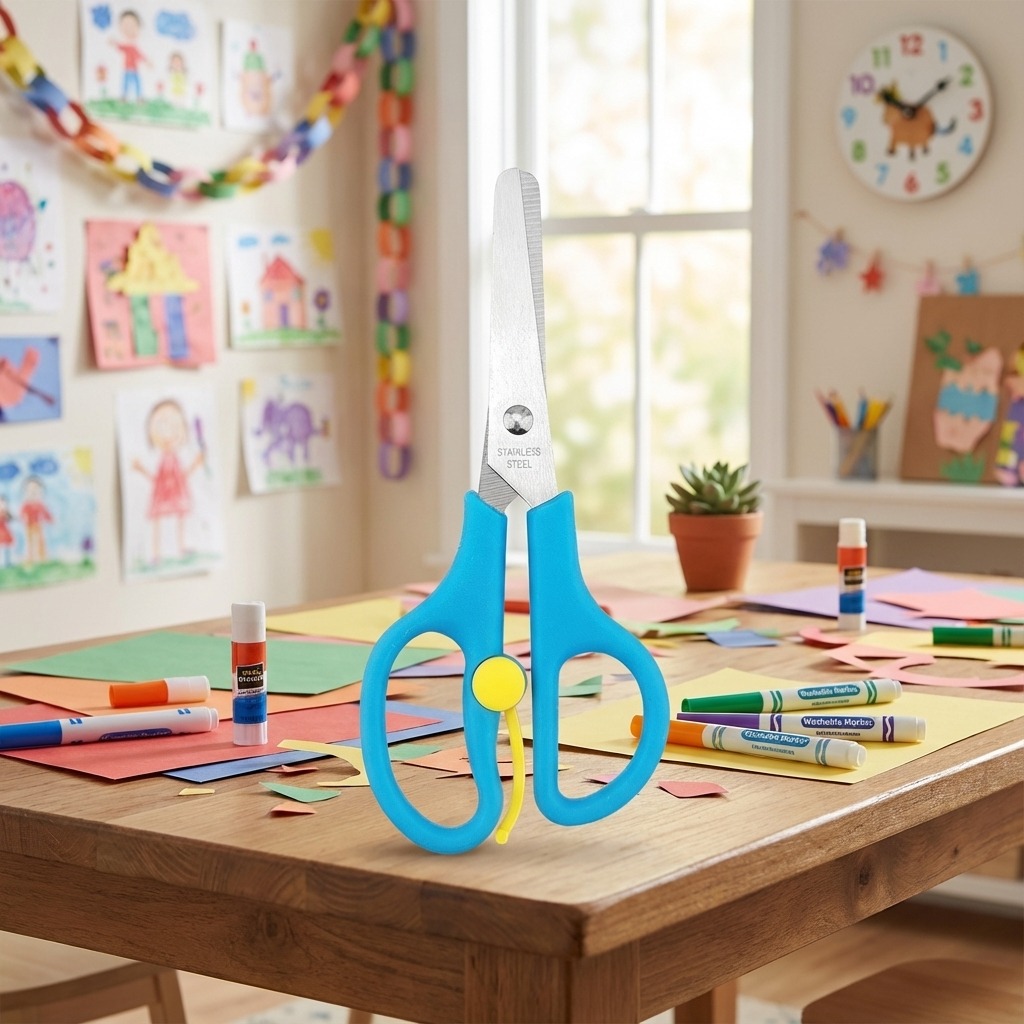
The source article describes a model with colorful handles, stainless steel construction, and a yellow safety latch. It also notes suitability for both right- and left-handed children. These are useful starting points, but buyers should verify every specification on the final sample rather than assuming all OEM versions will share the same details.
Safety Features Buyers Should Review
Children scissors are used in classrooms, homes, craft clubs, and activity packs, often with close adult supervision. Safety-related design should therefore be reviewed carefully. Rounded or controlled blade tips, a comfortable grip, a secure storage latch, and smooth opening and closing action can all influence the user experience. If the scissors include a latch, check whether it stays closed in a pencil case or retail pack and whether it can be operated easily by an adult or older child.
Safety expectations can vary by destination market and sales channel. Do not rely on general descriptions such as “safe for kids” alone. Ask the supplier what standards, test reports, warnings, age grading, and labeling may be relevant to your intended market. If documentation is required by your retailer or importer, request it before confirming packaging artwork or mass production.
Color, Ergonomics, and Classroom Practicality
Bright colors can make children scissors more appealing and easier to identify in a classroom or craft set. The original article mentions bright blue handles and a yellow safety latch. For OEM sourcing, color selection can also support brand recognition, product segmentation, or multi-pack organization. For example, one color may be used for school kits while another is reserved for retail display packs.
Ergonomics deserve equal attention. A handle that looks attractive may still be uncomfortable if the finger loops are too small, too slippery, or poorly shaped. Buyers should test samples with the intended user group in mind. If the product is promoted for both right- and left-handed use, confirm this through hands-on testing and packaging wording. Ambidextrous claims should be supported by actual usability, not only by a symmetrical appearance.
Spring Scissors for Kids: When Assisted Opening Helps
Spring scissors for kids use an assisted-opening action to reduce the effort needed between cuts. This can be useful for young children still building hand strength or for activities that require repeated cutting, such as paper strips, worksheets, or simple craft shapes. The source article highlights this assisted opening as a benefit for little hands.
When sourcing spring scissors, buyers should check the spring action over repeated use. Does it return smoothly? Is the resistance suitable for the target age range? Can the spring or latch catch on packaging or other items in a school bag? These questions are best answered through physical samples and, where possible, practical classroom-style testing.
Comparison Checklist for OEM Selection
| Selection Point | What to Check | Questions to Ask the Supplier |
|---|---|---|
| Blade material | Cutting consistency, corrosion resistance, finish quality | What material is used, and can it be confirmed on the sample specification? |
| Handle design | Grip comfort, finger loop size, left/right-hand usability | Is the handle intended for right-handed, left-handed, or ambidextrous use? |
| Safety latch | Closure strength, ease of use, stability during storage | How is the latch tested during inspection? |
| Spring mechanism | Smooth assisted opening and repeat performance | How many sample cycles should be tested before approval? |
| Packaging | Age information, warnings, barcode, branding space | Can packaging artwork be reviewed before production? |
| OEM control | Color matching, logo placement, carton marks | What customization details require final written approval? |
Packaging, Branding, and Wholesale Readiness
Packaging is not only a marketing decision. For children scissors, it can communicate age guidance, supervision reminders, product contents, barcode data, and importer information. Wholesale buyers should decide whether the item will be packed as a single pair, classroom set, craft-kit component, or retail blister pack. Each format may require different artwork, carton packing, and inspection criteria.
Before confirming an OEM order, prepare a simple specification sheet. Include handle color, blade description, latch or spring details, logo location, packaging type, carton marks, and any required documents. This reduces the risk of misunderstandings between buyer, supplier, packaging designer, and freight forwarder.
How to Approve Samples Before Ordering
- Request a reference sample or pre-production sample that matches the intended design.
- Check cutting performance on paper, construction paper, and any other material you plan to mention in sales copy.
- Inspect the handle for comfort, rough edges, color accuracy, and molding consistency.
- Open and close the scissors repeatedly to evaluate the spring action or latch function.
- Review packaging text carefully to avoid unsupported claims.
- Confirm the final specification in writing before bulk production begins.
Practical FAQ
Are OEM children scissors suitable for fabric?
The original article mentions lightweight fabrics, but buyers should test the exact sample on the materials they plan to advertise. If fabric cutting is important, request confirmation and avoid broad claims that the product has not been tested to support.
Can children scissors be customized with brand colors?
Often, OEM projects involve color or packaging customization, but availability depends on the supplier’s options. Ask about color matching, sample fees, lead time, and whether final colors may vary slightly between production batches.
What should be checked for school or classroom orders?
Focus on consistent cutting, comfortable grip, secure storage, clear labeling, and packaging durability. For large classroom orders, also ask how the supplier inspects mixed cartons and handles defective units.
Do spring scissors replace standard children scissors?
Not necessarily. Spring scissors are useful for assisted opening and repeated cuts, while standard children scissors may be preferred by older children or for general school use. Many buyers compare both formats before choosing an assortment.
What information should buyers request from a supplier?
Ask for a specification sheet, sample photos, packaging options, available customization details, inspection process, applicable compliance documents for your market, and written confirmation of the final approved sample.
