




How to Choose a Stainless Steel Grater Supplier
Finding the right stainless steel grater supplier is not only about comparing product photos or asking for the lowest unit price. For wholesalers, retailers, importers, and kitchenware brands, the supplier you choose affects product consistency, packaging accuracy, delivery timing, customer complaints, and repeat sales. A grater may look simple, but buyers still need to check blade sharpness, handle comfort, surface finishing, packing protection, and whether the supplier can support the intended sales channel.
The original topic highlights several useful points: stainless steel graters are chosen for daily kitchen preparation, a professional grater may include different textures for tasks such as zesting citrus or grating cheese, and an ergonomic non-slip handle can improve grip during use. These are valid product considerations, but a B2B buyer should also look beyond the sample. The goal is to confirm that the supplier can deliver the same quality repeatedly, communicate clearly, and answer commercial questions before production begins.
Key Takeaways
- Start with the use case: retail, foodservice, promotional, private label, or wholesale distribution.
- Ask for samples and inspect blade texture, handle grip, finishing, cleaning ease, and packaging protection.
- Do not assume material grade, certifications, MOQ, lead time, or testing results unless the supplier provides written confirmation.
- For OEM or private label orders, clarify artwork files, packaging structure, barcode needs, and approval steps before production.
- Choose a supplier that can answer technical and commercial questions consistently, not just quote quickly.
Define the Grater Type Before Contacting Suppliers
Before you compare stainless steel grater suppliers, define the exact product format you need. A handheld grater for home cooks, a box grater for retail shelves, a zesting tool for specialty stores, and a multi-piece grater set are different sourcing projects. Each has different expectations for blade pattern, handle design, packaging size, and target price range.
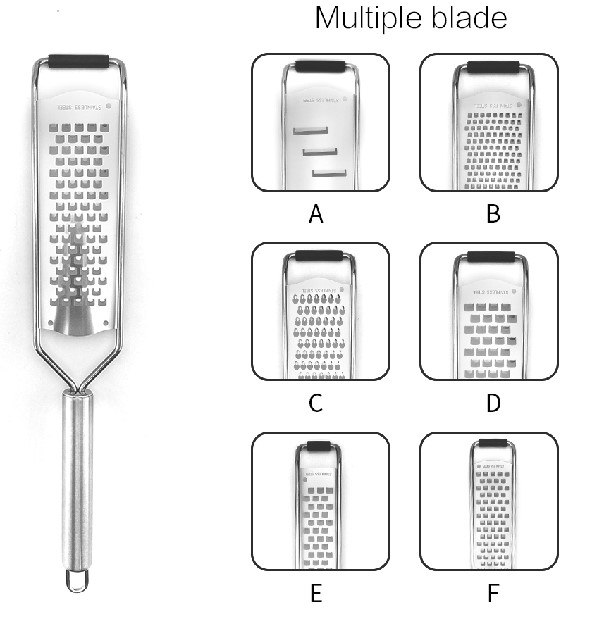
The source article mentions a five-piece multi-function grater set and different textures for fine or coarse grating. If you are sourcing a set, ask whether each piece has a clearly defined function. For example, one surface may be suitable for citrus zest, another for cheese, and another for vegetables. The supplier should be able to explain the intended use of each grater style without vague language.
Product Quality Checks for Stainless Steel Graters
A practical sample review should include both visual inspection and real kitchen testing. Check whether the blade edges feel clean and consistent, whether the handle is firmly attached, and whether any burrs or sharp non-cutting edges are present. A stainless steel grater should not feel flimsy in the hand, and the surface should be finished well enough for safe handling and cleaning.
Because the original article refers to rust resistance and sharp blades, buyers should ask the supplier what stainless steel is used and what quality checks are performed. Do not assume a specific grade unless it is confirmed in writing. If rust resistance is important for your market, ask whether the supplier can provide relevant material information or test documentation. Also test the sample with common ingredients such as cheese, carrots, citrus peel, chocolate, ginger, or nuts, depending on your target customer.
Supplier Evaluation Checklist
Use a structured checklist so that every supplier is compared on the same basis. A low price may not be a saving if the packaging crushes during transit, the blade texture is inconsistent, or the handle design causes complaints.
| Evaluation Area | What to Check | Questions to Ask |
|---|---|---|
| Product sample | Blade sharpness, handle grip, finish, weight, cleaning ease | Can you send production-level samples, not only showroom samples? |
| Material details | Stainless steel information and handle material | What material specifications can you confirm in writing? |
| Packaging | Retail box, card, insert, barcode area, transit protection | Can packaging be customized for private label or wholesale display? |
| OEM support | Logo placement, artwork process, sample approval | What files, approvals, and timelines are required for OEM packaging? |
| Quality control | Inspection steps, defect handling, consistency between batches | What checks are performed before shipment? |
| Commercial terms | MOQ, lead time, payment terms, carton details | What are the order requirements and how are changes handled? |
OEM and Wholesale Sourcing Questions
If you plan to sell under your own brand, the sourcing process should include more than a logo request. Ask whether the supplier can support custom packaging, instruction text, barcode placement, warning labels, and carton marks. If your market requires specific labeling or documentation, confirm what the supplier can provide and what must be arranged by your own compliance team.
For wholesale buyers, carton packing matters. A grater with an exposed cutting surface may need secure packaging to prevent scratching, bending, or safety issues during handling. Ask for carton dimensions, gross weight, inner pack details, and photos of the packed goods. If the supplier cannot provide this information early, it may become difficult to estimate freight cost or plan warehouse receiving.
How to Review Samples in Real Use
When samples arrive, do not judge them only by appearance. Use the grater repeatedly and record practical results. Does it grate smoothly, or does it require too much pressure? Does food clog the blade pattern? Is the handle comfortable when wet? Is the grip stable enough for common kitchen tasks? Does the grater rinse clean easily?
If testing a multi-piece set, evaluate every piece separately. A set may look complete, but one weak tool can reduce the perceived value of the whole package. Also check whether the product is easy to explain on a retail page or packaging panel. Customers should understand the difference between fine, coarse, zesting, slicing, or other grating functions without confusion.
Communication, Documentation, and Risk Control
A reliable stainless steel grater supplier should communicate clearly before money is paid and before production starts. Look for specific answers rather than broad promises. If you ask about material, packaging, lead time, inspection, or defect handling, the supplier should respond with details that can be verified.
For risk control, keep written records of the approved sample, packaging artwork, order quantity, agreed materials, carton information, and shipment requirements. If any product claim will appear on packaging or online listings, confirm whether evidence is available. Avoid publishing claims such as certified, food-grade, dishwasher-safe, or rust-proof unless the supplier provides support and your team verifies the claim for the target market.
Common Mistakes When Buying Stainless Steel Graters
- Choosing only by unit price without testing actual grating performance.
- Assuming every stainless steel grater uses the same material or finish.
- Approving packaging artwork before confirming carton protection and label requirements.
- Ignoring handle comfort, especially for products aimed at frequent use.
- Not asking how the supplier controls sharp edges, burrs, or inconsistent blade patterns.
- Failing to define whether the order is standard wholesale, OEM, private label, or promotional.
FAQ
What should I ask a stainless steel grater supplier first?
Start with product type, material information, sample availability, packaging options, MOQ, lead time, and whether the supplier supports OEM or private label requirements. Ask for written details rather than relying on general descriptions.
How can I check whether a grater sample is good quality?
Test it with real ingredients, inspect the cutting surface, check for burrs, review handle stability, and rinse it after use. If the product is a set, test every piece rather than only the most impressive one.
Can I request custom packaging for wholesale or retail?
Many kitchenware suppliers may offer packaging support, but you should confirm the available structures, artwork requirements, barcode placement, carton packing, sample approval process, and any additional cost before ordering.
Should I ask for certifications or test reports?
Yes, if your market or sales channel requires them. Do not assume compliance from a product description. Ask the supplier what documents are available, then verify whether they meet your import, retail, or platform requirements.
Is a multi-piece grater set better than a single grater?
It depends on your customer. A set can offer more functions, such as fine and coarse textures, but it also requires stronger packaging and clear user guidance. A single grater may be easier to sell when the use case is specific.
Choosing a stainless steel grater supplier is a sourcing decision that should combine product testing, supplier communication, documentation, and packaging review. By asking precise questions early, buyers can reduce avoidable problems and select products that better match their customers, sales channels, and quality expectations.
