




Grater OEM Yangjiang: Multifunctional Kitchenware Solutions
For importers, retailers, promotional product companies, and kitchenware brands, finding a suitable Grater OEM in Yangjiang is not only about choosing a low-cost item. A grater set may look simple, but buyers still need to evaluate usability, material consistency, packaging, customization options, and supplier communication before placing a wholesale or OEM order.
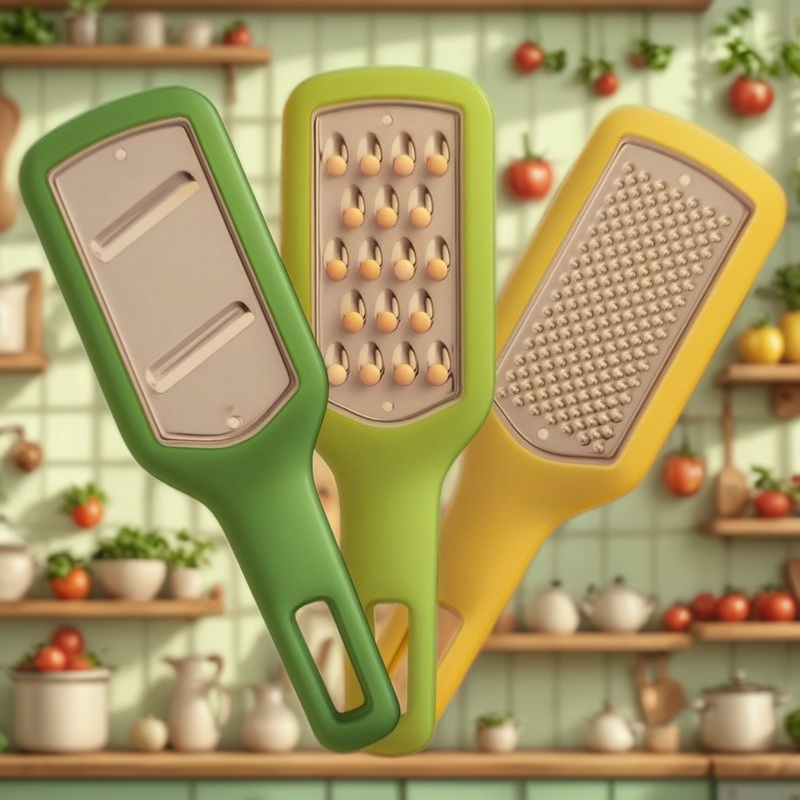
Yangjiang is widely known as a kitchenware production region, and many buyers search there for graters, peelers, slicers, and other food preparation tools. The original product concept discussed here is a colorful trio grater set: a green mandoline slicer for uniform cuts, a lime green coarse grater for foods such as cheese and chocolate, and a yellow fine grater for zesting citrus or grating hard spices. The set is presented with stainless steel and durable plastic components, ergonomic handles, and integrated hanging holes.
This guide explains how to review that type of multifunctional grater set from a sourcing perspective, what to ask an OEM supplier, and how to avoid common purchasing mistakes.
Key Takeaways
- A multifunctional grater set should be judged by cutting performance, handle comfort, safe storage, and cleaning convenience.
- Buyers should confirm material details, sample quality, packaging structure, and customization scope before committing to OEM production.
- Do not rely only on product photos; request samples and compare each grater function with the intended market use.
- For wholesale sourcing, ask the supplier clear questions about lead time, order quantities, inspection options, and carton packing.
What the Trio Grater Set Includes
The set described in the original article contains three separate food preparation tools, each intended for a different kitchen task. The green mandoline slicer is designed for producing more uniform cuts of vegetables and fruits. This is useful for consumers who want consistent slices for salads, garnishes, or meal preparation.
The lime green coarse grater is described as having raised bumps and is suitable for shredding foods such as cheese and chocolate. This type of grater is often chosen for everyday cooking, baking preparation, and dessert topping. The yellow fine grater is intended for smaller, more delicate jobs, such as citrus zest or hard spices.
From a buyer's point of view, the advantage of a three-piece set is category coverage. Instead of selling a single grater, a retailer can offer a compact solution for slicing, coarse grating, and fine grating. However, that also means every piece must perform well. If one item in the set feels weak or uncomfortable, it can affect customer reviews for the entire product.
Product Features Buyers Should Verify
The original product description mentions stainless steel, durable plastics, ergonomic handles, and integrated hanging holes. These are useful features, but a sourcing team should still verify the details instead of treating a short description as a full specification.
- Cutting surface: Ask what stainless steel type is used, how sharpness is controlled, and whether edge consistency is checked during production.
- Plastic parts: Ask what plastic material is used for the body and handle, and whether color matching can be controlled across production batches.
- Handle comfort: Test whether the grip remains stable when hands are wet or when harder foods are grated.
- Hanging holes: Confirm the hole size and position if the product will be displayed on hooks or stored on kitchen rails.
- Cleaning: Check whether food residue collects around raised bumps, blade openings, or handle joints.
These questions are especially important for OEM kitchen utensils because the final product may carry the buyer's brand name. A low-friction sourcing process begins with a detailed product review, not with packaging design.
Comparison Checklist for OEM Grater Sourcing
| Review Area | What to Check | Why It Matters |
|---|---|---|
| Function mix | Mandoline slicer, coarse grater, and fine grater performance | Ensures the set solves several real kitchen tasks |
| Material details | Stainless steel grade, plastic type, color consistency | Helps buyers define accurate specifications |
| Handle design | Grip comfort, balance, and control during use | Supports safer and easier food preparation |
| Storage design | Integrated hanging holes and retail display compatibility | Affects both home storage and store presentation |
| OEM options | Logo placement, colors, packaging, and instruction inserts | Clarifies what can be customized for the brand |
| Quality control | Sample approval, inspection process, and defect standards | Reduces surprises before shipment |
How to Discuss OEM Customization
OEM customization can include color selection, logo placement, packaging artwork, user instructions, barcode labels, and sometimes small design adjustments. Before asking for a quote, buyers should prepare a short but complete product brief. This should include target market, preferred retail price range, expected packaging format, estimated order volume, and any required compliance documents for the destination country.
Because commercial details are not provided in the source article, buyers should ask the supplier directly about minimum order quantity, sample fees, tooling requirements, production lead time, carton dimensions, and payment terms. If the product will be sold through chain stores or online marketplaces, ask whether the supplier can support pre-shipment inspection, drop test requirements, label placement, and packaging durability checks.
It is also worth asking whether the supplier can provide a related product line. The original article includes a product link for a multi-functional peeler: https://bonethome.com/product/upgrade-your-kitchen-with-a-multi-functional-peeler. For a brand building a kitchen preparation range, coordinating graters, peelers, slicers, and other utensils can create a more consistent shelf presentation.
Quality Questions to Ask a Yangjiang Grater Manufacturer
When evaluating a Yangjiang grater manufacturer, buyers should avoid vague questions such as “Is the quality good?” Instead, ask for measurable or observable checkpoints. Clear questions make it easier for both sides to agree on expectations before mass production.
- What materials are used for the metal grating surfaces and plastic handles?
- Can production samples be approved before the order begins?
- How are sharp edges, burrs, loose parts, and color differences checked?
- What packaging options are available for retail, wholesale, or e-commerce shipping?
- Can logos, color combinations, and instruction sheets be customized?
- What inspection standard should be agreed before shipment?
These questions do not assume any specific certification, capacity, or test result. They simply help the buyer collect the information needed for responsible purchasing.
Wholesale Positioning and Retail Use Cases
A multifunctional grater set can be positioned for several retail channels. Homeware stores may present it as a compact preparation set for daily cooking. Supermarkets may prefer simple packaging that explains the three functions quickly. Online sellers may need clear product photos showing the slicer, coarse grater, and fine grater in use.
For wholesale buyers, the key is to match the product to customer expectations. A colorful set can work well for home kitchens, giftable kitchen bundles, seasonal promotions, or entry-level cooking ranges. A professional buyer should still test whether the tools feel stable, whether the grating surfaces are sharp enough for the intended foods, and whether the plastic body feels comfortable during repeated use.
Practical FAQ
What should I ask before ordering a grater OEM sample?
Ask for material information, available colors, logo options, packaging choices, sample cost, sample lead time, and whether the sample will match future mass production.
Is a three-piece grater set better than a single grater?
It depends on the sales channel. A three-piece set gives customers more functions, while a single grater may be easier to position for a specific task. Buyers should compare customer needs and shelf space.
Can the grater set be customized for a private label brand?
OEM customization may be possible, but the buyer should confirm logo method, color control, packaging artwork, instruction inserts, MOQ, and any tooling requirements with the supplier.
How should buyers check quality before shipment?
Buyers can approve samples first, define defect standards, inspect sharpness and handle assembly, review packaging, and arrange a pre-shipment inspection when appropriate.
Final Sourcing Advice
A grater set is a small product, but it still deserves careful sourcing work. The best approach is to treat the mandoline slicer, coarse grater, and fine grater as three separate user experiences inside one retail item. Test each function, confirm the material and packaging details, and ask practical OEM questions early. For buyers comparing Grater OEM Yangjiang options, clear specifications and sample approval are the most reliable starting points.
For commercial inquiries, buyers may contact the supplier using the email listed in the original article: sales202@bonetcn.com.
