




High-Quality Tailor Tools: How to Choose Precision Scissors
Good tailoring starts before the first stitch. If fabric is stretched, chewed, or cut off-grain, even careful sewing cannot fully correct the problem. That is why high-quality tailor tools, especially cutting scissors, deserve close attention from dressmakers, alteration shops, sewing studios, craft retailers, and wholesale buyers. The right tool should help the user cut accurately, work comfortably, and repeat the same result across different fabrics.
This guide explains how to evaluate tailor cutting scissors in a practical way. It uses the available details from Bonet Houseware tailor scissors, including zinc-alloy handles, an 8-1/2 inch size, 2.5 mm blade thickness, and decorative finish options, while also outlining the questions buyers should ask before placing an order.
Key Takeaways
- Choose tailor scissors by cutting task, hand comfort, blade control, and expected fabric type.
- An 8-1/2 inch scissor is a common working size for general fabric cutting, sample rooms, and home sewing tables.
- Handle shape and weight matter because long cutting sessions can create hand fatigue.
- Decorative coatings are useful for visual merchandising, but cutting performance and consistency should be checked first.
- Wholesale and OEM buyers should confirm material details, packaging, samples, quality checks, MOQ, and lead time directly with the supplier.
Why Cutting Tools Matter in Tailoring
Scissors are not just accessories in a sewing kit. They determine how cleanly fabric separates, how much the fabric shifts during cutting, and how accurately a pattern piece follows its marked line. For professional tailors, inconsistent cutting can affect seam allowance, garment symmetry, and production time. For hobby users, poor scissors can make sewing feel more difficult than it should.
High-quality tailor tools should support three basic goals: a clean cut, stable handling, and repeatable control. A scissor that feels good for a quick test may still become tiring during multiple garment pieces. Likewise, a visually attractive tool may not be suitable if the blade action feels rough or the pivot becomes loose after use. Buyers should evaluate both appearance and working feel.
Product Details to Review on Bonet Tailor Scissors
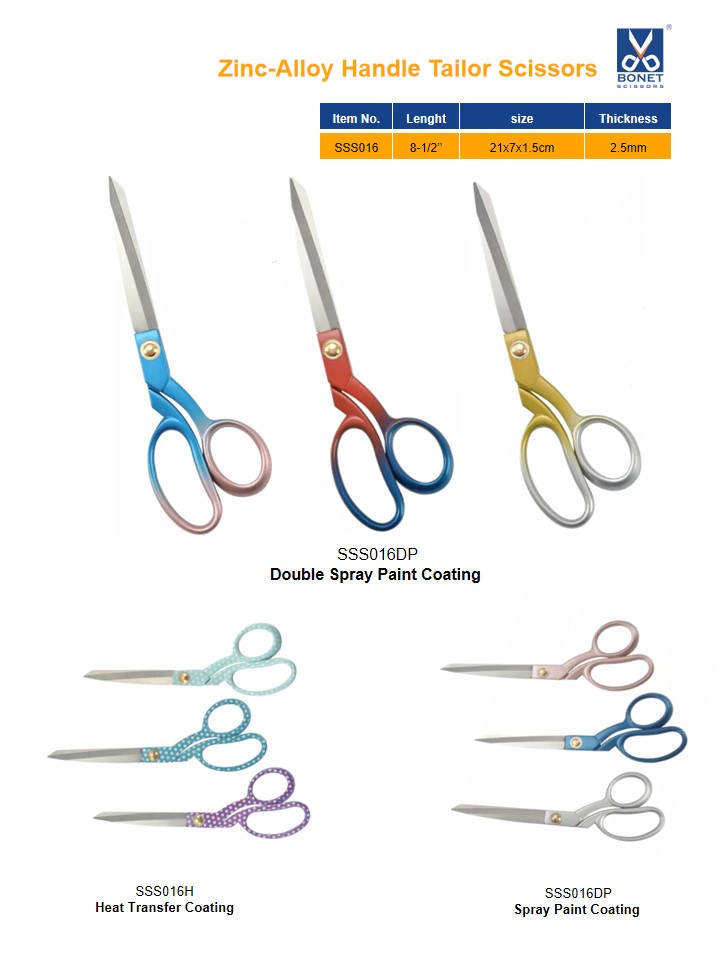
The original Bonet Houseware article presents tailor scissors with zinc-alloy handles. It also lists an 8-1/2 inch size and a 2.5 mm blade thickness. These details are useful starting points when comparing tailor scissors for retail, sewing workshops, or personal use.
The article also mentions several finish options. The SSS016DP series is described with double spray paint coatings in red, blue, or gold. The SSS016H series is described with heat transfer designs on pastel backgrounds. Other finish colors mentioned include dusty pink and wine red. These color choices may help retailers build a more attractive display or allow sewing users to separate scissors by task, for example one pair for fabric and another for paper patterns.
However, buyers should not rely on appearance alone. Before purchasing in quantity, ask for sample units and test them on the fabrics most relevant to your customers or workshop, such as cotton, denim, lining fabric, felt, or lightweight synthetics.
Comparison Checklist for Selecting Tailor Scissors
| Selection point | What to check | Why it matters |
|---|---|---|
| Size | Confirm the listed 8-1/2 inch length suits the main cutting task | A balanced size helps with long cuts while remaining manageable for curves |
| Blade thickness | Review the stated 2.5 mm blade thickness and test cutting feel | Thickness can influence stability and perceived strength during fabric cutting |
| Handle material | Check the zinc-alloy handle finish, grip feel, and edge comfort | Comfort affects control during repeated cutting sessions |
| Finish options | Compare spray paint, heat transfer designs, and colors | Useful for branding, retail assortment, and visual identification |
| Pivot action | Open and close the scissors repeatedly during inspection | Smooth action reduces effort and improves cutting consistency |
| Packaging and labeling | Ask what standard and custom packaging options are available | Important for wholesale, retail presentation, and product instructions |
How to Test Scissors Before Regular Use
Whether you are buying one pair for a sewing table or sourcing a carton for resale, testing should be simple and repeatable. Use fabric scraps that represent real working conditions rather than only thin paper. Cut straight lines, gentle curves, and short snips near the tip. Notice whether the fabric lifts, slips, or frays more than expected.
- Check the opening and closing action before cutting.
- Cut a long straight line on medium-weight woven fabric.
- Test the tip on a small notch or curve.
- Try a thicker sample, such as layered cotton or denim, if that reflects normal use.
- Inspect the cut edge and note hand comfort after several minutes.
If multiple people will use the scissors, ask users with different hand sizes to test the same sample. Comfort is subjective, and a handle that works well for one tailor may feel awkward to another.
Care and Use Tips for Longer Tool Life
Even good scissors can perform poorly if they are used for the wrong materials. Keep fabric scissors dedicated to fabric. Cutting cardboard, wire, adhesive tape, or heavy plastic can damage the edge or leave residue. Wipe the blades after use, especially after cutting fabrics that shed lint or contain finishing treatments.
Store scissors closed and dry. Do not toss them into a drawer with metal tools that can nick the blade. If the action becomes stiff, consult the supplier or a qualified sharpening service before attempting aggressive adjustment. For workplaces, create a simple tool-use rule: label scissors by purpose and train staff not to mix fabric scissors with paper scissors.
Sourcing Questions for Wholesale and OEM Buyers
For distributors, brand owners, and retail buyers, product selection includes more than the scissor itself. Commercial details should be confirmed directly with Bonet Houseware or any supplier under consideration. Avoid assuming capacity, certifications, MOQ, lead time, or test results unless the supplier provides current documentation.
- What materials are used for the blade and other components, and can the supplier provide a specification sheet?
- Are samples available for cutting tests before bulk ordering?
- What finish options are standard for the SSS016DP and SSS016H series, and which options require custom production?
- What packaging formats are available for retail or wholesale distribution?
- What quality inspection steps are used for blade alignment, pivot smoothness, coating appearance, and final packing?
- What are the current MOQ, production lead time, payment terms, and shipping options?
- Can the supplier support private labeling or OEM artwork, and what files or approvals are required?
FAQ
What size tailor scissors are best for general fabric cutting?
An 8-1/2 inch pair is often a practical general-purpose size because it can handle longer cuts while still offering control for curves. The best choice depends on fabric type, hand size, and cutting style.
Are decorative tailor scissors suitable for professional use?
They can be, but performance should be tested first. Decorative spray paint or heat transfer finishes may improve appearance, but buyers should still check blade action, comfort, alignment, and cutting results.
Can one pair of scissors be used for both fabric and paper patterns?
It is better to keep separate scissors. Paper can dull fabric scissors faster, which may lead to rough cutting on textiles.
What should wholesale buyers confirm before ordering?
Ask for product specifications, sample availability, finish options, packaging choices, quality inspection process, MOQ, lead time, and any documents needed for your market. Confirm all details in writing before purchase.
How should tailor scissors be maintained?
Use them only for suitable materials, keep them clean and dry, store them closed, and have sharpening or adjustment handled by a qualified service when needed.
