




Household Products Factory China: What Buyers Should Look For in Kitchenware
When buyers search for a household products factory China, they are often looking for more than a single kitchen tool. The real goal is usually a coordinated kitchenware line that can be merchandised as a set, packed efficiently, and repeated consistently across orders. That is a different sourcing challenge from buying one spatula or one bowl.
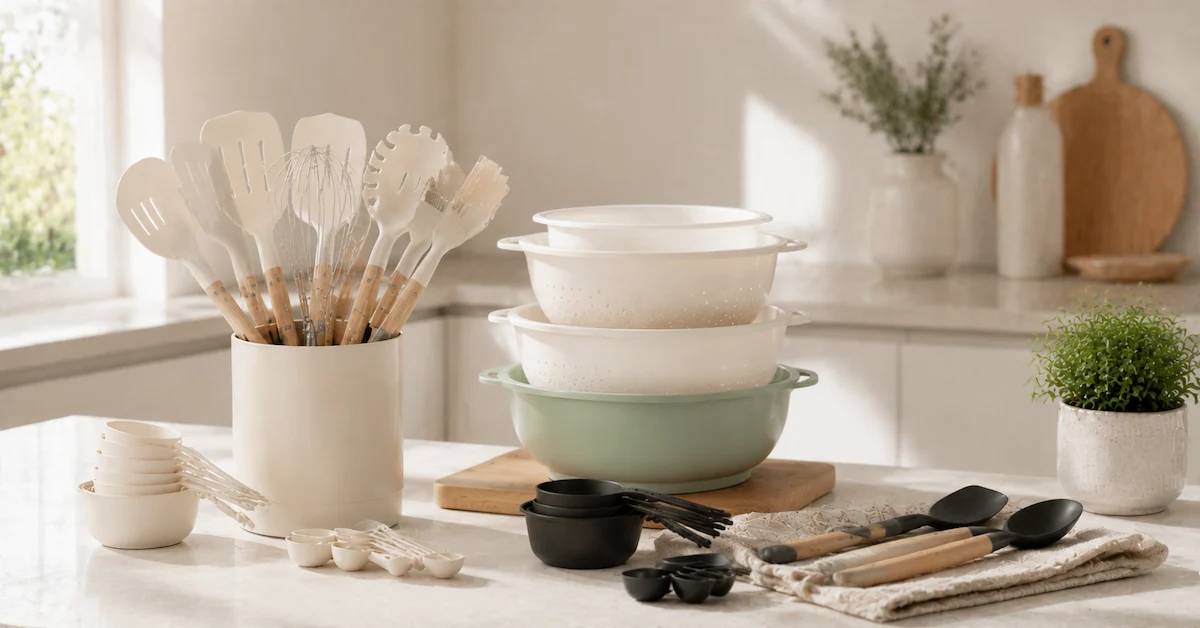
The product image shows an everyday kitchen assortment: cooking utensils, prep tools, nested bowls or colanders, measuring items, and a countertop holder. The visual direction is simple and coordinated, with neutral colors and practical forms. For retail buyers, importers, and private-label teams, the main question is not whether the set looks attractive in a sample photo. It is whether a supplier can keep the same look, feel, fit, and packaging reliability during production.
Key Takeaways
- A coordinated kitchenware set requires stronger supplier control than a single-item order.
- Buyers should verify material details in writing instead of assuming from product appearance.
- Color matching, handle assembly, nesting fit, and packaging protection are common risk points.
- The best supplier questions focus on process control, outsourced components, inspection methods, and repeatability.
What This Kitchenware Set Appears to Include
The visible assortment appears to cover routine cooking and preparation tasks. It includes utensil shapes such as spatulas, slotted spoons, ladles, a whisk, measuring cups or spoons, and nested bowls or colanders with side handles. A storage holder is also shown, suggesting the set is designed for countertop display as well as daily use.
These details are useful for sourcing teams because each item has a different functional requirement. A ladle needs bowl depth and handle balance. A whisk needs flexibility and secure joining. Measuring tools require shape consistency. Nested bowls must fit together without sticking, scratching, or wasting carton space. A kitchen supplies manufacturer China that handles this type of line must manage the product family as a system, not as a group of unrelated SKUs.
Why Coordinated Kitchenware Is Harder to Source Than It Looks
Coordinated sets can look straightforward, but they create several production challenges. Different components may require different forming, assembly, finishing, or packing processes. The original product information suggests utensil heads that may be silicone or coated plastic and handles with a light wood or bamboo-look appearance. The nested bowls or containers appear ceramic or enamel-coated, but the exact material composition is not confirmed in the source. Buyers should therefore ask the supplier to confirm material details before quotations are finalized.
The challenge is consistency across variation. A pale green finish on one component may not match another material under different lighting. A matte surface may show rub marks after transit. A handle may look aligned in one sample but drift during production. These issues are small individually, but they affect the perceived value of the whole set.
Supplier Evaluation Checklist
Before selecting a household products factory China, buyers should compare suppliers using practical criteria that relate directly to production risk. The table below can help sourcing, engineering, and product teams structure the review.
| Check Area | What to Ask | Why It Matters |
|---|---|---|
| Material confirmation | What are the confirmed materials for each utensil, handle, bowl, and accessory? | Prevents assumptions based only on photos or sample appearance. |
| In-house vs outsourced work | Which parts are made directly by the factory and which are sourced from partners? | Clarifies accountability for timing, quality, and corrective action. |
| Color and finish control | How are color standards approved and checked across different materials? | Reduces mismatch risk in coordinated sets. |
| Nesting and fit | How is bowl nesting checked during sampling and mass production? | Helps avoid sticking, rattling, scuffing, or inefficient packing. |
| Packaging layout | How are contact points protected during shipment? | Protects visible surfaces and supports retail presentation. |
Questions to Ask a Kitchen Supplies Manufacturer China
A good supplier conversation should go beyond catalog pages. Ask how the factory controls the complete assortment from sample approval to final packing. If multiple production routes are involved, ask who coordinates component matching and final inspection.
- Can you provide a written material breakdown for every item in the set?
- Which components are produced in-house, and which are subcontracted or purchased?
- How do you maintain color consistency between utensil heads, handles, bowls, and accessories?
- What checks are used for handle alignment, joining strength, and surface defects?
- How do you test the packing arrangement for abrasion, movement, and carton efficiency?
- What approval samples, reference samples, or production records will be kept for repeat orders?
These questions do not require the supplier to make unsupported claims. They help buyers discover whether the supplier has a repeatable process and whether commercial details, specifications, and inspection expectations can be documented clearly.
Common Buyer Mistakes With Utensil and Bowl Sets
One common mistake is judging the set mainly by its display appeal. A coordinated set must still work well item by item. A spatula should feel balanced. A whisk should not feel weak at the handle. Bowls should be deep enough for their intended use. Measuring items should be easy to read and store.
Another mistake is ignoring how materials age together. In a mixed-material set, one surface may stain, another may dull, and another may scratch if the finish or packing is not suitable. Buyers should review samples after realistic handling, not only when they are new from the box.
A third mistake is underestimating packaging. Nested bowls save space, but only if the surfaces are protected. Utensils packed too tightly can rub against each other. A countertop holder may improve presentation, but it also adds another component that must be checked for fit and stability.
When a Household Products Factory China Is the Right Fit
A household products factory China can be a strong fit when the project requires a unified kitchenware family for retail, wholesale, hospitality, or private-label programs. This is especially true when the buyer needs prep tools, cooking utensils, and storage-friendly bowls to share a consistent design language.
However, not every supplier is equally suited to every part of the range. Some suppliers may be stronger in molded utensils, while others may be more experienced with bowls, coated surfaces, assembly, or packaging. Buyers should not assume that one good sample proves full-program capability. Instead, request clear documentation, review production samples, and confirm how changes will be managed if the assortment expands later.
Practical FAQ
Can one supplier produce both utensils and bowls?
Sometimes, but buyers should confirm whether each component is made in-house or sourced through partner factories. The key issue is who controls quality, matching, final assembly, and corrective action.
What should I confirm before requesting a quotation?
Confirm the intended product list, materials, colors, packing method, labeling needs, inspection criteria, and target market requirements. Do not rely only on a product photo when comparing quotes.
Why is color matching difficult in kitchenware sets?
Different materials and finishes can reflect light differently, even when the color formula is similar. Buyers should approve physical color standards and ask how production lots are checked.
What is the most important packaging concern?
Surface protection is critical. Nested bowls, utensil heads, handles, and holders can rub during transport, so the supplier should explain how contact points are separated or cushioned.
Final Sourcing Advice
For buyers evaluating a household products factory China, the best approach is to treat the kitchenware set as a connected product system. Verify the materials, inspect the fit and finish, test the packing logic, and ask how the supplier controls outsourced parts if they are used. A reliable utensils manufacturer China or kitchen supplies manufacturer China should be able to explain how the set will remain consistent from approved sample to repeat production.
