




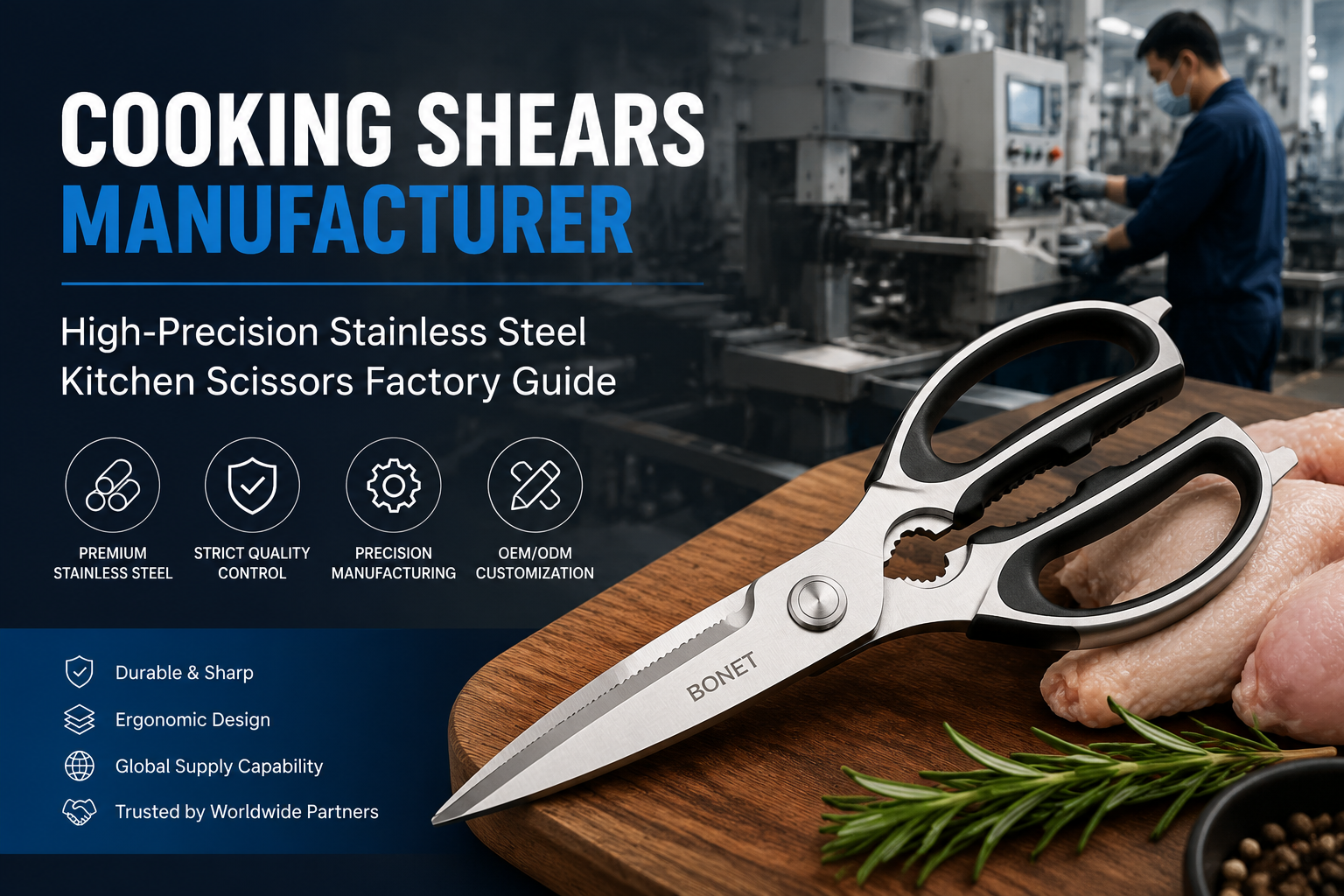
Cooking Shears Manufacturer: Factory Sourcing Guide for Kitchen Scissors Buyers
Cooking shears are a practical kitchen tool used for cutting poultry, meat, herbs, seafood, packaging, and food preparation materials. For importers, distributors, private-label brands, and kitchenware wholesalers, choosing a cooking shears manufacturer is not only about price. The supplier’s material control, blade processing, assembly accuracy, and quality inspection can affect cutting performance, durability, packaging consistency, and customer satisfaction.
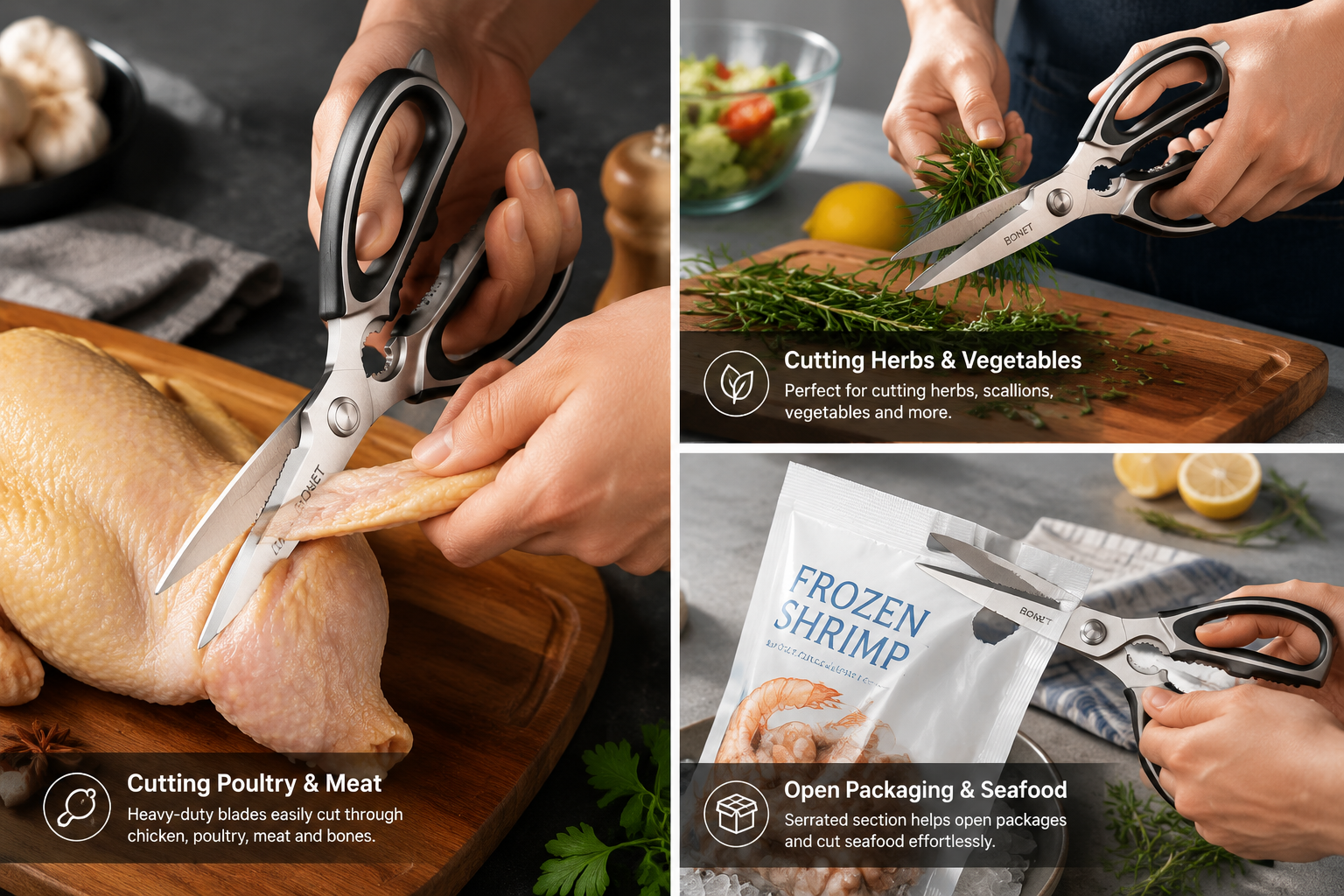
This guide explains how to evaluate a factory or supplier without relying on unsupported claims. Use it as a checklist when requesting quotations, samples, OEM options, and quality documentation.
Key Takeaways
- A reliable cooking shears supplier should explain its blade material, heat treatment, sharpening, assembly, and inspection process clearly.
- Buyers should verify claims about food contact safety, corrosion resistance, dishwasher use, and certifications with documents or test reports.
- OEM decisions should cover logo method, packaging structure, handle design, sample approval, and final inspection standards.
- Before confirming bulk orders, compare samples using cutting feel, blade alignment, handle comfort, finish quality, and packaging protection.
What a Cooking Shears Manufacturer Actually Does
A professional cooking shears manufacturer is more than a trading contact that assembles finished parts. In most sourcing projects, buyers should understand which processes are handled in-house and which are outsourced. Common manufacturing stages include blade cutting or stamping, forming, heat treatment, grinding, sharpening, polishing, handle molding or fitting, pivot assembly, adjustment, cleaning, and packing.
Not every supplier will manage every stage internally, and that is not automatically a problem. The important point is traceability. Ask who controls the blade material, who performs heat treatment, how sharpening consistency is checked, and how nonconforming products are separated before shipment.
Material Selection: Questions Buyers Should Ask
The original article identifies several common material references used for cooking shears, including 420 stainless steel, 3Cr13, 4Cr13, and food-contact stainless steel. These terms can appear in quotations, but buyers should avoid assuming that every product uses the same grade or performance level. Material choice affects hardness, corrosion resistance, edge retention, cost, and market positioning.
When discussing stainless steel kitchen scissors with a supplier, ask practical questions such as:
- What steel grade is used for the blade, and can it be stated on the specification sheet?
- Is the material suitable for direct food contact in the destination market?
- What hardness range is targeted after heat treatment?
- How is rust resistance evaluated during internal inspection?
- Are test reports or material declarations available for review?
If a product is promoted as dishwasher safe, food grade, heavy duty, or corrosion resistant, request evidence. These phrases are common in marketing, but they should be supported by product-specific documentation.
Typical Cooking Shears Manufacturing Process
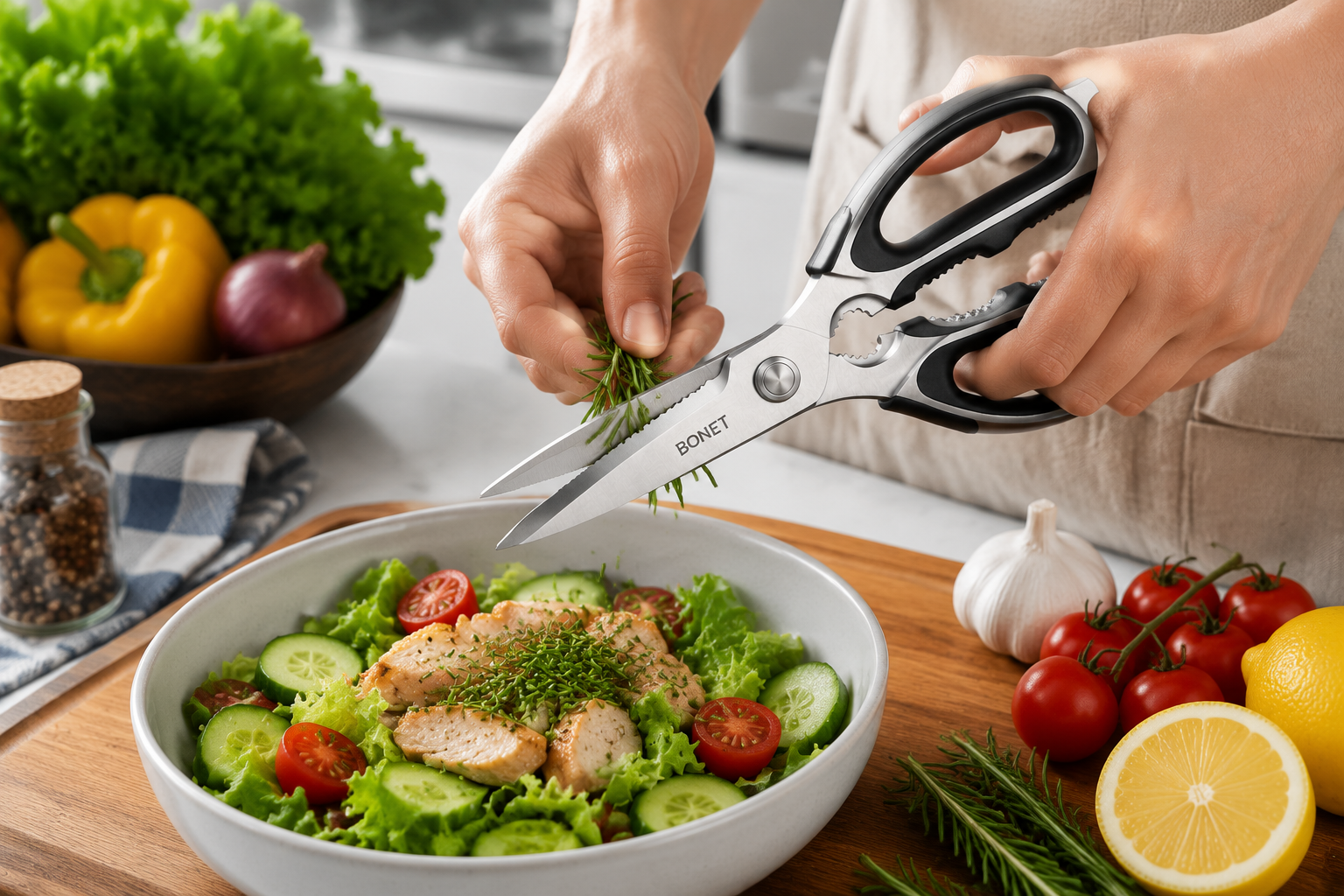
A clear production flow helps buyers identify possible quality risks. While each factory may have its own equipment and sequence, cooking shears usually follow a multi-step process.
- Blade forming: Stainless steel is cut, stamped, or formed into the blade profile required by the design.
- Heat treatment: The blades are treated to reach the intended balance of hardness and toughness.
- Grinding and sharpening: Cutting edges are shaped and refined so the two blades meet correctly.
- Surface finishing: Polishing or finishing improves appearance and may help reduce surface roughness.
- Handle production or fitting: Handles may be molded or assembled depending on the design and material.
- Pivot assembly: The pivot screw, rivet, or fastener is installed and adjusted for opening and closing feel.
- Inspection and packing: Finished shears are checked, cleaned, labeled, and packed according to the buyer’s requirements.
During factory evaluation, ask where each step is performed and how the supplier records production settings. For OEM kitchen scissors, consistent assembly is especially important because small differences in blade alignment can create a poor cutting feel.
Quality Control Points for Wholesale Orders
Quality control should be discussed before samples are approved, not after mass production is complete. A practical QC plan for cooking shears may include incoming material checks, blade hardness checks, visual inspection, sharpness assessment, opening and closing torque evaluation, blade alignment review, handle fitting inspection, surface finish review, and packaging drop or protection checks.
Buyers should define acceptable quality levels and inspection methods in writing. Instead of accepting a general phrase such as “strict QC,” ask the supplier to explain:
- Which defects are considered critical, major, and minor?
- How many pieces are inspected per batch?
- What cutting media is used for sharpness testing?
- How are rust spots, burrs, loose pivots, and handle gaps judged?
- Can pre-shipment inspection be arranged by the buyer or a third party?
OEM and Private Label Customization
OEM and ODM options are common in kitchenware sourcing, but they should be defined carefully. Basic OEM work may include logo printing, laser marking, customized color, barcode labels, instruction inserts, and retail packaging. More advanced development may involve handle redesign, blade profile changes, detachable structures, or added functions such as a bottle opener or poultry notch.
Before requesting a quotation, prepare a short specification sheet. Include target market, intended retail channel, blade material requirement if known, handle preference, packaging type, logo placement, quantity forecast, inspection expectations, and any compliance documents required by your market. If the supplier cannot confirm MOQ, lead time, tooling cost, or sample schedule immediately, ask them to provide these details in the quotation rather than relying on assumptions.
Cooking Shears vs. Regular Kitchen Scissors
Many buyers compare cooking shears with general household scissors. The distinction matters because kitchen use may involve wet foods, thicker materials, frequent cleaning, and direct food contact. The table below summarizes common sourcing considerations.
| Comparison Point | Cooking Shears | Regular Scissors | Buyer Check |
|---|---|---|---|
| Primary use | Food preparation, poultry, herbs, seafood, packaging | Paper, light packaging, general household use | Confirm intended use on product labeling |
| Blade requirement | Needs stable edge alignment and corrosion-aware material choice | May prioritize light cutting and low cost | Ask for blade grade and hardness target |
| Cleaning exposure | Often exposed to water, oil, salt, and food residue | Usually lower exposure to food and moisture | Verify cleaning instructions and rust testing |
| Handle design | Should support grip comfort during kitchen tasks | May be designed for occasional light use | Evaluate sample ergonomics with real cutting tasks |
| Packaging need | May require food-use messaging and retail safety information | Often simpler packaging | Review destination-market label requirements |
How to Evaluate a Cooking Shears Supplier
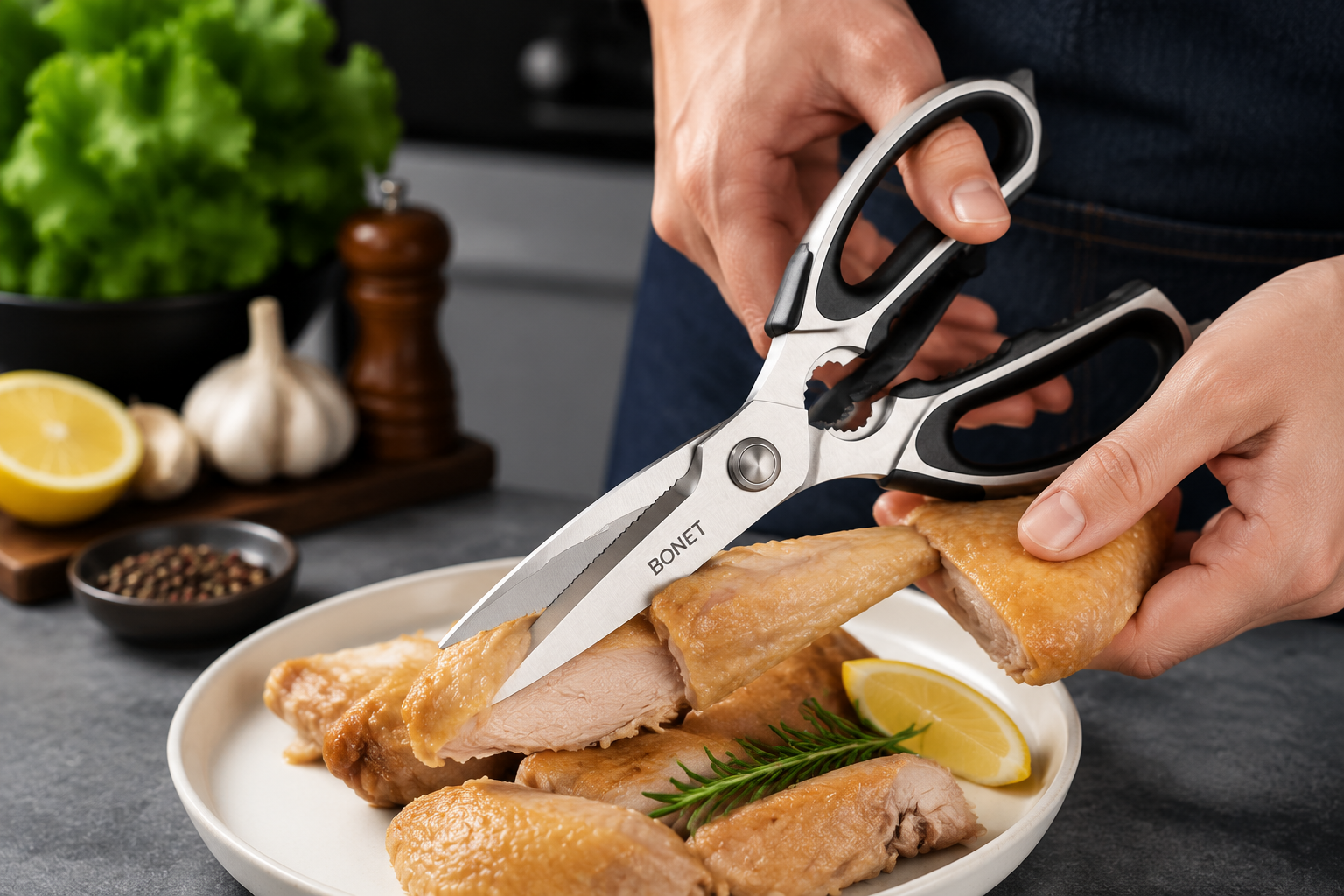
A good supplier evaluation combines document review, sample testing, and communication quality. Start by asking for a product specification sheet, available material information, packaging options, sample policy, estimated production schedule, and quality control process. If certifications or test reports are required for your market, ask whether they apply to the exact product you plan to buy.
Sample review should be practical. Cut herbs, thin packaging, poultry skin, cardboard sleeve material, and other items relevant to your market. Check whether the blades separate cleanly, whether the pivot loosens, whether the handles feel stable, and whether cleaning leaves visible stains. Compare several samples from the same batch to see whether quality is consistent.
Supplier Checklist Before Placing an Order
- Confirm blade material, handle material, finish, size, weight, and packaging details on a written specification sheet.
- Request clarification on MOQ, sample cost, tooling cost, lead time, payment terms, and inspection arrangement.
- Ask which quality tests are performed and whether results can be shared before shipment.
- Approve physical samples before mass production and keep one signed reference sample.
- Check carton strength, inner packing, barcode placement, warning text, and retail display requirements.
- Confirm how the supplier handles defects, replacement claims, and production changes.
Practical FAQ
Q1: What materials are commonly used for cooking shears?
A: The source article lists 420 stainless steel, 3Cr13, 4Cr13, and food-contact stainless steel as common references. Buyers should ask the supplier to confirm the exact material for the selected model.
Q2: Can cooking shears be customized for private label orders?
A: Many suppliers offer options such as logo marking, packaging design, color selection, and private-label presentation. Confirm available methods, costs, MOQ, and sample timing with the supplier.
Q3: Are all stainless steel cooking shears dishwasher safe?
A: Not necessarily. Dishwasher suitability depends on blade material, handle material, surface treatment, pivot structure, and care instructions. Ask for product-specific guidance and testing evidence.
Q4: What should buyers test on samples?
A: Check sharpness, blade alignment, pivot smoothness, handle comfort, surface finish, cleaning performance, packaging protection, and consistency between multiple samples.
Q5: What commercial details should be confirmed before ordering?
A: Ask about MOQ, unit pricing, tooling cost, sample policy, production lead time, inspection standard, shipping packaging, payment terms, and documentation required for your destination market.
Q6: How can buyers reduce sourcing risk?
A: Use a written specification, approve reference samples, request relevant documents, define inspection criteria, and avoid accepting unsupported claims about compliance or performance.
