




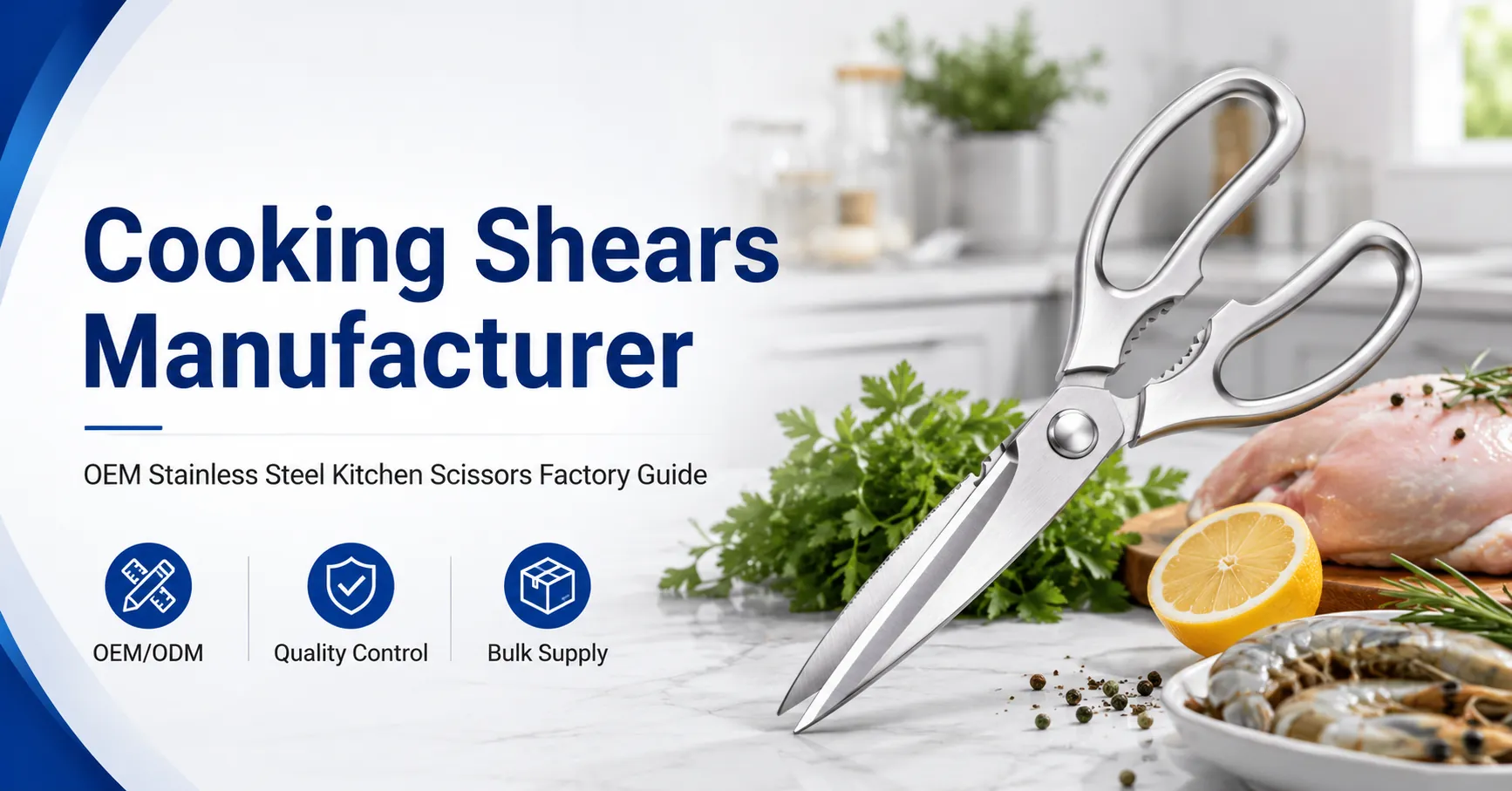
Cooking Shears Manufacturer: OEM Stainless Steel Kitchen Scissors Factory Guide
For kitchenware brands, importers, distributors, and wholesale buyers, choosing a cooking shears manufacturer should involve more than comparing unit prices. Cooking shears are everyday food-preparation tools used for cutting herbs, poultry, seafood, meat, vegetables, and food packaging. If the blades lose sharpness quickly, the hinge feels unstable, or the handles are uncomfortable, customer complaints can follow.
A dependable factory partner should be able to discuss blade quality, hinge construction, handle design, cleaning convenience, OEM options, packaging, and quality control in clear detail. This guide explains what buyers should review before ordering samples or confirming a bulk production plan.
Key Takeaways
- Do not judge cooking shears only by sample appearance; test cutting performance, hinge smoothness, and batch consistency.
- Ask suppliers specific questions about stainless steel blade material, surface finish, edge grinding, and rust-resistance expectations.
- For OEM and private label projects, confirm logo placement, packaging structure, barcode needs, and carton requirements early.
- Request a clear quality control checklist before bulk shipment, especially for sharpness, alignment, hinge tension, and packaging condition.
What a Cooking Shears Manufacturer Should Control
A professional manufacturer should understand both product structure and production consistency. One well-made sample is useful, but B2B buyers need repeated quality across cartons and reorder batches. Cooking shears include several performance-sensitive parts, so weak control in one process can affect the final user experience.
Key manufacturing points to discuss include:
- Stainless steel blade forming and shaping
- Blade grinding, sharpening, and edge consistency
- Hinge assembly, alignment, and tension control
- Handle molding, grip assembly, and comfort
- Surface polishing, cleaning, and visual inspection
- Retail packaging, barcode labels, and export carton protection
When evaluating suppliers, ask how they record inspection results and how they handle nonconforming products. Avoid vague answers such as “quality is good” without a process, checklist, or sample approval standard.
Blade Quality: The Core of Kitchen Scissors Performance
The blade is the most important part of cooking shears. Poorly aligned or thin blades may cut unevenly, bend under pressure, or feel rough during repeated use. Stainless steel is commonly preferred for kitchen shears because it is suitable for food-preparation tools and easier to clean after use, but buyers should still ask for the exact material information from the supplier rather than assuming a grade.
During sample review, check the following items:
- Blade thickness and overall rigidity
- Edge sharpness on paper, herbs, poultry skin, and packaging
- Blade alignment from tip to base
- Whether a serrated section is included, if required for the design
- Surface finish, burrs, scratches, and polishing quality
- Cleaning convenience after contact with food residue
Buyers should ask the factory what blade material is used, what edge-grinding process is applied, and whether pre-shipment sharpness checks are included. If the product is intended for a regulated market, confirm what documentation or third-party testing the supplier can provide; do not assume compliance without written evidence.
Hinge, Handle, and User Safety Considerations
The hinge controls how the shears open and close. If it is too loose, the blades may separate during cutting. If it is too tight, users may experience fatigue, especially when cutting poultry, seafood, or thicker food packaging. A stable hinge should feel smooth while keeping the blades properly aligned.
Handle design also matters. For retail buyers, comfort can affect product reviews and repeat purchase decisions. A handle should be comfortable for common kitchen tasks and should not have sharp edges, weak joints, or slippery surfaces. If anti-slip grip performance is important for your product positioning, ask the manufacturer how the grip is made and how it is checked.
Some cooking shears are detachable for easier cleaning and drying. If this feature is part of your design, confirm how the detachable mechanism works, whether users can reassemble it easily, and how the hinge behaves after repeated opening and cleaning cycles.
OEM and Private Label Questions to Ask
Many buyers search for a cooking shears manufacturer because they need OEM or private label support. Customization can help align the product with a retail brand, marketplace store, supermarket program, or kitchenware collection. However, customization should be managed carefully to avoid delays or packaging mistakes.
Common OEM discussion points include:
- Logo placement on the blade, handle, packaging, or insert card
- Handle color options and color matching method
- Retail packaging type, such as blister card, color box, or hanging card
- Barcode, warning text, and product label requirements
- Kitchen tool set combinations, if the shears are sold with other utensils
- Sample approval process before mass production
Ask the supplier whether artwork templates are available, what file formats are required, and who is responsible for final packaging proofing. Also confirm the minimum order quantity, lead time, and cost impact for each customization option rather than assuming all OEM services are included.
Comparison Checklist for Supplier Evaluation
Before placing a bulk order, use a structured checklist to compare manufacturers. This helps sourcing teams avoid choosing based only on the lowest quotation.
| Evaluation Item | What to Check | Questions for the Supplier |
|---|---|---|
| Blade quality | Sharpness, alignment, thickness, finish | What stainless steel material is used, and how is sharpness inspected? |
| Hinge performance | Smooth opening, stable tension, no wobble | How is hinge tension controlled during assembly? |
| Handle design | Comfort, grip, strength, edge smoothness | Can the handle be tested with repeated cutting tasks? |
| Cleaning design | Easy washing and drying, detachable option if needed | Is the design detachable, and how should users clean it? |
| OEM packaging | Logo, label, barcode, carton protection | Can packaging samples or proofs be approved before production? |
| Quality control | Inspection checklist and defect handling | What checks are completed before shipment? |
Quality Control Before Bulk Shipment
Cooking shears are used directly in food preparation, so quality control should be practical and repeatable. Buyers should request a pre-shipment inspection plan that includes both function and appearance. Useful QC checks may include blade sharpness, cutting smoothness, hinge tension, handle strength, rust-resistance review where applicable, surface finish, packaging accuracy, and carton condition.
It is also helpful to define acceptable and unacceptable defects in advance. For example, minor surface marks, loose hinges, misprinted packaging, dull blades, or unstable handle parts should be classified clearly. If you work with third-party inspection companies, share the inspection standard with the manufacturer before production starts.
How to Reduce Risk When Sourcing Kitchen Shears
A careful sourcing process can reduce delays, rework, and customer complaints. Start with a written product specification that describes the intended use, target market, packaging style, logo requirements, and performance expectations. Then request samples and test them in real kitchen scenarios rather than only checking appearance.
- Shortlist suppliers based on product experience and communication quality.
- Request current samples and confirm whether they match your target design.
- Test cutting performance on herbs, packaging, seafood, and poultry if relevant.
- Confirm OEM artwork, packaging layout, carton marks, and labeling needs.
- Approve a final pre-production sample before bulk manufacturing.
- Arrange inspection before shipment, especially for first orders.
If details such as MOQ, lead time, certifications, or testing reports matter for your channel, ask the supplier directly and request written confirmation. These commercial and compliance details can vary by model, order size, and destination market.
FAQ
Q1: What are cooking shears used for?
Cooking shears are used for cutting herbs, meat, poultry, seafood, vegetables, and food packaging. Some buyers also position them as general kitchen scissors for daily prep tasks.
Q2: Why are stainless steel blades common for kitchen shears?
Stainless steel is commonly used because it is suitable for kitchen tools, can hold a cutting edge, and is easier to clean than many non-stainless materials. Buyers should still confirm the exact material with the manufacturer.
Q3: Can cooking shears be customized for private label orders?
Usually, OEM options may include logo placement, handle color, packaging design, barcode labels, and set combinations. Confirm available options, MOQ, cost, and sample timing with the supplier.
Q4: Are detachable cooking shears better?
Detachable shears can be easier to clean and dry, which is helpful for food preparation. Buyers should test whether the detachable structure is stable, safe, and easy for consumers to reassemble.
Q5: Should buyers request samples before ordering in bulk?
Yes. Samples allow buyers to check sharpness, hinge stability, handle comfort, packaging quality, and whether the product matches the intended retail or wholesale positioning.
Final Sourcing Advice
A reliable cooking shears manufacturer should help buyers move from sample evaluation to bulk production with clear specifications, practical QC steps, and transparent OEM communication. Before committing to a purchase order, ask detailed questions about blade material, hinge testing, packaging proofing, inspection standards, MOQ, lead time, and available documentation for your target market.
