




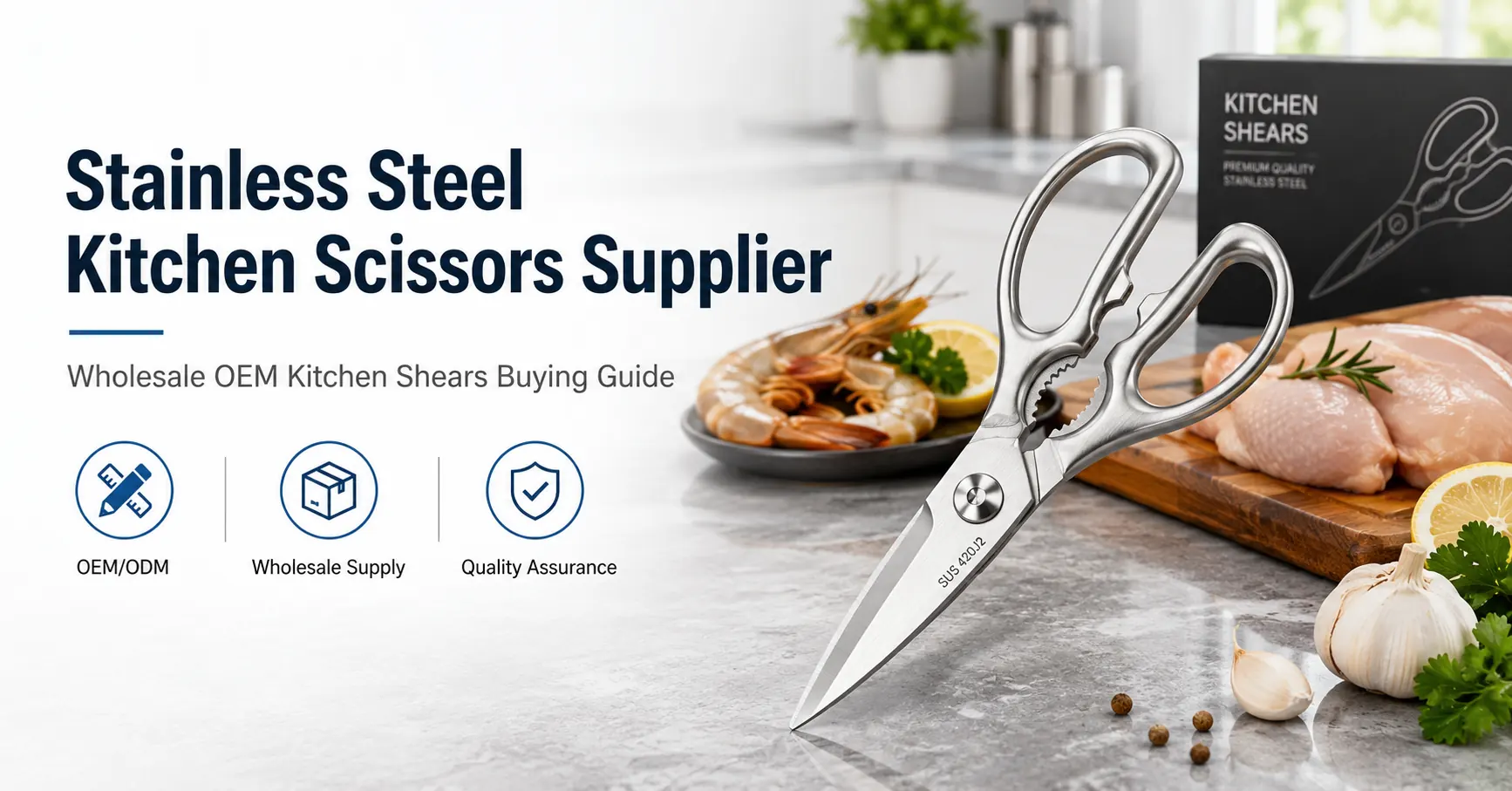
Stainless Steel Kitchen Scissors Supplier: Wholesale OEM Kitchen Shears Buying Guide
Stainless steel kitchen scissors are practical tools for cutting herbs, poultry, seafood, vegetables, food packaging, and other daily kitchen materials. For importers, supermarket buyers, Amazon sellers, distributors, and private label kitchenware brands, choosing the right stainless steel kitchen scissors supplier is not only a price decision. The product must cut cleanly, resist rust in normal kitchen use, feel stable in the hand, and arrive in packaging that suits the sales channel.
Because kitchen scissors touch food and are often used with wet hands, buyers should evaluate them differently from general household scissors. Blade quality, hinge structure, handle comfort, cleaning design, packaging, and quality control all affect customer reviews and repeat orders.
Key Takeaways
- Do not compare suppliers by unit price alone; cutting performance and hinge stability are equally important.
- Ask clear questions about stainless steel type, blade thickness, edge finishing, and rust-resistance expectations.
- Match packaging to the channel: supermarket hanging display, ecommerce shipping, distributor cartons, or private label retail boxes.
- Request samples before bulk orders and test them on realistic kitchen materials.
- Confirm OEM details, inspection standards, carton requirements, and repeat-order support before committing.
Why Kitchen Scissors Work Well for Wholesale Programs
Kitchen scissors have steady demand because they solve small preparation tasks that knives do not always handle conveniently. Consumers use them for trimming herbs, cutting food packaging, portioning poultry, snipping seafood shells, and preparing vegetables. For retailers, they are easy to explain, compact to ship, and suitable for both individual sale and kitchen tool sets.
For B2B buyers, stainless steel kitchen scissors can fit multiple channels:
- Supermarkets and home goods stores
- Amazon and marketplace sellers
- Kitchenware distributors
- Private label kitchen brands
- Restaurant and food preparation suppliers
- Promotional or bundled kitchen tool programs
The challenge is that low-quality scissors may look acceptable in photos but fail during use. A reliable sourcing process should therefore focus on samples, functional checks, and supplier communication.
What to Ask a Stainless Steel Kitchen Scissors Supplier
A capable supplier should be able to explain the product structure, available models, packaging choices, and customization limits. Buyers should ask direct questions instead of relying only on catalog images.
| Checklist Item | What Buyers Should Confirm | Why It Matters |
|---|---|---|
| Blade material | Ask what stainless steel is used and how it is identified. | Material affects rust resistance, durability, and market positioning. |
| Blade edge | Check sharpness, thickness, polishing, and whether any serrated section is included. | The edge determines cutting performance on food and packaging. |
| Hinge structure | Review rivet or screw strength, blade alignment, and opening smoothness. | A loose hinge quickly creates poor user experience. |
| Handle design | Compare grip size, comfort, material, and anti-slip feel. | Kitchen scissors are often used with wet or oily hands. |
| Cleaning design | Ask whether the blades separate, where gaps may trap residue, and how the item should be cleaned. | Food-contact tools must be easy to wash and dry. |
| Packaging | Confirm blister card, hanging card, color box, gift box, bulk carton, or ecommerce packaging options. | Packaging affects shelf display, shipping protection, and brand presentation. |
| Inspection | Ask which checks are performed before shipment and whether buyers can define acceptance criteria. | Consistent QC helps reduce complaints and returns. |
Blade Quality: The Core Buying Point
The blade is the main reason customers either trust or reject a pair of kitchen scissors. Buyers should examine stainless steel quality, blade thickness, edge sharpness, finishing, and alignment. Some models may include a serrated section to help grip slippery food materials, but this should be verified on the actual sample.
When discussing blade material, avoid vague descriptions such as “high quality steel” without detail. Ask the supplier what stainless steel option is used for each model, whether alternative materials are available for different price levels, and how the supplier controls consistency between sample and mass production.
Practical sample tests can include cutting herbs, food bags, thin cardboard packaging, chicken skin, seafood shells, and vegetables. The goal is not to abuse the product, but to check whether it performs for realistic consumer tasks.
Hinge, Handle, and Cleaning Design
Even sharp blades can feel poor if the hinge is unstable. The hinge should open and close smoothly, keep the blades aligned, and maintain suitable cutting tension. Buyers should check for wobbling, rough movement, uneven contact between blades, or an overly tight feel that causes hand fatigue.
Handle selection also affects positioning. Common handle material options in kitchen scissors may include PP plastic, ABS, TPR or silicone grip, and stainless steel integrated handles, depending on the model. A supermarket value line may prioritize cost and basic comfort, while a higher-positioned product may need a stronger grip and better finish.
Cleaning is especially important because kitchen scissors contact food directly. Buyers should ask whether the design has hard-to-clean gaps, whether the blades can be detached, and what care instructions should appear on the packaging. Detachable kitchen scissors can be easier to wash and dry after cutting meat, seafood, or herbs, but the hinge mechanism must still feel secure after reassembly.
OEM and Private Label Considerations
OEM customization can help buyers create a more recognizable product, but it should be managed carefully. Common options may include logo printing on the blade, logo printing on the handle, custom handle colors, private label packaging, barcode labels, instruction cards, and set combinations with other kitchen tools.
Before approving an OEM order, buyers should confirm practical details with the supplier:
- What artwork format is required for the logo and packaging?
- Where can the logo be placed without affecting food-contact surfaces or product appearance?
- What is the minimum order quantity for each customization option?
- Are pre-production samples available for approval?
- Will the bulk goods match the approved sample in color, finish, and packaging?
- What carton marks, barcodes, and labeling information are needed for the destination market?
Do not assume that every model supports every customization method. Confirm the limitations early, especially if the order is for a marketplace launch or retail chain review.
Packaging for Retail, Ecommerce, and Distribution
Packaging should protect the blade, explain the product clearly, and suit the sales environment. Hanging card or blister packaging can work well for supermarket peg displays. Color boxes may suit ecommerce sellers that want better perceived value and added shipping protection. Bulk carton packing can be more efficient for distributors or business-to-business replenishment.
Buyers should ask for package dimensions, carton quantity, carton strength, barcode placement, and whether the blade tips are protected. For online sales, consider drop-test needs and the risk of sharp edges damaging packaging during transport. For retail shelves, confirm that product claims, instructions, and warning statements are appropriate for the destination market.
Quality Control Before Bulk Shipment
Quality control should be defined before production, not after problems appear. For stainless steel kitchen scissors, useful inspection points include blade sharpness, blade alignment, hinge tension, handle strength, surface polishing, rust-related visual checks, packaging completeness, and export carton condition.
Buyers should also compare production samples with the approved sample. If possible, create a simple inspection checklist with acceptable and unacceptable examples. This helps avoid disputes over subjective issues such as “sharp enough,” “smooth enough,” or “minor scratches.”
FAQ
Q1: What are stainless steel kitchen scissors used for?
They are used for cutting herbs, poultry, seafood, vegetables, food packaging, and other common kitchen materials.
Q2: Are stainless steel kitchen scissors suitable for wholesale?
Yes. They are compact, practical, and suitable for supermarkets, ecommerce stores, distributors, and private label kitchenware programs.
Q3: Should buyers request samples before placing an order?
Yes. Samples allow buyers to test blade sharpness, hinge stability, handle comfort, cleaning design, and packaging quality before bulk production.
Q4: Can kitchen scissors be customized for OEM projects?
Often yes, but buyers should confirm available logo positions, packaging options, color choices, MOQ, sample approval steps, and production limits with the supplier.
Q5: What packaging is best for kitchen scissors?
It depends on the channel. Hanging cards suit retail displays, color boxes suit ecommerce and gifting, and bulk cartons may suit distributors.
Q6: Are detachable kitchen scissors always better?
They can be easier to clean and dry, but buyers should still check hinge strength, reassembly feel, and long-term stability on samples.
Final Sourcing Advice
A stainless steel kitchen scissors supplier should be evaluated as a long-term product partner, not only a source of low unit prices. Ask detailed questions, test samples with real kitchen tasks, review OEM and packaging requirements, and define inspection points before shipment. This approach helps buyers build a more reliable kitchen shears program for wholesale, retail, and private label channels.
