




How to Evaluate a Yangjiang Knife Manufacturer for Kitchen Knife Sets
Choosing a Yangjiang knife manufacturer is not simply a matter of comparing photographs and piece counts. For a kitchen knife set with a wooden storage block, several blade profiles, and kitchen shears, the real sourcing decision concerns steel selection, heat treatment, grinding consistency, handle construction, assembly control, and the supplier’s ability to repeat the same specification over time. This guide explains what buyers should verify before moving from an attractive product image to a serious quotation or private-label program.
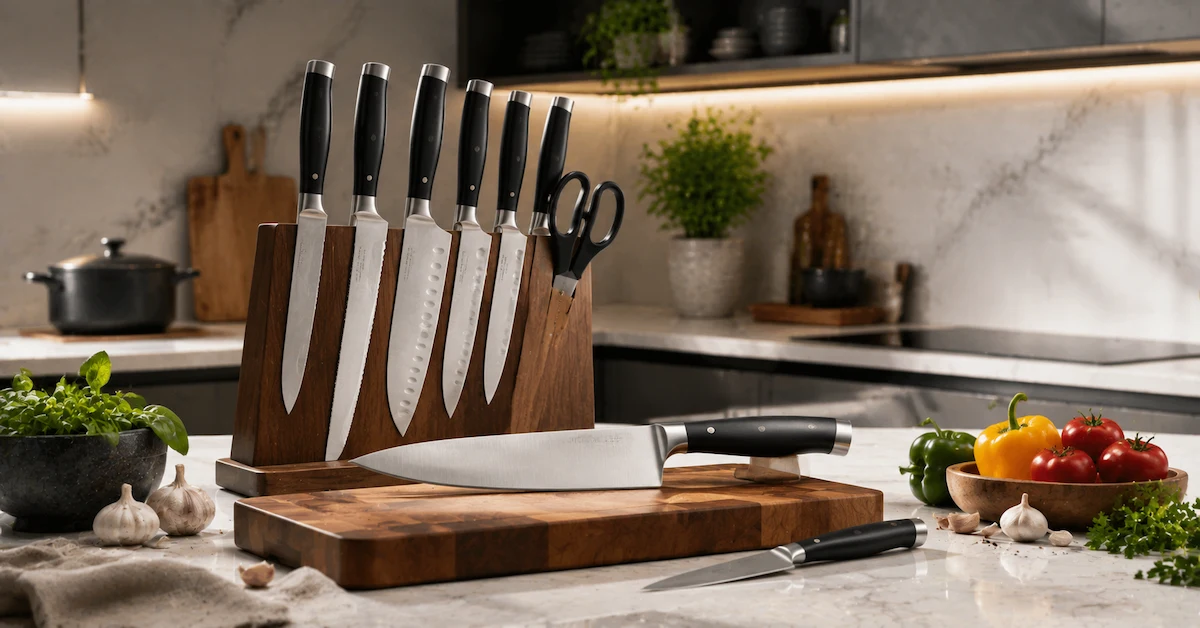
The product shown is a coordinated household kitchen set. It appears to include several vertically stored knives, a broad chef’s knife, a smaller pointed knife, kitchen shears, and a freestanding wooden block. A thick wooden cutting board is also visible, but its inclusion in the set is not confirmed. The image suggests a practical countertop package for home kitchens, hospitality starters, catering use, or retail distribution. It does not, by itself, confirm the steel grade, manufacturing process, origin, or performance.
What a buyer should confirm first
Before discussing price, define the product as a controlled specification rather than as a picture. The visible configuration contains several variables that affect cost, use, packaging, and quality inspection.
- Confirm the exact number of knives, shears, storage slots, and accessories.
- Identify each knife by intended function, such as chef’s knife, utility knife, paring knife, slicing knife, or other profile.
- Specify blade length, overall length, thickness, weight, grind type, and edge angle.
- Confirm whether the blades are forged or stamped, if that distinction matters to the program.
- Request the stainless-steel grade and the applicable heat-treatment specification.
- Define handle material, rivet construction, bolster design, and assembly requirements.
- Clarify whether the wooden block is supplied assembled, finished, packed separately, or shipped with the knives installed.
- Confirm whether the cutting board shown in marketing imagery is part of the commercial set.
These details are not administrative fine print. A two-piece difference can change carton dimensions and retail presentation. A different blade thickness affects balance and cutting behavior. A change in wood finish can influence packaging protection, odor, moisture exposure, and appearance at the point of sale.
Reading the visible product configuration
Blade formats and intended use
The set appears to combine narrow and broad blades rather than offering a single-purpose knife. A broad chef’s knife is generally selected for chopping and slicing. A smaller pointed knife is commonly used for peeling, trimming, or other detailed preparation. Additional vertically stored knives may serve different food-preparation tasks, although the exact profiles cannot be verified from the image.
One blade appears to show rows of oval dimples or a granton-style surface. Such features are often intended to reduce contact between the blade and certain foods, but the image does not establish the actual geometry or its effectiveness. Buyers should request technical drawings or production samples rather than relying on a catalog description.
Handles and storage
The handles appear black and smooth, with silver-colored bolster or end-cap sections and visible rivets. They may be polymer or composite, but the material is not stated. A supplier should identify the handle resin or composite, joining method, rivet material, and any relevant resistance requirements. If the set is intended for frequent commercial use, handle seams and transitions deserve close inspection because they are common points for contamination, looseness, or cosmetic inconsistency.
The dark brown wooden block has a natural-grain appearance and multiple slots. This is a useful retail and countertop feature, but it also introduces a separate manufacturing requirement. The block needs stable dimensions, clean slot machining, a suitable finish, and packaging that prevents scuffing or movement during transport. Buyers should ask whether the wood species is fixed, whether alternatives are available, and how moisture-related movement is managed. Avoid assuming that a visually similar block will remain identical across production runs.
Manufacturing questions that affect knife performance
Knife performance is determined by more than a bright polished surface. The production sequence typically involves forming or stamping the blade, heat treatment, grinding, sharpening, polishing, marking, handle assembly, and final inspection. The exact method used for this product is unknown and should be confirmed directly with the supplier.
Steel grade is a basic starting point. It provides a reference for corrosion behavior, toughness, hardness, finishing, and sharpening characteristics. A supplier that only describes a blade as “stainless steel” has not provided enough information for a technical purchasing decision. Ask for the specific grade and for the way it is controlled in production. If hardness is important, request the stated target and measurement method. Do not accept an assumed value merely because the knife looks similar to another product.
Heat treatment deserves particular attention. Inconsistent heating, quenching, or tempering can produce variation in hardness and edge stability from one production batch to another. Grinding and sharpening also require control. Edge angle, symmetry, burr removal, and transition quality influence the initial cutting feel and the ease of later maintenance. Exact tolerances, test results, and edge-retention claims should only be used when the supplier provides supporting documentation or agreed inspection data.
For a multi-piece set, consistency may matter more than the performance of one individual knife. The customer expects the blades, handles, shears, and block to look like one coordinated product. Color variation, uneven polishing, loose rivets, misaligned handles, incomplete block finishing, or damaged packaging can undermine an otherwise acceptable knife.
How to compare a knife manufacturer in China
When comparing a knife manufacturer China sourcing teams should separate capability claims from evidence. A factory profile may mention OEM, private label, export experience, or complete production. Those statements are useful only when linked to a defined product scope and a repeatable quality process.
Request a technical data sheet, current product photographs, a sample matching the proposed configuration, and a written component list. Ask who supplies the blade steel, whether sharpening and handle assembly are performed in-house, and which operations are outsourced. If the wooden block comes from a separate supplier, determine who controls its dimensions and incoming inspection.
For a private-label program, also clarify artwork approval, logo placement, carton structure, inner protection, barcode requirements, and packaging language. These commercial details should be settled before production, particularly when the set contains a wooden block that can increase volume and shipping risk.
Common sourcing mistakes
- Using the image as the full specification. Images rarely show blade thickness, steel grade, edge angle, or assembly quality.
- Assuming the cutting board is included because it appears beside the block.
- Comparing quotations with different piece counts or different blade dimensions.
- Accepting “stainless steel” without identifying the actual grade.
- Ignoring the block and packaging when calculating landed product cost.
- Approving a sample without checking every knife, both shears, the block slots, and the retail package.
- Requesting unsupported claims about dishwasher safety, corrosion resistance, certifications, or durability.
A practical warning: a low quotation may reflect omitted accessories, a thinner blade, a different handle construction, lower packaging protection, or an unspecified steel grade. Make the comparison line by line. Otherwise, the cheapest offer may only be the least complete one.
Buyer checklist for the next supplier discussion
Send the supplier a controlled request for quotation rather than a product image alone. Include the desired piece count, knife functions, approximate dimensions, handle appearance, block requirements, marking, packaging, order quantity, and inspection expectations. Ask the supplier to mark every item as confirmed, available with modification, or not available.
Before approval, inspect the sample for blade alignment, edge uniformity, surface scratches, bolster transitions, rivet security, handle movement, shears operation, and block stability. Check that each knife fits its intended slot without excessive looseness. If the final application involves food-service environments, establish cleaning and maintenance requirements separately; do not infer them from appearance.
Frequently asked questions
Is the pictured set definitely made in Yangjiang?
No. The product information indicates a Yangjiang and knife-manufacturer sourcing context, but the image alone does not verify the actual manufacturer or country of origin. Origin and production responsibility should be confirmed with supplier documentation.
Is the set forged or stamped?
This cannot be determined from the available image. Request confirmation of the blade-forming process and check whether the same process applies to every knife in the set.
What steel is used?
The blades have a bright brushed or polished appearance consistent with stainless-steel construction, but the grade is not stated. A technical quotation should identify the grade rather than relying on a visual description.
Does the set include the wooden cutting board?
Its inclusion is not confirmed. Treat the board as excluded until it appears in the written component list and quotation.
What is the best next step?
Prepare a component-level RFQ and request a representative sample from the Yangjiang knife manufacturer under consideration. Compare the sample, specification, inspection plan, packaging, and commercial terms together. That process gives sourcing teams a much stronger basis for deciding whether the set is suitable for retail, hospitality, catering, or private-label launch.
