

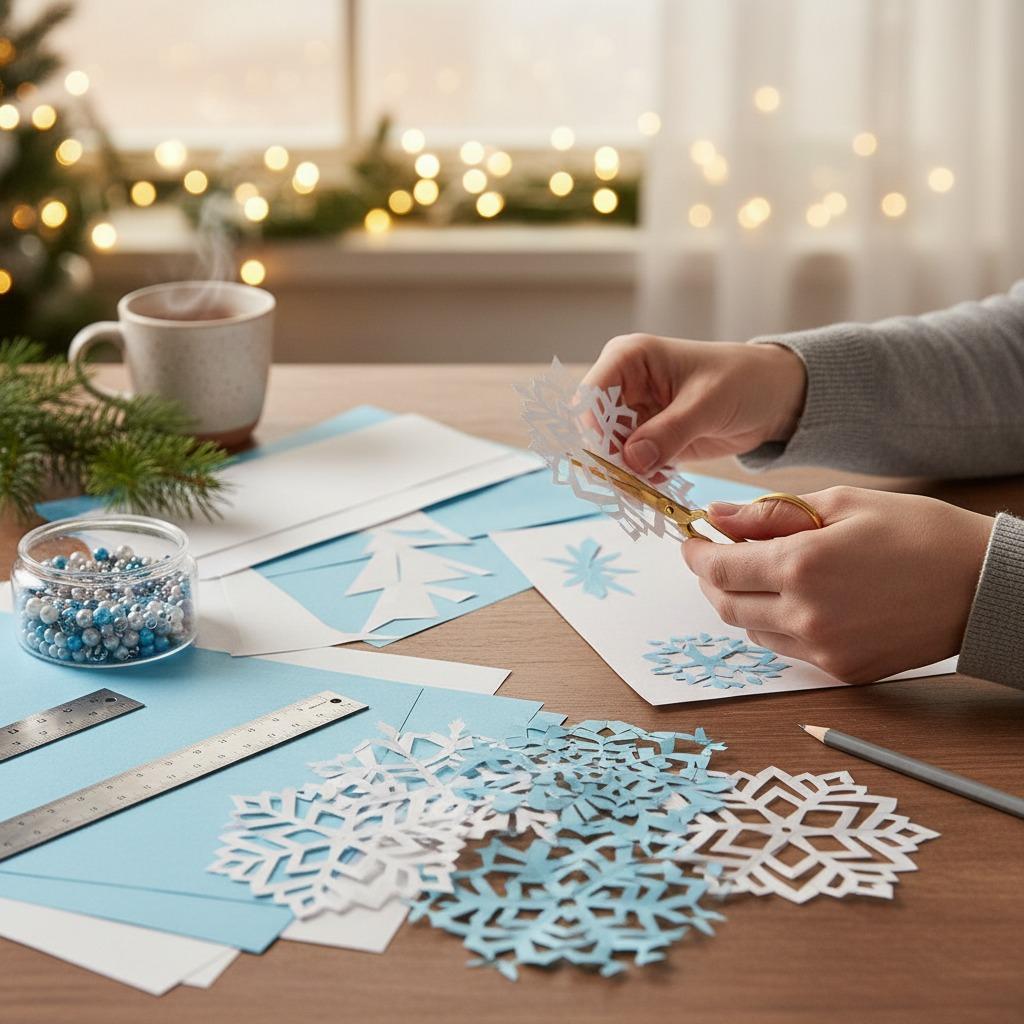

How to Make Classic Paper Snowflakes: A Step-by-Step Guide
Classic paper snowflakes are one of the simplest winter crafts to prepare for a classroom, family activity, holiday display, or quick lesson on symmetry. The project needs only paper, careful folding, and a pair of scissors, yet every finished snowflake looks different. This guide focuses on the traditional six-point paper snowflake, which more closely resembles the structure of real snow crystals than a four-point fold.
For children, the right cutting tool matters. A pair of school scissors can make the activity easier to control, especially when several layers of folded paper must be cut at once. Adult supervision is still important, particularly for younger children or any design that requires small, detailed cuts.
Key Takeaways
- Use thin paper for easier folding and cleaner cuts.
- A six-point snowflake starts with a square sheet folded into a triangle, then folded into thirds.
- Do not cut completely across the folded edges, or the snowflake may separate.
- Pre-folding paper helps younger children focus on safe cutting and pattern creation.
- Finished snowflakes can be flattened, hung, taped to windows, or used as gift decorations.
Materials You Need
You do not need a long craft list. In fact, paper snowflakes work best when the materials are simple. Standard printer paper is easy to find, while origami paper or lightweight craft paper can create neater folds. Avoid thick cardstock for beginners because it becomes difficult to cut after several folds.
| Item | Best Choice | Why It Matters |
|---|---|---|
| Paper | White printer paper, lightweight craft paper, or square origami paper | Thin paper folds evenly and is easier to cut through multiple layers. |
| Scissors | School scissors for children; sharper craft scissors for adults | The tool should match the user’s age, hand size, and cutting ability. |
| Pencil | Optional | Helpful for sketching cut lines before trimming. |
| Ruler | Optional | Useful when trimming rectangular paper into a square. |
| String or tape | Optional | Used for hanging snowflakes on windows, walls, or classroom boards. |
Before You Start: Paper and Scissor Tips
If you are making snowflakes with a group, prepare the workspace before handing out scissors. Clear the table, collect paper scraps in a small bin, and demonstrate how to hold the folded paper away from fingers while cutting. For a classroom, it can help to show one simple example first, then let students create their own patterns.
When choosing scissors, consider control more than size alone. Rounded tips are commonly preferred for younger children, while older students may need a pair that can cut through folded layers without tearing the paper. If the scissors are too dull, children may use too much force, which can lead to ragged edges or poor control. If they are too large, small hands may struggle to guide the cut accurately.
Step-by-Step: How to Make a Six-Point Paper Snowflake
- Start with a square. If you are using rectangular printer paper, fold one corner diagonally to meet the opposite edge. Cut off the extra strip so you have a square. If you are using square origami paper, you can skip this trimming step.
- Fold the square into a triangle. Bring one corner to the opposite corner and crease firmly. A sharp crease keeps the layers aligned and makes the final design more even.
- Fold the triangle in half again. You should now have a smaller triangle. Keep the folded edges neat and press the crease with your fingers.
- Fold the triangle into thirds. Imagine dividing the triangle into three equal sections. Fold one side across the center, then fold the other side over it. The result should look like a narrow wedge. This step takes practice, so adjust the folds until the bottom edges line up reasonably well.
- Trim the uneven top. Cut across the open end of the wedge to create a clean point or curved edge. The shape you cut here affects the outside edge of the snowflake.
- Cut your pattern. Cut small triangles, half-circles, notches, or curves along the sides. Vary the size and spacing of your cuts. Leave some folded edges intact so the snowflake stays connected.
- Unfold slowly. Open one fold at a time. If the paper catches, do not pull hard. Gently loosen the layers to avoid tearing delicate sections.
- Flatten and display. Press the finished snowflake under a book for a few minutes, then tape it to a window, hang it with string, or use it as a decoration on a card or gift.
Pattern Ideas for Different Skill Levels
Beginners should start with larger cuts because they are easier to control and less likely to tear. Try triangle notches along both sides of the folded wedge, then add a curved cut near the wide end. This creates a bold, simple snowflake that unfolds clearly.
For intermediate designs, combine straight and curved cuts. Small diamonds, narrow slits, and rounded scallops create more detailed results. If you draw the pattern first, use light pencil marks so they do not show strongly on the finished snowflake.
Advanced crafters can experiment with negative space. This means cutting away larger areas while leaving thin paper bridges intact. The challenge is balance: too few cuts can look plain, while too many cuts can make the snowflake weak. A good rule is to keep at least a few strong folded sections uncut from the center toward the outer edge.
Common Mistakes and How to Fix Them
The snowflake falls apart: This usually happens when the folded edges are cut through completely. Next time, leave connected sections along the folds.
The design looks too plain: Add more cuts near the center and along the sides of the folded wedge. Small repeated shapes often create the most interesting results.
The paper tears while unfolding: Use thinner paper, make fewer narrow cuts, and open the folds slowly. Pressing the creases too hard can also make delicate areas easier to tear.
The snowflake is not symmetrical: Check that the folds are aligned before cutting. Symmetry depends more on accurate folding than on complicated patterns.
Safety and Classroom Guidance
Paper snowflakes are suitable for many ages, but the activity should be adapted to the group. For young children, an adult can fold the paper in advance and mark a few large cutting areas. Children can then practice controlled cuts without struggling through the folding steps. For older children, the full process can support lessons on geometry, fractions, radial symmetry, and design planning.
Set simple rules before beginning: walk with scissors pointed down, cut only paper, keep fingers away from the cutting path, and place scissors on the table when not in use. If using glitter, glue, or markers after cutting, keep those materials separate until all scissors are put away.
Care, Storage, and Display Ideas
- Flatten finished snowflakes between sheets of paper under a heavy book.
- Store delicate designs in a folder or envelope so the points do not bend.
- Use removable tape for windows and walls to reduce residue.
- Hang several sizes from string to create a layered winter display.
- Reuse paper scraps for smaller snowflakes, labels, or practice cuts.
FAQ
What paper is best for paper snowflakes?
Lightweight paper is best because it folds cleanly and is easier to cut through several layers. Printer paper works well for most beginners.
How do I make a snowflake with six points?
Start with a square, fold it diagonally, fold it in half again, and then fold the triangle into thirds before cutting your pattern.
Can children use school scissors for this craft?
Yes, school scissors are commonly used for paper crafts, but children should be supervised. Choose a size and tip style appropriate for the child’s age and skill.
Why does my snowflake rip when I open it?
The cuts may be too narrow, the paper may be too thick, or the folds may be opened too quickly. Use thinner paper and unfold slowly.
How can I make each snowflake look different?
Change the edge shape, vary the size of the cuts, and combine triangles, curves, and small slits. Even small changes in the folded wedge create a new design.