




Innovative Sewing Scissors Manufacturers for Creative and Professional Buyers
For sewing studios, craft retailers, distributors, and private-label buyers, scissors are not a simple add-on product. They affect cutting accuracy, user comfort, repeat purchases, and customer perception of quality. When sourcing from sewing scissors manufacturers, buyers need to look beyond color and price and examine size range, blade thickness, handle material, consistency, packaging, and after-sales communication.
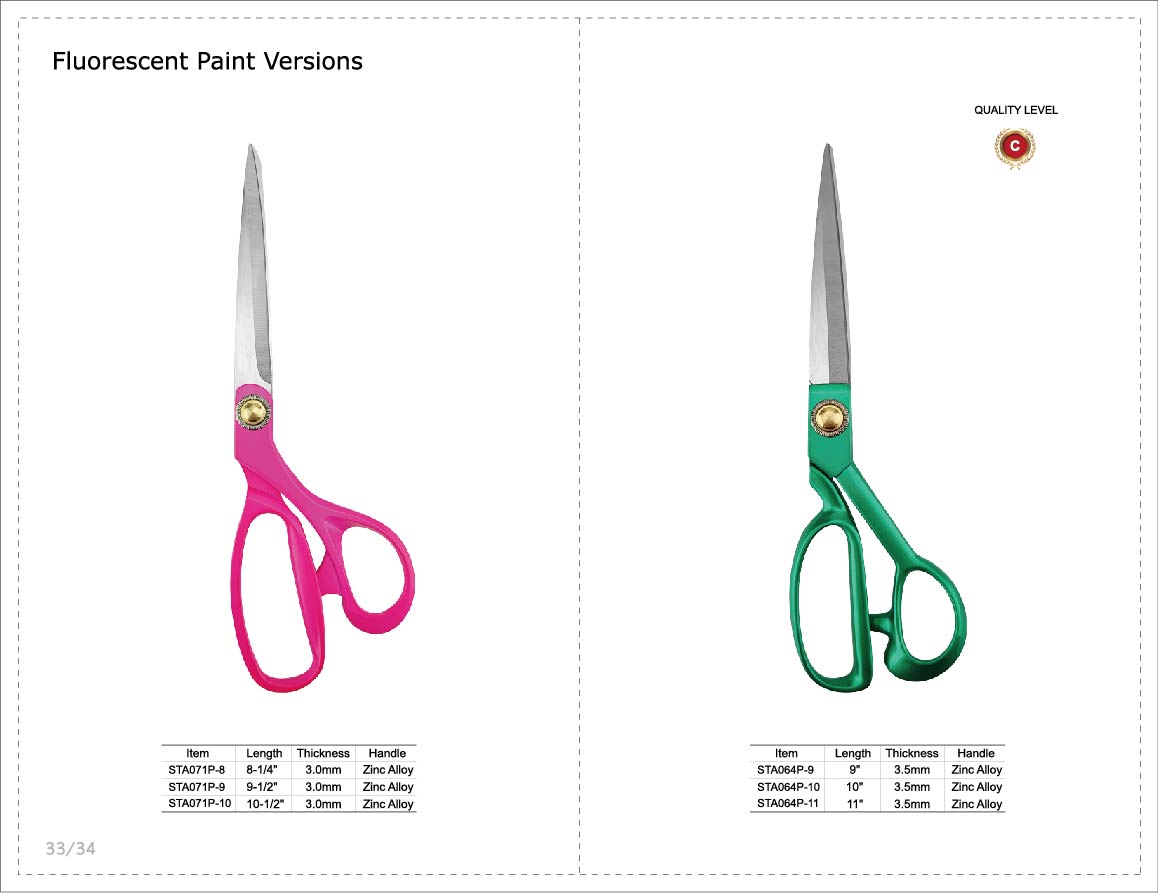
The original product information introduces two fluorescent paint versions: a bold pink edition and a green edition. Both are positioned for sewing, crafting, office, and studio use, with zinc alloy handles and several length options. This rewritten guide explains how to evaluate those options for wholesale or OEM sourcing without assuming unverified factory claims.
Key Takeaways
- The pink fluorescent scissors are listed in 8-1/4, 9-1/2, and 10-1/2 inch sizes with 3.0 mm thick blades.
- The green version is listed in 9, 10, and 11 inch lengths with 3.5 mm thick blades.
- Both versions are described with zinc alloy handles, making handle feel and finish quality important inspection points.
- B2B buyers should confirm MOQ, packaging, samples, branding options, inspection standards, and lead time directly with the supplier.
Why Fluorescent Sewing Scissors Are Worth Evaluating
Fluorescent color is not only a visual choice. In busy workrooms, classrooms, retail displays, and craft kits, bright scissors are easier to identify and separate from other tools. Pink and green finishes may also help brands create a more recognizable product line, especially when selling to hobby sewing, quilting, craft, or school supply channels.
However, visual appeal should not replace performance checks. A buyer should still review cutting smoothness, blade alignment, handle comfort, paint finish durability, edge retention, and whether the scissors can cut the intended materials. If the product is for fabric users, request samples and test them on common materials your customers use, such as cotton, felt, denim layers, thread, paper patterns, or lightweight craft materials.
Product Options Mentioned in the Original Article
The pink fluorescent paint version is available in three practical sizes: 8-1/4, 9-1/2, and 10-1/2 inches. The original description also states that it uses a zinc alloy handle and 3.0 mm thick blades. This makes it suitable to compare across general sewing, craft, and studio cutting requirements, depending on the buyer’s end market.
The green version is available in 9, 10, and 11 inch lengths. Its blades are described as 3.5 mm thick, which suggests buyers may want to test it for heavier or more demanding cutting tasks. The source also mentions an ergonomic zinc alloy handle. Because comfort is subjective, buyers should ask for samples and have different users test grip size, pressure points, and control over longer cutting sessions.
Comparison Table for Sourcing Decisions
| Item to Compare | Pink Fluorescent Version | Green Fluorescent Version | Buyer Check |
|---|---|---|---|
| Listed sizes | 8-1/4, 9-1/2, 10-1/2 inches | 9, 10, 11 inches | Match sizes to retail sets or target user groups |
| Blade thickness | 3.0 mm | 3.5 mm | Test cutting feel on intended materials |
| Handle material | Zinc alloy handle | Zinc alloy handle | Inspect casting, coating, grip shape, and comfort |
| Visual positioning | Bright, creative color | Bold color with a more classic tone | Choose based on retail display or brand palette |
| Best sourcing question | Can the finish stay consistent across batch production? | Can the heavier blade option meet the required use case? | Request samples and pre-shipment inspection criteria |
How to Assess a Sewing Scissors Manufacturer
When the search intent is “sewing scissors manufacturers,” buyers usually need a supplier that can deliver stable quality across repeat orders. Before comparing quotations, prepare a clear request for information. Ask what sizes are currently available, whether color finishes can be customized, what packaging formats are offered, and whether logo or private-label options are possible.
A responsible sourcing process should also include practical quality questions. For example, ask how the supplier checks blade alignment, cutting sharpness, opening and closing smoothness, handle coating consistency, and carton packing strength. Do not assume certifications, production capacity, or test results unless the supplier provides documents and current evidence. If your market has legal or safety requirements, confirm compliance with your own import adviser or testing partner.
Sample Testing Checklist for Wholesale Buyers
Samples are essential because product photos cannot show cutting feel. Use the same checklist for every supplier so your evaluation is fair and repeatable.
- Check whether both blade tips meet evenly when the scissors close.
- Open and close the scissors repeatedly to feel for looseness, grinding, or stiffness.
- Cut fabric from the base of the blade to the tip and note any snagging.
- Inspect the fluorescent paint for chips, bubbles, uneven coverage, or sharp handle edges.
- Measure size and blade thickness against the supplier’s stated information.
- Ask several users to test comfort, especially if the scissors are intended for long work sessions.
- Review packaging for barcode space, hanging display needs, warning labels, and shipping protection.
OEM, Branding, and Packaging Questions to Ask
If you plan to sell under your own brand, clarify OEM details early. Ask whether the supplier can support custom colors, logo placement, retail cards, blister packaging, gift boxes, or bulk workshop packing. Also ask whether any customization changes affect sample time, order quantity, tooling, printing cost, or production lead time.
For distributors and wholesalers, consistency is often more important than novelty. Confirm whether the same pink and green finishes can be repeated across future orders. Ask how color differences are controlled and whether a signed sample can be kept as the production reference. If your sales channel requires mixed sizes, confirm carton assortments, inner box quantities, and how the supplier labels each size to avoid warehouse confusion.
Use Cases: Matching Size to End Customer
Different customers prefer different scissor sizes. Smaller options, such as 8-1/4 or 9 inches, may appeal to crafters, students, or general household users who want control and easier storage. Mid-size and larger options, including 9-1/2, 10, 10-1/2, and 11 inches, may suit tailoring, pattern cutting, and workroom use where longer cuts are common.
Blade thickness also deserves attention. The listed 3.0 mm pink option and 3.5 mm green option should be compared through real cutting tests, not only specification sheets. A thicker blade may feel more substantial, but the final choice depends on balance, sharpness, pivot adjustment, and the material being cut.
Practical FAQ
What should I ask a sewing scissors supplier before ordering?
Ask for available sizes, blade thickness, handle material, sample policy, packaging options, logo options, MOQ, lead time, payment terms, inspection process, and how defects are handled.
Are fluorescent sewing scissors only for hobby use?
No. Bright finishes can be useful in craft rooms, sewing classes, retail displays, and professional workspaces. Buyers should still test cutting performance for the intended user.
How do I choose between the pink and green versions?
Use the pink version if its listed size range and 3.0 mm blade fit your market. Consider the green version if your customers prefer 9 to 11 inch scissors and you want to test the 3.5 mm blade option.
Can I assume OEM branding is available?
No. OEM branding, packaging, and color customization should be confirmed directly with the supplier, including costs, minimum order requirements, and sample approval steps.
What is the best way to reduce quality risk?
Approve physical samples, define inspection points in writing, keep a reference sample, and inspect production before shipment. This is especially important for finish color, blade alignment, and cutting feel.
