




Spiralizer Manufacturing: How to Source Reliable Vegetable Prep Tools
Spiralizer manufacturing covers the design, tooling, molding, blade forming, assembly, and inspection of kitchen tools that cut vegetables into spirals, ribbons, slices, julienne strips, or grated pieces. For importers, retailers, and private-label buyers, the main question is not simply whether a spiralizer looks attractive. The more important issue is whether the product is practical, consistent, safe to handle, and suitable for the target market.
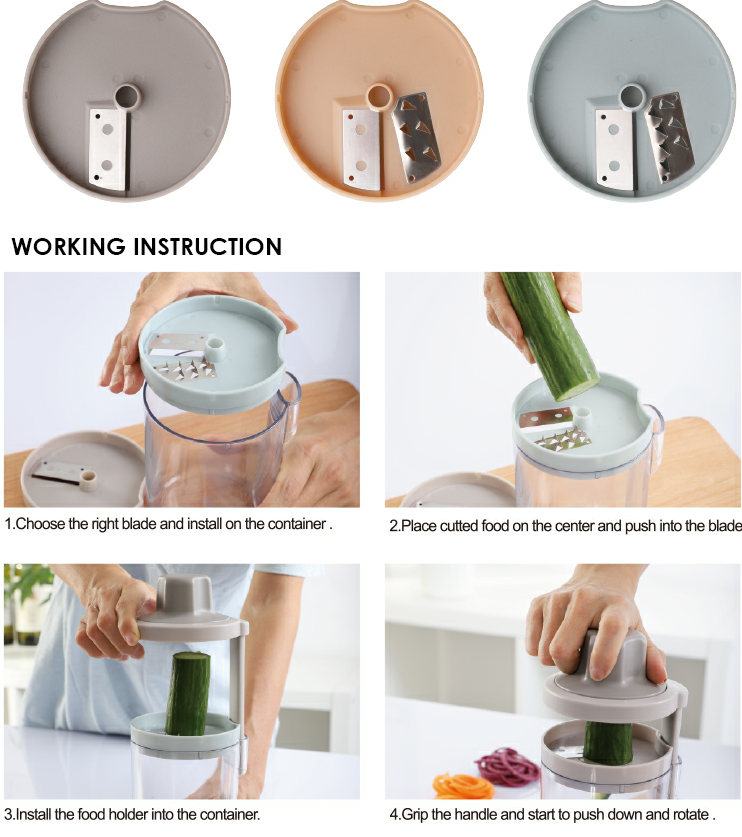
The original Bonet Houseware article highlighted a multi-functional Handheld Vegetable Slicer and Grater Set with modular components, a transparent container, interchangeable disk plates, and ergonomic handling. It also described color-coded disks: a pink disk for slicing vegetables such as cucumbers and carrots, a blue disk for julienne cutting, and a grey disk for coarse grating tougher vegetables. These are useful product concepts, but buyers should still verify the exact material grades, blade specifications, packaging, and compliance documents with the supplier before placing an order.
Key Takeaways
- Spiralizer manufacturing combines plastic molding, metal blade processing, assembly, and quality inspection.
- Color-coded interchangeable disks can improve usability, but blade sharpness and fit should be checked with samples.
- B2B buyers should ask suppliers for material details, test reports, packaging options, and inspection procedures.
- For OEM or wholesale programs, confirm artwork, mold ownership, spare parts, lead time, and after-sales handling in writing.
What Spiralizer Manufacturing Usually Involves
A vegetable spiralizer or handheld slicer set is typically made from several component groups: a body or container, cutting disks or plates, blades, lids or pushers, and sometimes a handle or grip. In production, plastic parts are commonly created through injection molding, while metal blades are stamped, sharpened, formed, and fixed into disk plates. The final product is then assembled, checked, packed, and prepared for shipment.
For a handheld slicer and grater set, small differences in tooling and assembly can affect user experience. A disk that sits loosely may wobble during cutting. A container that does not lock properly may spill prepared vegetables. A blade that is too dull will crush ingredients rather than cut them cleanly. Because of these risks, buyers should treat the product sample as a working tool, not just a visual reference.
Important Components to Review
The article source refers to a transparent container and interchangeable disk plates, which are practical features for a compact vegetable prep tool. A transparent container lets users see the prepared food as it is collected, while removable disks allow one tool to perform several cutting tasks. In sourcing, however, each component needs a separate review.
- Container: Ask what plastic is used, whether it is intended for food contact, and how it performs after washing and repeated use.
- Disk plates: Check how securely each disk fits into the main body and whether it can be removed without touching the blade edge.
- Blades: Request blade material information, sharpening method, corrosion-resistance details, and instructions for safe handling.
- Grip and ergonomics: Test whether the product is comfortable for different hand sizes and stable during cutting.
- Packaging: Confirm whether instructions, warnings, barcode labels, and retail packaging can be adapted for your market.
Comparison and Supplier Checklist
Before approving a supplier, compare both the product and the factory communication process. The table below can be used during sample evaluation or supplier qualification.
| Checkpoint | What to Ask | Why It Matters |
|---|---|---|
| Material disclosure | What plastics and blade metals are used, and can the supplier provide documentation? | Prevents uncertainty around food-contact suitability and durability. |
| Blade performance | Can samples cut cucumber, carrot, and firmer vegetables cleanly? | Confirms real cutting function, not just product appearance. |
| Disk fit | Do the pink slicing, blue julienne, and grey grating disks lock securely? | Loose disks can affect safety and cutting consistency. |
| Cleaning | Are the parts easy to rinse, and are there hard-to-clean corners? | Food residue can reduce user satisfaction and increase complaints. |
| Quality control | What inspections are performed before packing? | Helps reduce defects such as dull blades, poor fit, or missing parts. |
| OEM details | What logo, color, packaging, and instruction options are available? | Clarifies private-label feasibility before cost negotiation. |
How Factories Improve Consistency
Spiralizer factory operations depend on repeatability. For plastic parts, the mold condition, cooling time, and material handling all influence the final fit and finish. For blades, stamping and sharpening consistency determine how smoothly the slicer cuts. For assembly, workers or semi-automated stations must position each blade and disk correctly to prevent looseness or misalignment.
Buyers should not assume every batch will match the first sample unless clear controls are in place. Ask the supplier how golden samples are stored, how production samples are approved, and how defects are classified. If the order is for wholesale distribution, it is also sensible to arrange pre-shipment inspection based on agreed criteria such as function, appearance, packaging, labeling, and carton condition.
OEM and Wholesale Sourcing Questions
When the project involves OEM, private label, or a retailer-specific assortment, commercial details should be clarified early. Do not rely on general claims such as “factory direct” or “high quality” without supporting information. Instead, create a written product specification sheet and ask the supplier to confirm each item.
- What is included in one set: container, number of disks, lid, cleaning accessory, instructions, or other parts?
- Can disk colors be customized, or are pink, blue, and grey the standard options?
- Who owns any custom mold, artwork, or packaging design developed for the project?
- What are the minimum order quantity, lead time, sample cost, and payment terms?
- Which documents can be provided for the materials, packaging, and destination market requirements?
- How are missing parts, blade defects, or transit damage handled after delivery?
Evaluating User Experience Before Bulk Orders
A spiralizer or slicer set should be tested with real ingredients, not only inspected on a desk. Use common vegetables mentioned in the product concept, such as cucumbers and carrots, and add at least one firmer vegetable to test the grey coarse grating disk. Note whether the user must apply excessive force, whether the container stays stable, and whether vegetable pieces jam under the blade.
Cleaning is another important part of the test. Sharp blades can trap food fibers, and users may be reluctant to clean narrow slots by hand. Ask whether the supplier provides cleaning instructions and whether any included brush or tool is part of the standard set. If dishwasher use is important for your market, do not assume it is allowed; request written confirmation and supporting test information from the supplier.
Practical FAQ
What should buyers verify first when sourcing a spiralizer?
Start with function, material disclosure, and blade safety. A good-looking sample is not enough if the disks do not fit securely or the blades cannot cut vegetables cleanly.
Can a handheld slicer and grater set be customized for private label?
Many kitchen tool suppliers offer some level of customization, but the available options vary. Ask about logo placement, disk colors, retail packaging, instruction manuals, and whether customization changes lead time or order quantity.
Are color-coded disks useful?
Yes, color-coded disks can help users quickly identify functions. In the referenced product concept, pink is associated with slicing, blue with julienne cutting, and grey with coarse grating. Confirm the final function and color plan with the supplier before production.
How can buyers reduce quality risks?
Approve a detailed sample, create a written specification, request material and inspection information, and consider pre-shipment inspection. For repeat orders, compare production units with the approved sample.
What information should be included in the product specification?
Include component list, dimensions if available, materials, blade type, disk functions, packaging, labeling, instructions, test requirements, acceptable defect limits, and any destination-market documentation needed.
Final Thoughts
Spiralizer manufacturing is a practical area of kitchen tool production where small design and assembly choices have a direct effect on user satisfaction. For a Handheld Vegetable Slicer and Grater Set with interchangeable disks, the most important sourcing tasks are to confirm materials, test the cutting functions, check disk stability, and document all OEM or wholesale requirements. A careful supplier evaluation process helps buyers select products that are easier to use, easier to inspect, and better suited to long-term retail or distribution programs.
