




Kitchen Tools Supplier Guide for Retail and Distributor Buyers
Choosing a kitchen tools supplier is not only about finding individual utensils at a workable cost. For retailers, distributors, and sourcing teams, the bigger question is whether the supplier can support a coherent category program. A shelf with spatulas, ladles, tongs, whisks, measuring tools, boards, storage containers, and organizers needs to feel planned rather than random.
That is why wholesale kitchenware sourcing often starts with assortment strategy. Buyers need enough range to serve different customer needs, but not so many disconnected SKUs that inventory becomes difficult to manage. A good supplier conversation should cover product families, display formats, replenishment expectations, packaging options, and the practical questions that affect retail execution.
What Retail Buyers Need From a Kitchen Tools Supplier
A kitchen tools supplier for retail or distribution should help buyers build a usable assortment, not simply provide a long product list. Kitchen tools are often small-ticket items, but they influence basket size and repeat purchasing. A shopper may come for one ladle and also buy a cutting board, storage container, or utensil holder if the section is easy to understand.
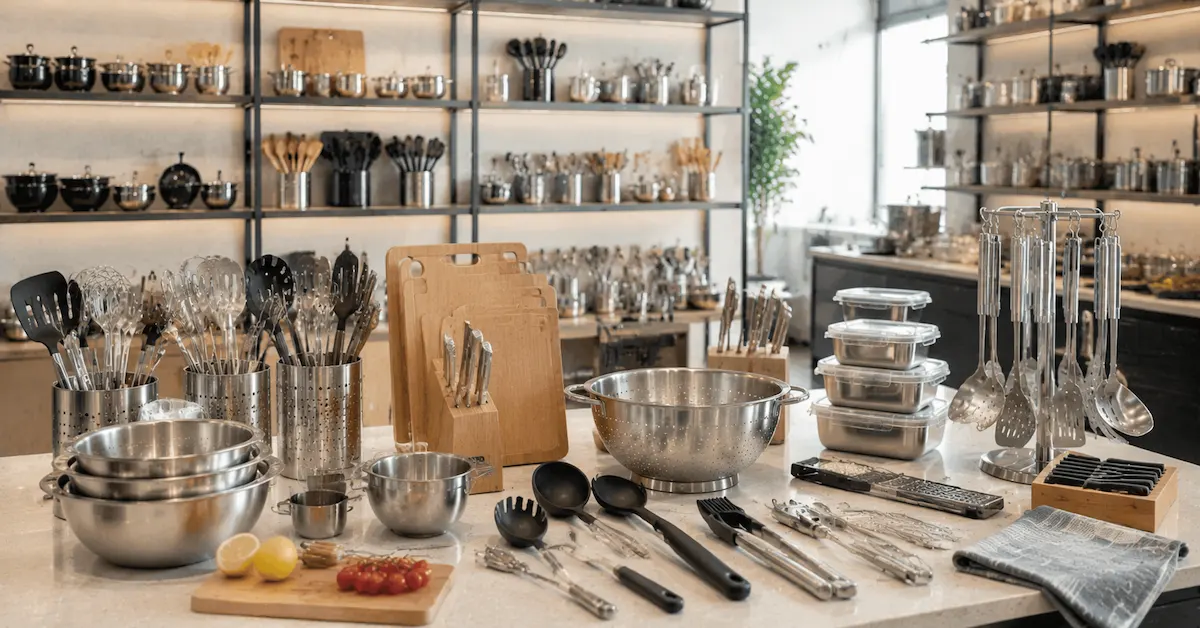
The original product display suggests a broad kitchenware mix that includes preparation tools, serving tools, boards, bowls, storage items, and organizers. That matters because most retail buyers are not trying to source one hero product. They are trying to build a kitchen tools section that works across everyday cooking, food preparation, serving, and home organization.
Build the Assortment Around Use Cases
The simplest way to evaluate a kitchen tools program is to group products by how customers use them. This prevents the assortment from becoming a collection of unrelated items. It also helps sourcing managers identify gaps before placing an opening order.
- Preparation tools: spatulas, whisks, graters, measuring cups, measuring spoons, and mixing bowls.
- Cooking and serving tools: ladles, tongs, serving spoons, turners, and other long-handled utensils.
- Cutting and surface items: cutting boards, including wood or bamboo-style boards when offered.
- Storage products: clear plastic containers and lids where visibility is part of the purchase appeal.
- Organization items: utensil holders, stands, hanging racks, or blocks that help customers imagine the products at home.
This use-case approach also supports better merchandising. A distributor can offer retailers a prep zone, a storage zone, and a countertop organization zone rather than asking them to assemble the story from scratch.
Compare Supplier Fit Before Expanding SKUs
It is tempting to judge a kitchen tools distributor by catalog size alone. A broad catalog can be useful, but only if the range is commercially manageable. Buyers should compare suppliers using practical criteria that affect daily selling and replenishment.
| Evaluation Area | What to Check | Why It Matters |
|---|---|---|
| Category breadth | Prep, cooking, serving, storage, and organization coverage | Helps buyers create a complete kitchen tools section |
| Visual consistency | Coordinated finishes, handle styles, and display logic | Makes shelves and showroom displays easier to shop |
| Merchandising formats | Hanging, standing, nested, boxed, or countertop options | Supports different retail layouts and distributor channels |
| Commercial clarity | Ask about MOQ, lead time, packing, reorder process, and private label options | Prevents confusion after samples or opening orders |
| Product evidence | Request material details, test information, and care instructions where needed | Reduces risk when making claims to retailers or end users |
Use Visible Materials as Cues, Not Assumptions
The product information shows common kitchenware materials and appearances, including polished metal utensils, dark handles, wood or bamboo-style boards, and clear plastic storage containers. These visual cues are useful for merchandising, but buyers should avoid making unsupported claims.
For example, a polished metal tool may look suitable for a premium display, but the exact metal grade, dishwasher suitability, and heat resistance should be confirmed with the supplier. Clear containers can communicate convenience because contents are visible, but food-contact details, lid performance, and care instructions should be requested before retail packaging or listings are finalized.
This distinction is important in B2B sourcing. The supplier’s display can show how the line may be merchandised, while technical claims must come from confirmed product documentation.
Merchandising Depth Is Often More Valuable Than One Standout Item
Kitchen tools rarely succeed as isolated products. A single attractive whisk or ladle may sell, but a coordinated group of utensils, boards, bowls, containers, and organizers gives retailers more ways to increase basket size. It also helps distributors serve different account types, from small home goods shops to larger retail programs.
The visible assortment suggests several presentation methods: hanging tools, countertop holders, nested storage, and stand-based organization. These formats are commercially useful because stores differ. Some need vertical hanging displays to save space. Others need countertop organizers for impulse purchases. Catalog and showroom buyers may prefer grouped families that are easy to explain to customers.
Common Wholesale Sourcing Mistakes to Avoid
One common mistake is treating kitchen tools as a simple commodity category. Even low-priced tools affect customer perception. Handle comfort, finish consistency, edge smoothness, storage practicality, and packaging clarity can all influence whether the range feels dependable.
Another mistake is over-ordering every item equally. A kitchen tools program usually contains traffic drivers, add-on items, and range fillers. Buyers should identify which products deserve depth and which only need enough stock to complete the display.
A third mistake is accepting broad claims without documentation. If your retail channel requires a specific material grade, labeling language, testing standard, barcode format, carton requirement, or private label process, ask the supplier directly before committing. If those details are not provided, do not build them into your sales copy.
Key Takeaways for Buyers
- Choose a kitchen tools supplier based on assortment usability, not catalog length alone.
- Group products by prep, cooking, serving, storage, and organization use cases.
- Confirm technical details before making claims about materials, heat resistance, dishwasher safety, or compliance.
- Ask how the supplier supports merchandising formats such as hanging, nesting, countertop display, or bundled programs.
- Plan replenishment around best sellers instead of ordering all SKUs at the same depth.
Practical Questions to Ask a Kitchen Tools Supplier
Before placing an order, sourcing managers should request information that connects product selection with retail execution. Useful questions include:
- Which products are available as ongoing items, and which are seasonal or limited?
- Can the assortment be organized by use case, material appearance, and display format?
- What are the packing options for retail, wholesale, or distributor replenishment?
- Are private label, barcode, or customized packaging options available?
- What material information, care instructions, and product documentation can be provided?
- What should buyers ask about MOQ, sample process, lead time, and reorder planning?
These questions help buyers compare suppliers on operational fit rather than relying only on product photos.
FAQ: Kitchen Tools Supplier Selection
Can one supplier support both retail display and distributor replenishment?
Possibly, if the supplier has enough assortment breadth and can provide clear information for ordering, packaging, and merchandising. Buyers should confirm reorder processes and product continuity before planning a long-term program.
Should buyers prioritize material variety or category coverage?
Category coverage usually comes first. Material variety is useful when it supports different price points or merchandising stories, but a scattered assortment is harder to sell than a coordinated one.
Are displayed kitchen tools always sold as sets?
Not necessarily. A display may show products together for merchandising purposes. Buyers should ask whether items are sold individually, in sets, or in mixed assortments before creating promotions.
What documentation should a buyer request?
Request material details, care instructions, packaging specifications, carton information, and any test or compliance documents required by your sales channel. Do not assume these details from appearance alone.
Final Buying Advice
The best kitchen tools supplier is not always the one with the most SKUs. For retail and distribution, the stronger choice is the supplier that helps you build a clear, replenishable, and easy-to-merchandise category. Start with the core use cases, confirm the commercial details, and then expand the assortment where customer demand justifies it.
