




Kitchenware Factory for Importers: What Buyers Should Check
Choosing a kitchenware factory for importers is not only about finding a supplier with a wide catalog. Importers often need utensils, bowls, cutting boards, storage containers, measuring tools, graters, tongs, ladles, and display-ready sets that can work across retail, wholesale, foodservice, or private-label programs. The sourcing challenge is to confirm whether a supplier can deliver consistent quality across that mixed range.
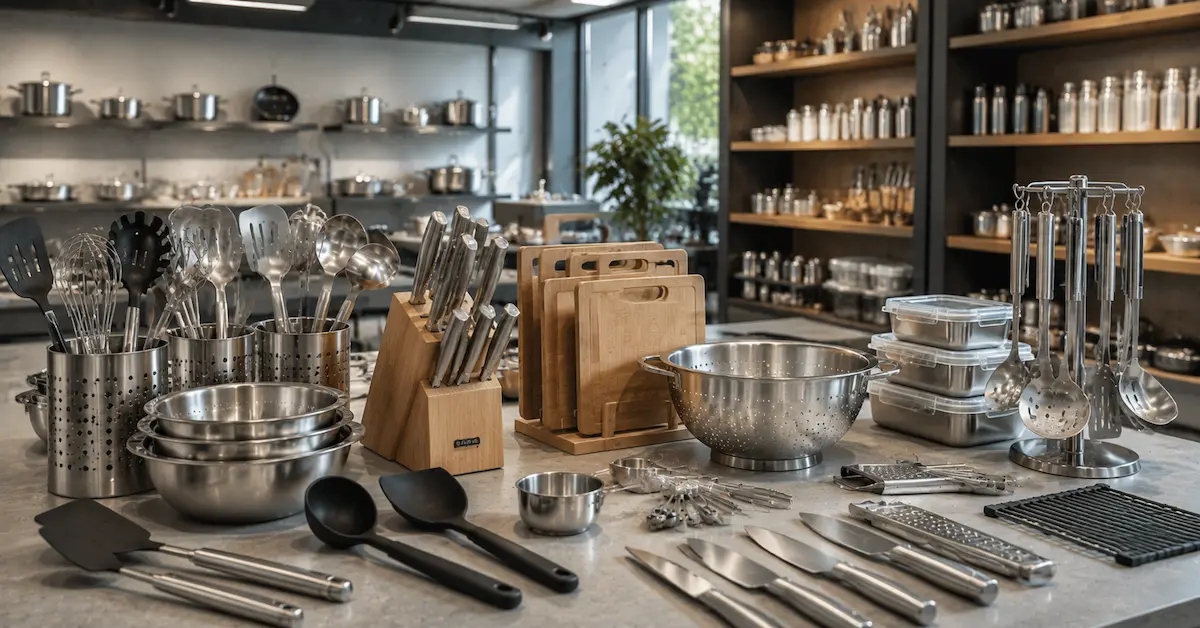
The original assortment shows a practical kitchenware line with stainless steel items, black handles, nested bowls, cutting boards that appear to be wood or bamboo, clear plastic storage containers, and a hanging utensil stand. Those visible details are useful, but they are only the starting point. A serious buyer still needs to verify materials, production responsibility, packaging strength, repeatability, and whether the factory can support the buyer’s target market.
Key Takeaways
- A broad kitchenware line can simplify sourcing, but only if quality is consistent across categories.
- Importers should ask which items are made in-house and which are sourced or assembled from partner workshops.
- Samples should be reviewed as a complete range, not only as individual display pieces.
- Packaging, carton protection, finish consistency, and lid fit are part of product quality.
- Do not assume material grade, compliance status, MOQ, or capacity; ask the supplier to document those details.
Why Mixed Kitchenware Lines Need Careful Evaluation
A wholesale kitchenware factory with a mixed product line can be attractive because it may reduce supplier management. Instead of sourcing utensils from one factory, boards from another, and containers from a third, importers may prefer a coordinated assortment from one supplier. This can help with brand presentation, packaging consistency, and shipping coordination.
However, a mixed line also increases risk. Stainless steel utensils, plastic lids, and wooden boards do not fail in the same way. A ladle may need a smooth edge and stable finish. A storage container needs a lid that closes properly. A cutting board needs clean edges and a surface suitable for its intended use. If one factory offers all categories, the buyer should check whether it has direct control over each product family or relies on outside partners.
What Buyers Can Learn from the Sample Assortment
The visible range includes common kitchen preparation and serving products: utensils, mixing bowls, knives, cutting boards, measuring tools, graters, tongs or turners, ladles, storage containers, and a hanging utensil stand. This type of assortment is useful for supermarkets, distributors, homeware retailers, and private-label buyers who want practical everyday items rather than highly specialized tools.
Stainless steel appears to be the dominant material in the utensils and bowls. Some handles appear black, possibly silicone or coated, though buyers should confirm the actual material before making any claim. The cutting boards appear to be bamboo or wood, and the storage containers are clear plastic with transparent lids. These mixed materials can create a coherent kitchen program, but only if color, finish, fit, and packaging are controlled from sample stage to bulk order.
Factory Assessment Checklist
When comparing kitchenware suppliers, do not rely only on catalog photos. Use a structured checklist during sample review, factory communication, or sourcing audits.
| Area to Check | Why It Matters | Questions to Ask the Supplier |
|---|---|---|
| Product ownership | Clarifies control over quality and timing | Which items are made in-house, assembled, or sourced from partners? |
| Material confirmation | Prevents incorrect product claims | What are the exact materials for metal, handles, lids, and boards? |
| Finish consistency | Affects retail appearance and user experience | How do you control polishing, coating, surface marks, and edge finishing? |
| Fit and function | Reduces complaints after sale | Do lids close evenly, bowls nest correctly, and handles feel secure? |
| Packaging | Protects products during export handling | How are mixed items packed to avoid scratches, dents, and deformation? |
| Private label support | Important for branded programs | What branding, packaging, and artwork options are available? |
How to Review Samples Like a Sourcing Team
Importers should request a mixed sample set, not just one polished hero item. A supplier may be able to prepare one attractive ladle or bowl, but the real test is whether the complete range feels consistent. Place the utensils side by side. Check whether handles match in color and finish. Stack the bowls. Open and close the containers several times. Look at the board edges and corners. Check whether hanging tools sit properly on the stand.
For retail programs, also review how the products will appear on shelf or in a showroom. Nested bowls save space. Hanging utensils can be easy to merchandise. Clear containers need to resist visible scuffing during packing and unpacking. For wholesale and distributor channels, carton labeling, inner packing, and receiving efficiency may matter as much as display appeal.
Questions Importers Should Ask Before Ordering
- What materials are used for each component, and can the supplier provide written confirmation?
- Which products are part of the factory’s regular production range?
- Which items require outsourced parts, special tooling, or partner workshops?
- Can the supplier provide pre-production samples for approval before bulk manufacturing?
- How are finish, dimensions, lid fit, handle assembly, and edge quality checked?
- What packaging options are available for retail, wholesale, or private-label programs?
- What order quantity, lead time, labeling, and artwork details should be confirmed before quotation?
These questions help buyers avoid vague promises. If a supplier cannot clearly explain its process, the buyer should slow down and request more evidence before committing.
Common Mistakes in Kitchenware Sourcing
One common mistake is treating all kitchenware as one low-risk category. In reality, each material has different quality concerns. Metal items may show scratches, burrs, uneven polishing, or weak joints. Plastic lids may warp, feel loose, or close with inconsistent pressure. Wooden or bamboo boards may vary in color, edge finish, or surface smoothness.
Another mistake is focusing only on price before defining acceptable quality. A lower quote may not include suitable packaging, private-label preparation, or the finish level required by the buyer’s channel. Importers should compare quotations against a clear specification sheet, approved sample, packing method, and inspection standard.
Buyers should also avoid assuming that a broad supplier is automatically better than a specialist. A factory with a wide range is valuable only when it can prove coordination, repeatability, and honest communication across product families.
Practical Sourcing Advice for Importers
Start with the sales channel. A supermarket program may prioritize shelf presentation, barcode labeling, and carton efficiency. A hospitality distributor may care more about handling comfort, easy cleaning, and practical durability. A private-label brand may need consistent color, packaging artwork support, and clear production approvals.
Next, narrow the assortment. Instead of ordering every visible item, choose the products most relevant to your market and request matched samples. Review them under realistic conditions: stack them, handle them, pack them back into cartons, and compare them with your current benchmark products.
Finally, document decisions before ordering. Confirm the final sample, packaging structure, labeling requirements, inspection points, and commercial terms directly with the supplier. If capacity, MOQ, lead time, certifications, or test reports are important for your market, ask the supplier for current documentation rather than relying on assumptions.
FAQ for Importers
Can one factory supply utensils, bowls, boards, and containers?
Sometimes, but importers should verify how the supplier manages each category. Some items may be made in-house, while others may be assembled or sourced through partner workshops.
Should I choose the supplier with the widest catalog?
Not automatically. A wide catalog is useful only if the factory can maintain consistent quality, packaging, and delivery across the products you actually plan to buy.
Is stainless steel always the best material for kitchenware?
Stainless steel is common for many utensils and bowls, but buyers should confirm the exact material, finish, thickness, and intended use before making product claims.
What is the best way to test a mixed kitchenware supplier?
Request a coordinated sample set, inspect each product family, compare packaging, and ask the supplier to explain production responsibility and quality control steps.
What details should be confirmed before placing an order?
Confirm materials, sample approval, packaging, labeling, artwork, inspection criteria, lead time, MOQ, and any market-specific documentation the buyer requires.
Final Sourcing Perspective
A kitchenware factory for importers can be a useful sourcing partner when it offers a practical assortment and communicates clearly about production. The visible mix of utensils, bowls, cutting boards, storage containers, and display pieces suggests the kind of broad range many buyers want to evaluate. Still, the buying decision should depend on verified samples, clear specifications, packaging review, and honest answers about what the supplier can consistently produce.
For importers building or refreshing a kitchenware line, the best next step is simple: define your channel needs, request a matched sample set, inspect the details, and compare the supplier’s claims with the physical products in front of you.
