




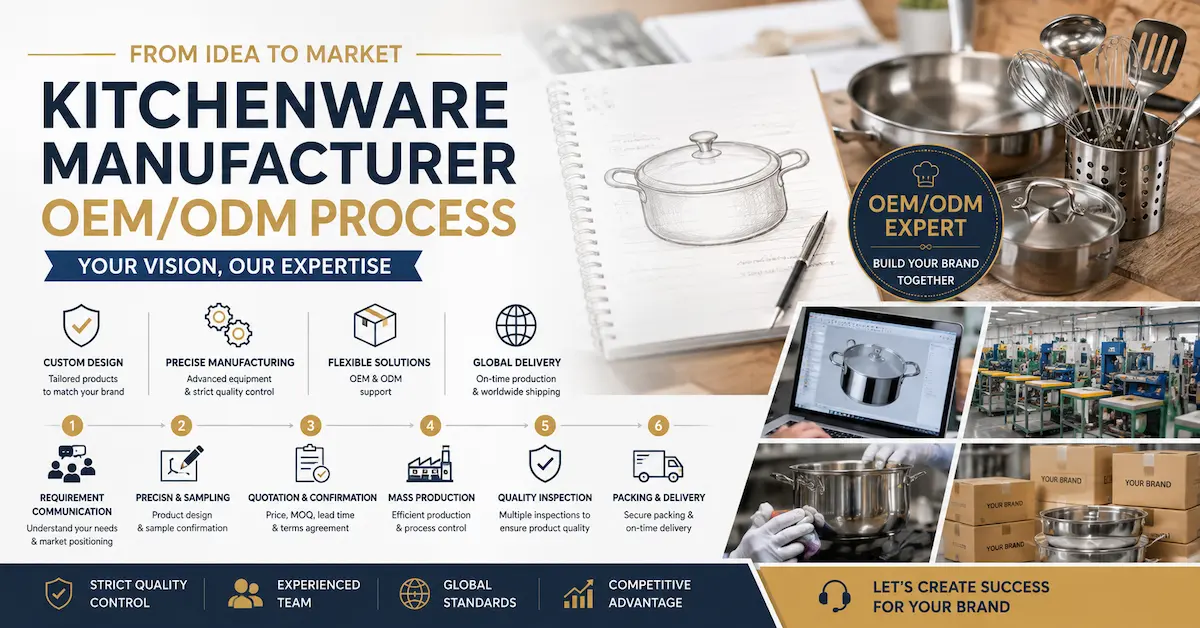
A private-label kitchen tool rarely fails because somebody forgot to choose a logo color. Projects usually drift earlier, when the product brief is too loose, a sample is approved without measurable notes, or packaging is treated as a separate job that can be solved during production. Buyers searching for a kitchenware manufacturer China often receive plenty of catalogs and quotations. What they need next is a development route that turns one commercial idea into a repeatable order.
This guide follows that route from the first inquiry to the second purchase order. The reader may be a brand owner, importer, distributor, retail buyer, online seller, or the one sourcing manager trying to keep six colleagues on the same revision. This is a working document: what needs deciding now, what can wait, and what evidence will still make sense when someone opens the project folder next year.
Buyer takeaway: a capable OEM kitchenware manufacturer should not merely make a sample. It should help build a controlled path from brief, feasibility, quotation, and sample approval through production, inspection, packing, shipment, and repeat-order learning.
OEM, ODM, and stock customization are different projects
The terms are often used as if they were interchangeable. They are not. A stock customization project begins with an existing model. The construction stays put; the buyer changes the logo, color, label, package, or some combination of those. For many launches, that is the shortest and least risky route. It fits a first retail trial, a distributor's missing range item, or an online seller who would rather prove demand before funding a mold.
An OEM project uses a buyer-controlled specification or modifies an existing platform more substantially. The changes can reach dimensions, material, component choice, function, finish, and pack. The factory follows the released file; the buyer, meanwhile, has to say which features are non-negotiable. An ODM project starts further upstream. Here the supplier might bring the initial concept, solve the engineering, make prototypes, manage tools, or build a related design family. The reward can be a product that is harder to compare with every other listing. The price is a longer chain of decisions, and a nasty habit of unfinished details falling between two teams.
Do not choose the label first. Choose the route after the supplier has reviewed the target user, sales channel, intended function, quantity, launch date, compliance needs, budget, and desired level of differentiation. A buyer may discover that an existing BONET platform with a redesigned handle and retail pack provides enough distinction. Another project may genuinely require a new mechanism or mold. The right route protects the commercial goal without adding complexity simply to make the project sound more original.

The ten-stage path from product brief to repeat order
1. Write the commercial brief before the technical specification
The first page should explain why the item exists. Name the destination market, sales channel, target user, retail position, expected quantity, desired launch window, and the problem the product is meant to solve. A mass retailer may need a familiar tool with dependable shelf presentation and replenishment. A specialist distributor may value a narrow professional task and service life. An ecommerce brand may need a clear visual difference, compact parcel dimensions, and a pilot quantity that does not trap cash in inventory.
This commercial setting changes the engineering choices. A dramatic gift box may be attractive but unsuitable for marketplace fulfillment fees. A complex detachable mechanism may support a premium story but create additional cleaning and durability questions. A custom color can strengthen brand recognition but introduce a material minimum that exceeds the first forecast. Put these tensions on the table early. The supplier cannot design a useful route when it only receives a product photo and the instruction, "Please quote your best price."
A strong opening brief contains reference images without pretending that a photograph is a specification. It states the intended tasks, user, preferred dimensions, material direction, must-have functions, features that may be traded, target packaging, logo needs, market, test expectations, order estimate, and desired cost position. It also asks the factory to list assumptions. Those assumptions reveal where the brief is still incomplete.
2. Select the development route and name the owner of each decision
After the brief, compare three routes side by side: existing design, limited OEM modification, and broader custom kitchenware production. Record what changes under each route, what stays standard, the likely tooling, sample method, minimum quantity, package options, test implications, and schedule. This prevents a common mistake in which the buyer compares the price of a stock model with the promise of a fully customized product.
Assign owners. The buyer may own final function, brand artwork, market requirements, and purchase approval. The factory may own manufacturability review, controlled drawings, sample construction, process planning, and production records. A testing laboratory, packaging supplier, mold maker, or component partner may own a specific deliverable. Ownership should not be implied by email history. Put it into a simple responsibility table with dates.
When one supplier coordinates several partners, ask for the production map. A knife, board, molded handle, printed sleeve, and inner tray may travel through different facilities. That is manageable when one project owner controls revisions, incoming acceptance, final assembly, inspection, and release. It becomes risky when every partner works from a different version.
3. Run feasibility before requesting the final quotation
Feasibility is the point where an experienced supplier earns its place. Put the actual product on the table: its shape, chosen material, manufacturing route, critical dimensions, joints, cleaning, safe use, decoration, pack, and forecast. Which parts has the factory made many times? Which detail deserves a bench trial? Where does cost climb, or variation creep in? A thoughtful response may suggest a small radius change to improve molding, a different logo position to avoid wear, or a standard component that lowers the minimum without changing the user experience.
Do not treat every suggestion as cost cutting. Follow the consequence: will function move, will the surface look different, is another test needed, does the tool change, and can the same part be bought next season? A cheaper handle compound is false economy when the grip feels waxy, the odor changes, or the approved evidence no longer applies. A lighter package is not efficient if the product moves during transport. Feasibility should make trade-offs visible, not hide them inside a revised price.
The output can be concise: an annotated reference, a preliminary specification, a process route, open questions, and a risk list. Mark each point as accepted, rejected, or awaiting evidence. Only then should the supplier build a quotation around a defined configuration.
4. Connect materials and claims to the destination market
A catalog material name is a starting point. The project file needs more precision. Trace the item with a finger and list what matters: every food-contact face, handle layer, hidden support, screw, coating, printed piece, adhesive, and pack component. With metal, the grade is only part of the story; thickness, heat treatment, finish, edge work, and the way the item is washed all show up in performance. Plastics and soft grips bring another set of questions about the compound, pigment, smell, contact use, heat, and cleaning.
Then read the sales copy with a red pen. Words such as "food safe," "dishwasher safe," "rust resistant," "heat resistant," and "professional" commit the project to something. What exactly is covered, how will it be checked, what result passes, and does the evidence belong to this market and this finished item? The required work can differ by destination country, customer standard, material, color, and intended use. Confirm the test plan before tooling and final materials are locked. Testing the wrong version at the end is expensive and may not support the item that will actually ship.
Ask the OEM kitchenware manufacturer to separate existing evidence from project-specific evidence. A report for one material or color may guide the plan, but it should not be stretched to cover a different component without review. Honest boundaries make the compliance file more credible and help the buyer budget correctly.
5. Build a quotation that exposes the cost drivers
A useful quotation says what is included. It names the model or revision, materials, dimensions, finish, logo method, packaging, quantity breaks, trade terms, sample cost, tooling, test assumptions, lead-time assumptions, and quotation validity. When alternatives are offered, they appear on separate lines. Otherwise, the lowest number may simply describe the least complete configuration.
Break minimum quantities into their sources. Product assembly, molded color, metal finish, printed box, sleeve, label, insert, and bought-in component can each have a different minimum. The highest constraint may not be the factory's production line. It may be a carton printer or a custom resin color. Once the constraint is named, the teams can solve it. A standard box with a printed label may support a pilot. A stock handle color may preserve cash while the brand tests demand. A shared component across several SKUs may create a practical family MOQ.
Price discussions become more productive when the buyer identifies protected features. Keep the blade construction, joint security, and package restraint, for example, while reviewing the logo method or decorative insert. Cost engineering should remove low-value complexity without quietly weakening the reason customers would buy the item.
6. Control the sample loop with revisions and questions
Every sample needs an identity. Use a project code, revision, date, and short description. Record whether it is a visual mock-up, functional prototype, color sample, packaging sample, pre-production sample, or final approved reference. These objects answer different questions. A hand-finished prototype may prove geometry but not production appearance. A digital pack rendering may prove layout but not board strength, fit, or barcode performance.
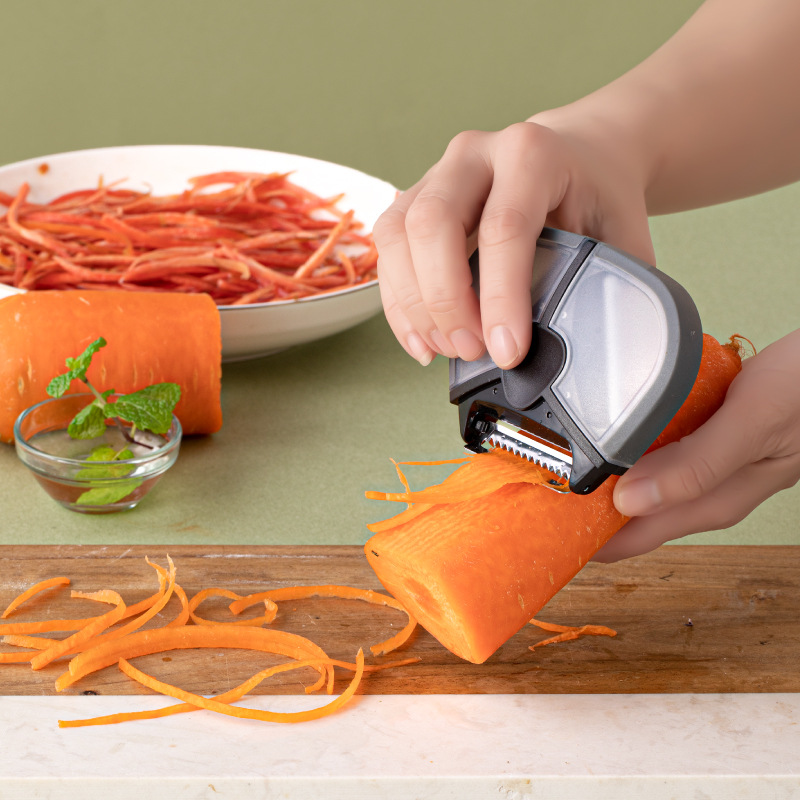
Review samples against the brief, not against memory. The approval sheet should cover dimensions, weight where useful, materials, color, surface, logo, assembly, function, cleaning observations, packaging, and known deviations. Add consistent photographs. For functional tools, define the task and the test media. A peeler can be assessed on agreed foods, blade exposure, cutting direction, grip, cleanability, and protective storage. With a food holder, try the real motions: close it, stack it, twist it, wash it, smell it, and look again at the surface.
Avoid the vague response "sample looks good." Give it a decision: approved, rejected, or accepted with the named differences left open. A buyer's change request also needs a useful reply. It should say whether price or timing moves, whether a tool or test must be repeated, and whether material is already sitting in the warehouse. That change record becomes valuable during production and even more valuable when a repeat order arrives months later.
7. Freeze the engineering release before buying production materials
The engineering release is the agreed package used to make the order. It may include a specification, drawings, bill of materials, color references, approved sample record, artwork, packaging structure, labels, carton marks, functional test plan, inspection checklist, and approved deviations. Each document needs a revision. The set must agree internally: the carton should name the same model and quantity as the packing instruction, and the artwork should show the same material and claims as the compliance plan.
Hold a short release review. Product, commercial, quality, and packaging owners should confirm that open questions are either closed or visibly accepted as risks. A mold or special fixture needs a label and a history: who paid for it, who looks after it, where it sits, who may alter it, and how wear will be handled. Buyer-owned tooling should never rely on a handshake about identification or permitted use.
Production should not begin because the calendar feels urgent. It should begin because the released configuration is sufficiently complete. A week saved by buying material early can disappear quickly when artwork changes, a test fails, or the approved color is not the color in the purchase order.
8. Use a pilot or pre-production sample to test the production route
A pre-production sample is meant to feel like production, not another hand-finished prototype. Use the planned material, tool, process, decoration, and pack wherever practical. Review the first pieces against the release package, then hand the checklist to the people who will actually use it. If an inspector reads a line three times and still has to guess, rewrite the line before the lot begins.
New tools and higher-risk products deserve a short production rehearsal. Even a modest pilot can expose a slow assembly step, scuffing between stations, a bad fit, a tray that buckles, or a check that takes far longer than anyone budgeted. The right pilot size depends on the product and economics. The principle is more important than a universal number: exercise the real process early enough that correction remains possible.
Record the findings and correction owner. If the pilot shows surface marks from handling, change the fixture or packing flow. If color varies, examine material preparation and approved limits. If the tool passes function but damages the inner tray, redesign restraint before printing the final quantity. The pilot is not a ceremonial sample; it is a process test.
9. Control mass production at the points where defects are created
Final inspection cannot manufacture quality after the order is packed. Incoming controls confirm critical materials and bought-in parts. First-piece approval checks the initial setup. In-process checks monitor characteristics that can drift: dimensions, alignment, molding, assembly, edge preparation, surface treatment, printing, and function. Packing checks protect assortment, quantity, label, barcode, accessory, and carton accuracy.
The control plan should name the characteristic, method, frequency or sample, acceptance rule, record, and response to failure. "Inspect carefully" is not a method. The supplier should also define segregation and traceability so suspect material does not re-enter production. A defect found during the line is useful information when it triggers containment and correction. The same defect found only after shipment is a much larger commercial problem.
Buyers do not need to micromanage every workstation, but they do need visibility into the controls that protect their claims and customer experience. Request a sample inspection record before the order. Align critical, major, and minor defects where appropriate. Name who can approve rework or a deviation. This makes the final release less subjective.
10. Treat packing, shipment, and the repeat order as part of development
Packaging must restrain the product, carry correct information, survive the selected distribution route, and present the item consistently. Verify the retail pack and the shipping system together. Sharp products need tip and blade protection. Multi-part sets need count and movement control. Ecommerce items need parcel-level thinking. Retail items need hanging, shelf, barcode, and tamper considerations. Confirm master-carton quantity, dimensions, weight, marks, and pallet or container assumptions.
Before shipment, close the document pack: final inspection, packing verification, approved artwork, applicable test records, shipment details, and any deviation approval. Keep retained samples when appropriate. When goods arrive, record receiving condition, customer feedback, returns, complaints, and any difference between forecast and actual selling. That information belongs in the repeat-order review.
A repeat order should not be released by copying an old purchase order. Confirm the controlled revision, materials, suppliers, color, artwork, packaging, tests, quantity, and delivery assumptions. Ask whether any process or component has changed. Good repeatability is not automatic; it is the result of preserving the project memory.
A practical stage-gate file for buyers and suppliers
| Gate | Minimum deliverable | Decision |
|---|---|---|
| Commercial fit | Market, user, channel, quantity, target date, protected features | Proceed, revise, or stop |
| Feasibility | Proposed route, process map, risk list, open questions | Choose stock, OEM, or ODM route |
| Quotation | Defined revision, inclusions, MOQ drivers, tooling, timing | Authorize samples and tests |
| Sample approval | Approval sheet, photos, deviations, packaging review | Freeze or revise configuration |
| Production release | Specification, artwork, QC plan, pack, schedule | Purchase materials and start |
| Shipment release | Inspection, packing, documents, approved deviations | Ship, rework, reinspect, or hold |
| Repeat order | Revision check, feedback, change declaration, updated forecast | Release the confirmed version |
How the development path changes by product category
Scissors and cutting tools
Define the cutting task before the appearance. Review blade material and geometry, edge, tip, pivot, handle, opening and closing feel, intended cleaning, and any additional function. Detachable construction, magnets, sheaths, openers, crackers, or herb features create separate checks. A single demonstration is not a durability plan. Agree on test media, cycles where relevant, inspection points, and failure rules.
Knife sets
A set multiplies both product and packing controls. Freeze the assortment, blade patterns, handles, marks, storage, inner protection, unit count, and color consistency. Identify whether components use one process stream or several. Inspect individual pieces and the complete unit. Artwork must name the actual contents and materials. A missing accessory or mixed knife can make the whole retail pack unsellable.
Utensils and food-preparation tools
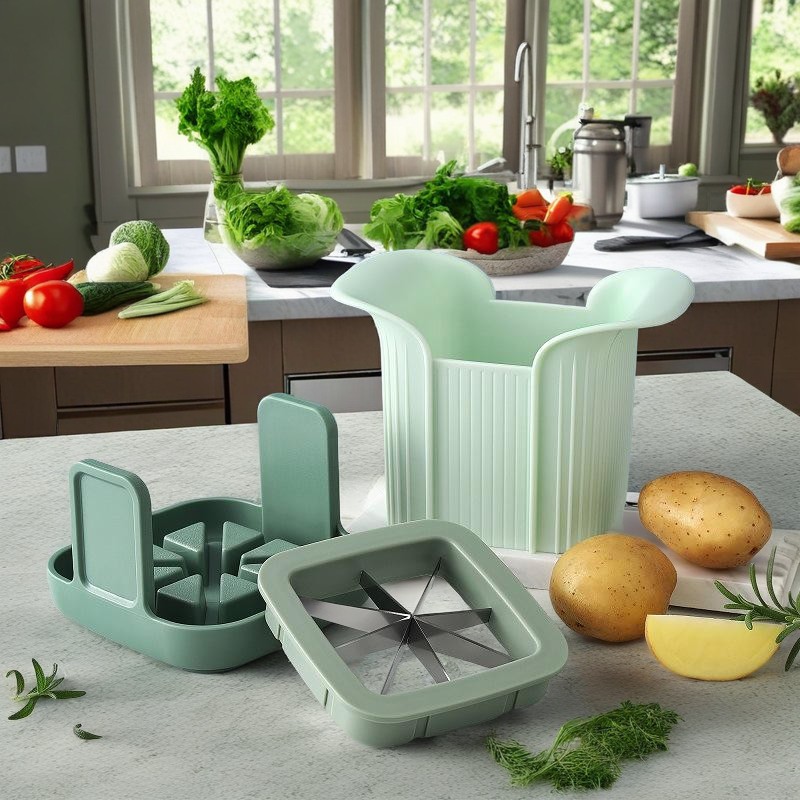
Map food-contact surfaces and internal construction. Review joining methods, deformation, grip, surface, odor, cleaning, and any temperature statement. Multi-part cutters need safe blade exposure, part fit, component count, and a cleaning route that customers can understand. A small convenience feature can introduce a new joint or crevice, so it belongs in the risk review.
Storage products, boards, and sets
Dimensions, flatness, closure, stacking, nesting, color, odor, surface, and load or deformation behavior may matter. Sets need a component map and packing sequence. Confirm how users separate, clean, dry, and store the parts. Package development should begin with the final nested arrangement, not with an estimated box drawn before the sample exists.
Customer groups need different versions of the same process
Retail and supermarket buyers usually place high weight on shelf consistency, barcode performance, package strength, carton accuracy, delivery windows, and repeatable replenishment. Their project file should include retail presentation and distribution tests early. A strong unit product with a weak hanging card can still fail at store level.
Importers and regional distributors may need broader assortments, mixed loading, multilingual artwork, market-specific documents, and spare capacity for repeat orders. They benefit from a product-family map and clear identification of direct manufacture versus coordinated partner sourcing.
Ecommerce brands and marketplace sellers often need visual differentiation, compact dimensions, photography-ready samples, reliable small-batch pilots, and packaging suited to parcel handling. They should compare unit margin after fulfillment, freight, inserts, and returns rather than focus only on factory unit price.
Hospitality and food-service suppliers may prioritize repeated function, cleanability, grip, replacement, and practical pack quantities over elaborate retail presentation. The test plan should resemble frequent use and the buyer's cleaning environment.
Promotional, gift, and subscription programs often face hard delivery dates and artwork approval chains. Their safest route may be an established product platform with controlled decoration and packaging, supported by a written critical path and early color approval.
Timeline planning: start with dependencies, not a promised number of days
A development schedule should show tasks and their starting conditions. The sample clock may begin after the brief, color reference, logo file, and sample payment are confirmed. Tooling may begin only after drawings are signed. Production may begin after sample, artwork, test plan, deposit, and material availability are cleared. Printing may depend on final translations and barcode approval. Shipment depends on inspection and document release.
Ask for optimistic, expected, and risk dates when the project is new. Add time for buyer review; factories are not the only source of delay. A sample can sit on a buyer's desk for ten days while the launch schedule still assumes same-day approval. Put feedback deadlines into the plan, and nominate a substitute approver before holidays or travel.
Changes reset dependencies. A new color may require another material run. A package change can alter carton dimensions and freight calculations. A stronger claim may add testing. The schedule should be updated when the scope changes, not preserved as a comforting number that no longer describes the work.
Tooling, artwork, and project knowledge need explicit control
Clarify tooling cost, ownership, identification, expected life, maintenance, storage, modification authority, and what happens after a long period without orders. Keep the final drawing and approved sample tied to that tool. When the supplier contributes engineering, agree on which files and rights are transferred. Commercial expectations around exclusivity should be written before launch, not assumed from a conversation.
Artwork deserves the same discipline. Use editable source files where agreed, a final print-ready version, dimensions, color references, barcode verification, legal marks, translations, and revision approval. Do not approve a low-resolution screenshot as the master. Keep a record of who checked market-facing claims.
The most valuable project asset may be the accumulated decision trail: why one material was chosen, which sample failed, how the package changed, and what users reported. Preserve it in a shared folder and carry it into replenishment. Staff changes are inevitable; controlled project knowledge prevents the product from being reinvented each season.
Common OEM failures and the correction that actually helps
The buyer asks for a final price before feasibility. Correction: compare priced configurations and written assumptions after the supplier reviews the brief.
The team approves a sample without recording deviations. Correction: issue a signed or otherwise controlled approval sheet with photos, revision, tests, pack, and exceptions.
Artwork and product development run in separate conversations. Correction: use one project code and check claims, material names, dimensions, and component counts across every file.
A test report is treated as universal. Correction: match the report to the entity, product, material, color, component, method, market, and current version before relying on it.
MOQ negotiation ignores the real constraint. Correction: identify whether product, color, print, component, or packaging creates the minimum, then redesign the pilot around the protected features.
Production begins while decisions remain in chat messages. Correction: hold a release review and issue a controlled manufacturing package before production material is committed.
Where BONET can enter the development conversation
BONET HOUSEWARE CO., LTD is based in Yangjiang, Guangdong. Its online range includes kitchen and household scissors, multifunctional tools, knives, utensils, boards, and kitchen gadgets. That product mix is relevant to buyers developing cutting tools, metal-and-plastic items, compact prep tools, private-label assortments, or related retail collections.
The most useful first exchange is specific. Send the target market and channel, intended user, reference product or task, estimated quantity, protected features, material preferences, customization, package, test expectations, and launch window. BONET can then identify an existing model, a limited OEM modification, or a broader ODM route for discussion. Current MOQ, price, timing, tooling, and evidence must be confirmed for the final configuration.
A search for kitchenware manufacturer China may introduce hundreds of suppliers. The shortlist becomes useful when each candidate answers against the same brief and leaves a clear route from sample to repeat production. BONET should be assessed on that basis: relevant product fit, transparent assumptions, controlled samples, workable quality planning, packaging execution, and communication.
Turn your idea into a reviewable project brief
Send BONET one product reference and the commercial setting behind it. Include the market, sales channel, user, quantity, material or function priorities, logo, color, packaging, tests, target date, and any requirement that cannot change. The team can reply with a practical development route and the questions needed before quotation.
Questions buyers ask before starting an OEM kitchenware project
What should I send in the first inquiry?
Send the destination market, sales channel, target user, intended task, reference images, quantity estimate, material direction, must-have features, color, logo, packaging, testing expectations, target date, and target price position if one exists. Label reference images as references and ask the supplier to state assumptions and missing decisions.
Should a new brand begin with OEM or ODM?
Start with the least complex route that can test the commercial idea. An existing product with controlled color, logo, and packaging may be enough for a pilot. Choose broader development when a distinctive function, construction, or protected design is central to the offer and the budget can support tooling, testing, and a longer approval loop.
How many samples are normally required?
There is no useful universal number. The project may need a visual sample, functional sample, color sample, pack sample, and pre-production sample, or one sample may answer several questions. What matters is that each sample has a purpose, revision, review record, and decision.
How can I reduce MOQ without weakening the product?
Ask which component creates the minimum. Keep an existing mold, stock color, standard inner pack, or shared component where it does not harm the buyer promise. Use labels or sleeves for a pilot if printed packaging is the constraint. Protect safety, core function, required evidence, and package restraint.
What proves that mass production will match the approved sample?
No single document proves it. Confidence comes from a controlled specification, approved sample record, material and component controls, first-piece approval, in-process checks, functional testing, final inspection, packing verification, traceability, and a defined response when results fall outside the agreed limit.
What should be reviewed before a repeat order?
Confirm the product and artwork revision, approved materials and suppliers, color, package, tests, quantity, delivery plan, complaint history, inspection findings, and any declared process change. Apply useful customer feedback to the specification before production begins.
For procurement teams using the phrase kitchenware manufacturer China to build a shortlist, the decisive question is not who can produce one attractive sample. It is who can preserve the approved product through the quiet, detailed work of production and replenishment.
