




Choosing a kitchenware supplier for chain stores is really a control problem, not just a buying task
If you are sourcing for a kitchenware supplier for chain stores, the first question is not “What looks good?” It is “What can stay consistent across dozens or hundreds of locations without creating headaches for operations?” A retail chain kitchenware supplier has to support repeat ordering, uniform presentation, acceptable durability, and packaging that survives distribution. Those are different demands from a one-off wholesale purchase, and they change the way buyers should evaluate any kitchenware wholesaler.
That matters because chain stores rarely fail on the initial purchase. They fail later, when one region receives a slightly different version, a replacement bowl no longer nests with the original set, or a countertop appliance arrives with a different footprint and the store team has to improvise. The right supplier helps prevent those small mismatches from turning into replenishment problems, merchandising inconsistency, or avoidable returns.
What chain buyers should expect from the supplier relationship
In chain retail, the supplier is not only a source of goods. It is part of the system that keeps the shelf plan and backroom inventory moving. That means the buying team should look for more than a price list. They need repeatability in product specification, packaging discipline, and enough manufacturing or sourcing depth to handle ongoing replenishment.
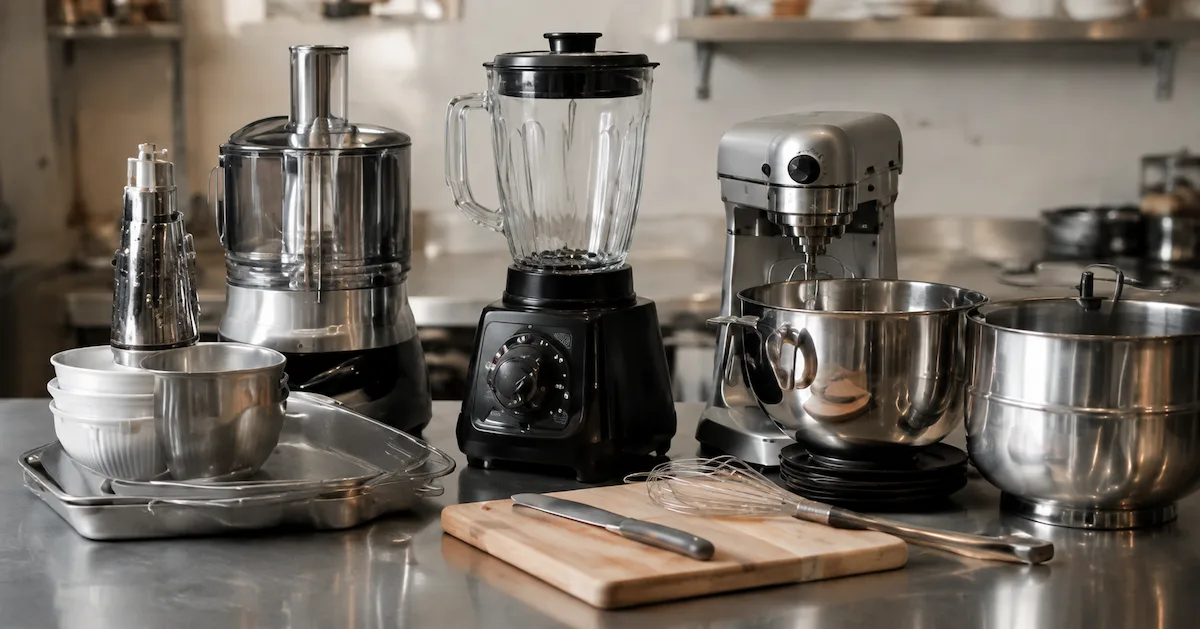
For kitchenware, that typically includes metal utensils, mixing bowls, prep tools, and in some programs, small countertop equipment used for display, demonstration, or commercial-style kitchen assortments. The assortment visible in the preparation data—stainless-steel mixing bowls, a whisk, a chef’s knife, a cutting board, a blender, and a stand mixer—shows the range chain programs often touch: hand tools, prep surfaces, and compact appliances. Each category has a different risk profile, so the supplier must be able to manage all of them with discipline.
Quick reference: what to compare before you place a chain order
Chain-store buying tends to move fast, but the comparison should still be structured. The points below are the ones that usually matter most.
Product consistency
Ask whether the item can be reordered without visible changes in finish, shape, packaging, or accessory set. For bowls, that means nesting behavior and rim geometry. For appliances, it means control layout, jar style, bowl size, and base footprint.
Material discipline
Stainless steel is popular for a reason: it is durable-looking, cleanable, and familiar to consumers. But “stainless” can still mean different grades, thicknesses, and surface finishes. If the supplier cannot clearly explain those differences, expect trouble later.
Packaging and shipment protection
Chain buyers should not overlook packaging just because a product is sturdy. Polished metal can scuff, glass jars can chip, and sharp tools need secure retail presentation. Good packaging lowers receiving damage and reduces store-level repacking.
Replenishment readiness
A retail chain kitchenware supplier should be able to support follow-on orders without forcing a reset of the entire assortment. This is where a kitchenware wholesaler with broad sourcing capability can be helpful, but only if the product records are controlled well enough to keep SKUs stable.
How the product mix affects sourcing decisions
Not every kitchenware program is built around the same type of demand. A store assortment aimed at home cooks will behave differently from one aimed at foodservice customers or mixed-use buyers. That distinction affects what you source, how you package it, and how much detail you need from the supplier.
Metal prep tools such as whisks, knives, and mixing bowls are relatively straightforward, but they still need careful specification. Buyers should pay attention to handle feel, weld quality, finish uniformity, and whether the bowls stack safely without binding. In a chain environment, even a small change in rim profile can alter how neatly products nest on a shelf or in a freight carton.
Countertop appliances are more demanding. A blender with a transparent jar and rotary control knob may look simple, but the buyer still needs clarity on base stability, cord management, jar retention, and whether the accessory set is consistent from batch to batch. A stand mixer adds another layer: bowl fit, head configuration, and the relationship between the bowl and beater system all affect user experience. If the supplier cannot describe the exact version being repeated, the chain buyer should slow down.
Processor-style equipment, especially units with feed tubes or vertical chutes, brings another practical issue: store associates and customers must understand it quickly. If the item is being sold on a retail floor rather than specified for back-of-house use, the product story has to be simple enough to survive merchandising. That is often overlooked when buyers focus only on the unit cost.
What a good sourcing process looks like
For chain programs, the sourcing process should begin with a standard product brief. It does not need to be elaborate, but it should define the form factor, material expectations, packaging requirements, and the acceptable visual range. That brief becomes the reference point for every sample and every replenishment order.
After that, request samples that reflect real retail use, not just showroom presentation. Handle the products the way a store team or distribution center would. Stack the bowls. Inspect the blade edge protection. Check whether the blender jar is clear enough to support content visibility. Open and reseal the packaging. These practical checks often reveal more than a polished sample photo ever will.
Then verify whether the supplier can maintain the same product over time. This is where a retail chain kitchenware supplier differs from a one-off importer. A chain program depends on continuity. If the supplier is sourcing from several factories, that is not automatically a problem, but the coordination has to be tight enough that the customer never sees the seams.
Common mistakes chain buyers still make
One common mistake is overvaluing the first shipment. A product may look excellent on day one and still be a poor fit if the supplier cannot reproduce it consistently. Chain buyers should ask how the item is controlled, not only how it looks in the sample room.
Another mistake is assuming all stainless steel products are functionally equivalent. They are not. Surface finish, gauge, and fabrication quality affect how an item feels in hand and how it holds up under repeated cleaning. The difference may be subtle on paper and obvious on the shelf after a few months.
There is also a tendency to treat small appliances like decorative SKU extensions. That can be risky. A blender or stand mixer needs more scrutiny than a spoon rest because any mismatch in motor housing, bowl fit, or control behavior can trigger customer complaints quickly. Chain stores cannot absorb that kind of inconsistency for long.
Finally, buyers sometimes neglect the store labor side. If the item is awkward to unpack, hard to re-stack, or too fragile for standard handling, the apparent savings disappear. That is true for metal bowls as well as countertop equipment, though the failure modes differ.
Practical advice for negotiating with suppliers
When you speak with a potential supplier, ask specific operational questions. How are repeat orders matched to the approved sample? What happens if a component changes? Can the supplier keep the same finish across production runs? How are carton dimensions controlled for distribution efficiency? Those questions may sound basic, but they expose whether the supplier understands chain-store realities.
Also ask for straightforward documentation of the product build and packaging. You do not need a long technical file for every SKU, but you do need enough detail to prevent ambiguity. If the supplier is vague about whether a jar is glass or plastic, or cannot clearly separate the appliance body from the accessory set, treat that as a warning sign rather than a minor omission.
For buyers comparing a kitchenware wholesaler against a more specialized retail chain kitchenware supplier, the distinction often comes down to service depth. A wholesaler may have broad assortment access, while a chain-focused supplier is usually better at SKU control, packaging consistency, and program continuity. The best choice depends on your assortment strategy, but chain programs usually benefit from the second capability more than they first admit.
FAQ for chain-store kitchenware sourcing
Should chain stores prioritize stainless steel items?
Often, yes, especially for bowls, utensils, and prep tools. Stainless steel is familiar, durable-looking, and easy to present in a retail assortment. Still, buyers should check finish and fabrication quality rather than assuming all stainless products perform the same way.
Are countertop appliances harder to source than hand tools?
Usually they are. Appliances add more risk through components, packaging, and user expectations. A blender or stand mixer is not just a visual product; it has mechanical fit, accessory consistency, and store presentation concerns.
What should a chain buyer request before approving a supplier?
At minimum: a stable sample, clear product descriptions, packaging details, and confirmation that repeat orders can match the approved version. If the supplier hesitates on any of those points, the chain program deserves a slower review.
The next step is simple: build a supplier brief that matches the way your stores actually sell
The best kitchenware supplier for chain stores is the one that reduces variation, protects margin through fewer defects and returns, and supports replenishment without drama. That usually comes from disciplined sourcing rather than chasing the lowest sticker price. A chain buyer should think in terms of continuity, packaging, and downstream labor, not only item appearance.
If you are preparing a new program or refreshing an existing assortment, start with a short internal brief: the product categories you need, the acceptable material range, the packaging format, and the store environment where the items will be sold. Then compare suppliers against that brief, not against a generic catalog. That is the point where a kitchenware wholesaler becomes useful, and where a retail chain kitchenware supplier proves whether it can actually support the chain, not just win the first order.
