




For buyers comparing a kitchenware supplier for chain stores, the real question is not whether a catalog looks complete. It is whether the supplier can keep a multi-store assortment consistent, practical, and easy to replenish once the initial launch rush is over. That matters because chain-store kitchenware is judged in two places at once: on the shelf, where shoppers compare finish and set composition, and in the back end, where sourcing teams worry about packaging, nesting efficiency, damage rates, and whether the same item can be reordered without surprises.
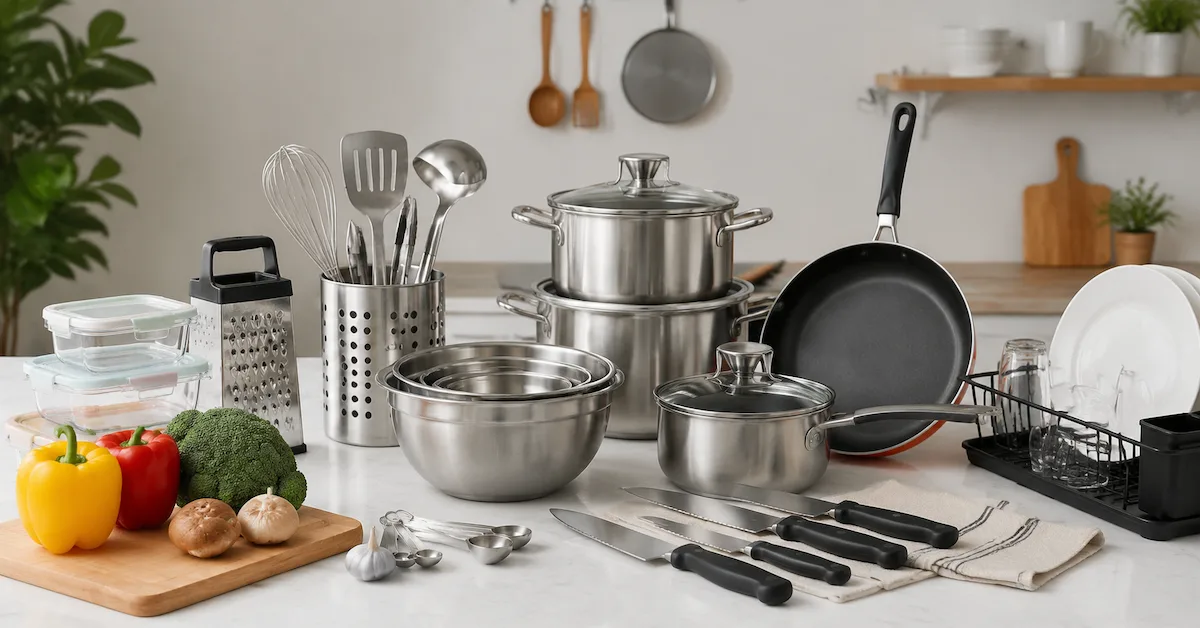
The product shown here points in the right direction for that kind of program. It is a coordinated commercial-kitchen cookware and utensil set with stock pots, a saucepan, frying pan, mixing bowls, utensils, a grater, knives, measuring spoons, a dish rack, and clear storage containers. The visible mix suggests a supplier that understands everyday kitchen workflows, not just isolated cookware SKUs. For chain stores, that is usually the difference between an assortment that sells once and an assortment that can be refreshed, expanded, and merchandised across locations.
What this type of set tells a buyer
The first thing to notice is range. This is not a single hero item; it is a grouped set that spans food prep, cooking, serving, and storage. That breadth matters because chain-store buyers often need to support different customer missions at different price points. One shopper wants a stainless-steel stock pot for soup and batch cooking. Another wants a practical dish rack and plastic food storage containers. A third wants a basic skillet and the tools to go with it. A supplier that can cover those use cases with a coordinated visual language makes merchandising easier.
The main cookware appears to be stainless steel with a brushed or polished silver finish. Several lids appear to be glass with metal or stainless knobs. The frying pan is black, and it likely uses a nonstick or enamel-style coating, although that cannot be confirmed from the image alone. Handles on utensils and knives appear to be black plastic or another heat-resistant polymer. The storage containers are clear plastic with snap-on lids. In other words, the assortment combines durable metal, visible glass, and practical polymer components in a way that fits both commercial kitchens and consumer retail.
Quick buyer takeaways
If you are evaluating a chain store kitchenware supplier, this type of set suggests three useful things.
First, the supplier is likely comfortable with multi-material sourcing. Stainless cookware, glass lids, coated pans, plastic accessories, and wire storage pieces do not come from the same manufacturing line, so coordination matters.
Second, the assortment is space-conscious. The nested bowls and stackable containers signal packaging and shelf efficiency, which is important when a retailer wants more perceived value without cluttering the shelf.
Third, the set serves multiple buying contexts. It can sit in a home-goods aisle, a seasonal promotion, a kitchen starter bundle, or even a foodservice-oriented assortment if the chain also sells to light commercial users. That flexibility is attractive, but only if the supplier can hold the line on consistency.
Why chain stores care about construction, not just appearance
Retail buyers sometimes get pulled toward a polished display and forget the operational side. That is risky. Kitchenware for chain stores has to survive shipping, pallet handling, stock-room storage, customer inspection, and repeated replenishment. A visually attractive set is useful only if the pieces are robust enough to arrive intact and remain presentable after being handled by multiple teams.
Stainless-steel cookware is usually a strong base for that reason. It resists corrosion better than bare carbon steel and gives a clean visual signal on shelf. Glass lids add visibility and a more premium feel, but they also introduce breakage risk. A buyer should therefore ask how the supplier packs lids and whether nesting or separators are used during transit. For chain programs, one broken lid can create more retail labor than the margin on the item justifies.
The black pan and black-handled tools introduce another practical consideration: coating durability and heat resistance. The image does not tell us whether the pan is nonstick, ceramic-coated, or enamel-coated, and it would be a mistake to pretend otherwise. What matters for a buyer is to ask how the coating behaves under expected use, how it is cleaned, and whether the handle construction supports the intended application. That kind of question is routine in a bulk kitchenware distributor conversation and should not be skipped just because the product looks familiar.
Manufacturing cues that help sourcing teams ask better questions
Stainless cookware and bowls
Cookware and mixing bowls of this type are often made by stamping or deep drawing, with handles attached by welding or rivets. That is a reasonable general expectation, but it is still only an expectation. Buyers do not need the factory recipe on day one; they need enough technical clarity to compare suppliers. Ask whether the metal is single-wall or layered, whether the handles are attached with visible rivets, and how the rim is finished. Those details affect strength, feel, and merchandising quality.
Glass lids and metal knobs
Glass lids are useful because shoppers like to see the cooking process without lifting the lid. From a sourcing standpoint, the question is less about style and more about edge finish, fit consistency, and packing protection. If a chain store launches a set with loose-fitting lids, the product may look fine on a sample table but disappoint in use. The same caution applies to knob attachment and the transition between glass and metal.
Plastic storage containers and utensil handles
Clear containers with snap-on lids are typically associated with injection molding, though the exact process is not confirmed here. The functional goal is obvious: visibility of contents, organized storage, and a light, stackable form. For chain stores, these pieces are often part of the value equation because they help the set feel more complete without a major cost jump. Still, buyers should pay attention to lid seal behavior and stacking stability rather than relying on appearance alone.
Selection criteria that matter more than catalog language
When you are narrowing down a chain store kitchenware supplier, the most useful criteria are unglamorous.
Start with assortment logic. Can the supplier support a coherent set, or are they only offering assorted pieces with no merchandising unity? A coordinated display usually helps sell-through better than a shelf of unrelated items.
Then look at packaging efficiency. Nested bowls, stackable containers, and grouped utensils can reduce freight waste and improve shelf density. That does not automatically make a product superior, but it often makes it easier to work into a retail plan.
Next, consider finish consistency. Stainless steel that varies too much in sheen, or black-coated items that do not match visually, can make the set look assembled rather than designed. Chain stores live and die on that kind of detail because customers notice it immediately, even if they cannot name it.
Finally, ask about replenishment discipline. A chain store program is not a one-time purchase. If the supplier cannot repeat the same visual and functional specification, the assortment breaks down after the first season. That is a common problem when buyers chase low opening cost instead of stable supply.
Common mistakes buyers make
One common mistake is treating a kitchen starter set as if every piece should be evaluated the same way. It should not. The stock pot, the skillet, the knives, and the storage containers each have different performance risks. A supplier may be excellent on stainless cookware and less reliable on plastics or coated surfaces.
Another mistake is overcommitting to a presentation sample. Display units often look cleaner than bulk-packed production pieces. That is normal, but it means procurement teams should ask for production-level packaging details before they place a large order.
A third mistake is ignoring the end user. Chain stores often carry kitchenware for home cooks, but the visible size mix here also speaks to heavier use. If the target shopper is a meal-prep customer, a catering buyer, or a small foodservice operator, then durability and storage efficiency become more important than decorative finishing.
How this set fits the commercial side of the market
The visible assortment is not just retail-friendly; it also fits a commercial-kitchen supply mindset. Stock pots, bowls, utensils, and containers map directly to prep workflows such as boiling, simmering, mixing, straining, serving, and storing ingredients. That crossover is useful for chain stores that serve both household buyers and light commercial customers, such as cafeterias, caterers, or small restaurants buying backup equipment.
That said, buyers should avoid assuming that a retail-ready set automatically meets the demands of a commercial environment. Commercial users ask harder questions about cleaning, wear, stacking, and replacement. A chain store supplier who understands both worlds is usually more valuable than one who only knows how to stage a display.
FAQ for procurement teams
Is one multi-piece set better than separate SKUs?
Not always. A set can be easier to merchandise and can improve perceived value, but separate SKUs may give you better control over margin and replenishment. The right answer depends on your store format and how tightly you manage shelf space.
Should the supplier specialize in cookware only?
Not necessarily. For chain programs, a supplier that can handle cookware, utensils, storage, and accessory items may simplify sourcing. The tradeoff is that you need to verify quality consistency across categories.
What should I ask for before launch?
Ask for production specification details, packaging structure, material confirmation, and replenishment continuity. If the set is intended for foodservice-style use, also clarify cleaning expectations and compatibility questions directly with the supplier instead of assuming them.
What to do next
If you are shortlisting a kitchenware supplier for chain stores, use the product structure itself as your audit tool. A credible supplier should be able to explain how the stainless-steel pieces are formed, how the lids are protected, how the coated pan is finished, how the plastic components are molded, and how the whole set is packed for retail or distribution. The best vendors do not just sell pieces; they sell repeatable assortments that can survive store handling and stay coherent across a chain.
For sourcing teams, that is the real decision. You are not only buying cookware. You are buying consistency, shelf readiness, and the ability to reorder without rebuilding the program from scratch.
