




Choosing a kitchenware supplier for chain stores is not just a purchasing exercise. For multi-location operators, the real issue is consistency: the same stock pot, the same saucepan profile, the same pan balance, the same fit on a commercial range, delivered to different sites without drama. That matters whether the business is a supermarket prepared-food counter, a casual dining group, a cafeteria network, or any operation that depends on repeatable kitchen performance. A supplier that understands chain buying can reduce variance across stores, which is often where service problems start.
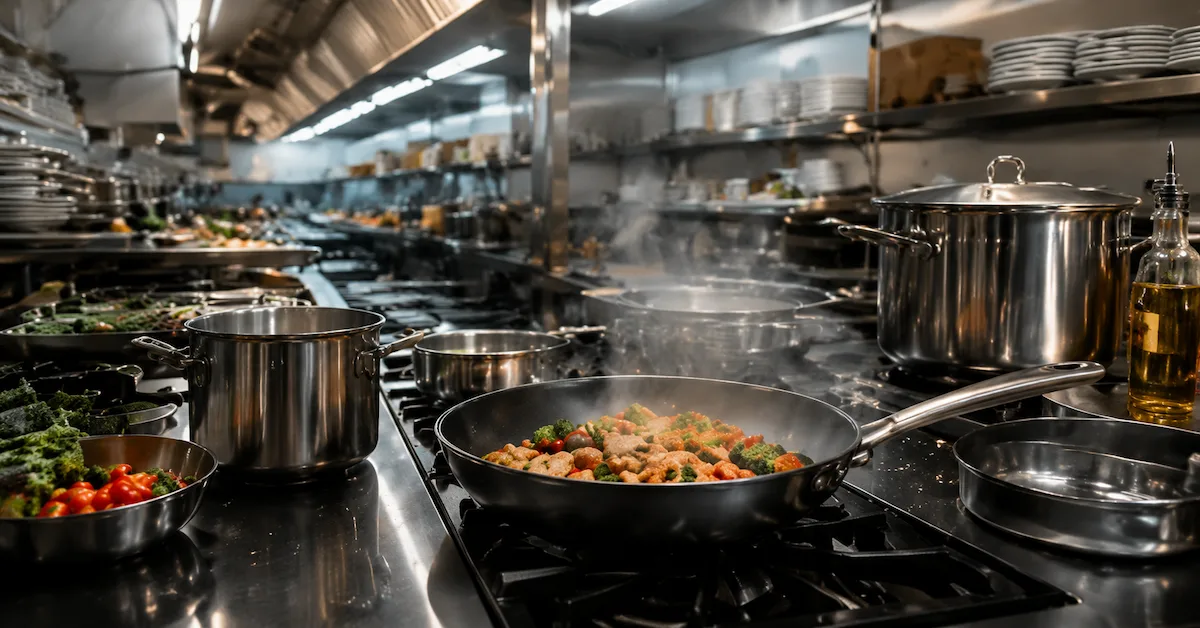
In practice, chain-store buyers are rarely shopping for a single hero item. They are trying to build a durable kitchen system. The cookware has to suit batch cooking, sautéing, boiling, simmering, and holding prepared food; it also has to stand up to repetitive use on a busy line. The equipment in a professional kitchen usually tells you a lot about what the buyer values: tall stainless steel stock pots with lids for soups and sauces, saucepans for smaller-volume work, a shallow skillet for fast searing, and a gas cookline with black cast-iron burner grates for constant heat. The details are unglamorous, but they are exactly what determine whether procurement runs smoothly once the first store opens.
What chain-store buyers are really solving
For a chain, kitchenware is not bought in isolation. It has to fit a menu, a workflow, a cleaning routine, and a replacement cycle. A supermarket kitchenware supplier or houseware supplier may be able to ship products, but that does not automatically mean they understand multi-site operations. The operator needs pieces that can be standardized across locations, reordered later without redesigning the setup, and used by staff with varying levels of training.
That is why commercial-grade stainless steel still dominates these environments. It holds up under heat, wiping, stacking, and repeated washing. A polished or satin metallic finish is not just about appearance; it can also make a kitchen easier to keep visually orderly, which matters in open kitchens and foodservice areas where customers see the line. One caution: shiny finish is not the same thing as better durability. Buyers should focus on construction quality, handle attachment, and how the vessel sits on the burner, not on appearance alone.
Typical cookware and equipment used in high-volume kitchens
Stock pots
Large stainless steel stock pots are the workhorses of batch production. They are used for soups, broths, pasta water, stock, beans, and holding liquids during service. In the kind of kitchen shown in the preparation data, there are at least two large stock pots with side handles and fitted lids. That tells you the operation is set up for volume, not just finishing plates.
For chain buyers, stock pots are where inconsistency becomes expensive. A slightly different diameter can affect burner coverage. A slightly different depth can change evaporation rate. A slightly different lid fit can slow service or waste heat. These are not trivial differences when dozens of stores are expected to reproduce the same recipe day after day.
Saucepans and sauté pans
Saucepans are the quieter part of the line, but they are essential for sauces, reductions, and smaller batches. A sauté pan or frying pan with a long handle, including a darker nonstick or black-coated version, expands the menu range further. On a commercial range, this kind of pan is often used for searing proteins, finishing vegetables, or working quickly during peak periods. The black cast-iron burner grates visible on many gas cooklines are a reminder that these pans need to sit stably and transfer heat evenly.
Buyers should be careful here. A pan that performs well in a test kitchen may not survive daily chain use if the handle geometry is awkward or the coating is not suited to repeated commercial heating. The specification sheet should be read against the actual service scenario, not just a catalog description.
Ranges and work surfaces
The cooking station itself matters as much as the cookware. Stainless steel surrounding surfaces and shelving are common because they are easy to wipe down and integrate well into professional layouts. A commercial gas range supports the rapid adjustment that kitchen teams need during service. In a chain context, the question is not whether the range is powerful enough in the abstract; it is whether the layout supports a standardized menu with minimal staff confusion. That is a design and procurement problem at the same time.
How to evaluate a supplier before you place chain orders
The best suppliers do more than list products. They help buyers reduce variation across sites. When evaluating a kitchenware supplier for chain stores, look for evidence that they can support repeat orders, package mixed SKUs logically, and keep product continuity over time. A chain does not want to redesign SOPs every time one item disappears from the catalog.
Ask practical questions: Can the supplier hold the same cookware family across several replenishment cycles? Can they supply multiple store openings at once without mixing batches in a way that complicates receiving? Do they understand which items belong in back-of-house production and which are better suited to customer-facing or light-duty use? A houseware supplier that mainly serves home kitchens may sell usable products, but the commercial context is different. Load, frequency, temperature, and staff turnover all change the equation.
Also ask how they manage product substitutions. For chains, a quiet substitution can be more disruptive than a delay. A lid that no longer fits the standard pot, or a pan handle that changes the balance, may not sound dramatic, but it can break standard operating procedures. Buyers should insist on notification before changes are shipped.
Material and construction details that matter
From the supplied product information, the visible cookware is predominantly stainless steel with a polished or satin metallic finish. That is typical of foodservice fabrication because stainless steel offers a good balance of corrosion resistance, cleanability, and heat tolerance. Some cookware is likely formed, stamped, deep-drawn, welded, and polished, although the exact process is not confirmed. In procurement terms, the process matters less than the result: uniform shaping, secure joins, and surfaces that can withstand heavy use without deforming early.
Handles deserve special attention. Side handles on stock pots should feel robust enough for lifting when full, not just when empty. Long pan handles should not create balance problems on a crowded range. Lids should sit predictably and be easy to remove under service pressure. None of this is sophisticated, but every kitchen manager knows how much friction a poor handle can create.
One practical aside: chain buyers sometimes over-specify finishes and under-specify ergonomics. The first looks good on paper. The second determines whether staff actually use the equipment safely and efficiently.
Where supermarket and restaurant supply needs overlap
A supermarket kitchenware supplier may serve prepared-food operations, deli counters, and in-store kitchens that look different from a standalone restaurant but face the same basic demands. Volume still matters. Heat still matters. Cleaning cycles still matter. The menus may be narrower, but the expectation of reliability is no lower. That is why many procurement teams now compare foodservice equipment with more than one supplier category before making a commitment.
For chain stores, the ideal sourcing partner is often one that can bridge retail and foodservice requirements: enough catalog breadth to support back-of-house operations, but enough discipline to maintain product continuity. That is a narrower capability set than many buyers expect. A general houseware supplier may be good at broad distribution, yet not prepared for the repeatability chain kitchens need.
Common buying mistakes
The first mistake is buying to unit price alone. A lower-cost pot that warps, a pan that loses balance, or a lid that does not fit consistently can cost more over time than the better-made item. The second mistake is approving samples that were never tested under actual service conditions. A sample that feels fine in a quiet demo is not the same as one used during peak breakfast or lunch service.
The third mistake is ignoring the store-to-store standard. If one location receives a slightly different saucepan profile, the training manual becomes less useful. The fourth is failing to plan for replenishment. Chain operators should think beyond opening day and ask what happens when the first wave of wear starts. If the supplier cannot repeat the item, the chain will eventually carry a mixed fleet of cookware, and mixed fleets slow kitchens down.
What a practical procurement checklist should include
For a cleaner buying process, build the checklist around function, not marketing copy. Confirm the cookware type, dimensions, handle style, lid fit, finish, and intended application. Note whether the item will be used for boiling, simmering, sautéing, or holding prepared food. Match each piece to the burner or work area it will actually occupy. If the kitchen uses a multi-burner commercial cookline, make sure the pan and pot sizes are compatible with the grate layout.
It also helps to document acceptable substitutions in advance. For example, if a specific saucepan design goes out of stock, what is the backup? Chain buyers who answer that question early avoid a lot of receiving problems later.
FAQ for chain-store procurement teams
Is stainless steel always the best choice?
Not always, but it is often the most practical starting point for high-volume kitchen use. It is durable, easy to clean, and familiar to staff. Some tasks benefit from coated or nonstick surfaces, but those should be selected carefully for the actual heat and cleaning routine.
Do open kitchens need different cookware?
They may need more attention to finish and presentation, since customers can see the line. That said, performance still comes first. A neat-looking pan that fails under load is still the wrong pan.
Can one supplier cover retail and restaurant formats?
Sometimes, yes. The better question is whether the supplier can maintain product consistency, supply depth, and technical fit across both formats. That is where many businesses separate the capable vendors from the convenient ones.
Next step for buyers
If you are sourcing cookware and cooking equipment for a multi-site operation, start with the standardization question: what must be identical across every location, and what can vary? Then compare suppliers on continuity, construction, and responsiveness, not just price. Whether you are speaking to a kitchenware supplier for chain stores, a supermarket kitchenware supplier, or a broader houseware supplier, the same test applies: can they support your operating model after the first shipment, not just before it?
That is the real decision. The right supplier should make the kitchen easier to run, the training easier to repeat, and the replenishment cycle easier to control. In chain operations, those are not small gains; they are the difference between a tidy opening and a system that stays manageable six months later.
