




What supermarkets actually need from a kitchenware supplier
A kitchenware supplier for supermarkets is not just a source of “more products.” It is a filter. The right supplier helps a retailer choose items that sell quickly, sit well on shelf, survive handling, and create fewer complaints after purchase. That matters more than it sounds. In supermarket aisles, kitchenware has to do a strange job: it must look simple enough for impulse buyers, be practical enough for repeat customers, and stay competitive in wholesale kitchenware pricing without feeling disposable in the wrong way.
For buyers, the challenge is usually not finding a tongs set, bowl scraper, spatula, or salad server. It is choosing which versions deserve shelf space. A supermarket kitchenware range can become cluttered very quickly, and once that happens, sell-through slows. Shoppers see too many near-identical items and walk past all of them. So the better question is not “what can we source?” but “what kind of kitchenware earns its place in a supermarket program?”
Why food tongs and serving tools are useful supermarket items
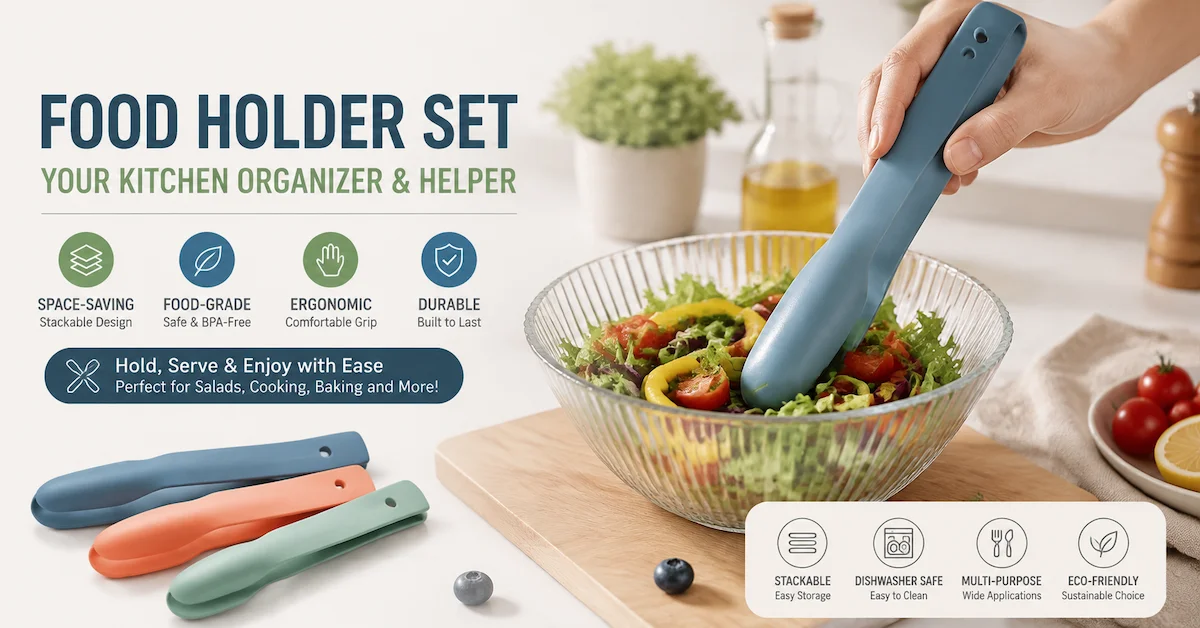
Among the simplest products in supermarket kitchenware are food tongs and food holder sets. They are small, easy to merchandise, and broadly useful. The product category described here is a long, flat, tong-like handheld tool with a rounded gripping end, a slim handle, and a hanging hole for storage. It is shown in multiple colors and positioned for salads, cooking, baking, and general food serving.
That combination is commercially interesting because it reaches several shopper groups at once. A home cook may use it for tossing salad or lifting baked items. A family buyer may see it as a convenient serving tool. A retailer or distributor may like the fact that it can be displayed in a compact form and bundled as a set. Even when the underlying item is plain, the use cases are wide enough to support steady supermarket demand.
The real value in this product type is not novelty. It is utility. Buyers want an item that feels intuitive the first time it is picked up. The spoon-like end suggests gripping and scooping without much explanation, and that matters on a busy shelf where packaging has only a few seconds to communicate the function.
What to look for in supermarket kitchenware sourcing
When sourcing supermarket kitchenware, the practical checklist is usually more important than the catalog description.
1. Shelf appeal
Color can matter a great deal. In the example product, the set appears in blue, coral/orange, and mint green. Those colors read as fresh and modern, which can help in a home goods aisle. But the point is not just visual brightness. Colors should also make it easy for shoppers to understand that the item is part of a coordinated kitchen range rather than a random tool.
2. Functional clarity
A buyer should be able to understand the item without a long explanation. The rounded gripping end, slim handle, and hanging hole all support that. A supermarket product that needs too much explanation often underperforms because shoppers do not want to decode it.
3. Material confidence
The product image notes claims such as food-grade, safe & BPA-free, and eco-friendly. Those may be genuine marketing positions, but unless backed by documentation, they should be treated carefully. For supermarket buyers, this is a common issue. Packaging language may be persuasive, but sourcing teams still need to verify whatever is important for compliance, buyer expectations, or retailer policy.
4. Durability and handling
Lightweight kitchen tools can be a strength, but only if they do not feel flimsy. A supermarket customer often judges a kitchen item in hand before buying. If the product flexes too much, has rough edges, or looks thin at stress points, it may be dismissed immediately. That is one reason molded utensils and consumer kitchenware should be reviewed physically whenever possible.
How this product fits a supermarket assortment
This type of food tongs or food holder set sits in the sweet spot between low-risk purchase and everyday usefulness. It is not a high-ticket cookware item, so the buyer is not betting heavily on one sale. Yet it is more useful than a novelty gadget, which means it can hold its own in a competitive retail assortment.
For supermarkets, that is useful in three ways:
It can support cross-merchandising near salad ingredients, baking supplies, or serving bowls.
It can be sold as part of a kitchen refresh display, especially during seasonal resets.
It can work in the value end of the aisle where shoppers expect practical, affordable tools.
The stackable design noted in the product information is worth attention here. Space-saving storage is not just a consumer benefit; it is also a retail and warehouse benefit. Items that pack efficiently are easier to transport, easier to stock, and easier to keep tidy on display. In wholesale kitchenware, that kind of efficiency often makes the difference between an item that is listable and one that is not.
Materials and manufacturing: what can be said safely
The visible finish suggests a smooth, matte or satin surface, likely from molded plastic or a silicone-plastic composite. The exact material is not confirmed, and it would be unwise to pretend otherwise. Still, the product belongs to the general category of molded consumer kitchenware, most likely made by an injection-molding or similar forming process.
Why does that matter to a supermarket buyer? Because process usually affects consistency. Molded kitchen tools are typically easier to standardize than mixed-material assemblies. That can help with color matching, repeat orders, and package uniformity. It also tends to keep unit economics manageable, which is important when the item must compete in a grocery retail environment where price sensitivity is high.
There is a small caution here: molded items can look neat in photos and still vary in hand feel. Smooth edges, ergonomic grip, and clean hole placement are worth checking on physical samples. A product that appears polished in a catalog may feel awkward if the handle balance is off or the gripping end is too shallow.
Common mistakes supermarket buyers make with kitchenware
One common mistake is buying too many similar SKUs. A supermarket kitchenware shelf is not a design gallery. If the assortment has five nearly identical serving tools in slightly different colors or shapes, shoppers may hesitate rather than choose.
Another mistake is over-weighting claims and under-weighting everyday usability. A label that says dishwasher safe or eco-friendly may be appealing, but shoppers still care whether the tool actually grips food well and stores neatly. If the product is awkward in use, the claims will not save it.
A third mistake is ignoring packaging. Small kitchen tools are often sold on hang cards, blister packs, or simple sleeves. If the product is a supermarket kitchenware item, the pack has to explain itself fast and survive some rough treatment. That is especially true in a busy retail environment where products get handled often.
Finally, some buyers treat these items as one-off purchases rather than range pieces. In practice, a food tongs set may perform better when it is part of a coherent display with salad servers, mixing tools, or other matching kitchen accessories. Retailers often do better when the assortment tells a story.
Practical buyer advice for sourcing this kind of item
If you are evaluating a kitchenware supplier for supermarkets, start with the basics:
Ask for material documentation, especially if any food-contact or BPA-free claims are important to your program.
Request samples and test the grip, edge finish, hanging hole, and ease of cleaning.
Check whether the set packaging is suitable for shelf display and warehouse handling.
Confirm the color consistency across replenishment orders.
Look at whether the product can be sold alone or as part of a matching range.
That last point is often overlooked. A supermarket buyer is not only choosing an object; they are choosing how that object behaves in the aisle. Does it look premium enough to justify shelf space? Does it fit a value program? Can it be promoted in a seasonal kitchen setup? These questions are often more relevant than technical descriptions.
FAQ: quick answers buyers usually ask
Is this kind of kitchen tool suitable for supermarket retail?
Yes, if it is visually clear, durable enough for consumer handling, and packaged for easy merchandising.
Can it be used for more than salads?
Yes. Based on the product description, it is positioned for salads, cooking, baking, plating, and general serving.
Should buyers rely on marketing claims like BPA-free or eco-friendly?
Not on their own. Those claims should be confirmed with product documentation before they are used in retailer-facing materials.
Does the stackable design matter?
Yes. Stackability helps both consumers and retailers, especially where shelf space and shipping efficiency matter.
What a strong supplier relationship should deliver
A good supplier does more than quote a product. It helps a supermarket buyer reduce uncertainty. That means clearer product data, stable appearance across orders, sensible packaging, and enough flexibility to work with retail requirements. For a simple product like a food tongs or food holder set, the supplier’s discipline is often more important than the product’s complexity.
If you are building or refreshing a supermarket kitchenware range, start with items that are easy to understand, easy to stock, and easy to use. This type of serving tool fits that brief better than many more complicated gadgets. It is small, practical, and familiar, which is often exactly what a supermarket aisle needs.
The next step is straightforward: review samples, verify the claims that matter, and compare how well the product fits your shelf strategy. In supermarket buying, the best-looking item is not always the best seller. The best one is usually the product that shoppers immediately know how to use, and that keeps doing its job after the first purchase.
