Kitchenware Supplier for Retail Buyers: Build Lines That Sell and Last
For importers, wholesalers, and retail buyers, choosing a kitchenware supplier is not only a matter of comparing catalog photos and unit prices. The real evaluation begins when samples are used, packed, shipped, displayed, and reviewed by customers. Will kitchen scissors cut cleanly after repeated use? Do knife handles feel stable? Are silicone utensils appropriate for non-stick cookware? Does the packaging protect the product and still look acceptable on a shelf or marketplace listing?
BONET HOUSEWARE CO.,LTD focuses on kitchenware and precision cutting tools, with product directions covering kitchen scissors, knives, utensils, chopping boards, and multi-functional kitchen tools. Its website positions the company in Yangjiang, a well-known knife and scissors manufacturing base in China. For buyers, the important question is how to turn those product categories into a coherent retail program with repeatable quality.
Key Takeaways
- Start with function, material behavior, and target retail channel before choosing colors or packaging.
- Ask suppliers clear questions about sample approval, inspection points, carton protection, and production control.
- Plan products as a line, not as random SKUs, so buyers, sales teams, and end customers understand the offer quickly.
- Do not assume certifications, test results, material grades, MOQ, or capacity; request current documents from the supplier.
Material Logic Comes Before Product Selection
A serious sourcing project should begin with how each product will be used. Cutting tools, utensils, boards, and gadgets all face different stresses. A pair of kitchen scissors may need smooth blade alignment and a stable pivot. A knife set may depend on edge consistency, handle balance, and safe packaging. A silicone spatula may be judged by surface finish, odor control, flexibility, and how it behaves with non-stick cookware.
For food-contact or food-preparation products, buyers should avoid vague descriptions such as “good material” or “high quality.” Instead, ask the supplier to identify the material used, explain whether it is suitable for the intended market, and provide any available documentation required by the buyer’s retailer or importer. If a material grade, compliance document, or test report is important, it should be confirmed in writing before bulk production.
How to Evaluate a Kitchenware Supplier Before Bulk Orders
A capable supplier should help reduce risk before shipment, not only respond after complaints. Kitchenware quality is often linked to a sequence of steps: material selection, forming, grinding, polishing, injection molding, assembly, inspection, cleaning, and packing. If one step is poorly controlled, the finished item may still look acceptable in a photo but fail in daily use.
Retail buyers should ask practical questions: Who approves the pre-production sample? Which dimensions or functions are checked during production? How are sharp edges, burrs, scratches, loose handles, odor, color variation, and packaging damage handled? Can the supplier share product photos, packing details, and inspection checkpoints before shipment? These questions do not require the supplier to make unsupported claims; they clarify the working process.
| Buyer Concern | Risky Approach | Better Sourcing Approach |
|---|---|---|
| Product quality | Only checks finished samples | Reviews material, function, assembly, and packaging checkpoints |
| Retail value | Buys unrelated low-price SKUs | Builds a product line by use case and channel |
| Packaging | Designed after production | Confirmed early for display, protection, and shipping |
| Bulk order risk | Solves issues after delivery | Uses sample approval and pre-shipment review |
| Supplier fit | Chooses only by quotation | Compares communication, documentation, and repeat-order support |
Build a Product Line, Not a Random SKU List
Retail kitchenware sells more clearly when it is planned around tasks. A buyer may create one line for daily food preparation, another for compact kitchens, and another for BBQ or outdoor cooking. This structure helps sales teams explain the range and helps customers understand why each item belongs on the shelf.
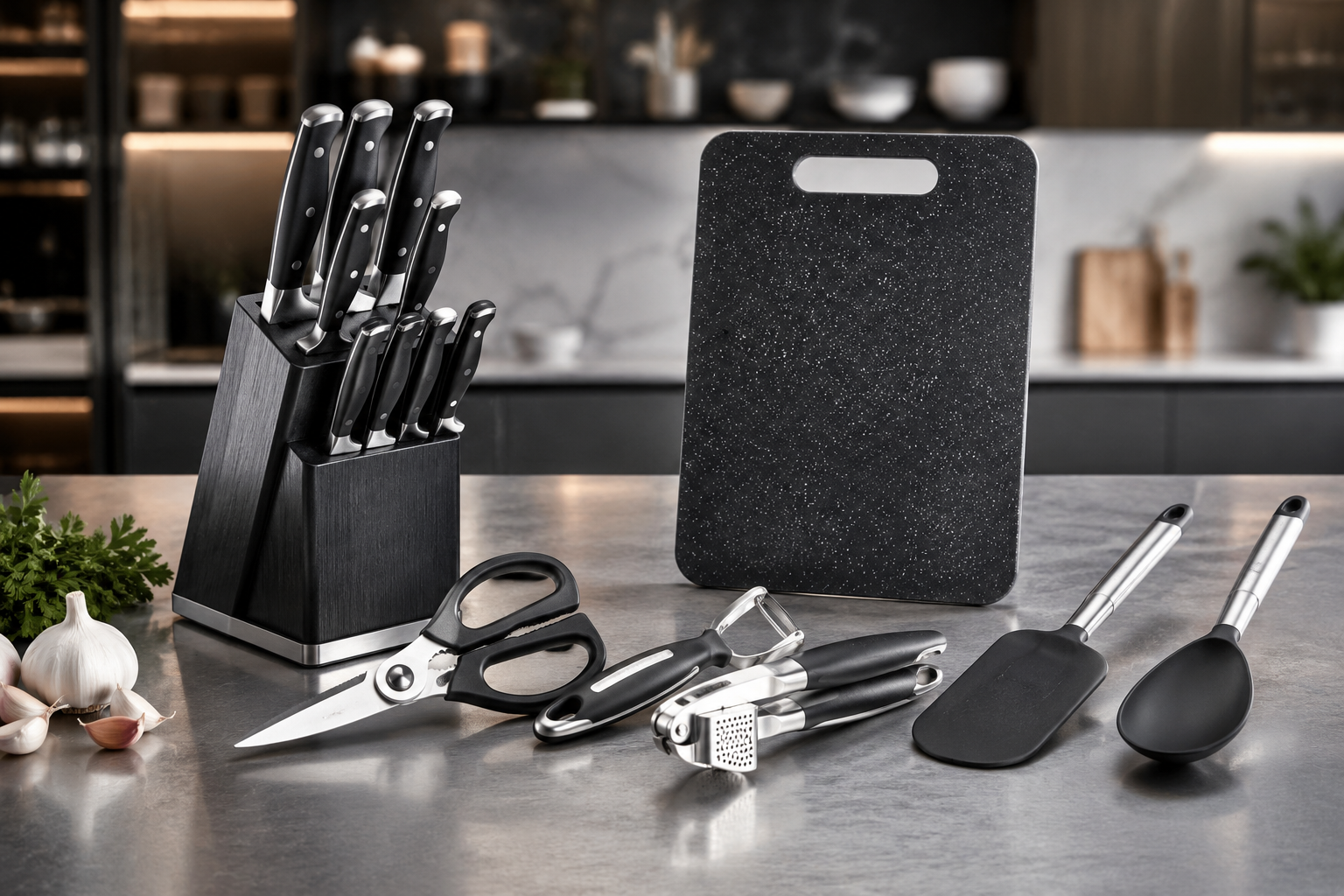
A basic retail kitchenware program may include:
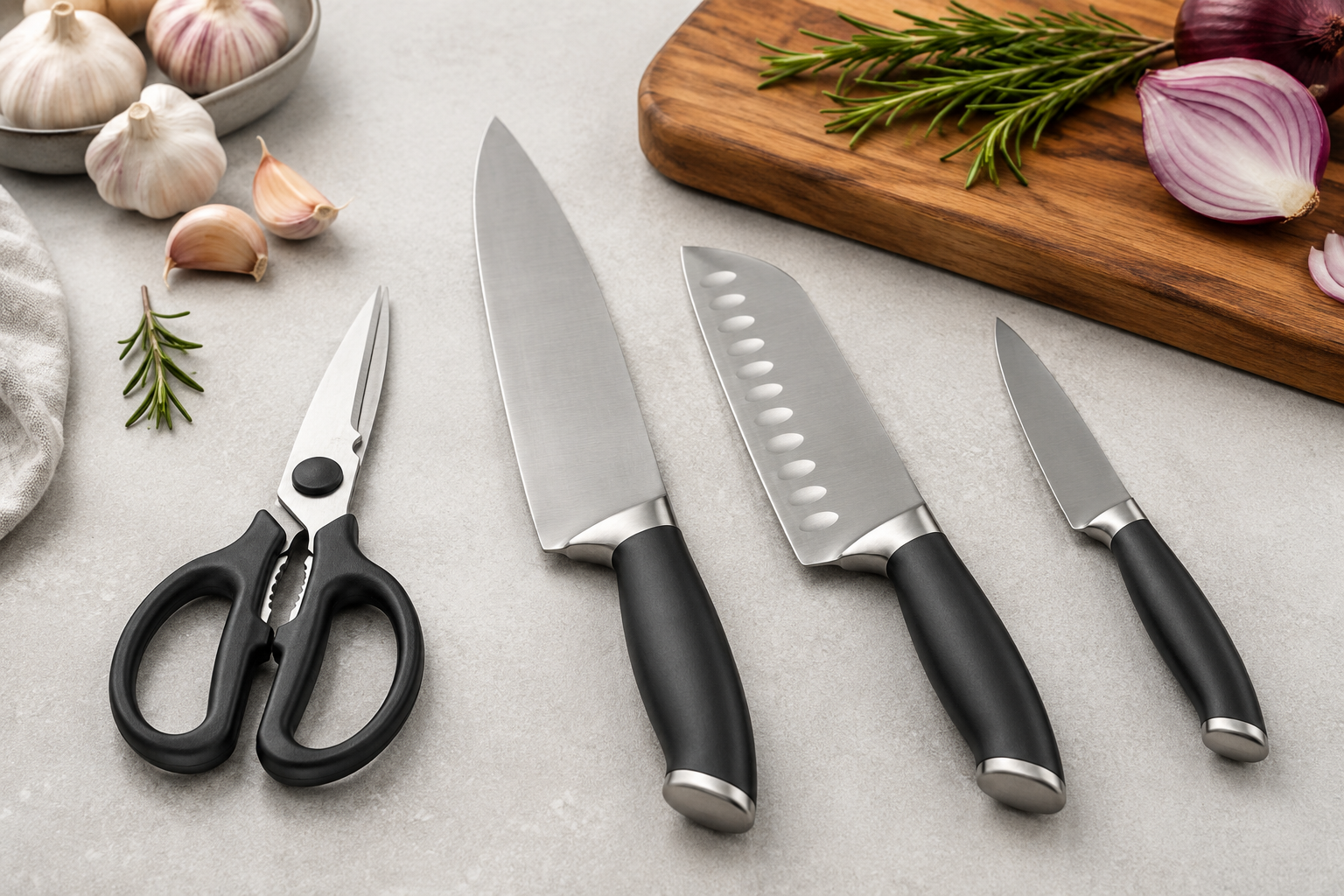
- Kitchen scissors for herbs, meat preparation, food packaging, and light household cutting.
- Kitchen knives for slicing, chopping, peeling, and everyday meal preparation.
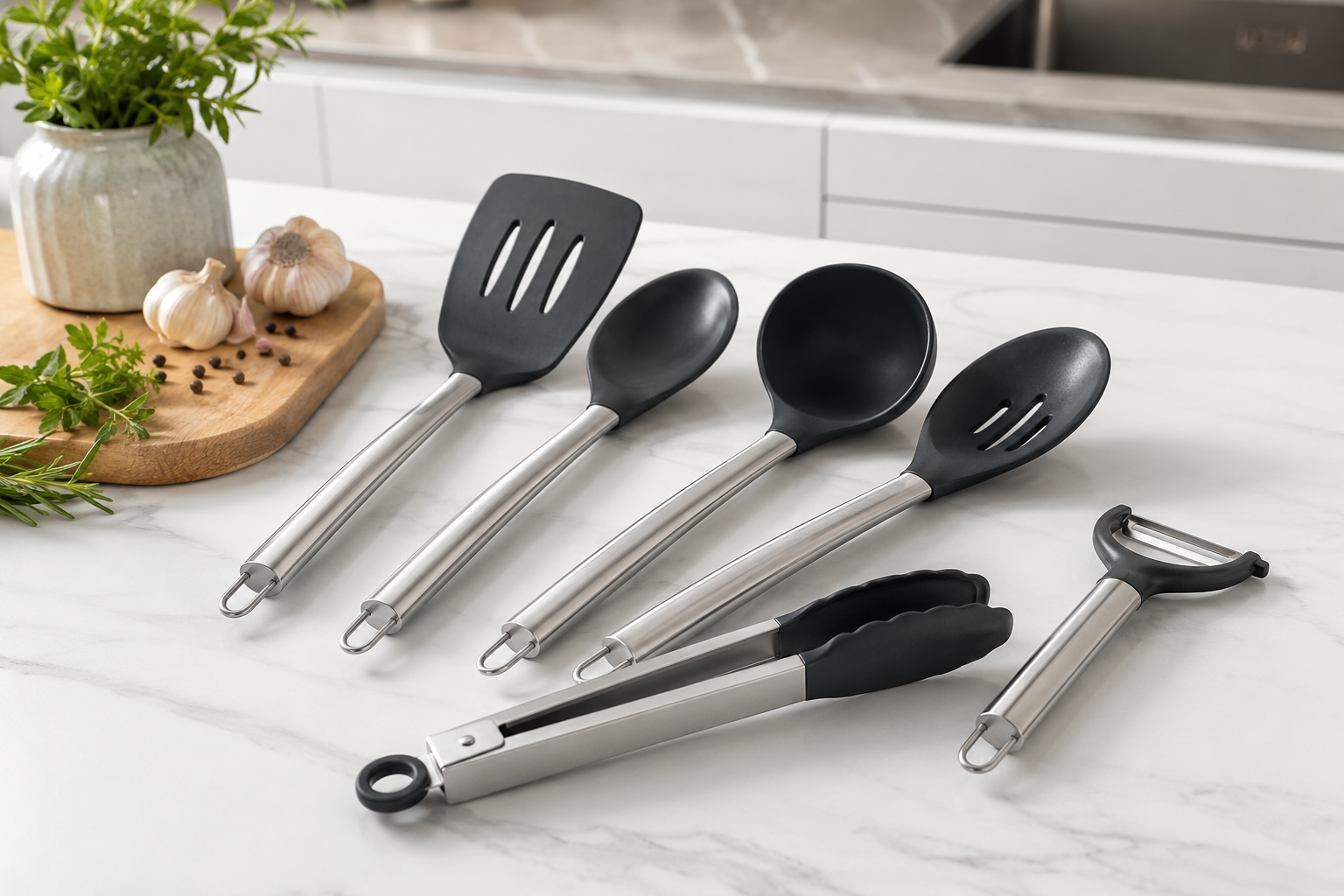
- Silicone utensils for stirring, serving, scraping, and use with non-stick cookware.
- Chopping boards for food preparation and bundled kitchen sets.
- Small tools such as peelers, garlic presses, graters, tongs, and food holders.
The goal is not to add more products for the sake of variety. The goal is to make each SKU easy to position by function, price level, packaging style, and target customer.
Sample Review Checklist for Retail Buyers
Before approving a sample, buyers should prepare a checklist that is specific enough to prevent misunderstandings. A sample that looks attractive in a meeting may still need improvement in grip comfort, edge finishing, cleaning, carton fit, or shelf presentation.
- Confirm the intended market, retail channel, and target price level.
- Check the product function by using the sample, not only photographing it.
- Review visible workmanship, including scratches, burrs, gaps, color differences, and loose parts.
- Ask what materials are used and what documents can be provided if required.
- Test packaging fit, barcode placement, warning text needs, and carton protection.
- Record approved sample details so future production can be compared consistently.
For kitchen scissors, check opening and closing action, blade alignment, pivot stability, and cutting feel. For knives, review edge consistency, handle comfort, balance, and visible finishing. For silicone utensils, check odor, flexibility, surface smoothness, and ease of cleaning. For boards, check flatness, edge finishing, and stability during cutting.
Packaging and Shipping Are Part of Product Quality
Packaging is often treated as a final step, but for retail buyers it is part of the product. A well-designed package protects the item, communicates its function, supports display, and reduces damage during transport. A poor package can create returns even when the product itself is acceptable.
Buyers should ask suppliers about inner packing, carton arrangement, product movement inside the package, and how sharp or heavy items are protected. For online retail, packaging may need stronger protection because individual parcels face different handling than palletized retail shipments. For supermarkets or homeware stores, the display format, hanging hole, window box, blister card, or color box may affect sell-through.
Repeat Orders Depend on Process, Not Luck
The first order proves whether a supplier can deliver a product. Repeat orders prove whether the supplier can maintain consistency. If a kitchen scissors SKU receives complaints about cleaning, the next version may need design adjustment. If a knife set suffers from shipping damage, the packaging structure should be reviewed. If silicone utensils sell slowly, the mix may need better balance between spatulas, spoons, ladles, and tongs.
When discussing repeat production, buyers should ask how the supplier controls approved samples, whether product changes are communicated before production, how defects are recorded, and how packaging updates are managed. If certifications, audit readiness, factory capacity, MOQ, or test reports are important for a retailer, buyers should request current evidence directly rather than relying on assumptions.
Practical FAQ for Kitchenware Sourcing
What should I ask a kitchenware supplier first?
Start with product use, material, target market, packaging format, sample process, and inspection checkpoints. Price matters, but unclear specifications create sourcing risk.
How can I compare two similar kitchen tools?
Use both samples. Compare function, grip, finishing, odor, cleaning, packaging fit, and carton protection. A cheaper item may cost more if it causes returns.
Should I choose an OEM kitchenware supplier or buy standard products?
Standard products may be faster for testing a market. OEM development can be useful when you need a specific handle, package, set combination, color range, or retailer program. Confirm development costs, timelines, samples, and ownership of artwork or tooling details.
What information should not be assumed?
Do not assume material grade, food-contact compliance, certifications, testing results, production capacity, MOQ, delivery time, or legal claims. Ask the supplier to provide current written confirmation and documents where needed.
How do I reduce risk before placing a bulk order?
Approve a detailed sample, define quality checkpoints, confirm packaging, request production photos when appropriate, and arrange inspection according to your company’s sourcing policy.