




How Can Supermarket Buyers Choose the Right Kitchenware Supplier?
A reliable kitchenware supplier for supermarkets should provide more than competitive pricing. For supermarket groups, retail chains, and importers, the right supplier must support product consistency, attractive packaging, stable supply, quality control, and customization requirements across different sales channels.
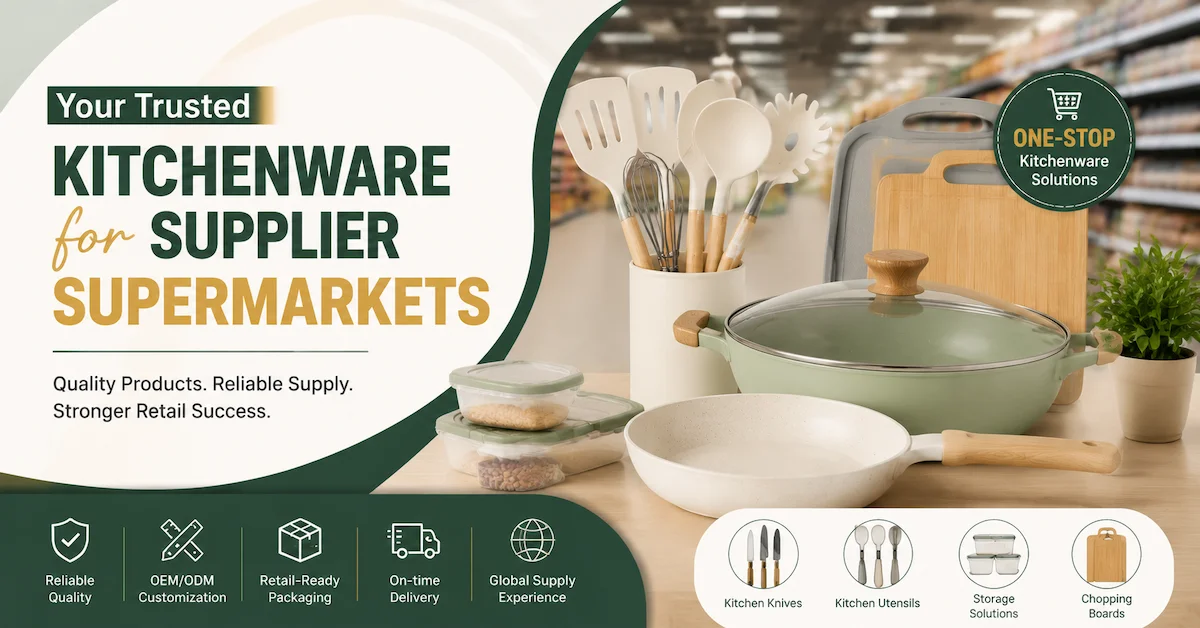
Supermarket kitchenware purchasing is different from individual product buying. Retail buyers usually need a complete product assortment, including kitchen scissors, knives, utensils, chopping boards, and kitchen gadgets, while also considering shelf presentation, customer demand, product rotation, and long-term replenishment.
A professional supplier should help buyers answer several important questions:
- Can the supplier provide the right product categories for supermarket shelves?
- Can product quality remain consistent during repeated orders?
- Can packaging meet retail requirements?
- Can the supplier support private label development?
- Can the supplier manage OEM customization and production requirements?
For supermarkets, supplier selection is not only a purchasing decision. It is a long-term retail supply-chain decision.
BONET provides kitchenware manufacturing solutions covering kitchen scissors, kitchen knives, utensils, chopping boards, multifunctional kitchen tools, and related kitchen products for global brands, distributors, retailers, and e-commerce businesses. BONET Products
What Do Supermarkets Expect from a Kitchenware Supplier?
Supermarket buyers usually focus on four major areas:
- Product suitability for retail customers
- Stable manufacturing capability
- Professional quality management
- Flexible customization support
A supplier that only provides products may not be enough for modern retail programs. Supermarkets often require suppliers who understand product positioning, packaging, market differences, and repeat-order requirements.
Key Supplier Evaluation Factors for Supermarket Buyers
| Evaluation Factor | What Supermarkets Should Check | Business Impact |
|---|---|---|
| Product assortment | Knives, scissors, utensils, gadgets, boards | Supports different shelf categories |
| Product quality | Materials, workmanship, function | Reduces customer complaints |
| Manufacturing ability | Production process and consistency | Ensures stable supply |
| Packaging capability | Retail boxes, labels, barcodes | Improves shelf readiness |
| Customization | Logo, color, packaging | Supports private label |
| Communication | Specification confirmation | Reduces production mistakes |
| Quality inspection | Inspection standards | Controls retail risk |
A strong retail kitchenware supplier should understand that supermarket products are judged by both customers and store operators. Appearance, usability, packaging, and consistency all influence sales performance.
Build the Right Kitchenware Product Assortment for Supermarkets
A successful supermarket kitchenware section usually requires a balanced product mix.
Buyers should avoid selecting products only based on supplier catalogs. Instead, they should consider customer purchasing habits, price levels, shelf space, and category positioning.
Common Kitchenware Categories for Supermarket Retail
| Product Category | Retail Application | Buyer Considerations |
|---|---|---|
| Kitchen scissors | Everyday household use | Cutting performance, safety, packaging |
| Kitchen knives | Essential kitchen tools | Blade quality, handle design, set options |
| Utensils | Cooking accessories | Material, appearance, functionality |
| Chopping boards | Food preparation | Size, material, retail presentation |
| Kitchen gadgets | Convenience products | Innovation and customer appeal |
| Multifunctional tools | Space-saving solutions | Practical functions and usability |
BONET currently focuses on kitchenware categories including all-purpose scissors, multifunctional products, kitchen knives, utensils, chopping boards, and kitchen gadgets. BONET Product Categories
For supermarket buyers, the goal is not simply adding more SKUs. The goal is creating a product range that customers can understand and purchase easily.
Why Manufacturing Capability Matters for Supermarket Supply
Supermarkets need suppliers who can maintain stable product quality over time.
A product that performs well during the first order but changes during later shipments can create serious retail problems.
Manufacturing capability affects:
- Product consistency
- Production stability
- Quality control
- Packaging accuracy
- Delivery planning
- Long-term cooperation
A supplier with its own manufacturing process can usually provide better communication between product design, production, inspection, and final shipment.
BONET's manufacturing process includes multiple production stages such as stamping, straight adjustment, heat treatment, grinding, polishing, injection molding, cleaning, assembly, quality inspection, and packing for related cutting-tool products. BONET Manufacturing Process
How Should Supermarkets Evaluate Kitchenware Quality?
Retail buyers should define quality standards before mass production.
A common mistake is approving products only by appearance. Kitchenware products need to be evaluated according to their actual usage environment.
Supermarket Kitchenware Quality Checklist
| Quality Area | Questions Buyers Should Ask |
|---|---|
| Appearance | Is the finish consistent? Are there visible defects? |
| Function | Does the product perform its intended purpose? |
| Material | Does it match the agreed specification? |
| Assembly | Are components securely connected? |
| Packaging | Is the product protected and retail-ready? |
| Consistency | Are bulk products consistent with approved samples? |
For example:
A kitchen scissor buyer should evaluate cutting performance, blade alignment, handle comfort, and packaging.
A knife buyer should evaluate blade structure, handle design, balance, and overall user experience.
A utensil buyer should consider material characteristics, shape, durability, and retail presentation.
Quality requirements should always match the product category and target market.
Materials Selection for Supermarket Kitchenware Products
Materials influence product positioning, customer perception, durability, and cost.
Supermarket buyers should understand the relationship between material selection and retail positioning.
BONET supports different kitchenware materials including stainless steel, silicone, plastic, wood, bamboo, aluminum alloy, and composite materials within its OEM/ODM capabilities. BONET OEM ODM Service
Common Material Considerations
Stainless Steel Kitchenware
Commonly used for:
- Kitchen scissors
- Knives
- Metal kitchen tools
Buyers should confirm:
- Product specification
- Surface finish
- Manufacturing requirements
- Intended application
Silicone Kitchen Tools
Commonly used for:
- Spatulas
- Spoons
- Cooking accessories
Important considerations include:
- Product design
- Color consistency
- Flexibility requirements
- Target market expectations
Plastic Kitchen Products
Plastic components may be used for:
- Handles
- Storage-related products
- Lightweight kitchen tools
Buyers should focus on:
- Appearance
- Structure
- User experience
- Market requirements
The correct material choice depends on product positioning rather than simply selecting the lowest-cost option.
OEM and Private Label Kitchenware for Supermarket Brands
Many supermarket chains develop their own private-label products to improve brand recognition and increase customer loyalty.
A suitable kitchenware supplier should support customization beyond basic manufacturing.
Common Private Label Requirements
Supermarket buyers may need:
- Custom logo
- Brand colors
- Product packaging
- Retail labels
- Barcode information
- Product combinations
- Customized product concepts
BONET's OEM/ODM service supports customization including production based on drawings or samples, material and color customization, logo printing or laser engraving, packaging customization, and product development support. BONET OEM ODM
OEM vs ODM for Supermarket Buyers
| Service Type | Suitable For | Example |
|---|---|---|
| OEM | Existing product requirements | Add supermarket brand logo and packaging |
| ODM | New product development | Create customized kitchen tool concepts |
Supermarket buyers should decide whether they need simple branding or deeper product development before selecting a supplier.
Packaging Requirements for Supermarket Kitchenware
Packaging directly affects supermarket sales.
Retail products need packaging that helps customers understand:
- What the product does
- Why they should buy it
- How it should be used
- What makes it different
Important Packaging Elements
| Element | Purpose |
|---|---|
| Product image | Shows product appearance |
| Brand identity | Builds recognition |
| Product information | Helps purchasing decisions |
| Barcode | Supports retail management |
| Protection | Prevents damage during transportation |
| Instructions | Improves customer experience |
BONET provides packaging customization options including retail packaging, gift boxes, barcode labels, and export cartons depending on project requirements. BONET OEM ODM Packaging
How Supermarkets Can Reduce Kitchenware Sourcing Risks
Supplier selection involves several risks:
- Unstable quality
- Incorrect specifications
- Packaging problems
- Delayed production
- Communication issues
- Product inconsistency
A professional sourcing process can reduce these risks.
Recommended Supplier Selection Process
Step 1: Define Product Requirements
Prepare:
- Product category
- Target customers
- Material requirements
- Packaging needs
- Sales channel
- Quality expectations
Step 2: Review Supplier Capability
Check:
- Product range
- Manufacturing process
- Customization ability
- Quality system
- Previous experience
Step 3: Confirm Samples
Evaluate:
- Product appearance
- Function
- Packaging
- User experience
Step 4: Establish Quality Standards
Define:
- Inspection points
- Approved samples
- Packaging requirements
- Product specifications
Step 5: Maintain Long-Term Communication
A supermarket supplier relationship depends on continuous improvement and stable cooperation.
Why Choose a Manufacturer Instead of a Simple Supplier?
For supermarket buyers, working directly with manufacturers can provide several advantages:
- Better communication
- More customization flexibility
- Better understanding of production
- Easier product development
- More control over quality
However, buyers should still evaluate whether the manufacturer has the right product capabilities, management systems, and experience for their specific category.
BONET introduces itself as a kitchenware manufacturer based in Yangjiang, China, with manufacturing capability, OEM/ODM services, and product categories designed for global business buyers. BONET About Us
FAQ
What should supermarkets look for in a kitchenware supplier?
Supermarkets should evaluate product range, quality consistency, manufacturing capability, packaging support, customization options, communication, and long-term supply reliability.
Can a kitchenware supplier support supermarket private-label products?
Yes. Many suppliers provide OEM and private-label services including logo customization, packaging development, colors, and product adjustments.
What kitchenware products are suitable for supermarket retail?
Common categories include kitchen scissors, knives, utensils, chopping boards, multifunctional tools, and kitchen gadgets.
Why is manufacturing capability important for supermarket buyers?
Manufacturing capability helps maintain consistent product quality, improve communication, and support repeat orders.
How can supermarkets compare different kitchenware suppliers?
Compare suppliers based on product capability, quality control, customization options, packaging support, production process, and overall sourcing value rather than price alone.
Does BONET provide OEM kitchenware services?
BONET provides OEM/ODM kitchenware services including product customization, sample development support, logo customization, packaging customization, and manufacturing support. BONET OEM ODM Service
What information should supermarkets provide when requesting a quotation?
Buyers should provide product requirements, quantity expectations, materials, customization needs, packaging requirements, target market, and quality standards.
How important is packaging for supermarket kitchenware?
Packaging is critical because it affects shelf presentation, customer understanding, logistics efficiency, and brand perception.
Should supermarkets choose the cheapest supplier?
Not always. The lowest price may increase risk if quality, packaging, communication, or supply consistency cannot meet retail requirements.
How can buyers contact BONET for kitchenware sourcing?
Supermarket buyers can prepare their product requirements and contact BONET through the official contact page for project discussion. BONET Contact Us
Conclusion
Selecting a kitchenware supplier for supermarkets requires a complete evaluation of products, manufacturing capability, quality management, customization support, and retail requirements.
The right supplier should help supermarkets build a reliable product assortment, maintain consistent quality, reduce sourcing risks, and support future product development.
For supermarket groups, distributors, and private-label brands, choosing a supplier with manufacturing experience and OEM/ODM capability can create stronger long-term value than simply choosing the lowest quotation.
BONET supports global business buyers with kitchenware manufacturing, customization services, production processes, and retail-oriented solutions. Buyers can explore BONET's product range, OEM/ODM capabilities, manufacturing information, and contact options to discuss specific supermarket sourcing projects. BONET Products BONET Contact Us
