




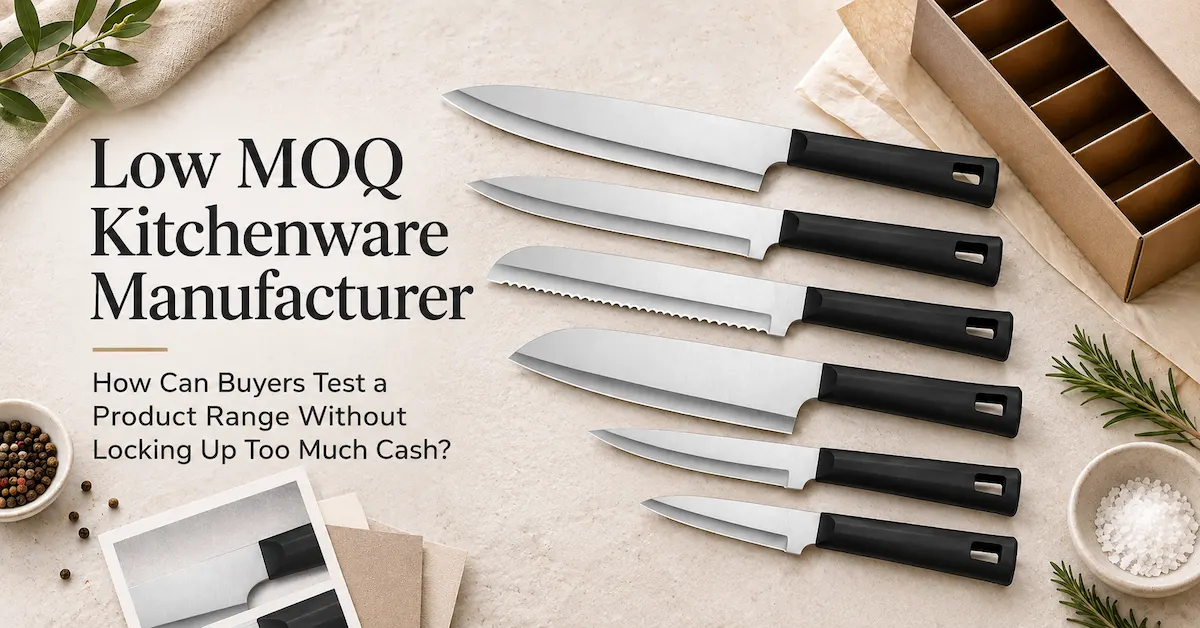
Quick Answer:
For a small opening order, the useful answer is not one headline MOQ. A reliable low MOQ kitchenware manufacturer should show the minimum for the item, finish, logo, pack and export carton separately. Buyers have more room when they begin with one product platform, trim the color count, reuse a logo and pack, and decide in advance what result would justify a repeat order. Low MOQ should be treated as a controlled market test with a clear learning objective, approved product version and path to scale.
Introduction: Low MOQ Is Valuable Only When the Order Teaches You Something
For a startup, emerging brand, retailer or importer, low MOQ sounds like insurance against unsold stock. That is why the phrase draws so much attention. A smaller opening order can protect cash, shorten the time before real customer feedback and reduce the cost of a weak product decision. But quantity alone does not make an order low risk.
Three hundred pieces may look cautious on a purchase order. Add two extra colors, a new mold, printed boxes, a fitted insert, barcodes, inspection and air freight, though, and the “small” order can consume a surprising amount of cash. A 1,000-unit order can sometimes be more efficient when the products share an existing platform, one color, one logo method and a common packaging structure. The commercial question is not simply “What is your MOQ?” It is “What creates each minimum, and which choices can be simplified without ruining the purpose of the test?”
Small batches also create a learning obligation. Before placing the order, the buyer should know what evidence will support a reorder. The test may measure sell-through, price acceptance, product use, return reasons, pack performance or the best SKU mix. Without that objective, low MOQ can become a series of small, expensive orders that never build a reliable supply program.
This guide presents a nine-step method for turning a small kitchenware order into a controlled commercial test. It covers product focus, SKU consolidation, customization depth, MOQ layers, cash exposure, sample approval, batch control and reorder triggers. It does not promise that every product or customization can be supplied at a particular quantity. Actual minimums, prices and timing must be confirmed for the selected products and project.
BONET HOUSEWARE is used as a public product reference. Its website presents kitchen knives, kitchen utensils, chopping boards, kitchen gadgets, multifunctional kitchenware and scissors. Its OEM/ODM information describes support for drawings or samples, material and color choices, logos, packaging, inspection, concept development and mass production. Those capabilities help buyers form better questions; they do not replace a live MOQ and feasibility confirmation.
What Is a Low MOQ Kitchenware Manufacturer?
A low MOQ kitchenware manufacturer is a production partner willing and able to support smaller opening quantities under a defined product, customization and packaging scope. “Low” is relative. It can differ by category, material, color, logo method, packaging type and production schedule. A realistic supplier explains those conditions instead of advertising one universal minimum.
A low MOQ kitchenware supplier may use existing product platforms, available materials, shared production runs, standard packaging or simple labels to make a smaller order practical. Deeper changes may require a different minimum because they introduce setup, tooling, material batches, printing or engineering work. This does not mean the supplier is inflexible. It means every customization has an operating cost and a batch logic.
The manufacturer's role is to make that logic visible. The buyer's role is to prioritize the test. If the primary question is whether customers want a product, stock packaging with a brand label may be enough. If the primary question is whether a new shape improves the task, a custom sample may be necessary even when the first production quantity must be larger.
| Low MOQ claim | Useful evidence | Question still open |
|---|---|---|
| Small product quantity | MOQ by SKU and selected configuration | Does color or material have a separate minimum? |
| Custom branding available | Logo method, setup and units per artwork | Can one logo setup serve several SKUs? |
| Custom packaging available | Print minimum, excess material and pack lead time | Who owns unused printed packaging? |
| Mixed products accepted | Minimum by SKU, total order and carton | Which choices can be consolidated? |
Why One MOQ Number Is Not Enough
The final order quantity is often controlled by several minimums. The product may have a production batch. The material or finish may have a color batch. A logo process may require setup. Printed packaging may have its own order quantity. Export cartons may require complete case packs. The largest or least flexible of these layers can become the effective minimum.
Ask suppliers to separate the layers. Suppose the item can run at 500 pieces while its printed box cannot. For the trial, a plain stock box plus a branded label may be the sensible compromise. If a custom color creates a separate batch, the buyer may launch one standard color and add variants after demand is proven. These are business decisions, not merely purchasing concessions.
| MOQ layer | What may create it | Small-batch option to discuss |
|---|---|---|
| Product | Setup, assembly efficiency or material supply | Use an existing product platform |
| Color or finish | Material batch, coating or color change | Start with one available color |
| Logo | Screen, pad, laser or other setup | Use one logo size and method |
| Packaging | Printed box, sleeve, insert or label production | Use a stock pack with a branded label |
| Carton | Fixed units per export carton | Round quantities to complete cartons |
The Nine-Step Low MOQ Test-Order Method
This method treats the first small order as a controlled experiment. Every step reduces one type of ambiguity before cash is committed. The output does not need to be a complicated document set. A concise test brief, MOQ map, cost model, approved sample record and reorder dashboard can be enough when they are current and used.
Step 1: Define What the Small Order Must Prove
Write one primary test question before choosing products. Be precise. Are you testing the shelf price, the usefulness of the item, the retailer's ability to explain it, or the gift value of the set? A private-label pack is another possible test, but it should not be mixed with every other question at once. One order can generate several observations, but it should have one priority.
Choose a measurable signal. Sell-through over a defined period, return rate, repeat purchase, retailer feedback, product reviews, use observations and pack damage are more useful than a general statement that the product “did well.” Define the decision attached to the signal: reorder, revise, hold or stop.
The objective determines the acceptable customization. If the test is about product demand, an existing platform may be enough. If the test is about a new product function, the sample and specification need more attention. If the test is about brand presentation, custom packaging may be worth the additional minimum.
| Test question | Evidence | Possible decision |
|---|---|---|
| Will the channel accept this price? | Sell-through and discount activity | Reorder, reposition or stop |
| Does the product solve the intended task? | Use feedback, returns and support questions | Keep, revise or redevelop |
| Which SKU should anchor the range? | Sales mix and basket attachment | Increase, reduce or replace a SKU |
| Does the pack protect and explain? | Damage, questions and conversion feedback | Retain or change packaging |
Step 2: Choose a Focused Product Platform
A small order becomes difficult when it tries to launch a complete catalog. Start with one hero product or one coherent product family. Add only variants or companions that share the user, visual language or production logic. Place the remaining ideas in a hold list until the first order creates a signal.
A focused platform can make a small MOQ kitchenware manufacturer program more practical because the supplier can discuss shared materials, colors, components, branding and packaging. The buyer benefits too: marketing has a clearer story, inventory is easier to read and the reorder decision is less fragmented.
Use the range roles “hero, variant, companion and hold.” The hero answers the main test. A variant provides controlled choice without creating a second product system. A companion completes the task or builds the basket. The hold list protects cash from attractive extras that do not help the first decision.
Have a product shortlist but need a focused small-batch range?
Discuss Your Test OrderStep 3: Build an Efficient SKU Mix
The opening quantity should be allocated according to what each SKU must prove. Do not divide units equally only because the spreadsheet is easier. Give more units to the hero item, enough units to a variant to compare demand, and a smaller controlled quantity to a companion product where feasible.
Look for consolidation opportunities. Several utensils may share one handle color. Multiple gadgets may use the same logo method. A set and a single item may share a carton or label format. Compatible items may fit one production window. Consolidation does not erase genuine product minimums, but it can reduce avoidable fragmentation.
Ask whether a mixed order minimum is different from the minimum for each SKU, color and logo. Clarify what the supplier means by 1,000 units. It might be 1,000 pieces of one item, or an order total spread over several items; the production implications are not alike. Have those quantities, splits and assumptions written into the quotation. A friendly phone confirmation is too easy to remember differently later.
Step 4: Match Customization Depth to the Test
Customization adds value when it helps answer the test question. It adds risk when it creates cost and delay without improving the evidence. Use a customization ladder: stock product, simple brand label, custom packaging, or product-level change. Move upward only when the deeper level is necessary.
For custom kitchenware low MOQ, ask which change drives the minimum. A standard item with a logo may remain practical. A unique color can introduce a material batch. A printed box can create unused packaging. A geometry or structural change can require a new sample, tooling or production setup.
An OEM kitchenware low MOQ project works best when the buyer's specification is already stable and uses a feasible production path. If the product is still being designed, the development cost and the production MOQ should be discussed separately. A low first quantity cannot remove the work needed to create the product.
For private label kitchenware low MOQ, consider stock or shared packaging with a controlled label before investing in a fully printed box. The first order can test the product and brand response; a later reorder can upgrade packaging after the winning SKU and message are clearer.
| Customization level | Useful for testing | Main small-batch risk |
|---|---|---|
| Existing product | Basic demand, channel and price acceptance | Limited differentiation |
| Logo or label | Brand recognition and simple private label | Setup by artwork or placement |
| Custom packaging | Shelf message, gifting and presentation | Print MOQ and unused packaging |
| Product modification | New use benefit or controlled differentiation | Development, tooling and feasibility cost |
Step 5: Map Every Minimum and Rounding Rule
Create an MOQ map for each selected SKU. Record product minimum, minimum per color, logo setup, packaging print quantity, carton pack and any total order condition. Add the owner and the date of the quotation because these conditions can change with product choice, material availability and production planning.
A low minimum order kitchenware factory should be able to explain where the number comes from. The buyer can then decide whether to change the quantity, simplify a choice, accept extra packaging for a future reorder or remove a weak SKU. Avoid pushing every minimum downward without understanding the cost transferred elsewhere.
| SKU field | Record | Decision if too high |
|---|---|---|
| Product and revision | Exact item, material, finish and configuration | Move to an existing platform |
| Color split | Units required per selected color | Launch one color or share across SKUs |
| Logo and artwork | Method, size, position and setup | Use one method and placement |
| Packaging and carton | Print quantity, case pack and excess units | Use stock pack, label or complete cartons |
Step 6: Calculate Total Test-Order Cash Exposure
Unit price is only one part of the first-order commitment. Add goods, samples, setup, tooling, logo work, packaging, inspection, freight, duties where applicable, handling, photography, launch content and a realistic allowance for slow or unsold inventory. The purpose is to compare the cash committed with the questions answered.
Small quantities can carry higher per-unit freight and fixed costs. That may still be rational when the test prevents a much larger inventory mistake.The buyer should understand the trade rather than expecting the lowest unit price and the lowest quantity at the same time.
Use a cash ceiling. If the total exceeds the ceiling, simplify the SKU mix, customization or shipping plan before negotiating only the unit price. The most useful low MOQ order is the one the business can fund, sell and learn from without creating pressure to reorder before the evidence is ready.
Have quantities, customization ideas and a target budget?
Request a Scope ConversationStep 7: Freeze the Product and Packaging Version
A small order still needs a controlled version. Approve the exact product, material, color, logo and packaging before production. Record the sample revision, artwork revision, carton quantity, open exception and approval date. Low quantity is not a reason to let the line work from an email picture or an unnamed sample.
Separate approval layers. The product sample can be accepted while the packaging remains open. The logo can be approved before the complete unit pack. The final release should identify all layers that are closed. This protects the first test from producing ambiguous feedback about an item that was never clearly defined.
If the buyer is working with a small batch kitchenware manufacturer, ask how changes are handled after approval. A late material, color or pack change may affect both quantity and timing. A written change record is more useful than an informal agreement that the new version is “almost the same.”
Step 8: Control the Small Production Batch
Small-batch production deserves the same clarity as a larger run. Confirm the production reference, first-piece or early-run check where appropriate, packaging approval, inspection scope, release owner and shipment quantity. The inspection effort should fit the risk and product; it should not disappear simply because the order is small.
Keep batch evidence connected to the SKU and revision. Photographs, inspection notes and carton counts are useful when they identify the actual order. Record any accepted exception. When the test order arrives, the buyer can then separate a product decision from a batch execution issue.
| Batch checkpoint | Evidence | Decision owner |
|---|---|---|
| Approved reference | Product and artwork revision | Buyer and manufacturer product contacts |
| Early-run check | First pieces or process confirmation where agreed | Production and quality |
| Final inspection | Result, photos, quantity and exceptions | Quality and buyer approver |
| Release | Written release and carton count | Named shipment owner |
Step 9: Set the Reorder Trigger Before Launch
Define when the team will review the test and what triggers a reorder. The trigger can combine sell-through, remaining weeks of stock, supplier lead time, customer feedback, cash availability and product changes. Waiting until the warehouse is nearly empty can force expensive freight or a rushed repeat order. Reordering too early can lock cash into a weak product.
Use demand by SKU rather than only total sales. The opening mix may be wrong even when the range succeeds. Increase the hero, reduce the slow variant, keep the companion or remove an item that did not help the basket. If feedback reveals a product or pack change, approve the new revision before the reorder.
A low MOQ kitchenware manufacturer China relationship becomes more valuable when the small order leads to a clearer second order. The goal is not to stay at the lowest possible quantity forever. The goal is to scale the right product and mix with evidence.
Explore Product Platforms for a Focused Test
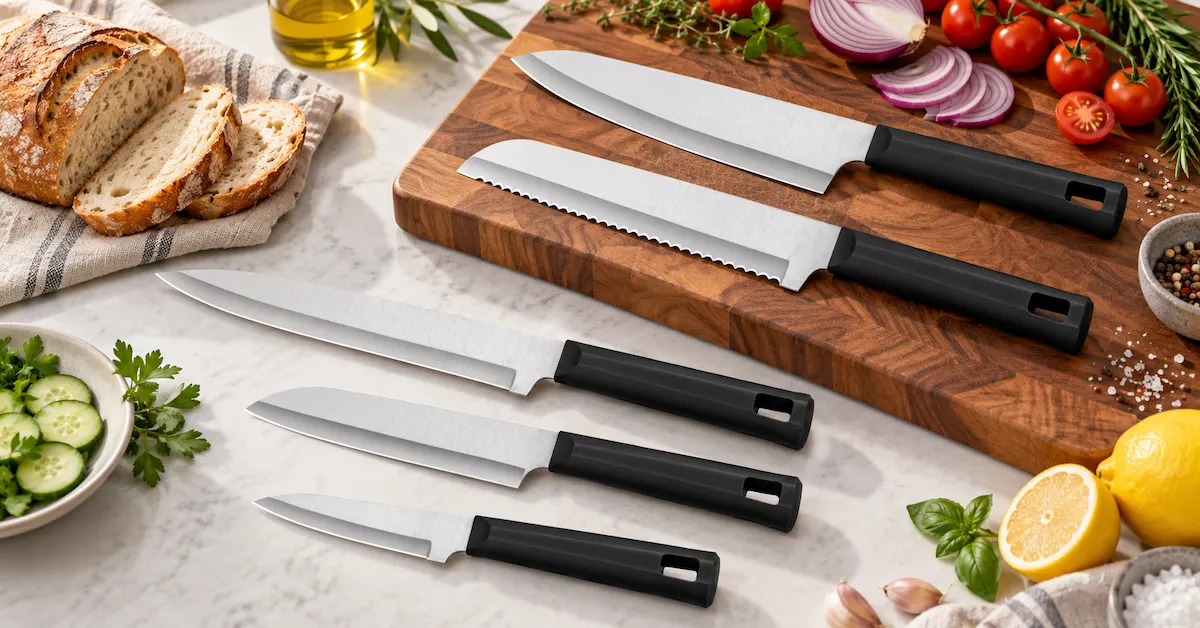
Start with a category that matches the test objective. Review kitchen knives, kitchen utensils, chopping boards, kitchen gadgets, multifunctional kitchenware and all-purpose scissors. Then ask which existing options, shared colors and packaging approaches could support the intended batch.
Low MOQ Manufacturer Evaluation Scorecard
Compare suppliers by how clearly they explain the small-batch model. A low number is not useful when the configuration, packaging or reorder path is vague. Score the evidence behind the offer, then clarify any weak area before approving samples or paying setup costs.
| Evaluation area | Strong evidence | Question to ask |
|---|---|---|
| MOQ transparency | Minimums separated by product, color, logo, pack and carton | Which choice sets the effective minimum? |
| Platform fit | Existing products and shared choices match the test | What can be shared without weakening the offer? |
| Cost clarity | Fixed, variable, packaging and freight assumptions are visible | What cost remains outside the unit price? |
| Batch control | Approved sample, inspection record and release owner | How is the small run tied to the approved version? |
| Reorder path | Future quantity, leftover packaging and revision rules are discussed | What changes on the second order? |
Small-Batch Inquiry Checklist
Send enough information for the supplier to separate genuine minimums from optional complexity. A useful opening inquiry includes:
- Target customer, channel and the primary question the test order should answer.
- Selected product links or reference images with hero, variant and companion roles.
- Quantity by SKU and color, plus the acceptable total cash commitment.
- Required versus preferred materials, colors, logos and packaging.
- Destination market, desired handover timing and any known buyer requirements.
- Request for product, color, logo, packaging and carton minimums to be shown separately.
- Sample, approval, inspection and batch-release expectations.
- Reorder scenario, leftover packaging treatment and likely scale if the test succeeds.
Frequently Asked Questions
What is considered a low MOQ for kitchenware?
There is no universal number. The practical minimum depends on the product, material, finish, color, logo, packaging, carton and production plan. Buyers should request a written MOQ breakdown for the exact configuration instead of comparing general advertising claims.
Can a low MOQ order include custom branding?
It may, depending on the product and logo process. Simple labels or shared logo methods can be more practical for a test order than multiple artwork setups or fully printed packaging. Confirm setup charges and minimums by artwork, size and placement.
How can a buyer lower the effective MOQ?
Use existing product platforms, reduce variants, share colors and logo methods, use stock packaging with labels, round to complete cartons and schedule compatible SKUs together. The manufacturer must confirm which of these options are feasible for the selected products.
Is the lowest MOQ always the safest option?
No. Very small quantities can have high fixed cost per unit, expensive freight, weak quality control economics or too little stock to produce a useful market signal. Compare total cash exposure, learning value and reorder timing rather than quantity alone.
Ready to scope a focused kitchenware test order?
Contact BONET for an InquiryConclusion: Use Low MOQ to Build a Better Second Order
The right low MOQ kitchenware manufacturer relationship is not defined by the smallest number in a sales message. It is defined by whether the supplier can explain the MOQ layers, help the buyer focus the product platform, match customization to the test, control the approved batch and support a clear reorder path.
For buyers, the nine-step method turns a small quantity into a business tool. Define what must be learned, choose a focused range, consolidate compatible choices, calculate the full cash exposure, freeze the product version and scale only when demand evidence supports the next order. That is how low MOQ protects cash without sacrificing product clarity.
