




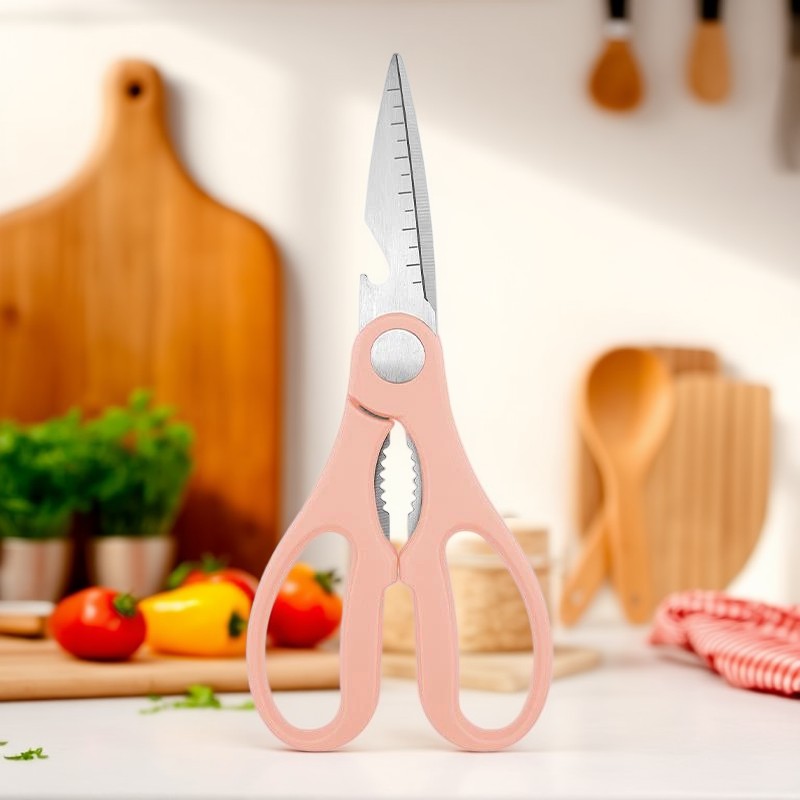
Magnetic Kitchen Scissors: Practical Buying and Use Guide
Kitchen scissors are often treated as a simple drawer tool, but a well-designed pair can handle many everyday preparation jobs that are awkward with a knife. Magnetic kitchen scissors are especially useful when they are easy to store, quick to reach, and built with integrated functions for common kitchen tasks. The original product description highlights a multi-function design with stainless steel blades, a built-in nutcracker between the handles, a serrated edge that can work as a fish scale scraper, a small notch at the blade base for opening bottles, ergonomic smooth-grip handles, a matte finish, and a protective sheath for storage.
This guide explains how to evaluate those features in practical terms. It is written for buyers comparing household kitchen scissors, retailers planning product assortments, and sourcing teams preparing questions for a supplier. It avoids assuming details that should be confirmed directly, such as exact steel grade, magnetic strength, dishwasher suitability, packaging, certifications, or commercial terms.
Key Takeaways
- Choose kitchen scissors based on real cutting tasks, not only on appearance or the number of add-on functions.
- Stainless steel blades are useful for kitchen use, but buyers should ask the supplier to confirm the exact grade, hardness, and care instructions.
- Integrated tools such as a nutcracker, fish scale scraper, and bottle opener can reduce tool clutter when they are comfortable and safe to use.
- A sheath supports safer drawer storage; if magnetic storage is required, confirm whether the product includes a magnet and how it should be mounted or stored.
- For wholesale or OEM sourcing, request samples and clarify materials, packaging, labeling, inspection standards, and after-sales responsibilities before ordering.
What Magnetic Kitchen Scissors Are Used For
Kitchen scissors can simplify small cutting tasks where a knife and board feel inefficient. They can trim herbs, cut packaging, portion cooked food, snip dough, prepare seafood, or help with poultry trimming. The product described in the original article is positioned as a multi-purpose tool for herbs, poultry, and seafood preparation, with added functions built around the handles and blade edges.
The word magnetic may refer to magnetic storage or a magnetic feature in the product design. Because the source does not provide detailed magnet specifications, buyers should not assume where the magnet is located or how strong it is. If magnetic storage is important, ask whether the scissors attach directly to a magnetic strip, whether the sheath is magnetic, and whether the magnet is intended for countertop, wall, or refrigerator-side storage.
Core Features to Compare Before Buying
The most useful kitchen scissors balance cutting performance, grip comfort, cleaning ease, and safe storage. Add-on tools are helpful only when they do not make the scissors bulky or hard to clean. Use the checklist below when comparing this type of product against other kitchen shears.
| Feature | Why It Matters | Questions to Ask |
|---|---|---|
| Stainless steel blades | Supports kitchen use and helps resist common moisture exposure. | What is the steel grade, blade thickness, and recommended maintenance? |
| Nutcracker between handles | Adds a hard-shell cracking function without a separate tool. | What shell types and sizes is it intended for? |
| Serrated fish scale edge | Can assist seafood preparation beyond basic cutting. | Is the edge designed for fish scaling, gripping, or both? |
| Bottle opener notch | Useful for occasional beverage or bottle opening tasks. | Has the opener position been tested for hand comfort and leverage? |
| Ergonomic smooth-grip handles | Improves control during repeated cutting. | What hand sizes were considered in the handle design? |
| Sheath | Helps protect blades and hands during storage. | Does the sheath lock securely, and is it easy to clean? |
| Magnetic function | May improve access and reduce drawer clutter. | Where is the magnet located, and what surfaces are suitable? |
How to Use Multi-Function Kitchen Scissors Safely
For cutting herbs, hold the herbs in a small bunch and snip directly into a bowl or pan. For poultry trimming, keep the food stable, cut slowly, and wash the scissors immediately after contact with raw meat. For seafood, the serrated edge described in the source may be used to help remove fish scales, but users should work away from the body and rinse loose scales from the tool before they dry.
The nutcracker and bottle opener functions should be used with steady pressure rather than sudden force. If a shell is too large or too hard, switch to a purpose-built tool instead of twisting the scissors. Multi-function tools are convenient, but they should not be pushed beyond their intended use.
Cleaning and Maintenance Guidance
Kitchen scissors come into contact with moisture, oils, herbs, meat juices, and seafood residue. Even stainless steel blades need proper cleaning and drying. Unless a supplier clearly states dishwasher suitability, hand washing is the safer default. Use warm water, mild dish soap, and a brush to clean around the hinge, serrated edge, handle gap, and bottle opener notch.
- Rinse the scissors soon after use, especially after cutting salty, acidic, or protein-rich foods.
- Wash both blades and all integrated tool areas with soap.
- Dry completely with a clean towel before placing the scissors into the sheath.
- Store away from children and avoid loose drawer contact that can dull the blades.
- If the hinge becomes stiff, ask the supplier whether food-safe lubrication is recommended.
Storage: Sheath, Drawer, or Magnetic Access
The original article mentions a sheath for safe storage and reduced drawer clutter. A sheath is valuable because it covers the cutting edges and helps prevent accidental cuts when reaching into a drawer. It also protects the blade from contact with harder utensils.
If the scissors are marketed as magnetic, storage expectations should be clarified. Some buyers may expect direct attachment to a magnetic knife strip, while others may expect a magnetic sheath or a separate holder. These are different designs. For consumer use, test whether the scissors are stable in the storage location and cannot be knocked down easily. For retail or wholesale buying, request clear product images, packaging instructions, and user warnings related to magnetic storage.
B2B Sourcing Notes for Retailers and OEM Buyers
When sourcing kitchen scissors for wholesale, private label, or OEM programs, the main risk is assuming that all multi-function shears are the same. Before placing an order, request a sample and evaluate cutting feel, handle comfort, finish consistency, sheath fit, and cleaning access. Ask the supplier to confirm the blade material, handle material, magnet details if applicable, packaging options, labeling requirements, and whether the product can be customized.
Commercial details should be confirmed in writing. Useful questions include: What is the minimum order quantity? What packaging formats are available? Can barcodes, instruction cards, or private-label artwork be supplied? What inspection criteria are used for blade sharpness, hinge movement, appearance, and sheath fit? Are there any market-specific compliance requirements the buyer must provide? These questions help prevent misunderstandings without relying on unverified claims.
Practical FAQ
Are magnetic kitchen scissors the same as regular kitchen shears?
Not always. The cutting function may be similar, but magnetic kitchen scissors may include a magnetic storage feature or be designed for use with magnetic holders. Confirm the exact magnetic design before buying.
Can these scissors replace a chef’s knife?
No. They are best for trimming, snipping, opening, and small preparation tasks. A knife is still better for chopping, slicing large ingredients, and precision cuts on a board.
Are stainless steel blades rust-proof?
Stainless steel offers corrosion resistance, but it still needs cleaning and drying. Do not leave kitchen scissors wet or covered with salt, acid, or food residue.
Is the sheath necessary?
A sheath is strongly recommended for safer storage. It protects the blade edge and reduces the risk of cuts when the scissors are stored in a drawer or utensil organizer.
What should buyers confirm with a supplier?
Confirm the exact materials, blade grade, magnetic function, cleaning instructions, packaging, customization options, inspection standards, and commercial terms such as MOQ and lead time.
Final Selection Advice
Good magnetic kitchen scissors should feel secure in the hand, cut cleanly, store safely, and make integrated functions easy to use. The features described in the source, including stainless steel blades, a nutcracker, fish scale scraper edge, bottle opener notch, ergonomic handles, matte finish, and sheath, can be useful when they are executed well. For the best purchase decision, compare samples, ask precise questions, and choose the design that fits the actual cooking or retail use case.
