




What makes a multipurpose scissors supplier worth considering? A supplier should be able to identify the exact model and components, explain the intended function of each built-in feature, agree on realistic test conditions, demonstrate a repeatable sample-approval process and reproduce the approved specification in future orders.
A multi-tool is only valuable when its additional functions work safely and consistently without undermining the scissors' main cutting task. This guide gives importers, private-label brands, kitchenware wholesalers and retail sourcing teams a function-by-function process for making that judgment.
1. Define “Multipurpose” Before Counting the Features
The term multipurpose scissors manufacturer can describe several different products. Some are ordinary household scissors marketed for more than one cutting material. Others are kitchen shears that combine cutting blades with bottle openers, nutcracker jaws, herb strippers, fish-scaling features or detachable components. A model can also include a blade cover or a magnetic storage accessory without changing how the cutting blades work. None of these definitions automatically establishes a performance level.
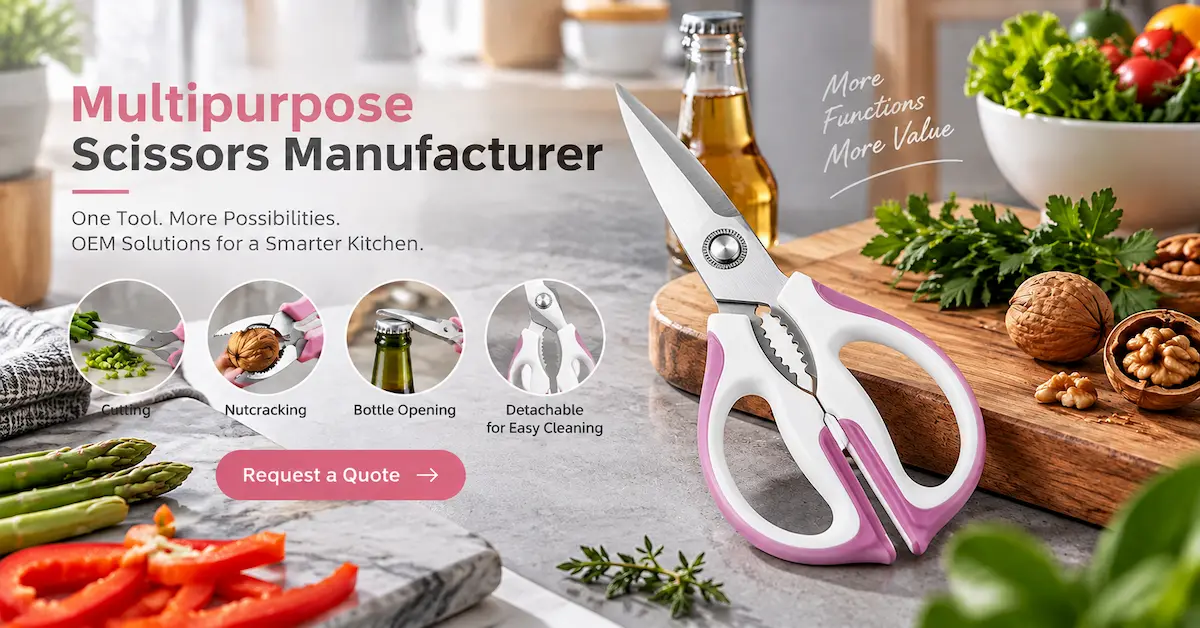
For a purchasing team, a clearer product definition is: multipurpose scissors are a cutting tool with one primary cutting application and additional specified functions that must each be validated for the intended user. That definition matters because it separates what is required from what is merely attractive in sales photography. A buyer can then prioritize the functions customers will genuinely use rather than selecting a model with the longest list of marketing claims.
Consider a supermarket customer preparing vegetables at home. Cutting herb stems or a sealed food bag may be the primary use. Opening a crown-cap bottle may be a useful secondary feature, but it should not make the handle uncomfortable during repeated snipping. A catering buyer may care more about washable joints and cutting control than about decorative multifunctional additions. A gift-program buyer may prefer a compact design and a readable display card. These audiences require different product specifications even if their keyword searches look similar.
Three questions that make an OEM brief more specific
- What are the two most common real tasks the customer will perform with this product?
- Which additional functions will appear in packaging, videos or online listings—and therefore need proof?
- Which features could introduce a problem with grip, cleaning, storage or repeatability if implemented poorly?
Document the answers before discussing colors, logos or pricing. A more disciplined scope makes it easier for suppliers to recommend a practical catalog platform or advise when a new design may be required.
2. Who Is Buying Multipurpose Scissors—and What Do They Need?
Private-label cookware brands may want matching colors, an intuitive grip, consistent product photography and appropriate care instructions. Their risk is that the model looks compatible with their cookware assortment but fails to deliver an everyday experience customers expect. They should test the complete product with the utensils and cookware they actually sell.
Supermarket and homeware chains usually need an easy-to-explain benefit, a clear barcode, safe shelf display and stable replenishment. If a product promises five functions, a retail customer should be able to identify those functions and use them from the supplied instructions. The purchasing team needs the same model and package to arrive consistently across stores.
Importers and regional distributors often compare multiple SKUs serving different price positions. They need clear variant definitions, batch traceability, realistic minimum quantities and a purchase order that does not accidentally combine incompatible configurations. One style might have a detachable assembly while another comes with a sheath or magnetic holder; the distinction must survive the quotation and packing list.
E-commerce brands have a further problem: the listing may be created months before the shipment reaches the consumer. Product images, feature icons and demonstration videos should show the actual approved version. A supposedly minor design change—such as a different sheath, new bottle-opening cutout or redesigned pivot—can make an old listing inaccurate.
Hospitality and food-preparation buyers should establish cleaning practices, duty cycle and intended food tasks carefully. A retail kitchen multitool should not be presented as suitable for every professional or industrial food operation. Where heavy-duty use is expected, develop application-specific tests and ask the supplier whether the proposed model is an appropriate candidate.
3. Compare Published BONET Models Without Inventing Performance Claims
It is more useful to compare actual catalog models than to describe an imaginary “premium multifunction scissor.” BONET HOUSEWARE CO., LTD. publishes several kitchen-scissors references on its own site. The following fields are taken from those product listings; they are starting points for sampling, not independent evidence of cutting life, heat treatment, corrosion behavior or conformity with a retail market's regulations.
| Model and product link | Published dimensions | Published material fields | Design direction and key checks |
|---|---|---|---|
| G2004 Multi-Purpose Kitchen Scissors | 19 × 9.5 × 1 cm | 420 stainless steel; PP | Detachable and multifunction-oriented. Verify separation, assembly and the actual usable integrated tools. |
| G2003 Cooking Shears | 24 × 7.5 × 1.5 cm | 420 stainless steel; PP + TPR | Magnetic-storage and detachable concept. Verify sheath contents, grip and reassembly. |
| G2011 Magnet Kitchen Scissors | 21.8 × 8.6 × 2 cm | 420 stainless steel; PP | Magnetic sheath and kitchen utility. Validate storage surface, retention and retail configuration. |
| SKI090 Multifunctional Scissors | 9-inch size listed | 420 stainless steel; PP | Multifunctional kitchen design. Confirm actual features and performance from an approved sample. |
BONET product-catalog information; measurements are not a substitute for signed specifications. Confirm the latest availability and project-specific version in the RFQ.
These references illustrate why a supplier comparison should separate objective features from subjective value judgments. G2003 lists a different plastic-material combination from G2004. G2011 emphasizes storage. SKI090 uses an inch-based size description rather than the three-dimensional catalog format shown for other models. None of that proves which pair is the most comfortable, strongest or safest for your intended use. Only defined testing of production-representative samples can address those questions.
Use the BONET all-purpose scissors category or the kitchen scissors collection to expand a shortlist. When an attractive product is found, ask the supplier for its model identifier, full bill of materials, included accessories, current drawing and a quote tied to that precise configuration.
4. The Core Cutting Test: Make the Main Function Non-Negotiable
Integrated features can distract a buyer from the most basic task. If scissors do not cut well, an opener or nutcracker will not rescue the product. A credible sample review begins with the blade-to-blade relationship: edge geometry, alignment, contact, opening and closing movement, and the pivot that holds the two blades together. A steel name alone cannot establish these finished-product qualities.
Start with the intended cutting materials. For a general kitchen shear, sample exercises may involve herb stems, parchment, thin food packaging and a defined soft-food item. Buyers proposing meat or poultry claims should establish separate, appropriate tasks and hygienic procedures. Do not imply that scissors can cut bones, wires or other hard materials merely because a product description calls them heavy duty. That requires application-specific verification.
Record the materials, sample thickness or other relevant characteristics, operator instructions, condition of the scissors, and what counts as a pass. For instance, “cuts designated packaging without repeated re-positioning or visible tearing” is more inspectable than “super sharp.” A fixed number of cycles can be agreed for comparative testing, but it should reflect project needs rather than an invented universal standard.
How to evaluate the entire cutting stroke
Ask the tester to observe the start of the cut, the middle of the blades and the tip. A tool may cut acceptably near the pivot yet allow thin material to slip at the tip. Another may feel smooth when empty but jam when cutting a representative food package. The tester should also note whether the blades cross, bind, grind harshly or move apart under load.
Evaluate both right- and left-hand user experiences if ambidextrous operation will be promised. Ergonomic comfort is not guaranteed by a symmetric photograph. Make sure the number of users, hand sizes and task repetitions match the claim the brand wants to make.
5. Build a Feature-by-Feature Acceptance Matrix
The defining quality risk in multipurpose scissors is the gap between a long feature list and the evidence supporting that list. Create a single table with every claimed function, its intended user action, sample test, observable failure and approval owner. This document should travel from product development to quality control and finally to marketing.
| Advertised function | Practical acceptance activity | Potential failure mode | Evidence before launch |
|---|---|---|---|
| Primary scissor cutting | Cut agreed representative materials through the full blade stroke | Slipping, tearing, binding or inconsistent tip contact | Approved sample and repeatable cutting record |
| Bottle opener, when fitted | Open the specific crown-cap style approved for the market | Cap slips, hand collides with edges or handle flexes unexpectedly | Documented demonstration and post-use condition check |
| Nutcracker, when fitted | Test agreed nut sizes, positioning and force application | Hinge distortion, poor grip or excessive force | Reviewed method plus pivot and handle condition after use |
| Herb stripper, when fitted | Pull representative herb stems through the intended opening | Leaf damage, blocked openings or difficult cleaning | Task demonstration, cleaning review and instructions |
| Detachable blades, when fitted | Separate, clean, reconnect and cut again as instructed | Unexpected separation, poor re-engagement or trapped debris | Reassembly checks and retained reference sample |
| Magnetic holder, when included | Test mounting and removal on defined surfaces and orientations | Unstable retention, scratching or unexpected release | Approved holder configuration and user guidance |
| Protective sheath, when included | Fit, remove and pack the sheath in intended positions | Loose fit, exposed tip or packing interference | Pack approval and protective-fit inspection |
This matrix intentionally contains no fabricated numerical limits. A supplier and buyer should agree on forces, cycles, acceptance limits, test articles and operator safeguards after assessing the actual design and use case. The test method must be reproducible across sample development and shipment inspection; otherwise a “passed QC” statement cannot be meaningfully compared from one order to the next.
Do not attach a retail feature icon to a product merely because another model in the same range has that feature. The approved bill of materials and accessory list must identify what the customer receives. If the final version removes a bottle opener or magnetic component, packaging and ecommerce content must be revised before release.
6. Bottle Openers and Nutcrackers: More Features Mean More Design Risks
A bottle opener integrated into the blade or handle transfers forces through a structure originally needed for cutting. It may be convenient, but its contact surfaces, lever action and nearby gripping areas need review. A tool that opens a bottle while placing fingers close to an unprotected cutting edge is not acceptable simply because the demonstration succeeds once. Observe hand clearance, comfort and stability when the user applies force.
The nutcracker position deserves similar scrutiny. The available grip should prevent uncontrolled slipping, and the pivot must remain serviceable after use. When a sample is tested, examine its closure, blade contact and opening movement afterward. It is possible for an auxiliary feature to work in isolation while gradually changing the way the scissors cut.
For a private-label product, specify which bottle-cap design and nut range the demonstration covers. A claim such as “opens every bottle” or “cracks any nut” is not technically meaningful. Where a function is absent from the model being supplied, remove it from the label and listing rather than relying on generalized category text.
Buyers should also compare the feature's actual utility with a standalone utensil. If a combined tool saves storage space but requires awkward positioning or heavy force, its claimed convenience may not survive customer use. A useful manufacturer will be willing to discuss the trade-off instead of presenting every added feature as an automatic improvement.
7. Detachable Scissors Need Two Separate Approvals
A detachable mechanism can improve access for washing, but it introduces a second operating state beyond normal cutting. Review the scissors first as a complete assembled pair and then as separated components. Specify the permitted separation method, safe handling, reassembly orientation and the final condition required before use. Cleaning convenience does not excuse a joint that separates unexpectedly during ordinary cutting.
Check whether the release happens only at a designated blade angle or through a defined action, and whether users can understand that instruction. Examine exposed edges when separated. A simple illustration may be more useful than a lengthy instruction paragraph, but the illustration must depict the exact version customers will receive.
For sample approval, repeat the separation and connection sequence in a controlled way, inspect for visible wear or looseness and repeat the cutting task afterward. Determine whether any part could be lost or incorrectly reattached. Decide whether the retailer should provide specific washing instructions, cautions for handling sharp parts or storage guidance.
Never assume dishwasher compatibility from the ability to detach blades. Claims about washing, coating durability, polymer performance or corrosion resistance require evidence tied to the completed model, its materials and its actual cleaning conditions. Where evidence is incomplete, use conservative and accurate care instructions.
8. Magnetic Storage Is a Product System, Not Just an Extra Accessory
For scissors promoted with a magnetic sheath, the product being sold includes more than its two blades. The buyer must identify the holder, magnetic component, intended mounting surface, position, packaging method and instructions. A demonstration on one refrigerator panel cannot justify a claim that the tool will attach securely to every metal object.
Review retention and removal under the conditions customers are expected to use. Confirm whether the mounting location is appropriate, whether a protective surface could be damaged and whether children could reach an exposed blade. The test should be connected to the actual holder and scissors combination, not a similar-looking sample from a different production run.
G2003 and G2011 are relevant BONET reference directions for this discussion, but the current quotation must confirm which accessories are included. If a magnetic sheath is optional, it needs its own line in the bill of materials and price breakdown. The listing image must not silently display an accessory excluded from the pack.
9. Materials and Edge Engineering: Ask Beyond “Stainless Steel”
BONET's G2003, G2004, G2011 and SKI090 product listings identify 420 stainless steel for the metal material. That is useful catalog-level information, but it does not specify a complete performance envelope. Edge characteristics depend on blade geometry, thickness, processing, heat treatment, grinding, matching and final pivot adjustment. A material grade should not be treated as a substitute for finished-product tests.
For the selected model, request material identification by component, blade finish and any specified hardness or processing controls required by the buyer. If the supplier cannot provide a particular property, do not add it to the retail copy. Similarly, phrases such as “rustproof forever” or “professional grade” should not be inserted unless the test and usage basis can be explained.
Handle construction also differs. G2003 lists PP + TPR, while G2004, G2011 and SKI090 list PP. Confirm the current assembled sample rather than inferring grip feel from a material abbreviation. Inspect molding seams, finger-loop dimensions, surface finish, flash, sharp corners and how comfortably the handle operates through the complete cutting stroke.
If your customer will handle the scissors with damp hands, test that use condition rather than assuming “anti-slip” from a visual texture. A sample should not feel stable only when held lightly and unused. It needs to remain controllable while performing the relevant task without creating uncomfortable pressure points.
10. Convert Retail Claims into a Traceable Evidence File
Scissors packaging often carries icons for stainless steel, easy cleaning, sharp cutting, food preparation, bottle opening, nutcracking or dishwasher compatibility. Each icon is a claim. For an importer or private-label retailer, the key task is to trace that claim to an actual component, agreed specification or test record. A graphic designer should not have to guess which claims are true.
Useful claim-control record: claim wording → exact model and revision → relevant component or accessory → supporting document or evaluation → approved retail wording → owner → review date. This record is particularly important when separate SKUs share a similar package design.
Review destination-market requirements with the responsible importer or compliance specialist. Rules about food contact, consumer safety, labeling, hazardous substances, warnings and product claims vary by material, market and intended use. A company's quality-management certificate is not an automatic product-level performance test, and a food-contact claim should not be inferred from the phrase “kitchen scissors.”
Use precise language in your supplier communication. “Please provide the report covering this exact finished product and intended use” is better than “Are your scissors certified?” This makes it harder to confuse an unrelated material document, social audit or broad factory credential with evidence for a particular SKU.
11. Connect Functional Failures to the Manufacturing Process
A manufacturer should be evaluated through the process that creates the feature, not only through pictures of equipment. BONET's published manufacturing overview describes stages used across relevant cutting-tool activities, including stamping, blade straightening, heat treatment, rough and finer grinding, polishing, plastic injection, cleaning, assembly, quality checking and packing. The correct route will vary by model; a buyer should ask which steps apply to the exact scissors under consideration and which components or operations are externally sourced.
Blade alignment problems may originate in forming, straightening, grinding or setting. An uncomfortable handle can result from material or mold differences, excessive flash or an awkward loop dimension. Unstable bottle opening may relate to feature geometry or insufficient support. A loose magnetic holder may involve the holder material, assembly or the intended mounting condition. These relationships are reasons to investigate, not allegations that any particular BONET model has those defects.
Review the points where inspection can still prevent waste
At incoming inspection, ask how the relevant material and bought-in components are identified. After blade processing, inspect the features that determine geometry and edge condition. After plastic molding, review handle fit and appearance. At assembly, measure the functional condition that the consumer experiences. At packing, compare the complete unit with the approved retail sample.
A supplier that discovers a serious misalignment only after branded retail cards have been sealed has fewer correction options. Earlier checkpoints can reduce rework and unnecessary waste. Request a process-control plan stating which checks occur, who records results and what happens when an issue is discovered. The plan should contain actual methods rather than generic claims such as “100% high quality.”
For newly added integrated functions, connect the control plan to their manufacturing origin. If a modified cutout adds a bottle opener, the corresponding tooling, edge condition and final function need review. If a different pivot allows detachment, confirm how assembly personnel distinguish it from the non-detachable version. Product identity management is an essential part of multifunction manufacturing.
12. Treat the Pivot and Handle as Shared Resources
Cutting, bottle opening, nutcracking and reassembly can all place load on the same scissors structure. This means the pivot and handles should not be judged as if every feature were an isolated attachment. Changes that improve one function may affect another. The practical approval question is: does the complete pair still perform its primary cutting task after realistic use of each secondary function?
Build a sequence for the sample review. First record the scissors' initial cutting behavior and opening feel. Then exercise the proposed accessory function under defined conditions. Finally repeat the cutting assessment and observe whether the hinge has loosened, alignment has changed or any damage is visible. If the buyer requires a long-use claim, discuss how a more extensive durability evaluation should be constructed.
Also evaluate how the user's hand moves from one function to another. An opener may require a different grip from scissors cutting. A poorly placed contact edge could create a pinch or awkward hand position. A design that appears compact on a drawing may become uncomfortable when used repeatedly. Include user observation and intended instructions as part of technical approval.
13. Develop a Sample Program with Clear Approval Gates
One good-looking sample is not necessarily representative of mass production. A multipurpose scissors manufacturer may provide an early catalog reference, a modified design sample, a preproduction sample or a fully packed retail sample. Each proves something different. Agree in writing which sample is being supplied and which attributes remain provisional.
| Approval stage | Primary question | Deliverable buyer should retain |
|---|---|---|
| Concept and model selection | Does the product direction match the intended consumer and feature list? | Selected catalog identifier, feature list and unresolved questions |
| Engineering sample | Are geometry, materials and integrated functions feasible? | Drawings, materials description and prototype evaluation notes |
| Functional validation sample | Does each claimed function pass the agreed checks? | Signed test matrix, observations and sample identification |
| Preproduction sample | Does the intended manufacturing method produce the approved result? | Approved revision, physical sample and component list |
| Packed retail sample | Do product, logo, accessories, instructions and packaging agree? | Signed packaging artwork, packed reference and carton details |
A sample stage is useful only if the decision has consequences. State who can authorize the next step, how deviations are recorded and whether a failed feature requires a sample redesign or an approved change to the claim. Keep both the buyer's and supplier's retained physical references identified with the same model and revision.
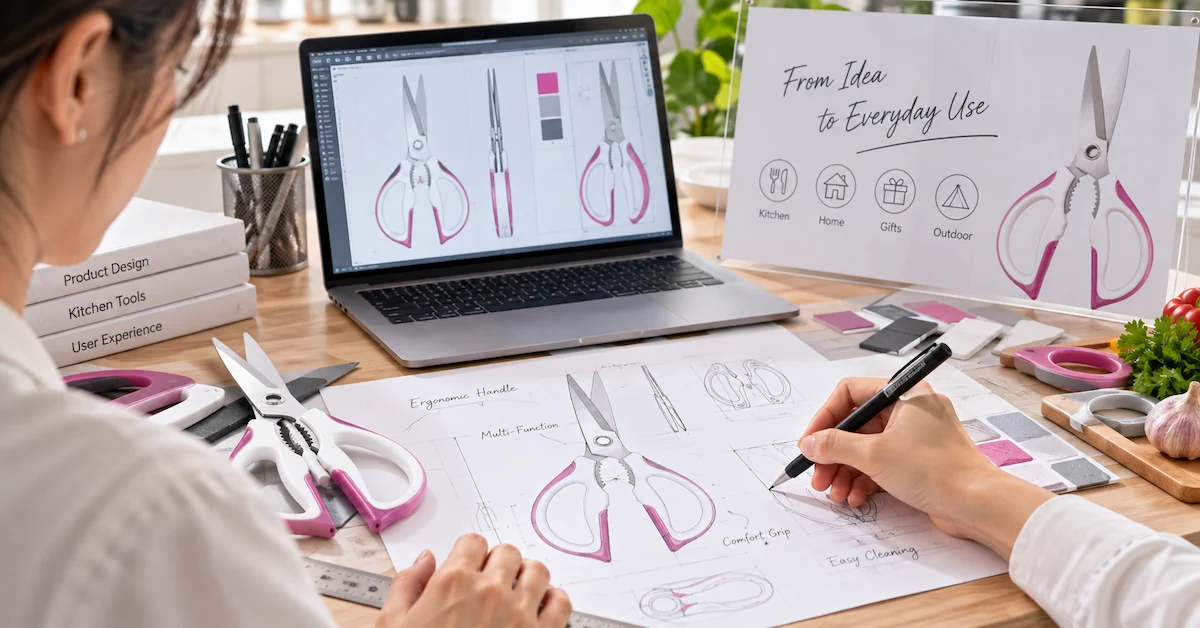
If you are developing a new combined tool rather than modifying an existing model, clarify tooling ownership and approval responsibilities before authorizing mold work. The contract should address design files, intellectual-property obligations, repairs, use restrictions and what happens if the project is cancelled. Logo-only customization normally requires a different level of engineering review from a new hinge or handle mechanism.
Have a Feature List but Need a Manufacturable Model?
Send BONET your intended functions, target customer, reference drawings and opening order plan. Ask which existing scissors offer the closest starting point, and which functions need engineering evaluation or sample testing.
14. Final Inspection: Build a Practical Lot-Release Checklist
Bulk quality control should compare produced goods with the approved specification, not with a general idea of a good pair of scissors. Inspection needs a sampling plan agreed before the order, a clear definition of defects and a process for handling nonconforming units. If the buyer uses an acceptance-quality-limit approach, select the sampling standard and parameters through the applicable purchasing agreement rather than assuming a particular AQL figure is correct for every function or safety risk.
Different failures need different treatment. Cosmetic scuffs, an incorrect package barcode and a mechanism that could unexpectedly separate are not equivalent. Determine which requirements justify immediate lot containment or expanded testing. An inspection report should record the product identifier, sampled quantity, test conditions, findings, corrective action and release decision.
A buyer-ready multipurpose scissors QC sheet
| Control area | Example verification | Question if it fails |
|---|---|---|
| Product identity | Model, revision, color, included components | Was the wrong version or accessory packed? |
| Blade function | Defined cutting task, opening behavior and blade contact | Is the issue linked to grinding, pivot or assembly? |
| Integrated features | Relevant opener, cracker, stripper or other feature test | Is the feature defective or was it never specified? |
| Detachable assembly | Correct separation, reassembly and subsequent cutting | Is the locking/engagement geometry consistent? |
| Surface and handles | Finish, flash, sharp exposed edges, color and grip fit | Is molding or finishing outside the approved range? |
| Accessories | Sheath fit, magnet-holder contents and selected installation behavior | Is an accessory missing or incorrectly specified? |
| Retail packaging | Actual functions versus claims, barcode, warnings, protection | Are artwork and packing instructions on the correct revision? |
| Master cartons | SKU, quantity, dimensions, packing orientation and carton condition | Could product mix-ups or shipping damage occur? |
Use photos and videos for defects that can be visually shown, but keep appropriate functional evidence as well. A picture of a closed pair cannot prove cutting performance, and a product hero image cannot establish bottle-opening comfort. Inspection records should be readable by the purchaser, quality engineer and supplier even when the original developer is no longer on the project.
15. Design the Retail Pack Around the Actual Functions
Packaging can convert a useful multitool into a confusing product if functions are displayed without explanation. Before artwork approval, check that the product photographs, function diagrams and listed contents match the approved physical version. If detachable operation needs illustration, demonstrate the safe sequence. If the supplier provides a storage sheath, show how it is fitted and clarify whether the accessory is included in the quoted price.
For supermarkets, review hanging-hole position, shelf-facing graphics and the portion of the scissors visible through the pack. For e-commerce, consider movement inside individual parcels and the potential for exposed points or dented corners. For gift programs, test the completed pack as a unit, since a rigid presentation box that looks attractive may still let a tool or accessory shift in transport.
A consumer should not need to infer that every decorative symbol means a tested capability. In particular, claims such as “dishwasher safe,” “food contact compliant,” “left-hand compatible,” “rustproof” or “cuts through bones” demand clear support for the specific model and market. If that support is not available, remove or narrow the claim before the print run.
The final pack artwork belongs in the same controlled release as the product drawing and inspection criteria. Treat a packaging revision as a versioned manufacturing document, not merely an email attachment sent to the printer.
16. OEM and ODM Customization: Identify What Actually Changes
BONET's published OEM/ODM capabilities include production against drawings or samples, conceptual development, structural optimization, material recommendations, surface-treatment advice, sample development, logo options and packaging support. For a multipurpose scissors order, the buyer should ask for a model-specific proposal. The service description is not evidence that every possible feature combination can be engineered into any existing SKU.
Start by separating changes into three groups. Presentation changes involve brand artwork, an available handle color or retail packaging. Component changes affect material, sheath, handle surface or an included accessory. Functional engineering changes affect blade profile, opener geometry, nutcracker area, pivot, detachment or the force path through the tool. The testing and tooling implications increase as you move from presentation to mechanical function.
Logo engraving on a blade may require review of positioning, durability and legibility. A custom handle may change mold requirements, grip comfort and component assembly. A new bottle-opening cutout can change the profile of a load-bearing section. Do not compare these modifications on the assumption that all OEM customization is a simple one-time artwork charge.
Define what is included with the quotation: design review, prototypes, tooling, sample revisions, tests, packaging files and final inspection. When a supplier suggests an easier or lower-cost alternative, ask which specifications change and whether the revised version needs another approval round.
17. MOQ, Tooling and Price: Compare the Same Configuration
There is no universal minimum order quantity for all multipurpose scissors. A model may have different minimums for handle color, logo process, specialized accessory or retail pack. Mixing several models in one purchase does not necessarily allow every component to meet its own manufacturing minimum. Request exact quantities by SKU and customization variation instead of asking only “What is your MOQ?”
For a fair price comparison, state whether the quote includes the sheath, magnetic holder, printed insert, hanging card, gift packaging, special color and sample or tooling cost. Clarify whether product testing and pre-shipment inspection are in the quoted scope. A lower scissors-only price can become a higher finished unit cost if essential accessories are billed separately.
Illustrative calculation: assume—not as a BONET quotation—that a completed retail unit costs $2.10 before transport, has $0.35 of retail-pack cost and carries $0.15 of allocated project charges at a chosen volume. The result is $2.60 before freight, duties and destination costs. If the same supplier offers a simpler version without the sheath at $2.30, it is not a like-for-like comparison unless the buyer deliberately approves removal of that component. All such figures are hypothetical and should be replaced with real RFQ values.
Tooling cost should also be considered against expected product life and ownership rights. If a branded program will be replenished over several seasons, document whether the mold is exclusive, who maintains it, how revisions are approved and what arrangements apply if production moves. A prototype price is not enough to answer these questions.
18. Lead Time and Repeat Orders: Control Version Drift
Ask the factory to distinguish design discussion, sample preparation, tooling, material procurement, production, inspection and shipping milestones. A published factory capability does not imply a fixed lead time for a particular customized scissors project. The schedule depends on what is modified and when the buyer approves materials and artwork. Identify the event that starts the production lead-time clock.
Repeat orders introduce a particular risk: small component substitutions can accumulate until the final product differs from the sample originally approved. A new spring, screw, polymer formulation, coating, magnetic component or retail card may look minor, but it can affect performance, compatibility or claims. Establish a formal change-notification process covering both in-house work and purchased components.
One useful record includes the model number, buyer SKU, bill-of-materials revision, drawings, approved functions, physical sample reference, logo files, packaging version and inspection plan. The next purchase order should specify those revision identifiers. If any item changes, ask the supplier to identify the effect and obtain approval before production or packing.
Strong sourcing relationships make deviations visible rather than hiding them. A supplier that explains a component shortage and proposes a controlled alternative can be easier to manage than one that delivers an unexplained substitute. Document the agreed action and any necessary retesting.
19. Common Sourcing Mistakes That Reduce Real Value
Buying the longest feature list. A scissors model with seven claimed functions may perform worse for a particular consumer than a simpler model that handles three genuine tasks effectively. Define primary and secondary functions and evaluate them separately.
Assuming all 420 stainless steel scissors are equivalent. Grade names say something about material, not the full geometry, heat treatment, edge grinding or final pivot setting. Demand evidence from finished samples.
Failing to check what is in the box. One catalog photograph may show a sheath or magnetic holder even when the chosen quotation excludes it. Record accessories separately in the bill of materials.
Approving a prototype as if it were mass-production evidence. Early samples can reveal concept potential, but production tools, assembly methods and materials may differ. Require a production-representative approval before release.
Publishing unsupported safety or cleaning claims. Terms such as dishwasher safe, rustproof or safe for every food task must be supported for the exact configuration and destination market. If evidence is missing, alter the claim instead of guessing.
Omitting auxiliary functions from final QC. A supplier can pass cutting tests while a bottle-opening feature slips or a detachable mechanism does not re-engage. Make the functional matrix part of the release requirements.
Letting a repeat order inherit an old photograph. Update the reference sample and product listing when a functional or visual component changes. Retail consistency begins with revision control.
20. A Technical RFQ Template for Multipurpose Scissors
When contacting a multipurpose scissors manufacturer, an inquiry should enable the supplier to reply with a comparable technical and commercial offer. You do not need to have every design question answered; mark undecided items clearly. What matters is not leaving important features to assumption.
Project: Multipurpose kitchen scissors for a private-label retail assortment. We are evaluating BONET models G2004, G2003, G2011 and/or SKI090, or a comparable model you recommend.
Market and customer: State destination country, sales channel, customer group and the two main cutting tasks. Include any special food-preparation or cleaning expectations.
Required functions: List each one separately: cutting materials, bottle opener, nutcracker, herb stripper, detachable assembly, magnetic holder, protective sheath. Mark each as required, optional or not needed.
Technical confirmation: Request blade and handle material identities, overall dimensions, relevant construction details, available drawings, accessory list, current care instructions and proposed functional tests.
Customization: Describe logo placement, approved colors, any shape changes, packaging format, barcode and language. Request a clear explanation of existing tooling versus new engineering work.
Commercial plan: State estimated opening quantity by SKU and color, expected replenishment pattern, destination, preferred trade terms and target timing. Ask for separate MOQ, tooling, sampling, packing and other project costs.
Quality and evidence: Ask how functional tests, material checks, production inspections, sample sign-off and change notifications will be managed. Provide any market-specific compliance requirements identified by your specialist.
Supplier response requested: Please identify any deviations from the brief, confirm what is included in each model quotation and propose a sample-development and inspection plan.
This structure is more productive than sending a message asking for “the best multipurpose kitchen scissors at the cheapest price.” The supplier can suggest alternatives without pretending that different mechanisms and packaging formats are interchangeable. Buyers can also compare several supplier responses using the same written requirements.
Ask BONET for a Model-Specific OEM Proposal
Compare real product references, provide your function-test checklist and request a quotation that states the complete configuration, available customization, sampling route and order terms.
Frequently Asked Questions
What is the difference between multipurpose scissors and ordinary household scissors?
Ordinary household scissors are primarily evaluated for cutting selected materials. Multipurpose scissors may incorporate additional features such as a bottle opener, nutcracker, herb stripper, detachable construction or special storage accessory. Which functions exist depends on the model. Every promised additional function needs an appropriate test and accurate retail description.
How do I choose a multipurpose scissors manufacturer for OEM orders?
Start with a real product reference, primary use and complete list of required additional functions. Ask for model-specific materials, samples, tooling implications, quality checkpoints and final pack contents. Compare the ability to reproduce your approved configuration, not just factory marketing or headline unit prices.
Which BONET models can I examine for multipurpose kitchen scissors?
Relevant published models include G2004, G2003, G2011 and SKI090. Their catalog entries describe different dimensions, materials and functional directions. Confirm up-to-date availability and precise accessories with BONET because a category listing does not establish the configuration of a particular quotation.
Are G2004 and G2011 made from the same materials?
The listed metal material for both is 420 stainless steel and the listed plastic material is PP. That does not mean they have identical geometry, molding, accessories or finished performance. Compare physical samples and signed specifications before deciding whether they can occupy the same retail position.
How should a built-in bottle opener be tested?
Define the cap type, sample setup and safe grip position. Observe whether the tool opens it controllably without dangerous hand contact or unintended flex. Afterward, check that the blades and pivot still operate as approved. Agree on any extended or repeated-use requirements before claiming durability.
Do nutcracker features need a separate inspection?
Yes, when the feature is part of the sold configuration. Inspect the contact surfaces, hand clearance and the effect of cracking on the shared hinge or handle. Do not infer compatibility with all sizes or hardness levels of nuts from a single demonstration.
Are detachable kitchen scissors automatically easier to clean safely?
Separation can improve access, but safety depends on exposed sharp edges, the release mechanism, reassembly and care instructions. Validate the exact detachable design. Do not assume dishwasher compatibility or food-contact compliance from detachability alone.
Does a magnetic kitchen-scissors holder work on all metal surfaces?
No universal compatibility should be claimed without evidence. Surface composition, orientation, finish, holder design and product weight can affect the result. Test the actual holder on defined intended surfaces and provide accurate installation instructions.
Can BONET provide custom colors, logos and packaging?
BONET's OEM/ODM service page describes color, material, branding and packaging options, alongside development and sample support. However, the supplier should confirm feasibility and minimum quantities for the exact model and option selected. A change to the hinge or blade is a different project from applying a logo.
What is the MOQ for multipurpose scissors wholesale orders?
MOQ varies with model, order configuration, colors, printing and packaging. Ask BONET for a current project-specific minimum by SKU and customization. Do not assume a fixed number from a general marketing page or combine quantities from different tools without written agreement.
What is the most important inspection before bulk shipment?
The release decision should include primary cutting performance, assembly condition and every advertised auxiliary function, along with product identity and packaging. There is no single test that replaces the entire specification. Apply a buyer-approved sampling plan and define how safety-relevant failures are handled.
What should I include in a request for quotation?
Provide intended market, sales channel, exact model or reference drawing, required functions, materials, estimate by SKU, logo and packaging requirements, sample expectations, evidence requirements and target delivery schedule. Ask the supplier to identify deviations, quote contents and functional inspection methods in writing.
Conclusion
A dependable multipurpose scissors manufacturer should be evaluated on the usefulness and repeatability of the complete tool rather than the number of functions advertised on its box. The primary blades must cut the intended materials consistently. An opener, nutcracker, herb stripper, detachable hinge or magnetic holder should add a clear benefit without compromising comfort, safe handling, cleaning or the next production batch.
For global importers, wholesalers and private-label kitchenware brands, the most effective sourcing workflow is to select real models, define every required function, agree on observable tests, approve production-representative samples and tie the final retail pack to the same controlled revision. BONET HOUSEWARE publishes product references including G2004, G2003, G2011 and SKI090, together with OEM/ODM development support. The next step is to ask which model can meet your market's real requirements and what evidence is needed before an order is released.
